Lotus Institute
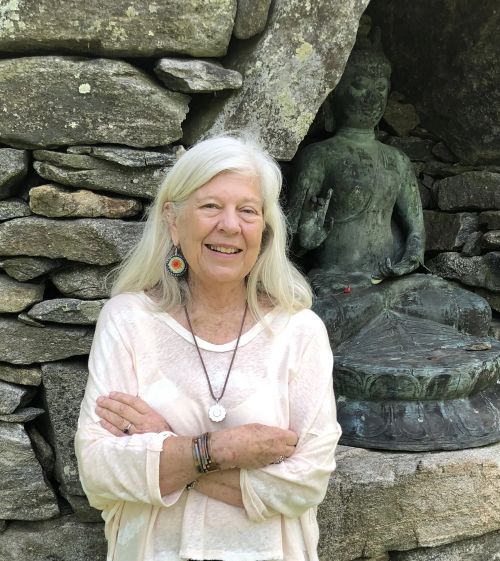
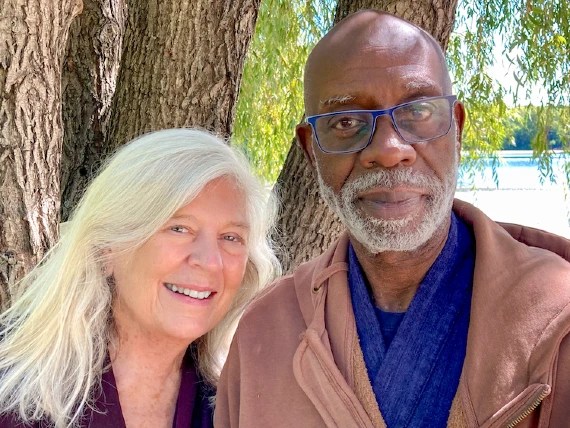
Peggy Rowe Ward and her late husband, Larry Ward, established the Lotus Institute in the tradition of the Vietnamese teacher, Thich Nhat Hanh.
“As a little girl, I had a real connection with Jesus,” she tells me, “I really felt he was my friend. And I had a lot of insights being in different plays where I got to be Mary or a shepherd or a donkey – you know? – those kinds of things. I loved being the donkey as he got to speak. That was one of the insights I had as a kid. Mary had no lines. How could that be?”
That original sense of closeness to Jesus, however, faded as she grew older.
“I think puberty happened, and I just lost that natural friendship. And the church didn’t help. I had a lot of questions that weren’t answered very well. I didn’t have that deep connection I had with Jesus until I met Thich Nhat Hanh, and then it all came back.”
When she was 21, her younger brother was killed by a drunk driver.
“I just threw myself into spiritual studies and classes, trying to make sense of that. I did everything I could think of including yoga and meditation. The thing that helped me when I was 21 was a gothic romance novel, Green Darkness by Anya Seton, which had a theme of reincarnation. That gave me some peace, to think about that. It is still an aspiration of mine to write a Buddhist romantasy.”
She attended Miami University in Ohio. She majored in sociology and later went back and got a master’s in psychology and a doctorate in education. Along the way, she discovered Daoism.
“Probably through the I Ching. It felt familiar to me and helpful. Same thing with Buddhism. When I tried to read books – like Philip Kapleau’s, for example – I found them too intellectual for my learning style or too cognitive. While I was drawn to Buddhist study, it just didn’t get to me at all. All those concepts: impermanence, no-self, this/that, right effort, the eight-this, the six-that. If you’re coming to Buddhism with your heart broken, it’s not an easy entry.”
Then her first husband was killed in a skiing accident.
“He was 39. Death is quite the transformative magic in my experience. Having your heart broken, however it gets broken. That’s when I realized, ‘I need help!’ With my heart and also with my understanding, to try to make sense of something you can’t make sense of. I did a lot of vision quests and deep study. Then I went to my first Thich Nhat Hanh retreat.”
Someone gave her a brochure.
“It said, ‘Peace in every step.’ And I saw a picture of Thich Nhat Hanh, and I’d never heard of him. There was something about that title and that smile, so I went to the retreat. Five-days at Mount Madonna Center near Santa Cruz. And that was it. It really rekindled my childlike love of Jesus. I had one of the few powerful visions of my life when I walked behind Thich Nhat Hanh, I felt I was walking behind Jesus as one of the women. I saw it as clear as you and me. Saw my feet in these old dusty leather sandals. It just reawakened my childhood love for Jesus. So that did it for me. I was like, ‘Well, I’m in!’ And shortly after that, I met my husband, Larry. He’d been a friend of mine. Thich Nhat Hanh wasn’t very healthy in the early nineties, and we thought he would die soon. I said to Larry, ‘I’m prioritizing my time and income to get to Plum Village, France, every year, and I’d like you to check this teacher out, because that’s one of the things I’m going to be doing.’ And Larry fell in love with Thay[1], too. We went to Plum Village at least three weeks a year every year.
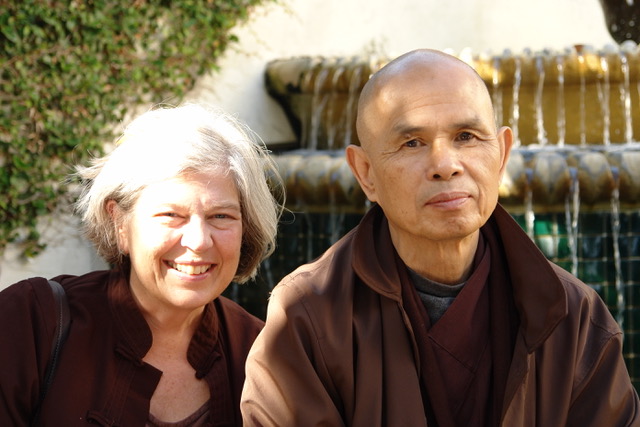
“Thay had this kind of sweetness that attracted me. His embodied presence of love invited me to discover these qualities in myself. The whole idea of not just sitting but living a life of an engaged Buddhist practitioner whether you’re cooking or cleaning or doing the dishes, or protesting, you’re practicing. Your whole life is practice. So that really appealed to me, and the practice helped me heal. I was a believer. You know, we’re not supposed to have beliefs according to Thay – our belief is our experience – but my experience was I could re-enter life again. That was a miracle.
“We met a Theravadan elder at Plum Village who invited us to teach at his temple in Thailand. Our first visit to his temple, he met us in the parking lot, bowed to us and invited us to walk behind him. We thought he would be taking us to the main temple for prostrations before the Buddha. Instead, he walked us into the monastery grounds. He stopped in front of a bronze statue of a monk and bowed. He turned to us and said with a soft smile, ‘my teacher, my everything’. This is my experience of Thich Nhat Hanh. My teacher, my everything.”
Peggy and Larry helped Nhat Hanh establish his first US monastery in California.
“Larry was at the auction when they bought the land. He was the person who held up the paddle. The Thich Nhat Hanh tradition is our family. Thich Nhat Hanh married us in 1994. He asked us to write the book Love’s Garden on mindful relationships. And Larry filled in at Parallax Press when there was a shift. We lived at Deer Park for months.” She shows me a book with Larry’s name on it. “That’s his book, his poetry. It was published August 2025, two weeks after he died. And he somehow was totally involved in this that last year of his life by some miracle, because he was really in the decline. I call it ‘deathing’ when the person is in this decline. But he didn’t get to hold Morning Night; this is sad to me. And I am happy that I can hold it for him.”
Although he is in the Rinzai tradition, Nhat Hanh is not always considered in the same light as the Japanese teachers who established Zen practice in North America. I ask Peggy how his teaching differed from theirs.
“To me, every school of Buddhism has the flavor of their culture and their teacher that it’s streamed through. The Vietnamese culture is very much about poetry and not about law, and very much about community happiness. Larry and I were invited to teach with other Zen groups. They’d bring us in because we have strong community-building skills. Thich Nhat Hanh in comparison to many others stressed the sangha aspect, the community aspect. And as an Order of Interbeing member, we are engaged in sangha building. That is emphasized in our communities. Our teacher said this is our most important work.”
I mentioned that when I visited Nhat Hanh’s Blue Cliff community in New York, the people I spoke to told me was that he was not expected to pass transmission onto a particular individual.
“He said his lineage was the sangha,” Peggy explains. “So his transmission went to the community. All of us are his continuation. That made him unpopular with people who wanted to be a lineage holder, because we all got to be his transmission, his life. He was clear: his lineage transmission was to the sangha.”
However, when he died in 2022, his lineage had to confront the practical issues about how they would continue.
“It’s interesting to me,” Peggy muses, “especially with the death of a charismatic leader like we’ve had, the tendency whether it’s an organization, a business, or spiritual community is to encourage more legislation. Up the laws, because you want to try to keep that person alive. If you have more rules, maybe you have more ‘this,’ then you’ll keep ‘that.’ When what really needs to happen – in my experience – is to up the love. It’s about the transmission of love not laws. Larry and I worked with diversity issues our whole adult lives. We need laws – it’s not that laws are bad – but laws aren’t going to be the way through. Love is.”
It turns out, however, that there is more organizational structure than just “the transmission went to the community.”
“Is there a central headquarters,” I ask. “Something like the Soto-shu?”
“There’s the Unified Buddhist Church. As we’re a global organization, there’s an annual gathering in-person, but a lot happens virtually.
I ask if that group then determines who can be identified as a teacher in the Nhat Hanh tradition.
“Oh, yes. There’s even forms. There’s a process that includes interviews and recommendations. But you’re talking to the wrong person about this.”
“Why is that?”
“Because I believe that we need thousands of Dharma teachers. I have a dream of offering the transmission in a stadium. I believe that it’s about love not law. So right now, we’ve been really trying to bring in BIPOC, LGBTQI+, and younger people. Like many religious groups, we’re in danger of aging out. For a future to be possible, we need more diversity of learning style, gender, culture and age. That’s the kind of work Larry and I are involved in. We offered a transmission ceremony in Africa the day before Larry died. You know, it was virtual . . . Yes. That is a lot of the work we are involved in, trying to create a container that is as wide as the world. For a future to be possible.”
I ask about the Lotus Institute.
“This is the non-profit Larry and I started in 1994. We are inspired by the Lotus Sutra. We have this desire to help everyone wake up to their Bodhisattva calling. We don’t need to be Buddhist. We wanted to weave in the foundation the body, trauma resiliency, social justice and love. We have coursework on applying the paramitas and embodying the vow called the Midnight Path. We also have an inspired course on reciprocal mentoring entitled Anam Cara. Our retreats are designed around Thich Nhat Nah’s model of transformation. And we love practicing in an inter-generational community.
“There’s no building, but right now we have a non-profit that’s been going for 30 years, and we have a remarkable team. We have virtual retreats, classes, monthly talks. We invite amazing BIPOC Dharma teachers to offer teachings. I offer regular Dharma talks and we offer sound healing and gentle yoga. It was at its peak the first year of Donald Trump. I used to say that Trump was really good for Buddhist business. So much suffering.”
I ask if she thinks he continues to be.
“I think there’s more despair this time around, if that’s possible. There’s a lot of traumatic freeze that we experience in the bodies of our friends and society.”
I ask what she means by a “traumatic freeze.”
“Our nervous system . . . When things are so activating in society with all these wars and all this disrespect, we can get activated. Like if we have our foot on the gas in our car and our foot on the brakes at the same time. And so this energy of dysregulation gets stuck in the body, and it creates what we call either ‘stuck on high’ or ‘stuck on low.’ And ‘stuck on low’ may develop into the freeze state, where people just kind of get numb. A lot of society is numb; that’s my experience. Otherwise we couldn’t be dealing with this level of disrespect and damage unless there’s some level of numbness going on. So this is trauma, which is physiology not psychology. This is what happens to the body when it’s hyper-vigilant, hyper-activated. Things just kind of wear down. Especially in our brown and black communities where people are scared to leave their house. You know, in Minnesota, our sanghas there did a lot to support schools, so that other people picked up kids from schools because ICE was picking up parents at the school pick-ups. And bringing food to their homes. ICE was hanging out at grocery stores to pick up people. Imagine the level of fear you’d be living in – for yourself, for your kids – if it wasn’t safe to drop your kids off and pick them up after school. If that happens day after day after day to the nervous system it’s called a continual trauma which is constant, and so it just kind of wears out our nervous system. We support our students in learning how to self-regulate, co-regulate and then to come together in co-imagination”.
I ask if she sees a relationship between spirituality and politics.
“Inter-are,” she says. “You know? They’re interconnected. In our Precepts, we’re encouraged to take a stand against things that contribute to ill health, but we’re also not to engage in partisan politics. So that is one of the things that really is confusing to people. How can you do that? How is that possible when they inter-are? If people can see that we’re interconnected rather than separate, we’d hope that we’d be more respectful and kind with each other. Compassionate. You have to have an experience of that.”
“And how do I achieve that experience?” I ask.
I expect her to talk about meditation, but instead she tells me that first we need to do is be at home with our bodies.
“It’s really getting in your body with your practice. Embodied walking. Really slowing down what you’re doing to take your breath and body and to bring care to find out what will nourish you at a deep level and taking the time for selfcare. Thay said that the real miracle is to walk on the earth.”
She tells me about retreats conducted for people who are actively involved in some form of social justice work, the type of activity Nhat Hanh coined the term “engaged Buddhism” to describe.
“Working out there with the folks that are on the front lines, the first couple of days of retreat are about helping them to rest and to receive nourishment and restore their humanity. And then we look at what action they can take. ’Cause actions are also from the heart, how we can express our compassion. But generally people need rest and nourishment. In our retreats we have music, and we offer what’s called in our tradition ‘total relaxation.’ We always have silence. At an upcoming retreat, we have two women involved in Threshold Choir on the teaching team. They show up when people ask them to come to thresholds, graduation, death, birth. They know all these little beautiful songs that people can learn easily. And we have somebody coming to that retreat that offers sound healing. So we’re going to have that. We have a friend that transmits Japanese archery. Silent meals. But we also have a lot of fun. I’m co-teaching with Diane Little Eagle, a Native American elder and Dharma teacher in our tradition, and she very wise and fun.”
“What you have not mentioned,” I say, “is meditation.”
“We do of course. Walking meditation, sitting meditation, standing meditation and lying meditation. Didn’t I say ‘walking meditation?’”
She had not.
“Well, a lot of times we refer to ‘outdoor walking’ so that we can introduce the practice into nonreligious places or nonspiritual places. We can introduce ‘mindful walking,’ but we don’t call it ‘walking meditation’ – like – if I’m working in the hospital. You know, we use different words. But it’s definitely meditation.”
“If I come to one of your retreats, will you teach me to meditate?”
She considers the question for nine seconds before replying.
“Meditation is natural when we are relaxed and happy. Usually, I think one of the first things we do is try some movement of qigong or something with the body. Then we have people sit and work with the posture. The first meditations are often guided, helping people really get into their body by looking at the spinal column being lined up and the shoulders relaxed. Soft front, strong back. The head over the center of the body. There’s a lot we do with the foundations of practice before we get into just following the breath. And in trauma-informed mindfulness, we also work with following a sound, because sometimes the sound doesn’t open up as many trauma doors as breath. So there’s a lot we do with the body before following the breath, because people aren’t in their bodies. A lot of people that are sitting are in kind of a disembodied trance state. They can sit perfectly still, but they’re not really bringing in the benefit of the practice into their body. Mindfulness is an energy. Mindfulness is light.
“I remember once going to a Zen Center to teach, and it was long term practitioners. And – boy! – they could sit still. But they weren’t happy. We couldn’t believe it! So we had to move more; we had qigong, gentle yoga, outdoor walking. We found out from a lot of them later that they’d given up on their practice. They were disassociated with their sitting. So getting them to move more helped them to discover things. This one group, oh, my God! You know the expression, ‘Deadly serious?’ They approached their Zen practice with that. So when they meet someone like us, we’re scary as hell. Pretty uncomfortable. They’re not so sure about us. Some of them never would gravitate to do anything with me. ’Cause I’m one of those ‘touchy-feely’ women.”
“Oh, those goddamn touchy-feely women,” I say chuckling.
She chuckles as well. “Goddamn touchy-feely women. And intuitive. So . . . Yeah, Larry and I were great working together. I miss him so much. We used to have people write us a letter when we’d get to a place, not put their name on it, and just ask what would they like support with? What do you want to learn? And they’d write us a letter, and we then we would design what we were going to do. And people were so honest with these letters. They were like, ‘Oh, this is going on, and this is going on.’ And sometimes there would be themes, with either grief or health or transitions. You’d sometimes feel a group theme. But often it was just the range of experience. That’s how we’d work, and then we’d put something together. Like, we did a Day of Mindfulness on Labor Day once. I don’t know if it was because it was Labor Day in the United States, but people were so exhausted. We did three resting meditations that day ’cause every time I’d go to teach or do something differently, you just saw people dropping over like flies.”
“So,” I ask, “what’s the purpose of all this? What’s it do? What am I gonna get out of it?”
“We call that the WIIFM, ‘What’s in it for me?’” She takes a breath. “When I first met Thich Nhat Hanh, I arrived with a broken heart, and in Buddhist teachings that’s when you have the greatest access to bodhicitta. So I tell people, if you’ve come here with a broken heart, this may be good for you.” She laughs. “Extra credit for you, buddy. But we’re just going to do different practices and see what’s nourishing, and see what you can learn about yourself, and take some time to rest. Now in our country, you wonder what the hell is going on? We are a small percentage of the population here – Buddhists and peacemakers and pacifists – all of us are broken hearted right now. All of us are. All of us are incredulous that we could be part of a country that’s so disrespectful. And Thich Nhat Hanh’s the one that taught me that I have to see it’s me, too. I think I felt superiority at first, being a peacemaker, thinking I was above it all. But it’s my war, my society. And I’m not proud of it. I’m not proud of being an American right now, and I love my country. What can I do? But, yeah, many of us are suffering. We’re incredulous. So we do a lot to try to enjoy each other, help people nourish each other, strengthen each other, and get back out there to work in society. Thich Nhat Hanh’s formula is Stopping, Calming, Resting, Healing and Transforming. Many forget that the formula includes rest.”
I ask her to go back to what she called “beloved community,” the term she uses for “sangha.”
“Building beloved community is about making people feel as welcome as you can. There has to be safety. And that’s not an easy one, because we can’t promise that people will be safe, but we can do our best. This is where embodied practice comes in and so does self-regulation. Every retreat we teach and practice how to regulate our nervous system. We need to see that there is a place for us at the table. We need to feel safe.
“Safety in what sense?”
“Safety to show up. Now imagine you’re BIPOC, imagine you’re transgender. Ask your family members about it.” She knows that I have a transgender grandchild, bi-racial grandchildren, and a first-nations great-grandchild. “What helps them feel safe? There is an upcoming BIPOC retreat at Deer Park, and that’s one of the ways that our non-white kin feel more comfortable and welcome is at a retreat with people where they have affinity. That’s a more welcoming point of entry for the Dharma, to have an ally group of some sort. That’s how people get to know you. Now I’m lucky to be one of the people who has LGBTQI+ friends and younger, under 35, connect to. We are nourished by pouring our energy in the dharma in this way. We prioritize mentoring, supporting and connecting with the younger Dharma teachers through, BIPOC, the Wake Up and rainbow community. They know I’m not perfect. I did grow up in privilege – you can’t help it as a white person; you can’t even see it – but I’m doing my best. And so people know that about me and about us. So, yes, being an active ally is one way to grow beloved community. This is what we’re saying on our flyer that our mission is about building beloved community. Most of our retreatants have had been in their twenties up to 80 something. And that’s what we want. We want the whole spectrum of age. We want everyone to have a place at the table”.
“You told me earlier that you think of yourself as a teacher. What does a Dharma teacher teach?”
“Our own experience.”
“And what is it that you hope for with the people who come to you as a teacher?”
“We hope that they can feel a little bit calmer and safer within themselves. We are hoping they can feel more at home in their body and mind. We’re hoping that they can get a sense of glimpsing their hearts and feeling that they’re alive for a reason and that we need them. We need their presence on the planet. And hoping they can touch into some of that. They can get nourished at a deep level just for being themselves, just by breathing. So that’s the advantage of teaching about the breath. Right here. Now. You can be it at home; doesn’t cost a thing. Yes. we want them to feel loved. The ‘L’ word again. We want to love everyone.”
“Those touchy-feely women.”
“I know!”
And we both laugh.
[1] An affectionate term Nhat Hanh’s students use when referring to him.

