
Rochester Zen Center –
At one point in the course of our Zoom conversation, Bodhin Kjolhede has to get up from his desk and leave the room. As he comes back, I notice he is wearing a t-shirt with the Latin phrase: Ego Sum Abbas.
“My students give me a lot of gag gifts,” he explains, “and this was from one who explained that it’s a line from the Carmina Burana. I can’t wear it when I go the Zen Center anymore because I’m no longer the ‘abbas,’ so I just wear it around the house.”
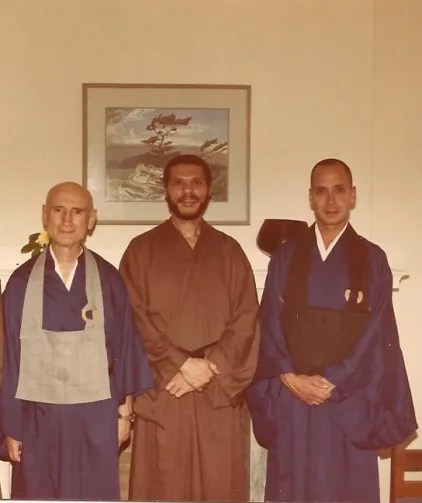
Bodhin had been Philip Kapleau’s successor as abbot of the Rochester Zen Center from 1987 to 2022. When he retired, he turned the center over to two successors, John Pulleyn and Dhara Kowal, who now serve as co-directors. He does, however, return yearly, to lead a seven-day sesshin.
During the thirty-five years of Bodhin’s tenure as abbot, Zen transitioned from what was at first seen as an exotic and foreign practice to one which has become respected as a mainstream spiritual tradition in the Americas and Europe.
His first visit to the Rochester Center was in 1970. Two of his sisters had preceded him there, and the three of them were later joined by two more sisters. “At one point there were five of us at the Zen Center going to sesshin.”
It was a vibrant period for Zen growth. Many young people were making their way to places like Rochester, California, and Hawaii seeking authentic Zen teachers.
“It was a time of great tumult in society with the Vietnam War and Watergate, especially with psychedelics and other drugs. And somehow that all came together to foster more questioning of existential things than I had heard of before then or even since then. I felt at the time why wouldn’t everyone be arriving at this point where they were asking basic questions about life and death and meaning.”
When I first met Bodhin, thirteen years prior to this conversation, he and I had had a frank discussion about our use of psychedelics. They were certainly a factor for many members of the baby boom generation. As he puts it now, “Psychedelics really split me open and got me wondering. There’s a Danish poet, Piet Hein, who said, ‘I want to know what this whole show is all about before it’s out.’”
I point out that there is as much tumult and chaos in society today as then, there may even be more polarization and divisiveness.
“I agree. It’s been approaching madness, especially this past year (2026). But in those days – ten or twenty years ago – there wasn’t social media, this enormous influence of social media. And that, possibly, distracts people from existential matters.”
Six years after his first visit to the Center, he was ordained a priest. During his time at the Center, there had been multiple changes in the way in which Zen is presented. He tells me that when he returns to conduct sesshin, the people he sees in dokusan are those who have – as he put it – “entered the first gate.” That is, they have resolved their first koan and moved on in the curriculum. Although a great deal of emphasis had traditionally been put on the importance of this step at Rochester, he admits the people who have passed that gate remain “a small minority of Zen Center members.”
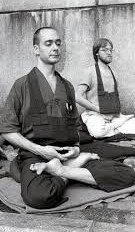
“And when I go back and give this one seven-day sesshin a year, I am struck by the difference of tone of the sesshin. It used to be, back in the ’70s when I came up the ranks, it was a very martial environment. Roshi Kapleau came trailing vines of Japan when he came there. He was an autocratic leader who had really, really absorbed the martial spirit of Japanese Zen. And at that time, in the 1970s, there were so many of us who responded to that, who felt an affinity with that – myself included – that we just had to turn people away all the time. There was what I thought at the time was a great ardour for the truth – I think that’s fair – but, in addition, I think there was greed. Greed for kensho. And when I took over in 1987, not with any particular agenda, I started to feel that people weren’t responding. People who came to the center and came to their first sesshin or their fourth sesshin, they weren’t responding in the same way, for example, to the heavy use of the stick that I and my cohorts had been used to.”
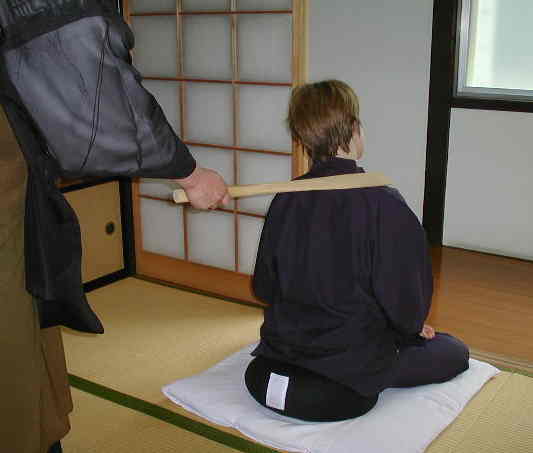
He is referring to the kyosaku, the so-called “encouragement stick,” with which Zen students were struck on the shoulder to ward off drowsiness. In The Three Pillars of Zen, Philip Kapleau describes its use in Japan in exalted terms, and he brought it with him to Rochester. But by the mid-’80s – when many aspects of Zen came under scrutiny – its use began to be questioned.
“I think it was just an evolution,” Bodhin says. “I tried, as the abbot, for thirty-five years to adapt, to see where people were at, to read the room. And I think over the years, it got to the point where now we use the stick a lot less, and certainly it’s only when people want it. We never use it unless it is requested. When I first came to the center, you would get the stick whether you wanted it or not, and people knew that coming in. But I changed that pretty quickly.”
One of the reasons its use had been tolerated as long as it had been was that people felt it promoted the high degree of alertness needed to achieve that first breakthrough – the kensho experience – which many came to Rochester specifically to attain. I ask if sesshins are as effective now that the use of the stick has abated.
“It’s a fair question. I don’t see more people having a breakthrough then than now. It’s still quite infrequent. I haven’t done any studies on it, but my sense is, my impression is it’s about the same. So it’s fascinating to me. You may have heard, there was one sesshin at Hoshin-ji, Japan, where something like seventeen people got through Mu. And what I remember it being attributed to was the unusual ferocity of the stick. Over the years I’ve come to be skeptical about that. What does that really mean that you can force people into kensho? What does it mean in the long run?
“The assumption, Rick – the assumption on my part and others, I suppose – was that the stick was being wielded by people who had your interests in mind. It helped me, by the way. I sometimes half-jokingly say I’d still be working on Mu if they hadn’t wailed on me so much with the stick. So it definitely has that effect of deepening your concentration. If you can work with it.”
By his own admission, it is still fairly rare for people to be passed on Mu, and, even when they are, he warns them not to confuse this with full awakening. “I say, ‘Don’t even think of this as kensho. It’s just that you’ve seen enough into Mu that my judgement is that you’ll be able to work well enough with the koans subsequent to Mu.’ But, of course, the habit forces, the different degrees of greed, anger, and delusion continue to operate. You see this over and over. Roshi Kapleau used to say that the value of kensho – or even less than kensho – is that it gives you the faith to keep going, a new kind of faith, and I think that’s true. That first breakthrough reveals how much work there is yet to be done.”
He tells me that as a teacher, he had put less emphasis on the need for that initial breakthrough than Kapleau had. He even suggests that putting too much emphasis on “attainment” in this sense can “backfire.”
“It can set up these expectations that after you’ve been passed on your first koan you should be sailing free from then on. So I talk less about a first breakthrough and more about continuing on after that and how we’re all in the same boat, and we all can struggle for lifetimes to come to full enlightenment. I once read a psychological study that supports this. They weren’t talking about Zen, but they said the more emphasis that is put on a goal, the more likely the person will quit after that goal has been reached.”
I mention that other Kapleau heirs had told me that they felt that their training had placed too much emphasis on attaining wisdom (prajna) and not enough on developing compassion (karuna). Bodhin nods his head and remarks, “Without compassion what does wisdom mean? Wisdom has to express itself in compassion.”

“How do Zen teachers teach?” I ask.
“I think what I’ve come to see is the most effective teaching we can do is to be an example.”
“So modeling.”
“Yeah. I mean it’s not the only way. But whatever you say isn’t going to count for much unless students can see that you’re living it. You’re walking the walk. I certainly looked upon Roshi Kapleau as a model. When I first took over the center, I got a call from somebody at the Minneapolis Zen Center who asked if I wanted to participate in a forum in which we were to respond to the proposition ‘All Zen comes down to one word: imitation.’ And at that time I flinched because all I hear with ‘imitation’ is ‘inauthenticity.’ But over the years I’ve come to see that there is something to that, especially in Japanese culture. You know, a calligraphy student will start by tracing the characters of a master calligrapher. You trace them to get it in your body. Dogen says that being with a master is like walking through a mist, somehow you absorb it.”
Which, he stresses, “makes upright conduct all the more important. I believe more than ever that the greatest harm to a sangha is from a teacher’s misconduct. I’ve come to see that the practice, the actual practice of zazen – sitting and moving zazen – is so powerful that all we’ve got to do is be good enough for it to work for the student and not upend the boat by doing outrageous things that we say are ‘crazy wisdom’ or whatever.”
The invitation from the Minneapolis Center had been significant, because in the early days of the transfer of Zen to the West, there had been little communication – and often a significant deal of competition – between lineages. It was something Bodhin was conscious of when he became abbot of the Rochester Center and hosted the first meeting of what would become the American Zen Teachers’ Association.
“It was second-generation teachers. At the time, it was kind of hopeless to get the first generation of teachers together. I’d heard stories that they got together once and that it went nowhere. There was just too much baggage or some generational thing. What I’d hoped to do was to get the second generation together and see if we could communicate better and have a more fraternal relationship.”
That meeting came about as the result of an initial step taken by Kusan Sunim, a teacher in the Korean Lineage, who held a meeting in Ann Arbor for Zen teachers, scholars, and the general public. There were academic presentations from scholars such as Ken Kraft (a Rochester board member) and talks from various Zen teachers. The general public, Bodhin notes, “was free to wander in and out as they wished. And I was not comfortable with that format. What I wanted was more of a means of confiding in one another as teachers, never mind scholars and the public, but just having it kept to Zen teachers to be able to share the struggles that we were going through. So at the end of that weekend, Kusan Sunim said to me, ‘How about having Rochester doing the same thing next year?’ And I took a breath because I had just stepped into Roshi Kapleau’s shoes and was feeling a little insecure. But I said, ‘Okay, we’ll have a meeting, but it has to be just Zen teachers.’ And he said, ‘Okay.’ And that’s what led to what would become the AZTA.”
Although it was eventually necessary for AZTA to establish criteria for membership, from its inception it chose not to present itself as a credentialling organization. James Ford had been the first person to talk to me about AZTA. When I met him in 2013, he described it essentially as a “support group. They don’t even want to call themselves a professional organization.” He estimated at the time that its membership probably included 80% of the teachers in North America. But then, he added, “there’s this whole question of who’s a Zen teacher? It’s more than who authorizes them. The great struggle in the AZTA is it doesn’t want to be a credentialing body, but they have to have a standard for membership. And they’re cross-tradition. So there’s nobody who’s a teacher in the AZTA who would be qualified to be a teacher in every other group. Their expectations are so different.”
Still, the entity provided a means for traditions to interact with one another, and, although since he retired Bodhin is no longer a member – “I don’t even get emails from the AZTA” – it is to his credit that the organization was initiated.
One result of better communication between centers has been that Zen students have the opportunity to practice with a variety of teachers. Previously, there had been a tendency for teachers to require that students commit themselves to working only with them.
“Roshi Kapleau,” Bodhin explains, “wouldn’t even give you dokusan until you had formally become his student in a ceremony. And I just over the years – again, gradually – I just felt that’s not suitable. That strikes me as more of a Japanese thing, that absolute fealty to one lord, one daimyo. Although I do think there’s a good argument for not formally getting advice from different teachers. But all of that just faded over the years.”
The argument for getting advice from a variety of teachers – as Josh Bartok explained to me when I first began collecting these interviews – is that the student learns to distinguish between what is “personality” and what is “Dharma.”
Bodhin nods his head. “Yeah. That’s the argument against one teacher. And that’s also how things have changed in Rochester. Now with any given person I might see in dokusan, I can’t tell for sure whether they’re formally my student or Dhara’s or John Pulleyn’s or someone else’s. Again without any kind of intention, we’ve seen a shift so that some of the people going to dokusan with me will also go to one of the other two teachers in Rochester or others. Everything has kind of opened up, and it seems to be working.”
“How are your successors different from you?” I ask. “How have they changed things?
“I think they have gone further in making it an even kinder and gentler place. I think both of them – how shall I put this? – are even more open to people just finding their own way. And, I might add, Dhara at least is more tuned into the whole identity thing. Pronouns and other identity things. I was kind of blustering about that pronoun thing, and Dhara said, ‘You know, even the Stafford Fire Department puts on their application form, “What is your preferred pronoun?”’” Stafford is the township near Rochester’s Chapin Mill Retreat Center.
Bodhin feels confident he has left the Zen Center in good hands. The evolution of North American Zen naturally continues, but at the same time, he points out, its core values remain constant.
“We’ve got away from that heavy emphasis on a first awakening experience that Roshi Kapleau emphasized. I think John and Dhara share my commitment to neither giving too much emphasis to awakening nor denying the importance of confirming this Buddha Nature.”
In my talks with other centers, I know that fewer people take up Zen practice with the “greed” for kensho that drove people of my and Bodhin’s generation. They are more likely to come seeking peace of mind or relief from stress.
“I think that’s fair,” Bodhin says. “Don’t we all want peace? But when people say that to me, I say, ‘Okay, but how are you going to get real ultimate peace?’ And I want them to see – I suppose – that the only way to do that is to see beyond the whole world of duality and self-and-other and us-and-them.”


One thought on “Bodhin Kjolhede”