Adapted from The Third Step East –
For many people in the 1950s and early ’60s, their first encounter with Zen came not from reading Philip Kapleau’s Three Pillars of Zen or Shunryu Suzuki’s Zen Mind, Beginners Mind but rather from reading Jack Kerouac’s 1958 novel, The Dharma Bums.
By the 1940s, information about Zen was plentiful and accessible outside of Asia. The number of actual practitioners in North America was small, but there were active communities on both coasts. It might have remained a minor religious and intellectual curiosity, however, had there not been an audience which found something compelling about this very foreign tradition. The circumstances which would come together to make Zen a cultural phenomenon in the United States began with an unlikely group of writers who first met in New York in 1943.
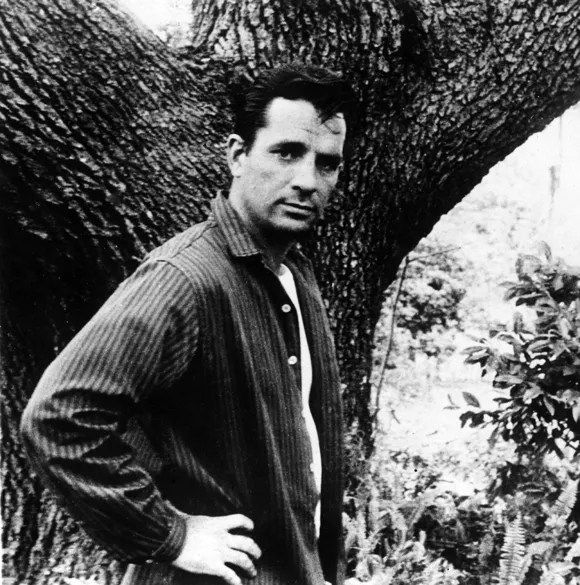
Jack Kerouac coined the term “Beat” to refer to a small cadre of poets and prose writers which included himself and friends like Allen Ginsberg, Gregory Corso, and William Burroughs. He was inconsistent about what he meant by the term. At times, it referred to being “beat down” by the circumstances of their lives and the difficulties they had with contemporary culture; at others, it referred to the “beat” of jazz music and the spontaneous improvisations which the writers emulated in their own work; and at times he suggested it referred to “beatitude,” to an effort to develop a spiritual basis in one’s life.
By the 1950s, many of the Beats had relocated to San Francisco where Ginsberg was enrolled in classes at the Berkeley campus of the University of California. He also attended the poetry soirées of poet, Kenneth Rexroth, who introduced him to a few young West Coast poets, including Gary Snyder. None of the younger poets were yet published, but Rexroth admired their work and had confidence in them.
These writers were the harbingers of the counter-culture movement of the 60’s, railing against contemporary mores and standards. Ginsberg began his most famous work, Howl, with the lament that he had seen “the best minds of my generation destroyed by madness.” They were deeply aware of the injustices they saw in America and the disenfranchisement of marginalized members of society – homosexuals, racial minorities, or people whose ideas were considered socially or politically suspect. They were sexually adventurous; they flaunted their use of alcohol and experimented with drugs, including peyote. Their books and poems inspired a generation of young readers to question the structures of previous generations—institutionalized and legal racism, conservative Christian moral and religious values, an assumption that the natural role of women was that of being sexual partners and helpmates for the men in their lives, the belief that homosexuality was a psychological aberration, the unquestioning acceptance of what was generally referred to as the American Way of Life. It was a generation which would be receptive to new ideas from distant cultures.
In 1954, Kerouac visited Ginsberg in San Francisco, who introduced him to Gary Snyder. Snyder was, at the time, preparing to go to Japan to work with an authentic Zen Master. He became the inspiration for the character Japhy Ryder in The Dharma Bums, the book Kerouac released after the success of On the Road.
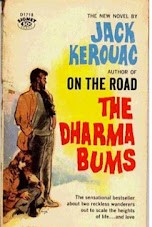
Philip Whalen is generally considered a Beat poet, although he wasn’t a member of Kerouac’s original group of friends. He was, however, a friend of Snyder. They he met at Reed College, which Whalen attended on the GI Bill. He had served in the Army during the war. Poor eyesight had kept him from going overseas, but he was trained to be a radio mechanic and instructor. Like Snyder, he was already writing poetry when he arrived at Reed and was reading Asian literature and philosophy, although at the time Whalen’s interest was in Vedanta rather than Buddhism. When Snyder came to San Francisco after dropping out of graduate school at Indiana University, Whalen joined him, and, through Snyder’s intervention, became one of the poets who took part in the famous Six Gallery reading where Ginsberg first read “Howl.” He appears in The Dharma Bums as Warren Coughlin, whom Kerouac described as a “big fat bespectacled quiet booboo.” Japhy Ryder, however, tells the narrator that there is more to Coughlin than meets the eye.
Although he was seven years older than Snyder, Whalen often followed the younger man’s lead. Snyder, for example, was able to convince him to apply to be a fire lookout for the Forest Service, and Whalen proved better able to handle the position than Kerouac would. It provided him solitude and time to read and write. He spent three seasons in the Cascades. The Forest Service managers were particularly happy to have him because of his skills as a radio operator.
He also practiced a desultory form of self-taught meditation while on lookout based on his reading of Patanjali’s Yoga Aphorisms. He dipped into Tibetan Buddhism but found the complex hierarchies of bodhisattvas and deities—which would fascinate Ginsberg—bewildering and off-putting. While staying with Snyder in San Francisco, he read his friend’s copies of D. T. Suzuki, and, while this was more to his taste, he did not yet see it as a path appropriate for him.
Another way in which Whalen followed Snyder’s lead was in using peyote. The hallucinogenic cactus buds were easily available in San Francisco, and many of the Beat writers used them. Snyder respected peyote as a traditional Native American aid to developing spiritual insight; Ginsberg included a reference to peyote in the litany that forms the first part of Howl. Whalen, however, remained cautious until 1955. When he did try it in the spring of that year, he reported that it acted on “my spirit and mind and body and everything else as a great cure.” He had visions which drew upon his interest in Vedanta, and he found himself identifying with the gods Vishnu and Ganesh. He used it again in June and still felt energized by the effects of the drug and the insights he derived from that second trip when he returned to the Cascades to take up his Forestry Service responsibilities.
The journey to his lookout on Sourdough Mountain was made on horseback accompanied by pack mules to carry the supplies. These animals, however, first had to be ferried by raft across Ross Lake. In order to accustom them to the raft, they were corralled on it the night before departure. During that night, one of the horses fell off the raft, waking everyone with its frantic splashing. Whalen was the first of the crew members to reach the horse, and he hooked his arm under its neck, keeping its head above water while another crew member went to fetch a boat to tow the animal ashore. As he struggled there, Whalen saw the moon rising over Jack Mountain.
“I was kneeling over the edge of this raft in my underwear,” he wrote later, “holding this horse under the chin. It was two o’clock in the morning and it was a beautiful summer night, and the mountains were all around, and the lake, and this horse, and me—and I suddenly had a great weird kind of satori, a sort of feeling about the absolute connection between me, and the horse, and the mountains, and everything else. And you can’t describe it very well—the feeling—because the feeling is a feeling. But it was . . . a big take of some kind.”
The event seemed particularly significant because his given name, Philip, meant “lover of horses” in Greek. The “horse in the water” became, for him, a kind of totem animal and its significance was confirmed to him when he discovered that the old Chinese Zen Master, Mazu Daoyi, was known as “Master Horse.”
That summer he came to think of his experiences on peyote not so much as “visions” but as what he called “identifications.” Peyote was like the finger pointing to the moon in the frequently quoted Zen admonition that if one paid too much attention to the finger, one would miss what it was pointing to. Whalen found himself becoming more interested in what the peyote “identification” was indicating.
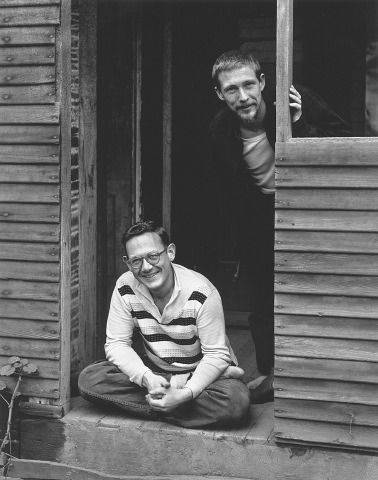
In 1966 Whalen followed Snyder’s lead once again, joining him in Japan where he found work teaching English at the YMCA of Kyoto. Here, at last, he discovered his own way. He was oddly at home in the spiritual capital of Japan and spent long periods of time wandering the city absorbing the atmosphere of the temples, gardens and shrines he came upon. The Japanese, likewise, responded warmly to his open and friendly manner. A man who knew Whalen in Japan at the time described him as “the kindest looking man I ever met.”
Kenneth Rexroth, who visited Whalen and Snyder in Japan, noted that when “Philip Whalen, in his red whiskers, looking like a happy Ainu bear-god, walks down Omiya-dori in Kyoto’s weavers’ quarters, every face lights up with that old-time Buddhist joy, even though most of the inhabitants are Left Communists, militant atheists, Koreans and Untouchables. . . . I have in fact seen Philip ambling past the market stalls and running into a march of demonstrating strikers, and everyone smiled and waved and he waved back.”
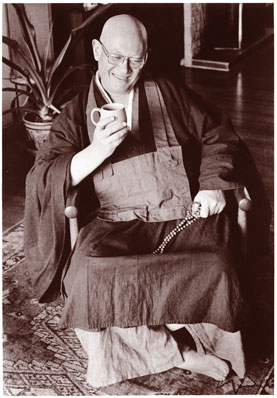
He still resisted taking up formal Zen practice with a teacher, but he learned the fundamentals of zazen from – and occasionally sat with – Richard Baker, who was also living in Kyoto at the time. Morning zazen became part of his daily routine; no matter how late he had stayed up the night before, no matter how much alcohol he had consumed, he rose early enough the next morning to sit.
By the time Whalen returned to the US, Baker had been installed as Shunryu Suzuki’s successor as abbot of the San Francisco Zen Center, and he invited Whalen to live there. The only demand put upon him was that he should join the rest of the community in morning zazen practice. Since this was already Whalen’s habit, it was not a difficult condition to meet.
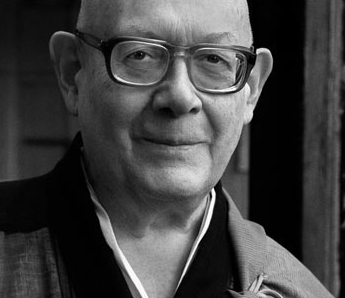
Baker admired Whalen as a poet and, as Whalen later discovered, had arranged for him to gain residence at Zen Center ahead of a number of people who had earlier applied to stay there. Whalen found his living circumstances pleasant; they afforded him ample opportunity to write and pursue his own interests. Over the next ten years, while Snyder attained respectability as a member of the Board of the California Arts Council and was awarded the Pulitzer Prize for Poetry, Whalen almost inadvertently underwent ordination and training in the Soto Zen Tradition.
When a former drag-queen and drug addict, Issan Dorsey—who was also living at Zen Center—moved out to establish a hospice and practice center for AIDS victims, Whalen joined him with Baker’s encouragement. In 1987, Dorsey and Whalen became the first individuals to whom Baker gave “Dharma transmission,” and, when Dorsey himself succumbed to AIDS, Whalen became his successor as abbot of the Hartford Street Zendo.
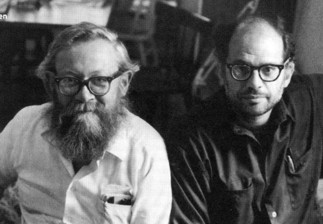
While researching his book, One Bird, One Stone, Sean Murphy made a number of unsuccessful attempts to arrange an interview with Philip Whalen, who was then abbot of the Hartford Street Zendo. Finally, Murphy determined to visit the center without an appointment on the chance that he might be able to meet Whalen. When he arrived, a ceremony was in progress marking the tenth anniversary of Issan Dorsey’s death. The organizers assumed Murphy had come to mark the occasion, and he was conscripted to take part in a ritual procession.
During the ceremony, Murphy was able to identify the elderly Whalen who by then was very nearly blind and had to be accompanied by an attendant. At the reception that followed, Murphy took the opportunity to approach Whalen. He pulled up a chair beside Whalen and introduced himself as the writer who had been trying to arrange an interview.
“Ah, yes,” said Whalen. “I haven’t called you back.” He sighed an old man’s raspy sigh. “I’ve done so many interviews, you know,” he said, reaching moodily for a stuffed mushroom h’ors d’oeuvre. “I find them terribly irritating.”
Philip Whalen died in 2002 at the age of 78.