Pacific Zen Institute –
I first interviewed John Tarrant at his home in Santa Rosa in 2013. His was the third interview I conducted in this project, and I was still finding my way as an interviewer. I did a second interview with him last November; it was my 289th.
He is Australian and grew up in Launceston, a small, town in Tasmania. “It’s the kind of place people ran away from and then went all over the world. People I went to high school with ended up in Long Island, Africa. I came to America. It’s that kind of place. Like many British colonial places, it had a traumatic history; it was a prison colony, and you can still feel the darkness on it. Some of the most loved and architecturally prized buildings were prisons that had been abandoned. When I was about twenty, I kept getting migraines and I realized that if I left Tasmania, they would go away. And they did.
“At first I fled further into darkest Tasmania, I went down into the smelters in Queenstown. Worked swinging sledgehammers and tended the blast furnace with the fire spilling out of it. And eventually I went fishing in North Queensland. I don’t know what I was doing there, but I was trying to find a way to change, to get out of my conditioning. And eventually I thought, ‘This isn’t really going anywhere.’ I was working in Brisbane as a proof-reader, a low-level job. And on a street corner, I ran into a woman who was an editor for that book company, and she said some Tibetans were coming to town. I didn’t know anything about Tibetans or meditation or Buddhism, but I said, ‘How do I get hold of them?’ She immediately recognized that I was interested in a more than casual way, and she said, ‘Well, you can go, but, if you do, you won’t come back.’ Which was clever in a way. And I did go and study with them; it was what I was looking for.”
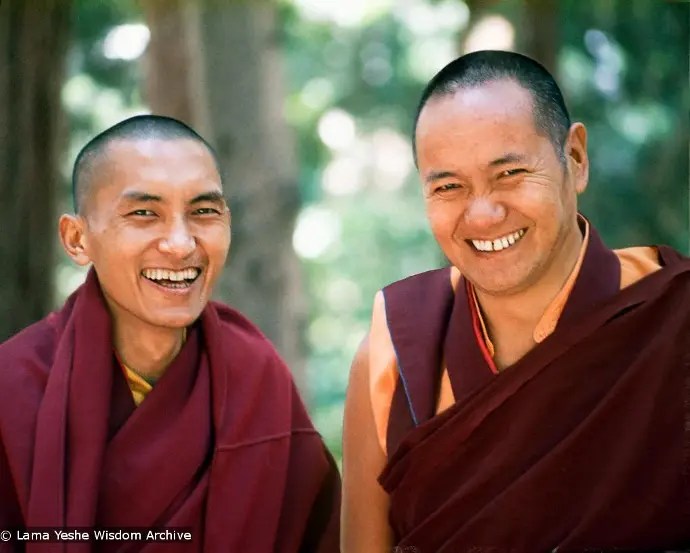
The Tibetans were Lamas Yeshe and Zopa, who had been working with western students in Darjeeling since the mid-60s and were, in the mid-70s, offering retreats elsewhere, including Australia.
“They had a road show. They would come through and hold a month-long retreat and some meetings with their senior students.” Later he found some people who were trying to form a Zen group; they didn’t have a teacher but were guiding themselves by books they read. “So they would hold these little retreats, one day retreats and more, and I’d drive up and sit with them.”
The group approached their practice, as he puts it, with a convert’s zeal. “They thought, ‘Well, we should do it the way they do it in Japan.’ But nobody really knows what the spirit of that is. If you’re in Zen and you go to Japan, you find out, ‘Oh, the Japanese are different.’ On the one hand, Zen belongs to them, so they’re at ease. On the other hand, Westerners who go to Japan to study often struggle since it’s very hard for the Japanese to promote people who aren’t Japanese. I could tell that the Tibetans wanted help preserving their culture and the Japanese did too. So I decided to study in America.”
The group sent out letters to various Zen centers, and they received a reply from Robert Aitken in Hawaii, so that’s where they went.
I ask what he was looking for, first with the Tibetans and then with the Zen group.
“Well, I had noticed first through poetry and then through meditation that my consciousness could change. My mind was like a wild animal. I’d go hiking out in the bush for a week, and I noticed how my mind calmed down when I was hiking, and that was somewhat like what happened when I was meditating but more so. I learned to meditate in a casual kind of way. And l liked the koan tradition because it depended on metaphor.”
“Had you been investigating koans before you went to Hawaii?”
“I just read the usual things you would have read. D. T. Suzuki, whom I liked. People didn’t like him later because he didn’t seem to emphasize practice, but – I don’t know – I liked his work.”
I ask what Robert Aitken was like.
“He was very scholarly but generous about Zen, and his wife funded the zendo. He really didn’t charge as long as you did the zazen and worked to maintain the zendo, kept the garden up, and fixed the roof and things. So it was an ideal thing for a young person who was broke and from another country and didn’t have a work visa. He was great in that way. He was a scholar, and he had read a lot, and his introduction to Zen had been through R. H. Blythe and Basho, the poet. Blythe was very interested in Basho, who had those kind of spaces in his consciousness that coded as Zen to a Westerner. And Blythe had also shared koans with Aitken in the camp in Japan, where they were imprisoned together during the war. Aitken always had great reverence for him, he always called him Mr. Blythe. Which tells you about Robert Aitken’s old-fashionedness itself. He didn’t call him Reginald or Blythe. It was Mr. Blythe. It was touching. And he had very strong feelings for him and also for Nyogen Senzaki who had survived the internment camp at Hart Mountain in Idaho. That was the only zendo in America during the war. And after the war, Aitken studied with him. Aitken was a reflective, scholarly person, but spontaneity was outside his realm. You know? So he’d walk into the meditation hall, and he wanted to say something like, ‘You must concentrate on your koan,’ but he’d pull a little slip of paper out of his kimono sleeve and just read, ‘You must concentrate on your koan.’ He was very socially anxious, and you had to take account of that. But he was a good teacher for me because he was literate.”
As it happened, John’s first breakthrough came not with Aitken but with the Korean, Seung Sahn.
“I was training pretty much in the zendo in Hawaii, and didn’t take weekends off, though you were allowed to. And after six months, they’d give you a month off, and they’d say, ‘Go somewhere.’ So I went to hike in the Rockies, and then I had connections on the East Coast so I went to New York, which was overwhelming. I heard that Seung Sahn was giving a four-day retreat on Long Island in a basement dojo. And so I met him. And I was ready – I’d been sitting a lot, four to six hours a day at the zendo – I was ready for things to open up for me. If you really sit a lot, an old text makes sense: ‘purifying mistaken knowledge and attitudes you have held from the past.’ I found that it changes your character and softens you. So that had been happening for me. And so with Seung Sahn I had my first opening. Everything became clear and I could answer his koans. It seemed that a gate was opening, and he was pretty happy about it, and he wanted me to travel with him. But I thought, no, he didn’t seem like a good teacher for me.”
I ask how Seung Sahn’s approach differed from Aitken’s.
“Well, he was Korean. The Japanese – you know – they’re a very precise and literary culture. Koreans are wild in a way in terms of Zen. He wouldn’t say, ‘What koan are you working on?’ He’d say, ‘Who are you!’ I walked in, and he said, ‘Who are you?’ I said, ‘Well, my name’s John.’ ‘Where do you come from?’ And I said, ‘Australia.’ He said again, ‘Who are you?’ And he lifted his stick, and I realized the question wasn’t about coming from Australia. But I was full of life, and a yell came out of me. And he liked that, so he paid attention to me. I passed my first couple of koans with him, they were from a classic text, the Wumenguan. Something was opening but it was still in process. He gave me his own ‘Dropping Ashes on the Buddha’ koan to take with me. Something the Japanese would call a miscellaneous koan. So I went back to Hawaii and sat more retreats. There was a Japanese teacher, Koun Yamada, who had a lot of influence in America. He lived in Kamakura, and he visited America, and Robert Aitken eventually got transferred to him and was sort of under his wing. So then in one of those sesshins everything opened up for me.”
He ended up going through the formal koan curriculum with Aitken, and eventually Aitken suggested he consider teaching.
“Teaching wasn’t on my horizon really. I was studying and getting a master’s in psychology. I didn’t know that I wanted to be a psychologist so much as to get to a different realm of the mind to complement the Zen. A lot of people go into psychology and then go into Zen, but it was the other way around for me. I thought I wouldn’t mind a Western point of view on what’s going on here. And that turned out to be important to me, the whole soul and Zen notion. So I started to teach, and I wanted to have a child, and I don’t know, I just didn’t want to live in Hawaii for the rest of my life. After you’d been in Hawaii for ten years, you either settled in and it was your world, or you left. So I left.”
He moved to Santa Rosa where he was offered a job at a psychotherapy institute, although as it turned out the institute closed before he arrived.
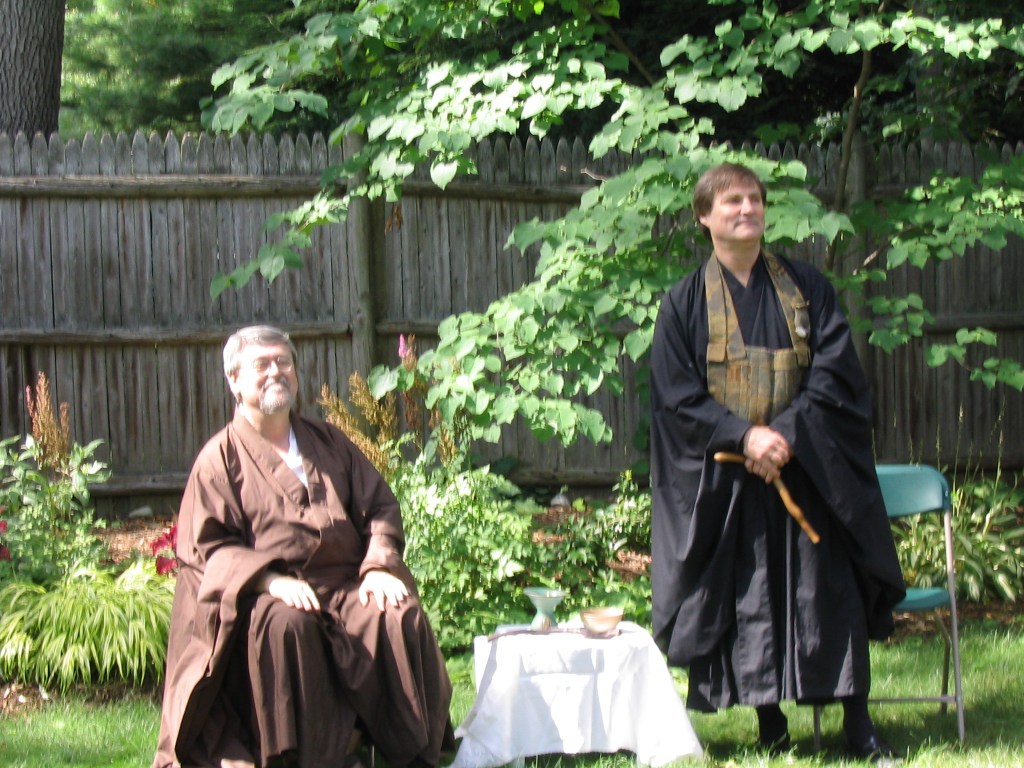
“So I just settled down and got a license and opened a private practice and started a zendo straight away because of somebody I know you’ve interviewed.” The somebody is James Ford. “I went into a bookstore to buy a gift for Robert Aitken. I got a Lafcadio Hearn Japanese book on crepe paper, and I bought that, and this guy was very persistent, and he said, ‘Why are you buying this?’ I said, ‘Well, it’s a gift for a friend.’ ‘Who’s your friend?’ ‘Somebody in Hawaii.’ ‘Well, who?’ He was nosy but amusing, and he was very interested in Zen, and he eventually came and sat with me. And he was very into running this very good second-hand bookstore. But it was one of those things where you realize, ‘This is a wonderful thing, but I’m going to starve if I keep doing it.’ Eventually he went off and went to theological school. Yeah. So he came and sat. I was in a one-bedroom apartment, and we’d meditate on the porch. Then I got a bigger house and did dokusan outside on the lawn with umbrellas when it rained.”
Gradually his understanding of the practice began to change.
“I realized that in its own way, the American Zen scene had a very particular cultural attitude. Partly it was trying to be Japanese, but also it was very American in a way that I wasn’t. I mean, I liked Americans, and I liked America. I liked the freedom in America, that you can think. Ondaatje, the novelist, said if he hadn’t moved to North America – it was Canada in his case – there were things it wouldn’t have occurred to him to think. So there was a kind of freedom. He said he would have been a good poet but not a good novelist. And I noticed that kind of thing in America, but also there were disadvantages, of course.”
I ask, “Such as?”
“People who went into spiritual traditions in America were rigid. And they were always looking for somebody to find fault with. And they’re outraged about all sorts of things a) that I didn’t care about, and b) and I didn’t think were necessarily true or well understood. I noticed that I didn’t really enjoy being around the temples. Not because I was so uptight or anything, but there was a lot of: ‘He did this, and he shouldn’t have.’ And I noticed it in myself. I thought, ‘Hang on, this is not good for me.’”
One of the things that I admire about John is the way in which he has brought koan work out of the dokusan room and integrated into the lives of his students. I tell him that when I interviewed Shishin Wick, he had told me that when studying with Taizan Maezumi they were specifically told not to bring personal matters into dokusan. However, when he became a teacher in his own right, he said, personal stuff was the only thing students came to him with.
“Well, Yamada Koun and Robert Aitken didn’t want to talk about non-koan things and actually couldn’t listen very well,” John tells me. “Yamada compensated by his warmth, Aitken by being very knowledgeable about the history. Americans do love to talk about their feelings, so I had to learn. I realized that I don’t listen either. In temples, what’s pushed down is the shadow, the negative elements in one’s personality. So in the end those have to be taken into account. I found the Jungian work was the thing that most went with any kind of spirituality for me. So I studied that.”
I suggest that if nothing else psychotherapy is certainly about listening.
“Indeed. It’s also about psyche, which is a Greek word. You know, the Greek character, Psyche. I did that spirit and soul thing in the book Light Inside the Dark, but a lot of people still go into a zendo to get away from their lives. Perhaps I did that. But sooner or later you have to let life back in and let the material transform in some way. If you want a whole life rather than a perfect life, then you let the passions back in. And you don’t censor. If somebody comes and tells me, I’m traumatized about X – you know – I might or might not believe them. I don’t necessarily believe the explanation, but it’s worth listening to people.”
I mention that when, twelve years prior, I had first written to him, he’d replied to me by saying he wasn’t the “same type of animal” as the other people I was interviewing at the time. “And yet,” I say, “you’re wearing a rakusu as we speak now.”
“Ritual and ceremony provide a container and allow the soul to go deep. For me, it makes me aware, ‘Oh, I’m in the temple.’ And that’s one of the ceremonies we’ve kept at the Pacific Zen Center, the rakusu ceremony and the vows. Although we’ve made it a transformation path. Rather than ‘Don’t steal; I’ll never steal.’ It’s ‘Oh, I wonder what stealing is about for me.’ You know? It’s a different kind of path.”
I had been told that students at PZI wrote their own vows, and I ask how that worked.
“It works best if you have a group of people; you’re looking at it together. Because almost everybody wants certainty, and as a Zen person it’s my job to stop people from being certain. And people want to be good when they take the rakusu, but I’d rather they tried to be whole. Nobody can keep all those vows because they’re contradictory and nobody does anyway.”
Having students write their own vows is one way in which John and PZI differ from other Zen groups. I ask what he believes some other significant differences are. He takes a moment to reflect.
“Let me try and work out what I do. I’m uncertain how to describe it. It’s pretty orthodox Zen in someways, but it’s not in the forms. We had a lot of people who really liked the keisaku” – the stick students were slapped on the shoulder with to “energize” them – “but too many people felt traumatized, so we just decided, ‘It’s not that important, so we won’t use it.’ So we don’t beat people with the keisaku now. Which was a very Japanese, or very Chinese thing. Also we’re not that interested in people who want to learn mindfulness. In that tradition, there always seems to be someone in charge. But in koans it’s sort of out of control. And we are a koan tradition. We expect you to take on a koan after a while. And if you want to go deep into the bowels of the community, then you do koans, and you stay with it and have some sort of opening experience and transformation. And it’s our job to try and make that as capacious and as generous an experience as possible, though it’s not always possible. And then if somebody’s talented and they look like they might be somebody who might take up teaching, then I want to take them through the thousand koans we use these days. The Kapleau tradition, we’ve drifted from that a bit and we’re a bit more in the Rinzai lines. But – you know – the Kapleau tradition is fine. There’s some question about is a thousand koans better than a hundred koans.”
I point out that Kapleau didn’t finish the curriculum with his teacher, and so his heirs only do about 400 koans.
“Yeah, for that reason Bodhin Kjolhede who was a successor of Kapleau came to study one of the books with me that he didn’t get to do. It’s all right though. It’s not the worst thing not to have finished the koans. So what do the koans do? If you walk around Daitokuji in Kyoto, you’ll be walking through a beautiful garden, and suddenly you’ll see a sign that says, ‘The universe is in a teacup.’ There’s no explanation or handholding; you just walk on. So the koans do that. They shock your imagination and they always start out with a predicament.”
He refers to the fifth case of the Wumenguan:
You’re hanging from a branch by your teeth, your feet cannot find the trunk, your hands cannot reach a branch. Somebody comes beneath the tree and asks you, “Why did Bodhidharma come from the West?” And if you do not answer you fail in your duty. If you do answer, you lose your life. What will you do?
“Well, if you’re hanging from a branch by your teeth, your hands can reach something, so there’s clearly an absurd element to it. And the question you are asked might seem arcane but that’s exactly how the mind works, wandering off. But it points to what it is to be human and the kind of difficulties, predicaments we find ourselves in. The psyche might map onto that. That for some reason touches people. Or you find yourself in a stone crypt and you can’t get out. Your cellphone doesn’t work, that sort of thing. That’s the archetype of imprisonment. So there are a lot of koans that are just plainly predicaments. But not all of them offer this. Some of them are more about your mysterious karma or why you are here. But the metaphor of the koan interests the psyche without providing sensible reasons. That’s what I loved about koans. I felt, ‘Oh, it changes me.’”
I have a card John gave me in 2013. I use it as a bookmark. On one side there is a calligraphy of the characters for “Moon on Water.” On the other side, there is a text:
OK. Here is one koan method for happiness in all its simplicity. Just find a relationship with the koan. You don’t have to get ready or settle yourself down. You just start living inside your own life and let the koan keep you company like a good dog or a friend. The koan doesn’t go anywhere else or ever leave you. . . . You can keep company with a koan without assessing, criticizing or judging yourself. The koan doesn’t find fault. And even if you do criticize yourself, don’t criticize that. Compassion finds an entry. This is important.


Seems important when profiling teachers to be willing to discuss issues and limitations along with the celebration of their good work. Part of our duty of care to readers in my view.
http://www.ciolek.com/WWWVLPages/ZenPages/DOCS/szc-newsletter-feb-mar-2000.pdf
Thanks for your you efforts in sharing about modern Zen teachers!
LikeLike