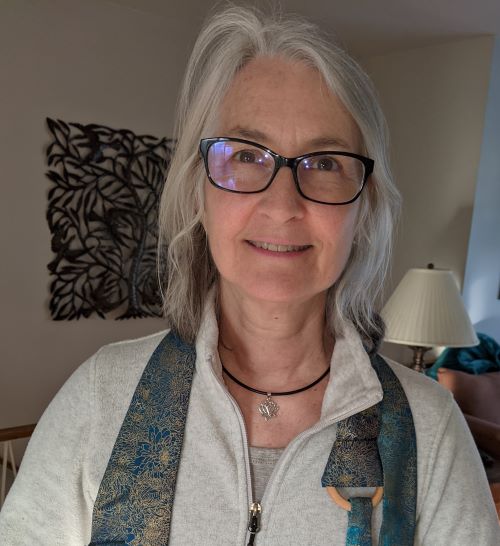
Joyful Mind Zen Community, Rockville, Maryland
There are factions in the US currently resisting the concept of political “wokeness,” in the sense of being “awakened” to racial or gender injustices inherent in societal structures. But for Martine Palmiter spiritual and the political “awakening” are intertwined.
“I was raised American Baptist, and I actually loved going to church with my mother mainly. And it was progressive; one of the first integrated churches in our county. Our pastor railed against the Vietnam War and held out Martin Luther King as a beacon. So I was raised in that faith tradition and grew up hearing all of this kind of rebellion, and I was very impacted by that. And in high school I joined a Bible-study group. But that’s actually how I left the Christian church because we were praying and praying and nothing ever touched my heart. Nothing went through, so I left.
“And when I went to college, a real turning point for me was a course in Feminism 101, which just turned my life around.” It had been during the era which came to be called the Second Wave of Feminism, and Martine was reading writers Susan Brownmiller and Kate Millet.
“So that touched my heart. I learned about inequality and centuries of cultural conditioning throughout history and across continents that limited the lives and minds of women and girls. I opened up to women being diminished or invisible in most religions. I was exposed to the women’s spirituality movement. I learned about physical harm and diminishment of women in the ancient Chinese foot-binding and rape. It was kind of the first time I’d heard about all these things, and these things really touched me. I would leave that class shaking for an hour or two after each session. It just opened me up to something I hadn’t known. It changed my life. I started looking for women’s spirituality circles. I became a wiccan. I searched out Unitarians. I went on this spiritual search for years – probably twenty years – before I found Zen.”
I express some surprise that her study had led her to seek spiritual answers to the issues she was encountering rather than political ones.
“The politics didn’t interest me. The spirituality did.”
I ask how she viewed male and female spiritualities differing at that time.
“Well, at the time I was shocked that there could even be something as a female godhead. I had never thought about that. I ended up studying Marija Gimbutas and all the ancient pre-industrial cultures – you know – before the patriarchal traditions.”
I ask what she got from those studies.
“That’s a really good question. They made me know what I didn’t know. I kept learning. I’m a life-long learner. I just kept opening up and exploring, saying, ‘Well, this isn’t it. This isn’t it. This isn’t it.’ It was just a huge amount of data. Being in a female body was really important for me.”
“And that had been an issue for you?”
“Yeah. When I learned the history of women in the world, the way I learned it, women really did take second place in most things. And I think what Marija Gimbutus’s studies did for me was make me know that there were periods of time in our human history where there had been an equality of gender/sexes where men and women were equally revered for who they were.”
In the course of time, she married and moved with her husband to Florida. While there, she looked for women’s spirituality support groups and found one in Miami that nurtured her during the time she having children. “And I drove to Tampa and went to what I thought was a women’s retreat. I didn’t know it was a Buddhist retreat. I just thought it was a women’s circle, another one, and it ended up being led by Tsultrim Allione, who is a lama now in the Tibetan lineage focusing on a women’s tradition. And it was all women, and we were in a yurt. We fasted, and we meditated – me for the first time – and we did dakini practice, and we chanted. I felt something very deeply in my body. It was the first time I had meditated deeply; we did it from morning till evening for five days. I didn’t know it was Buddhist practice at the time. I think what I got the most from that practice was the chanting. We did a lot of chanting with the different chakras. And I still know those chants. I was in my 20s, so forty years later, they’re still in me. I think I practiced that on my own for maybe ten years with the pagan women’s circles when I returned to Maryland. I would teach them the Tara chant. And then I tried to become a Christian again.”
“Interesting. What prompted that?”
“Well, I wanted more community. I wanted something for my children. So I took them to two different Unitarian churches. I went to two Congregational churches with them. But it wasn’t it for me. And it was very soon after that I found Zen. I was grateful. It felt like a relief to find something that I could do with my body and in silence. One of my teachers – Roshi Robert Kennedy – said, ‘When you get to the end of the line, that’s where Zen is.’ That’s exactly how I felt.” Kennedy was a Catholic Jesuit priest as well as a Zen teacher.
“So I was in this bowling alley with my kids, and there was a woman at the table next to me, and we started talking and we hit it off. I told her about my women’s circle but that I was getting tired of the full moon dancing and singing and just wanted some quiet practice. She said, ‘I’ve been practicing Zen for twenty years. Have you ever tried Zen?’ She was a student of Eido Shimano Roshi. And I told her, ‘I know nothing about Zen.’
“She told me she was looking to reinvigorate her Zen practice but was willing to look around. We both explored a Tibetan place in Maryland, and a Theravadan Forest Monastery for a weekend retreat. The men and women were separated. It was not quite right for me. And then she found a Korean Zen group very close to my house. And we practiced there for a year. But I didn’t stay there. It was mostly men, and there was a lot of talking about swordplay and martial arts, and I said, ‘Oh, here we go again. The patriarchy.’ So I ended up going online, and I found Rose Mary Dougherty’s name and learned that she was starting a Zen sangha nearby.”
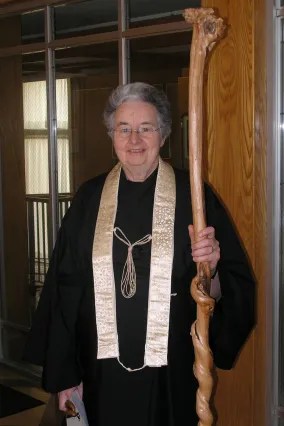
Rose Mary Doughterty was a member of the Catholic School Sisters of Notre Dame who had studied Zen with Kennedy and Janet Richardson, also a nun and Kennedy’s heir.
“I didn’t know Rose Mary was a nun for a year. I just called her up, and she said, ‘Come over to sit.’ And I was the only one there, ’cause she was just starting, and she had a Zendo in her side porch. She said, ‘We’re going to sit for twenty minutes, twice.’ She rang the bell. She taught me kinhin. And right there I knew she was my teacher. Her presence alone. She had presence.”
“So you find this woman who’s a Catholic nun – although you don’t know she’s a Catholic nun – and you start going to her house because she has presence. Where does that lead?”
“Well, it leads to seventeen years of devotion to Zen practice and to her.”
“And probably somewhere along the way, she suggested you do a seven-day retreat.”
“She did. And I told her I was terrified. It was a five-day retreat, and I told her I was terrified.”
The retreat took place at a convent in Pennsylvania, and the sesshin leader was Janet Richardson.
“A lot of Catholics who didn’t find what they wanted in Catholicism loved the Zen-Catholic connection. It didn’t burden me at all. It felt freeing. As a matter of fact, it might have been helpful to me that I came as a non-Catholic.”
The tradition Robert Kennedy and Janet Richardson practiced in made use of koans, but Rose Mary didn’t.
“She didn’t do koans; she did shikan taza only. Just this. My teacher was not known, in particular, for her talks or her teachings. Many people say what I say; she was known for her presence and her strong sitting. And I think that’s what I really got from her. She didn’t even really talk about Dogen. She read poetry, and she said she taught ‘Just this.’ That was her entire teaching. And it was not enough for a lot of our people. A lot of our members left looking for more. But for me it was just right.”
A lot happened over the next seventeen years. “I got divorced. The kids left home. My father died. A very good friend died of brain cancer. And losing that friend, I can actually remember telling Rose Mary that I gave up on God again. I gave up on Zen for two years after that but eventually returned to the Sangha.”
In 2014 Rose Mary was discovered to have Parkinson’s.
“We noticed it first with her hands shaking. Then she felt she had to come out and tell people about the diagnosis. And her voice started going. It was really . . . We loved her so much; the sangha loved her so much.” Martine’s voice chokes with emotion. “And eventually she had to go a nursing home in Baltimore – it’s an hour from here – and she stopped teaching. And I felt, ‘Who’s going to be my teacher? How am I going to go on?’ I had, luckily, another roshi – Charles Birx – talk to me at the time, saying, ‘You have all her teachings. Now it’s time for you. She has her path, and you have your path.’”
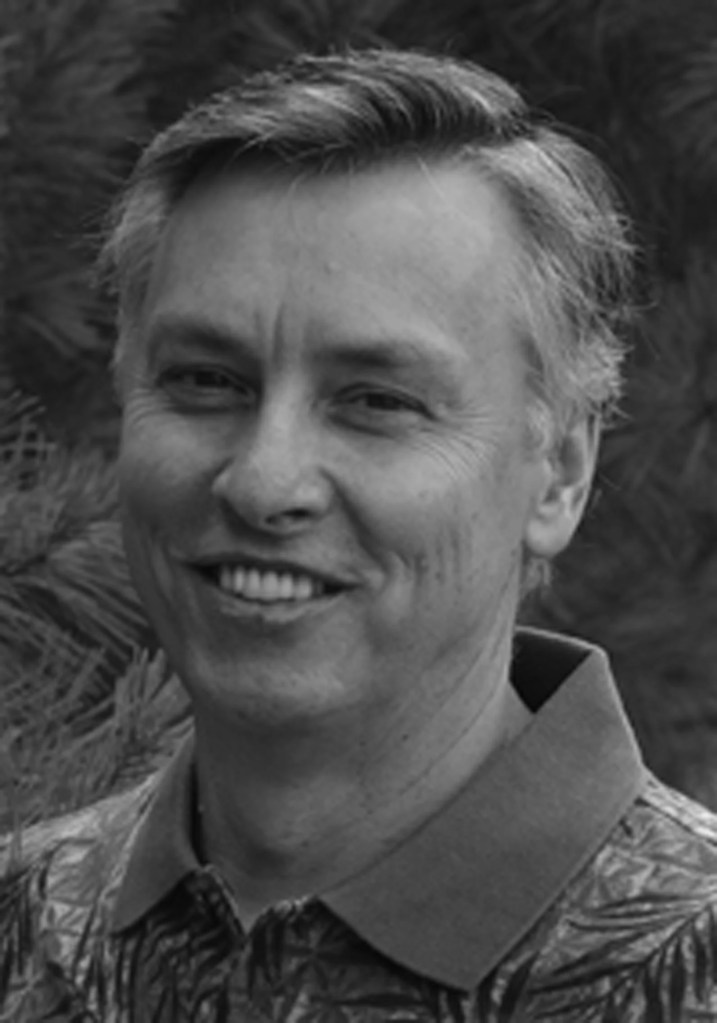
Charles Birx is another Robert Kennedy heir. He and his wife, Ellen, are the guiding teachers at the New River Zen Community in Virginia.
“And what he said threw me back on myself, where I needed to go, and I never sat more strongly in my life. I did a private retreat for myself for a week sitting with this question, ‘What now? Who am I?’ You know? I went right back to the beginning of Zen. And I had a kensho experience. I dropped everything. Everything I ever believed in, everything I’d ever done. Just complete emptiness. Complete dropping. I dropped all the dropping. Everything just broke through for me. Crying and laughing and all of that. And I called my Rose Mary, crying, and was so glad she was able to pick up the phone in the nursing home. And I told her I finally understood ‘just this.’ I thanked her and asked her what I could do. I said, ‘I don’t know what’s next. I would like to share this with others.’ And she said, ‘Well, can you really claim to be a teacher? I want you to sit and pray. I will pray for you.’ She did a lot of praying for me.
“And Roshi Charles told me, ‘Why don’t you go up and see her?’ So 6:30 in the morning on Sundays, I would go up, and we would study together, and she confirmed my Dharma teacher transmission, and we would sit together in the nursing home, the nurses coming in and interrupting. And her presence was right there, in the midst of it all. I was just blown away, the bright light from her being as the nurses came in and poked and prodded her, her generosity and kindness never left.
“And I would say to myself, ‘What will I teach? How will I teach? I don’t know how to be a teacher.’ And Rose Mary didn’t say anything, except, ‘You’ll figure it out.’ And what happened to me, as I was driving back from a retreat with Roshi Kennedy, I heard a podcast – a Zen podcast – on the women ancestors in The Hidden Lamp. So I pulled over to the side of the road. I had never heard of such a thing. I had never heard of a woman ancestor in all the years practicing with Rose Mary. So I was stunned. The podcast was about Miaoxin[1] and all the Zen women in history that I’d never heard of. No one had ever told me a Zen story with a woman in it, except for the woman handing out tea on the side of the road. So I immediately got the book, and I just read everything I could on women in Zen. And here I found my feminist self alive again practicing Zen, I and got Rose Mary’s permission to teach from the Hidden Lamp. She told me, “Just make sure people also sit zazen.”
Rose Mary arranged for another of her students, Robert Ertman, to install Martine as an fully transmitted teacher in the Soto tradition.
“And then one day I got a call that she was actively dying. We had just met three days before, and this was a surprise. And I went in there, and they’d cleared her room out, and they had her in a hospital bed. It was a Catholic nursing home, so they cleared everything out of her Zen life. But there she was, breathing and fully present. She was unconscious. And I did the one thing I knew how to do.
Then she chanted the mantra from the ending of the Heart Sutra: “‘Gate, gate, paragate, parasamgate, bodhi, sva-ha!’ I chanted that several times in her ear. Just for her. And then I left, and she died. And I knew my path then. Yeah. I loved her.”
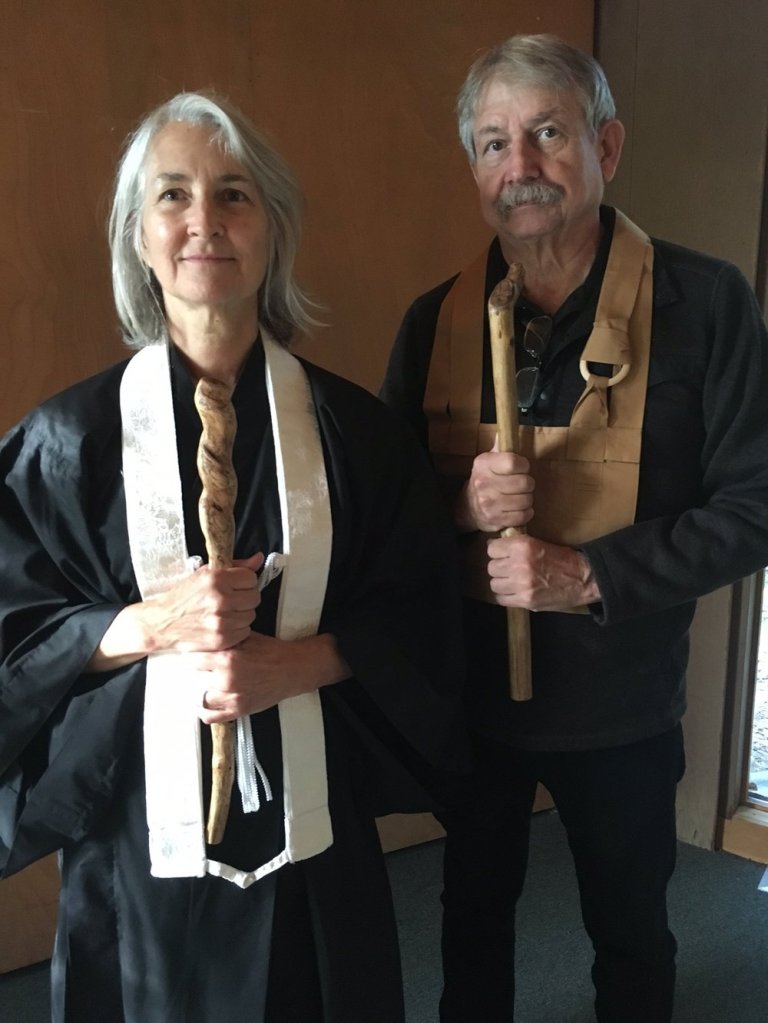
After Rose Mary’s death, Martine and Robert Ertman became co-teachers at the One Heart Sangha in Rockville, Maryland. In 2023, Martine founded the Joyful Mind Zen Community. She also established an online women’s Zen group. “And I started a women’s sesshin once a year, which was very needed.
“The Hidden Lamp started me on koans and stories. Then George Floyd happened. And the pain of that was going right in – I allowed it right in – because I had already done the women’s work. The pain of the women was coming in also, with the ladies of the tea group, hearing the stories of their lives. I developed a workshop called ‘Waking Up to Whiteness.’ And I offered it through Zen Peacemakers as a brand-new teacher on Zoom – ’cause COVID was happening – and I had full confidence I needed to wake up; we all needed to wake up. So you caught me in this interview at a time of great openness. Flowering. I am opening again to all suffering. So . . . So I was talking to somebody the other day about this interview, and they said, ‘What are you going to say your teaching is about?’ And I said, ‘Courage. Confidence. Curiosity. Love.’ I think that’s it.”
“And if I asked you what a Zen teacher teaches?” I ask.
She laughs. “Courage. Confidence. Love. Right?”
[1] The most famous story about Miaoxin tells of a time she overheard a group of monks arguing about whether it was a flag that moved or the wind that moved. She told then it was neither the flag nor the wind but their minds that moved.


One thought on “Martine Taikai Palmiter”