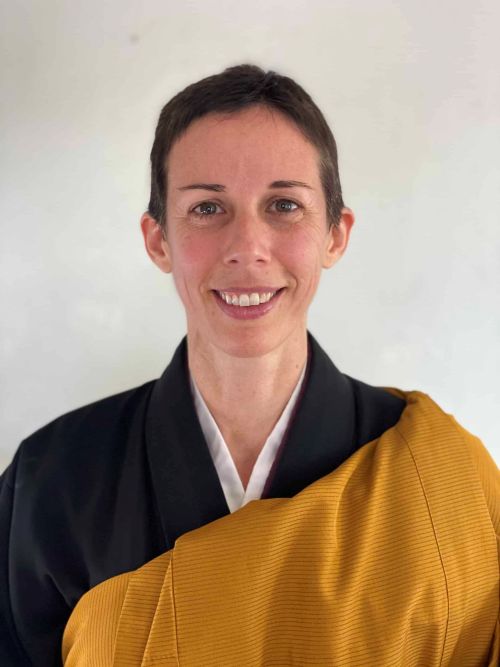
Zen Fields, Ames, Iowa –
Sara Jisho Siebert is a Soto Zen priest who teaches at Zen Fields in Ames, Iowa. Her back story is striking.
“When I was fourteen, a number of people in my life experienced sexual violence and talked to me about it. My mom is a great listener, and I guess I picked up some skills, so people would come to me and tell me the thing that was bothering them. By the time I was 17, I was just so tired of not knowing what to say to people when they had experienced this, and my mom brought it to my attention that there was this training for volunteers to do a crisis hotline. So I went through that training. It was a joint program between sexual violence and domestic violence, and I realized: this is just it. This is where I need to be. It’s so relevant in so many peoples’ lives. We need to do something about it. So I just let it drag me around, for a long time. I was working a lot. It is very easy to get burned out in spaces like that because they’re understaffed and underfunded and everything else. So I was doing a lot. For the first seven years it was direct service crisis response work. And then I really started to ask more questions around prevention, and most of the interesting prevention work at the time seemed to be happening outside of the US. So my work led me around to eleven different countries, living in different spaces, doing that work. And I’d been in Haiti probably the longest but also Uganda and some other places. And that is definitely what led me to Zen. I had in all of that time a number of cycles of burnout around the levels of pain, thinking: ‘This is never gonna stop!’ And the Buddhist stories made so much sense.”
The books she read on Buddhism stressed the importance of finding a teacher, something she thought it was unlikely she’d be able to do in Iowa.
“So I moved to Los Angeles and found an apartment and looked in the yellow pages, and I called about four places. I called the Vietnamese place, the Korean place. I was just calling places that looked near my apartment in Los Angeles. I thought, ‘I can’t possibly fight through three hours of traffic to get to a place regularly.’ So I was looking in the area where I’d found an apartment. Nobody who answered the phones spoke English. I’d say, ‘I’m so sorry, but I don’t speak your language. Do you have any offerings in English?’ ‘No. Sorry.’ And then I called Zenshuji, And, ‘Moshi moshi!’ And I was like, ‘Oh, crap, not again!’” She’s laughing as she tells the story. “It was Rev. Shumyo Kojima who has been an amazing person in my path. And I said, ‘I’m so sorry. I don’t speak any Japanese. Do you have any programs in English?’ And he said, ‘Yes. No problem. Come on Monday if you want to.’ So I came on Monday.”
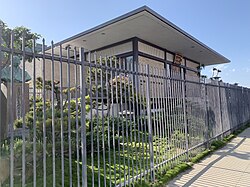
Zenshuji, established in 1922, was the first Soto temple on the US mainland. It was the temple Taizan Maezumi was sent to in 1956 to serve the Japanese American congregation. As in San Francisco, during the ’60s there was an influx of non-Asian youth inquiring about Zen, and by 1967, under Maezumi’s leadership, they established a separate entity, the Zen Center of Los Angeles.
It was a matter of chance that Jisho began her formal practice at Zenshuji rather than at ZCLA, but as a result she has a particular perspective about Zen. The majority of people who seek out a Zen Center are looking for a meditation center. For Jisho, Zen is a denomination not limited to zazen and sutra study, though those still have great importance. Also her understanding of the history of American Zen practice differs from that of many of the people I have interviewed. She stresses that Zen in the West did not originate with people like Taizan Maezumi or Shunryu Suzuki, that Zen temples had been part if active denomination in both Los Angeles and San Francisco – and somewhat later in Chicago – for decades before those particular priests arrived.
“It is important to recognize how Asian American sanghas are continuing to feed what Zen looks like in the United States. It didn’t just happen in the past or in some specific time period. It’s continuing to be cultivated. We just have so much honoring to do to the Asian American traditions and structures that have supported and continue to support Buddhism.”
I tell her that the story – as I am familiar with it – was that in both San Francisco and Los Angeles, the ethnic communities for whom the temple were originally established came to resent the amount of time Suzuki and Maezumi spent with the non-ethnic population. I ask if there had been any residual resentment when she arrived.
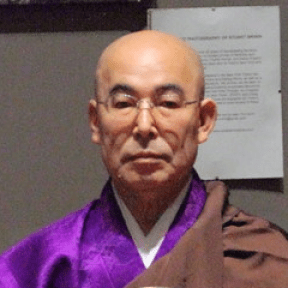
“Yeah. It’s a really good question. So my teacher, Rev. Gengo Akiba, was the sokan – or representative of the Soto Zen school in North America – at the time, he was in Oakland but was coming down to Zenshuji each month, and I met him that way. My teacher has spent most of his time in this country going back and forth to Japan trying to bring together the whole gamut of Japanese American, US born with no Japanese ancestry, and Japanese Japanese in the Soto structure together, and trying to figure out how to create harmony and hear each other and cross-pollinate the learning. He feels that maybe all sides have something to learn from each other. I think he has about ten disciples, some in Japan and some in the United States. He has been kind of gently pulling people together the whole while. And I’ve had so much encouragement from him, and from Japanese American priests at Soko-ji who work with him. Real open-hearted acceptance.
“I feel like it’s been somewhat harder sometimes for lay people who spent a lot of their lives experiencing discrimination outside the bubble of the temple environment. At Zenshuji, the older generation that was there when I started –– many have passed away now – but when I started many of them grew up in or had close family members in internment camps.”
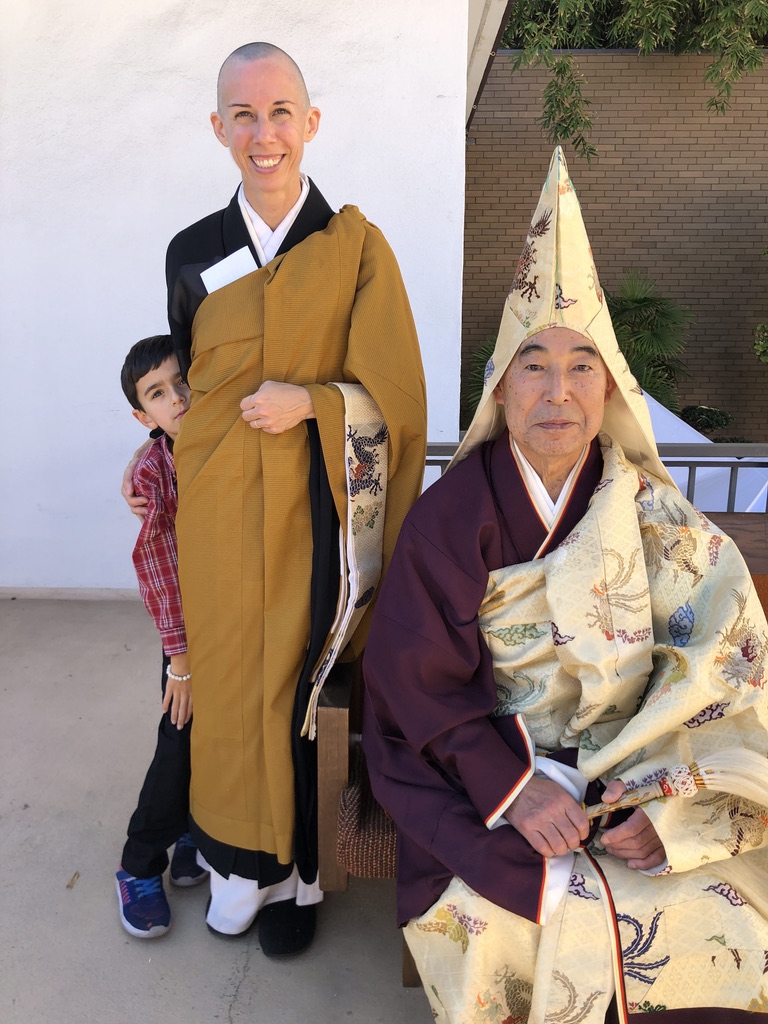
I ask how she became a priest, and she tells me it’s a terrible story.
“Well, I went to Zenshuji for about four years, and it never, honestly, occurred to me until someone who started almost the same week I did was asking to ordain. And I went out to dinner with him and another priest, and they’re like, ‘Well, why don’t you do it too?’ And I was like, ‘Why would I do that?’ And then I started to think about it. And I felt that something was palpably different about my life since I started this. I made a ton of mistakes in those four years; I screwed up a ton of things, and yet something is different about the way that I am in them, and something is really helpful about this practice, so why wouldn’t I want to devote my life to that? And I saw that happening with other people too. So why wouldn’t I want . . . Not because I have the answer already, but why wouldn’t I want to invest every fiber of my being into figuring this out? And so it made sense to me.”
“And that’s not something you could have done as a lay person?” I ask.
“Well, it’s about what is your primary purpose? So my life looks a lot like a lay person’s life now – right? – I have kids, I have a husband, I live in a house, I work part-time at another job that is not directly on the surface of it Zen-related in any way. But all of that, to me, is part of my vow. The main point is the practice of awakening for all beings. And anything else I do under that, it’s a twenty-four hour a day practice, so anything else we do under that, it shifts in and out over time, but the main purpose is that purpose.
“And then, practically, there are just a lot of practice opportunities that open up if you are ordained. It depends on lineage too in a lot of ways. There are teachers who have figured out lay ordination; there are teachers who have figured out a really rigorous training process for lay students who are very deeply dedicated who, for some reason, don’t want to ordain. Again I’m in more of a Japanese/Japanese American system, and that just didn’t exist. So if you want to work closely with a teacher, you ordain.”
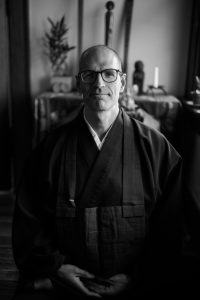
Her husband, Daishin McCabe, received Dharma transmission before she did, and they moved to Iowa, where she had grown up. “He started offering things online, trying to find a space, finding ways to offer Zen practices to people. After a couple of years, I had my transmission ceremony and we happened to have a couple of lawyers who were part of our community, and they told us, ‘You need to make a 510c3 so we can support you and make this beyond you and have a board and all these things.’ So . . . It’s been slow. We still don’t have our own space. We use a Quaker Meeting House.”
“They make good places to meet,” I note.
“It’s a wonderful place to meet. Our expenses are next to nothing, so we do interesting things with our money. It’s been a wonderful experience of listening to the community we’re building about what’s needed next.”
“You have sangha there?”
“Yeah, we do. I have one ordained student that is in training, and there are quite a number of people who are regulars. It is a small group. Although I do some guest teaching for the New York Zen Center for Contemplative Care, and I was laughing with them one time that––though their sangha is huge––if you looked at percentage of the local population that comes to our events compared to theirs, we’re not doing too bad.”
I ask what kind of relationship she has with other American Zen lineages.
“I belong to the Soto Zen Buddhist Association. There was also a peer group that I was part of for, like, five years, and most of the people who were in that group – who I loved dearly – were from lineages that are no longer connected with the Japanese denomination in any way. It was good for all of us, I think, to have that different take from each other, and they were just beautiful, deep practitioners as well. And then, of course, the Association of Soto Zen Buddhists is the group that is still connected to the hierarchy in Japan, and there’s a conference a couple of times a year. And that’s a good mix of Japanese and Japanese American temple representatives as well as mostly American-born priests. So having those connections to something wider is really helpful, and having those connections with individuals is also important. It stops us from having a really surface black and white narrative of anything. There’s a lot of diversity out there in terms of how people see this practice.”
“Okay,” I say. “So you are a Zen priest, and you’ve told me that zazen is not the only practice that defines the school. So, tell me: What is Zen?”
She takes a moment to consider her response, and I elaborate my question. “Say I’m someone who lives in the neighborhood, and I’m walking down the street, and I see a sign saying ‘Zen.’ And I knock on the door, and I’m not being aggressive or anything, but I am curious. What is Zen?”
She nods her head then speaks slowly and carefully: “It is how we live the moments of our life – of this life – with the awareness and presence and compassion and wisdom that will allow us to fully embrace and be in our lives in a helpful way. It’s difficult to measure. It’s an expanded version of how you would usually live your life. And that appears in all our different daily activities. It’s how we clean; it’s how we cook; it’s how we eat. It’s how we make our beds or don’t. It’s about how we relate with one another and the challenges that come up. It’s how we relate with our own minds in any given moment in any given activity in our life.”
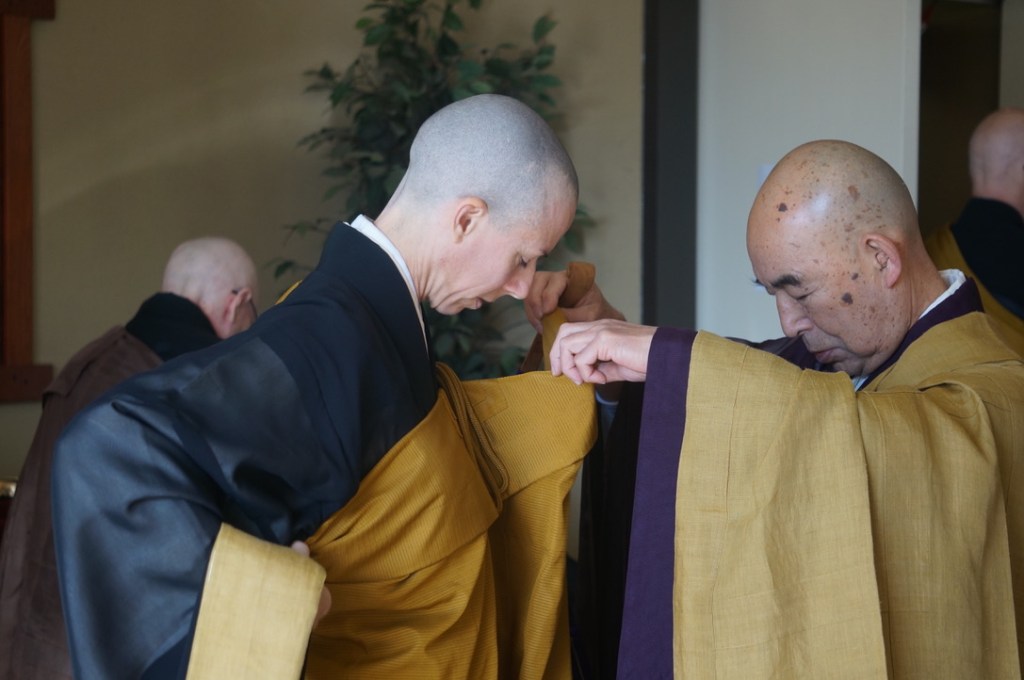
It is very much a Soto answer. Other schools might have talked about the importance of awakening. I mention that one of the things I have noticed with other Soto priests is the way they focus in a precise way on the activities with which they are engaged, for example, if I were to pass them a cup they don’t take it thoughtlessly but would receive it, consciously, with both hands. How important, I ask, is that attention to what I call “minutia”? This time there’s no hesitation in her reply.
“It’s all we have. Whatever’s in front of us is all we really have; the rest of it is just a figment of our imagination. In the relative world, what’s in front of us is all we’ve got. Whatever it is, if we can bring our full care to it, our full attention and care, that’s all we’ve got; that’s all there is. If I’m worrying about this thing over here and I can’t be present, then what’s the point? So there isn’t anything that is too mundane or too small. And it’s not about kind of an obsession with minutia. It’s about, ‘What else is your brain going to be doing?’ Our brains are pretty smart as human beings, and, a lot of the time, they can get in the way of our just being here. You can think that’s nitpicking or something like that, but the thing we are doing now is important. It’s not something to be skipped over to get to something important. We miss our lives if we make things too small to care about.”
“And when people come to you, when they seek you out, what are they expecting you to do for them?”
She laughs: “Like the expectation that there will be some kind of a magical equanimity that you won’t be bothered by the conditions in the world in any way. And – you know – we try to talk regularly about that not being what this is about. And it’s tricky, because . . . In my first years of practice in the Japanese American context, there was a bit of a humorous kind of almost flippant response to that kind of inquiry that was very much like, ‘This won’t do anything for you. If you’ve come looking for something, you’re not going to find it.’ I often refer to the tea master at Zenshuji – she’s wonderful, Hiromi-san – she is the tea ceremony teacher. Because she’s been there forever and because of her status, she can say the most wonderful, irreverent things, like, ‘We do the same thing in tea as you do in zazen. We make people sit in an uncomfortable position for a really long time, but at least they get a cup of tea out of it! Why do you people do this?’ But I think there was a lot of humor around that. I think the joking also helps because it acknowledges that people do want . . . They want a purpose; they want an outcome. And if we’re looking for that in some kind of rational way, we close ourselves off from what actually might be. And so if we can let up on looking for that type of outcome and just be, we might actually find . . . something.” She smiles; she has a great smile. “But don’t count on it.”


One thought on “Sara Jisho Siebert”