Dharma Sangha –
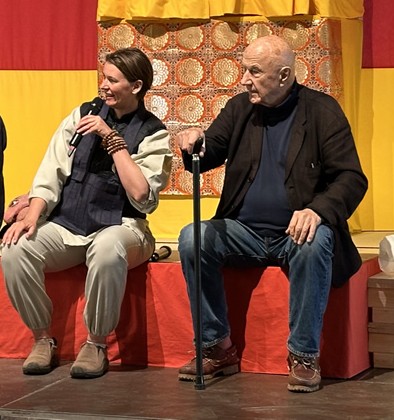
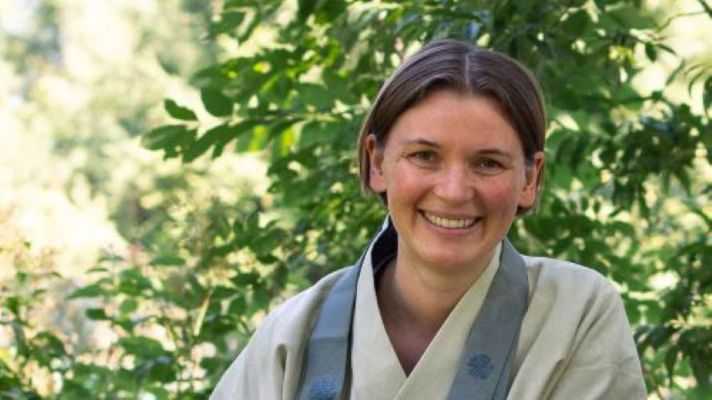
Nicole Baden succeeded Richard Baker as the abbot of the two Dharma Sangha practice centers, the Crestone Mountain Zen Center in Colorado, and the Zen Buddhistisches Zentrum Schwarzwald in Germany. Her first encounter with Richard, however, was not particularly auspicious.
“I was born in Northern Germany in a small village just south of Hamburg. I grew up in a big family with my grandparents owning the farm where I grew up, and with all my cousins. I am the oldest of thirteen cousins all on the same farm. My father was the first person in that family who didn’t continue the farming; he became a banker. And later when my grandfather started being too old to do the farming, my father learned how to do it. And then for the longest time he did both banking and farming on the weekends, and now he is still taking care of the farm together with my cousin.”
The family was Christian Protestant, and Nicole’s grandparents, in particular, were very devout.
“I learned to read by reading the Bible. A children’s version at first and then I graduated to the adult version. My grandparents very much believed, but what they really brought into the family was the compassion aspect. Like the way they understand Jesus as a person who really cares about others, and they brought that into the family. And I was raised with the understanding that your job in the world was to be a good person. And I’m feeling like that led me into Buddhism. I did try to cultivate from early on, as a child, the sense that God sees you in a true way somehow, so you should learn to see yourself the way God sees you.”
However, when – as a teenager – she began to consider the significance of her life, she found that the Christian God failed to meet her needs. “I really tried, and I just never heard back. So at some point, I gave up. So I thought, maybe I need a therapist or something. I was starting at fifteen/sixteen, as any teenage person would be, to be concerned about, ‘What’s my identity? Do other people like me? And am I good enough?’ The core issue was I noticed very clearly and painfully that all of my decisions were based on what I thought other people were thinking of me. There’s a German word for it –ferngesteuert – as if you’re remote controlled. That was the feeling, and I kept writing that into my journal. I felt as if I was remote controlled by others essentially. I noticed how I was trying somehow to become the person that I thought others would want me to be or how they would like me better. And I could not escape; I could not not watch my mind. There was my thinking, but there was always an observer to the thinking. I could not not observe the thinking. And so I noticed that feeling of how I was totally about ‘what do other people think.’ And I started asking the question, ‘But what do I really want?’ So I asked my parents if I could go to therapy or something.”
Her father had an acquaintance who had investigated several meditation centers in Germany; they discussed Nicole’s situation, and the friend gave her father a number of brochures, suggesting these places and programs might be more suited to her condition than therapy would be. But she had no way of evaluating the various offerings and eventually chose one at random.
“I just put them all on the floor, sat next to them, closed my eyes, and I said to myself, ‘If intuition actually exists, I really need it to work right now.’ I put my hand into the pile, waited until I found a brochure that just felt right, picked it up, opened it, and it was the Zen Buddhist Studies Center in the Black Forest. It was about something called ‘Work Practice.’”
As a gift for her 18th birthday, her parents paid the program fee and drove her 900 km to the Black Forest.
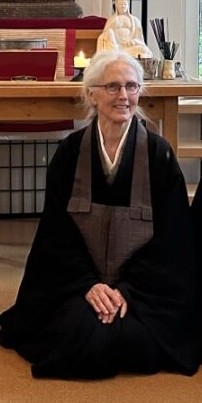
The program was supervised by Gisela Weischede, one of the founding directors of the center. “It was a small group, but she was there. She was the leader at the time. And then a handful of residents. Baker Roshi wasn’t there. She was his disciple. It was Baker Roshi’s center in Johanneshof.”
It was not a retreat as such but, as the brochure stated, a Work Practice.
“At that time there was no culture for receiving new people. So it was super small. It was a couple of monks basically who were beginning to make the place work more or less. And so we got up at 4:00 a.m., which was hell. And then we meditated for fifty minutes, ten minutes kinhin, forty minutes sitting, and then service which was also hell for me. There was almost no break. Oryoki breakfast. It was all in silence. And then – I don’t know – up to seven hours work per day.”
It was her first experience of meditation, and it was difficult.
“They said, when I first arrived, ‘Have you ever sat before?’ And I thought – I mean, literally – I thought, ‘Have I ever sat before? Yes. Sometimes I stand, sometimes I walk, and sometimes I sit. Like, we sit at school, for example.’ And then they clarified it. ‘No, no. We mean like meditation.’ ‘Oh! No, I’ve never done that before.’ And they said, ‘Well, we do that a lot here.’ And I said, ‘Oh, okay. That’s fine. I’ll figure it out.’ They didn’t give me much of an instruction. They just said, ‘Don’t move.’ That was like the main thing.” She smiles then laughs softly. “And be on time! Be on time and don’t move.”
It was, she admits, horrible. And yet, “What opened up for me, that was just mind-blowing. I don’t want to go overboard here. There was a whole lot of inner stuff that made me do what I did. First of all, I was committed. I needed help so badly, and Gisela felt like the first real person that I had ever met. I loved my family very much – that was all good – but what I mean by ‘first real person’ is that I could just feel that she was located in the world in a different way. The very doubts and insecurities that I had, I could see she doesn’t have them. I saw everything I wanted in her. So for me, the commitment – even though it was horrible doing it – was that I could see whatever it is that she’s doing is making a person like that, so I need to do what it is that’s creating that person. I was from the first moment deeply committed to staying, to making it work, and to figuring out how it worked.”
The program was two weeks long, then she returned home where she began a meditation practice before going to school each morning.
The following year, after graduating high school, she planned to do a trip around the world, but she also decided to start by returning to Johanneshof. She had not yet met Richard.
“When I was there in the work practice, sometimes there were references. Right? Again, there was no formal instructions, so I had to figure out everything myself. So I created the most ridiculous ideas of how things were hanging together. And they kept referencing something called ‘Baker Roshi’ – ‘What Baker Roshi says’ – and it had the feel the way my grandmother says, ‘The Bible says.’ So ‘the Bible says such-and-such,’ they said the same when, ‘Baker Roshi says.’ So I thought, ‘Oh, “Baker Roshi,” that must be an old Tibetan book.’
“So I came back after I had graduated from high school. I thought I would do a trip around the world, and I would start at Johanneshof. But then it ended up being the only station. I had all-in-all one-and-a-half year’s time, and I ended up just staying there. And the second time I was there, I came back for Gisela who was the person who had really inspired me, and I wanted to see her again, and I wanted to meditate there and stuff. I was in much better shape at that time. And it was in the summer, and it wasn’t work practice. It was all more relaxed, so that was very interesting to see the place so much more relaxed and lit up and nice and green everything. So when I was there again, the first time I met Baker Roshi is he came down the stairs. I was sitting on the couch in the corner of our main room, and he came down the stairs, this tall guy with a shaved head, and he stopped and he said, ‘Oh, you must be Nicole.’ And I said, ‘Yes.’ And he said, ‘Hello. My name is Richard.’ And so we greeted, and he moved on, and he went into the office. But I was super suspicious of this person. ‘Why’s this guy just going into the office?’ Because I knew from Gisela that people weren’t just supposed to go into the office. So I followed him to make sure he didn’t steal anything or do anything funny. Right? So I was standing in front of the office door, and I saw Gisela – she, of course, was sitting in the office – relate to him in some way that I didn’t expect. She bowed to him and was very respectful, and she called him, ‘Baker Roshi.’ And I said, ‘Oh, wait. It’s not a book!’”
Richard invited her to a seminar he was participating in at another location, and it was there that she had her first formal teacher/student interview – dokusan – with him. She felt immediately that he was someone she could ask any question at all. “That was the major for me, that now there’s this person, I know where they live, and I can ask this person every question. It was like the best thing ever. I didn’t think of him as my teacher or as a teacher or anything, but I had so many questions and he had real responses to my questions. That meant the world to me. I decided to stay at Johanneshof because I realized I don’t have to travel around the world.”
When her parents and grandparents became concerned that she might have fallen in with a cult, she explained that “Baker Roshi was the most intelligent person that I’d ever met, and I think intelligence was a currency in my family. He’s someone who can explain the questions of life or who can open the questions of life. I guess that was the main thing, and everyone who knew me would have known what a big deal that is for me, that I had so many questions about life, and that I felt here was somebody who could help me with them.”
“What kind of questions?” I ask.
“Like one of the big questions I had was how do you make decisions? How do you know what is right or wrong, for example. And the kind of answer that he would give is, he would never directly answer, ‘Well, here’s how.’ But he would just give me guiding principles. He’d say, ‘There’s no right or wrong; there is only decision and consequence,’ for example. He would just give me a way to think about the questions in such a way that I could start – much like Rilke would say – living the question. The questions that were stuck in the head, he would turn them into liveable and practical questions, as he did over and over again.”
And if her parents and grandparents asked what Zen was about?
“It’s a practice that allows you to meet yourself and life in a true way.”
She stayed at Johanneshof for eighteen months, then went to college to study psychology.
“I chose the university where I ended up going because I was walking through the university, and there was a poster at the door of the professor I was interested in, and he was known to do something called trans-personal psychology. And he was the only person in Germany who did that, and that would have a contemplative component to it. So at the door of this professor that I wanted to meet just to get to know him before I signed the papers of matriculation, on that door there a poster for a conference in Todtmoos which is ten kilometers north of Johanneshof. And on the poster it had the name of the professor, and the second name was Zentatsu Richard Baker Roshi as a co-presenter at that conference. So the professor wasn’t there and I never ended up meeting him, but I thought, ‘Oh! He knows Baker Roshi!’ So then I decided to study in Oldenburg.”
During the four years she was in university, she continued to travel to both Johanneshof and Crestone Mountain for sesshin. And as things turned out, although she graduated, she did not take up psychotherapy as a career but found her life practice in Zen.
It wasn’t an entirely smooth journey however.
“I had several crises. I think the first one was when I left Crestone. I ended up leaving Crestone in 2013. My visa was running out anyway, but I also had health issues at that time. Crestone was super understaffed. That’s always been the case in Crestone. I had like five staff positions at the same time for a couple of years. It was just . . . I was burned out basically. And I realized it was too harsh, and I didn’t have enough nourishment, but the main thing in that crisis is that it was also too male. There were no women, and I didn’t have a female role model. And it felt at that time as if had to make a choice, either I can be a woman or I can be a practitioner. I realized, ‘Well, I can’t not be a woman! That’s just not a choice I have. So the other thing has to go.’ What I said to Baker Roshi at that time was, ‘I am always going to keep practicing.’ But I didn’t find the circumstances at that time conducive anymore. They weren’t nourishing, and I couldn’t make them nourishing. It just didn’t work. I was trying it for a long time, and I couldn’t make it work. So at that time I left for several weeks. Like two or three months even. But I stayed in touch. I really wanted to practice, it was just I needed more sleep, I needed to grow my hair – I had a shaved head and so forth – and I just wanted to be a female person or the person I was biologically. And I wanted to stop not listening to what was physically going on for me.
“Today, I think the reason that Johanneshof is flourishing with a lot of young people – and definitely right now more women than men – is that we’ve learned how to acknowledge different bodies and just make the practice work. At that time, the imaginary ideal was the iron man. And when I really understood that, I was, ‘I don’t want to be an iron man. Is that what I’m becoming?’ And that’s what I started feeling. My muscle tone was getting harder and harder, and I couldn’t not do that. And I also realized the system of the people living around me, they kept discouraging femininity somehow. It was viewed like a weakness or something. It wasn’t neutral. And I realized, ‘Oh, my God! I’m becoming like that.’
“You can learn a great deal from monasticism and from meditation. And I was at a point – I think – when my eyes opened to those aspects. They weren’t open to those aspects for several years – for pretty much exactly ten years, I would say – but there was a point when I realized I’m fine now. It was like I wasn’t so desperate in my own suffering anymore, I realized I don’t need to do this for myself anymore. And at that point, it was like my view widened. I was like, ‘What’s really going on here?’”
She helped shift the culture of the centers both in Colorado and Germany. “The core thing we shifted is we’re widening the feeling – oftentimes it’s just an implicit feeling – about what the Buddha (or the ideal practitioner) includes. When I first lived in Crestone it seemed to only include male properties. And just by implicit feeling and understanding, there’s a lot more ‘allowing’ practice now. ‘Allowing’ is one of the big things that I do in practice.”
I ask what she means by that.
“The standard thing I say is that meditation is a mind in which everything may be, is allowed to be, but nothing has to be. Nothing must be; it doesn’t need to be a certain way. And the way I mean that it is fundamentally an ‘allowing’ space, a space that allows anything to be, no matter what it is. And that emphasizes a certain tenderness toward our experience rather than trying to have our experience be a certain way.”
I ask how she came to become a teacher in the Dharma Sangha.
“I don’t know,” she muses. “It’s such a super gradual process of an unfolding relationship within the sangha for decades really. After I had been there for ten years or something Baker Roshi called me to a meeting. And that was seldom; he does meet with people, but he doesn’t call people to meetings. If Baker Roshi calls you to a meeting, it’s serious. So he called me to a meeting, and he said, ‘Well, I would just like to tell you that I think you have everything it takes to practice.’ And I said, ‘Well, okay. Thank you. That’s great.’ And then he said, ‘I think you can become a teacher.’ And that’s all he said. He said, ‘I just wanted you to know that. I think you have the potential to become a teacher at some point.’ And I just took note of that. Then five years nothing happened. Nothing at all. He never picked up on that conversation. Nothing. And he said to me five years later, ‘So that was a test by the way.’ And I said, ‘What was a test?’ He said, ‘Well, I wanted to see if you’d start talking about it.’ And I never did. It just never occurred to me that I’d bring that topic up by myself, and I didn’t think about it.”
When it became clear that Richard was also considering her his potential heir, she had initial reservations because of his continued estrangement from the San Francisco Zen Center
“I knew Baker Roshi well enough to know that I could completely trust him. I had no doubts about that. But I did want to make sure, as much as that was possible, that during his lifetime the unresolved issues were resolved. I wanted that for him, but I wanted that for the lineage also. And I wanted to at least know where are we at in the situation. So first what I did was I said, ‘If you want me to be your successor, I need to understand your life better.’ So I just had him tell me his life. I just let him talk, and I tried to understand it. And then I identified the points that – for me – I found problematic, and I wanted to see can there be process or transformation on those. And the core one, I think, was there this one particular sexual relationship that I really struggled with that he had when he was the abbot that he told me about, which was the one with a person who clearly was a student.
“I heard his version, and I felt, ‘Mmm. I need to hear from her; I need to know how she feels.’ So I reached out to her. She immediately responded and was very happy I reached out, and got into a very, very good contact. She’s very touched, and she told me her story, and that made me feel better. And I noticed in the conversation, the way it came across was like this relationship really is the reason that Baker Roshi is a persona non grata. And I didn’t know until actually when I had contact with her that she didn’t want that at all, that the thing she wanted the most was for there be reconciliation also for her own life. I don’t know how or why, but it was one of those things I just felt had to happen. Like it has to happen. So she and I talked together and what could she possibly do? She wanted to do something that would allow for reconciliation.”
What the woman did was write an open letter addressed to the SFZC leadership expressing her desire for reconciliation. After that, as Nicole puts it, “It took several interrelated – like dominos or something – interrelated pieces to fall into place before things could happen. It turns out Baker Roshi felt a lot of guilt around his relationship with this woman. That was the main thing he felt guilty about. He told me that now that she wrote this letter he feels like he has permission to get in touch with San Francisco Zen Center again. Before he was just too ashamed; he didn’t want to. He hadn’t visited San Francisco Zen Center for a long time. But that was one of the things that if I was going to accept this responsibility, I needed to be with them in that situation while he was still alive. I just had to be there and feel what that is like. And so Fu Schroeder reached out and it was just clear from her presence – she was the abbot of Green Gulch, and she was still in a position with high responsibility – and it was clear. She didn’t call it that at first, but she definitely reached out her hands and wanted reconciliation. Nobody thought it was possible, but it was clear that she hoped for it somehow. And so with that feeling, it was easy for Baker Roshi and me to go to San Francisco although the first visit was very scary and made both of us quite nervous, and he was super careful and didn’t know quite how to be there.
“We had a meeting in one of the last evenings in Green Gulch, we’re all sitting, the whole staff, a lot of people from the old days happened to be there that day. And so it was a big circle of people, and it was a meet-and-speak with Baker Roshi primarily. People from the past came to support him a little bit, and I really appreciated how they addressed the possibility of actually figuring out how to remove wounds or how to actually get a real – not just a verbal, ‘Oh, yeah, let’s be friends again’ – but a real feeling what is it that would be needed for reconciliation. And I think what was different in that meeting versus all the other times before when Baker Roshi had apologized and so forth, but it never really landed for people, this time, I think, because of the new generation being present also, he handled the situation very differently. He was absolutely not defensive. All he did was just be present, just acknowledging the harm that had been caused and took responsibility for his actions. And everyone was just so moved by how his heart was so vulnerable and totally present. It just became clear how he was part of the sangha. Like, nobody could deny it; he was definitely an important part of the sangha. And so after that meeting and that evening, people just poured over; it was as if a valve had opened, that they finally had permission to say, ‘Thank you’ for all he did in establishing Zen Center. And for the third generation it was very clear that that came as a relief. It came as a relief to be allowed to say, ‘Thank you.’”
On their return to Germany after this initial meeting in California, Richard Baker formally installed Nicole as the new abbot of the Dharma Sangha in a four-day Mountain Seat ceremony in September 2024.