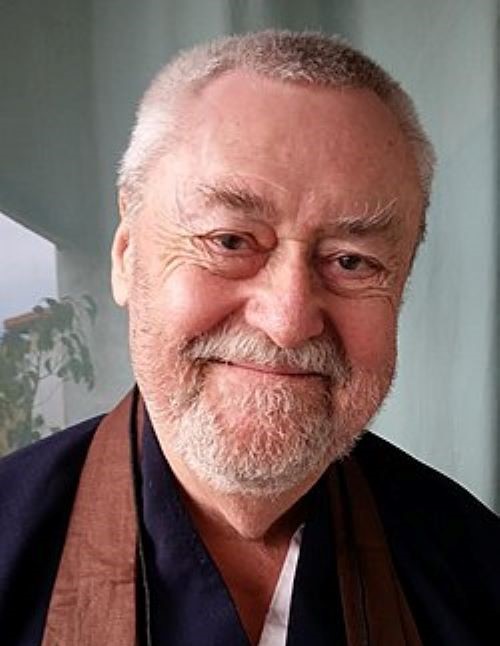
Conversations with James Ford –
James Ford was among the first twelve interviews I did in 2013 when I began this tour of teachers and centers. Our most recent conversation, ten years later, was the 231st I’ve conducted. James has transmission in both the Soto tradition – through Jiyu Kennett Roshi – and the Harada-Yasutani lineage through John Tarrant. In addition, he is a retired Unitarian minister. All of which places him in an especially good position to reflect on the matters of transmission and authorization.
Formal authorization is a matter of importance in the Zen tradition. Teachers are not self-proclaimed – or shouldn’t be self-proclaimed – but are identified and certified by predecessors who themselves have received recognition in lines of descent which are traced back in formal documents – kechimyakus – to the Buddha himself, although James estimates that the historicity of the lineages probably don’t go back further than the 7th or 8th centuries CE.
The concept of transmission implies not only an unbroken orthodox teaching lineage proceeding from the Buddha to the present, but – at least in its original iteration – a unbroken succession of insight. An 11th Century Chinese story recorded as the 6th Case in the Mumonkan gives the legendary background:
When the World Honored One was at Spirit Mountain with the assembly, he twirled a flower in front of them. Everyone was silent. Only Mahakasyapa broke into a little smile.
The World Honored One said, “I have the treasury of the true Dharma eye, the wonderful mind of Nirvana, the true form of no form and the subtle gate of the teaching. I now entrust this to Mahakasyapa.”
Mahakasyapa didn’t receive information or knowledge in this entrustment; rather, he was recognized as sharing the same insight into the nature of reality that the Buddha had. This can be called satori or enlightenment. More cautiously it is more likely to be called “awakening” today. The moment of realization – the moment of Mahakasyapa’s smile – can be called “kensho.”
While the primacy of an “awakening” is still maintained in koan traditions, it is no longer a requisite in Soto teaching. I didn’t realize that when I began this tour. I set out naïvely and erroneously assuming most Zen centers would be similar to the Montreal Center where I practiced. It was Mitra Bishop – the 14th interview I conducted – who explained to me that in order to ensure an adequate number of priests to serve the elaborate temple system it had established, the Soto sect “officially dispensed with the need for kensho in order to be able to teach early in the 20th century.” So James’s authorizations appear to be to differing ends.
They took place decades apart and were, he tells me, very different experiences.

He had been a teenage high school drop-out when he met Kennett. During our first conversation, he described a workshop at the San Francisco Zen Center he attended. “Went in. Got a little talk. Then got formal instruction in how to do zazen. and then off to a formal interview, and my first formal interview was with Dainin Katagiri. ‘Sensei’ in those days. And, if I recall the conversation correctly, he says, ‘How long have you been sitting?’ And I said, ‘Five minutes?’ He said, ‘Good. Keep that mind.’” James chuckles at the memory. “And, yeah, that’s good advice.”
He didn’t stay at SFZC, however. “I wanted to ordain. They had expectations. I thought that was stupid.”
Then, as he puts it, “Jiyu Kennett blew into town.” Kennett was a British-born, Japanese-trained Soto priest who came to California in 1969 on a lecture tour. “I was her first student. Now another fellow claims he was her first student, but he arrived there on a Thursday, and I was there on a Wednesday.
“I was very young, and I really had no idea what was going on. I mean, I thought I had ideas, but they weren’t very congruent with any measure of reality. But I believed in a mystical transmission. I believed in enlightenment. I had some experiences that were proved to be authentic, but – as I think I have said consistently – if people came and reported my encounters to me as theirs, I would have been encouraging, but I would not have confirmed them in any manner.”
Unlike many in the Soto tradition, Kennett valued kensho. “A little floaty about what that precisely meant. But her official teacher was Chisan Koho, and he was one of the Soto people who had done extensive koan training. Though as I cast my memory back on those days, I don’t think she had a real grasp of koan work. But she was definitely interested in experiences. And I had experiences. But it was very cultish, and eventually the dime dropped even for me, and I left.”
Before he left, however, he received transmission from her, authorization to teach. He didn’t pursue it however and, in fact, fell away from Buddhist practice for a while. “I was casting about. I thought I was done with Zen. I liked the sitting. I continued sitting for a while, though it gradually fell away. And I looked around. So I went to the local Episcopal Church, I danced with New Age Sufis. Then I found the Unitarian Church. It was a great home. It had all the community stuff. It was light on the spiritual practice, but it had good community and a way to act in the world, a social-conscience thing that resonated deeply with my view of the world. And very soon after that, I resumed sitting.”
He doubted he would persist if he practiced on his own, so he started a sitting group. After all, he was authorized to do so. One of the members had some koan training, which intrigued James. “I badgered him even though he said he wasn’t authorized to teach. We worked with koans for a little bit. We did that for maybe a year, until he decided he didn’t want to do it anymore. It was beyond what he felt he might be useful for.”
By this time, James had returned to school and was working in a bookstore. In spite of his credentials, he still felt the need to identify a teacher for himself. “I checked out the local Soto guy on the hill, and there was no juice. And so I wrote this long letter to Robert Aitken. And the day I mailed it, this guy walks into the bookstore with a woman, and he says, ‘Do you have anything unusual in Orientalia?’ And I said, ‘Ha! We have a Lafcadio Herne ghost story with hand-colored plates.’ He said, ‘Let me see it.’ We went over, unlocked the thing. He said, ‘How much is it?’ I said, ‘It’s a hundred bucks.’ And this is thirty-five years ago. And he says, ‘I’ll take it.’ I said, ‘Oh! For yourself?’ ‘No,’ he said. ‘For a gift.’ ‘Who’s the gift for?’ As you can tell, I’m a pushy personality. ‘For my teacher.’ ‘Teacher of what?’ He said, ‘Zen.’” The book buyer was John Tarrant, who was the subject of the second interview I conducted in this series. “And he’s a student of Robert Aitken and he’s just come over to finish his doctorate. He had been doing this mixed extended and residential program. And – you know – we had a couple of meetings, and he’s a year younger than me. You could just smell the whiff of scandal in his aura.”
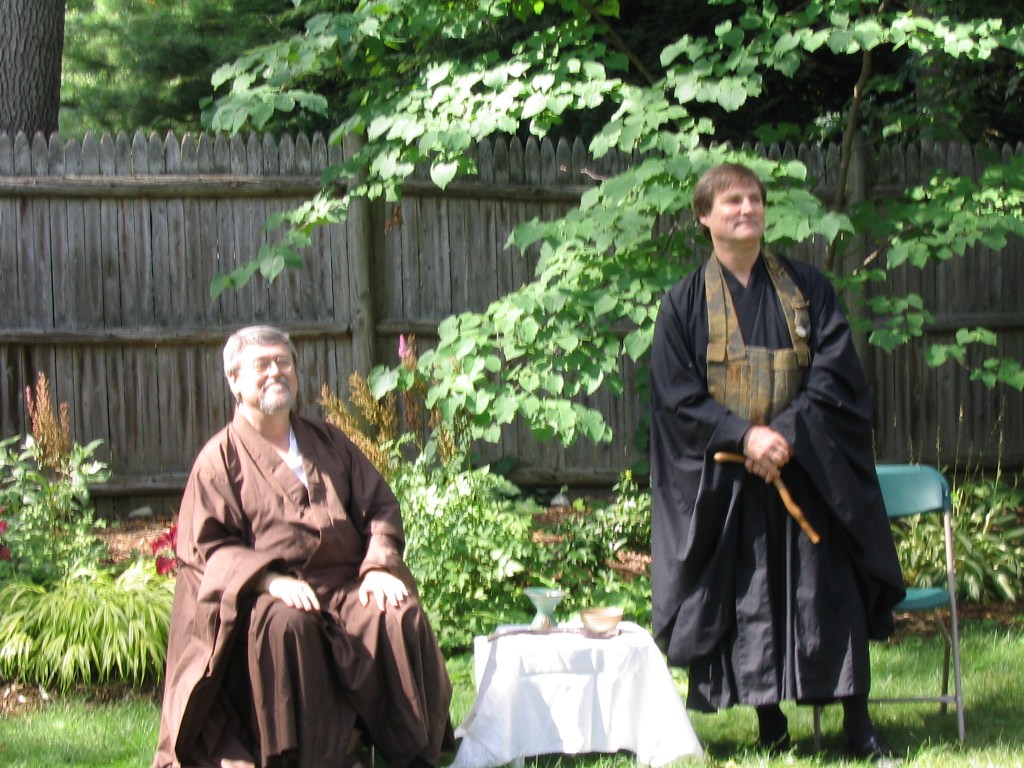
James eventually received transmission from Tarrant as well, although only after twenty years of training.
“It was a whole different set of circumstances. With Jiyu Kennett, I had the rudiments of monastic formation in the Soto style. It was, at best, only three years with her. With John, when I began I was already young-middle-aged at that point, and, with him, it lasted over twenty years. And with him, I was interested in a specific technology, koan introspection. It took me a little while to find out what that actually meant, and I thought it really worked for me. I was enormously grateful, and he gave me a lot more time than other people got. And it was blended with other things. I had to make a living. I was studying other things. About a quarter of the way in, I got an undergraduate degree. I went on to go to seminary and had all of that stuff going on at the same time. I would say that although I have had multiple mentors and teachers, John gave me the spiritual practice that continues to be the most important thing in my life. But I always consider myself responsible for my own practice even with him. And the process of acknowledgement of that was rather different and, to my mind, more real than with Kennett Roshi. I’ve come to believe transmission itself is myth and history. It is something. It’s several things. On the path of awakening, it is an acknowledgment someone has seen into the deep matter. That is, we, as ordinary caught-up-in-the-play-of-cause-and-effect humans, in this body, in this place, also see our at-one-ment, our wild boundless nature. At the same time. I believe John recognized I understood this down to my bones. And he authorized me from that place. Transmission, of course, in pure Soto at this point is simply a bureaucratic rank and has nothing necessarily to do with awakening. There is something real in monastic formation, but any actual insight and realization pops up because I think the forms incline people to realization. Realization just comes or it doesn’t come. What the Soto monastic system does do is it makes competent priests. Of course even for John, what I believe he could authorize was his sense that I had some critical insights, that I had seen into who I am, and that I had some facility with our tools, koans, et cetera.”
James continued his training as a Unitarian Minister while working with Tarrant. His first posting was to Milwaukee, “And when we moved to Milwaukee, John said it was okay to start a group. To give talks. Somewhere along the line, then, he authorized me to teach. It’s a system; kind of spins out of Robert Aitken. First there’s this kind of short-tether teaching permission where I could do koan work and such but I couldn’t give transmission. In 1990 or 1991 he presented me with a kotsu as a symbol of a Zen teacher and said to use the title ‘sensei.’ And in 2005, he gave me Inka Shomei, full authorization as a koan teacher within our lineage.”
When I first met James in 2013, he had already identified a number of successors who, through him, inherited transmission in both the Soto and Harada-Yasutani lineages. Ten years later, he had thirteen heirs, although one had given back his robes and resigned from teaching.
“Because of this blending of transmission lines,” he explains, “and reflecting the trend in North America and the West to give a two-tier transmission, I’ve come to offer three steps in Dharma transmission: denkai, denbo, and inka. ‘Denkai’ means I think there’s something there. And, sure, try on spiritual direction, but we’re continuing, and you don’t have the authorization to identify someone else as a teacher.”
I interrupt him. “Is it just a matter of them having the potential to do spiritual direction or that they’ve attained some degree of insight?”
“It says that I believe they’ve had some insights. They’ve had kensho experiences. They’re moving in the direction that means I think they’re probably spiritual directors in the making.”
“And denbo?”
“‘Denbo,’ the way I do it, is, ‘You’re a teacher. You’re independent of me.’ I don’t make any harder claims on this, but I recommend you meet with people to deepen your practice. ‘Inka’ is they’ve been doing it for some years – and, for me, that ‘some years’ keeps getting longer – and in my best estimation, you’re a teacher. Good luck.”
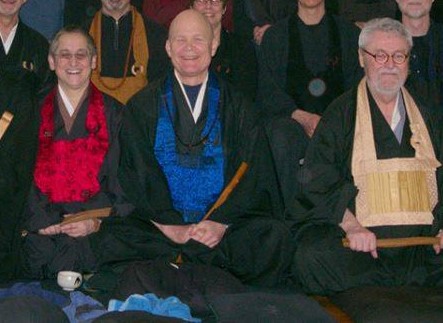
When I ask about numbers, he tells me, “I’ve given denkai to five people, denbo to four, and inka to four people. Most but not all of my Dharma successors have also chosen to ordain as Zen priests within the Japanese Soto transmission I received from Jiyu Kennett.”
“Would you,” I ask, “give these ranks to someone you knew, right off the bat, was never going to be a teacher?”
“Um . . .” he muses. “There might be a reason to do that.”
“But you haven’t done that.”
“Everybody I’ve given denkai to, I’ve given denkai because I believe they’re in the chute, and their karma is to teach.”
“Okay. So authorization to teach. What does a Zen teacher teach?”
“I think the primary function of the Zen path and, therefore, the task of the Zen teacher is the project of awakening. And awakening, I believe, is a relatively narrowly defined thing. It is our direct, visceral insight into our wild openness, its manifestation within a wild interdependence, and its expression in each little temporary thing that arises including you and me.”
“Which doesn’t answer the question because you can’t teach awakening.”
“Well, you can’t. No. So the better teachers understand that. I do notice that people say they can or such. Zen teachers can teach specific disciplines that are associated with awakening. Zazen, shikan taza, koan introspection. I’m aware other people put a lot of emphasis on breath practices and similar concentration disciplines that, putatively, are going to put us in the way of our fundamental encounters.”
“There are, of course, various ways in which one can be a ‘teacher,’” I suggest. “One can teach a technique, so – as you said – teaching how to sit zazen or do some kind of breath practice. That’s teaching a technique, I guess like a guitar teacher teaching someone how to form a G chord. Or one can teach theory. Tibetans are big on that for example. Is it the role of the Zen teacher to teach theory, the philosophy – if you will – of Buddhism? Explain what a klesha is?”
“It is an interesting question. People who are authorized to teach often don’t seem to know a lot. And sometimes that’s okay because they have big hearts, and they have some taste of the intimate and maybe they can guide people with that and maybe no. But I do believe the Buddhadharma does require some – some – technical knowledge.”
He also tells me he prefers the term “spiritual director” to teacher, which perhaps more accurately conveys what someone with transmission is engaged in.
“I think the word ‘teacher’ pops up in our language because it’s a straight translation of ‘sensei.’ Or an acceptable translation of ‘sensei.’”
“And what qualifications do someone who is authorized as a spiritual director in Zen require?”
“I think the real problem in the institution of Zen at this point is that the purpose of the practice is that’s it’s associated with our awakening. And our awakening is itself incomplete. I’ve come to have this little slogan: ‘There’s waking up, and there’s growing up.’ And these two things need each other, but they’re not the same project. And a boatload of Zen in the west is unconcerned with the whole part of growing up. And I think we’ve seen that.”
“A large portion of the Zen community fails to take maturing as seriously as they should. Is that what you just said?”
“That is my view.”
“And the term ‘transmission’? What does it mean? What is being “transmitted”?
“So that’s kind of a delightful question. In China, transmission was this thing. It had nothing to do with ordination. It was conferred upon monks, nuns, and householders. Monks and nuns tended to own the franchise, but there are dramatic historical examples that this ‘thing’ happens. The rhetoric is grand. It speaks to the mind-to-mind transmission, the sense that there is something to apprehend, and people do it. So it becomes somebody claiming that somebody else has achieved that level of insight – that kind of insight – and it implies the ability to share that, to guide others in that direction as well. As you know, in Japan, particularly in the Soto school, there’s conflation of ordination and transmission which becomes a very low level on the ordination path. I’ve come to believe that transmission is a signifier that somebody within a lineage has confidence that somebody else has some depth of insight and believes that individual can share that with others. Clearly that’s flawed and people get transmission for all sorts of different reasons. But that remains the hope as I see it.”
“Calling it ‘mind-to-mind’ implies a sense of continuity, does it not?” I ask. “Which is what lineage chants claim. The Buddha passed it on to Mahakasyapa who passed it onto Ananda who conferred it to someone else who passed it on to Robert Aitken, who passed it on to John Tarrant, who passed it on to James Ford.”
“It does. And it’s a wonderful symbol, and I believe it points to some true things. And anybody who pays attention to the history of it knows that it’s a blending of history and mythology. It used to be more important than it is at the moment, I think. In my first twenty years on the Zen way, transmission was important if for no other reason it sorted out frauds and poseurs and people who just wanted some kind of authority over other people. Now that there are so many people with transmission and the quality and the expectations of what you need to receive it that I think it has become so diffuse we’re back to square one. I think it’s a necessary but not sufficient condition for somebody who’s aspiring to find the aspirations of the Zen way for themselves. One thing that the curricular koan system offers is at least one quasi-objective standard.”
The koan myth is that there is a continuous line of transmission going back to Buddhism’s roots in India 2500 years ago. The reality is that “transmission,” as currently understood, has a much shorter history.
“I’m not sure there was a transmission as we understand the word in India 2500 years ago,” James muses. “I think transmission, as we understand it, is a Chinese phenomenon.”
“So after Buddhism’s contact with Daoism.”
“Yeah. I know currently the tendency is to minimize the Daoist influence – Zen is definitely a Buddhist school – but there are Chinese influences there, and the influences are Daoist and Confucian. I think lineage is a Confucianist thing.”
“Is what is being transmitted now in North America the same as what was being transmitted in 19th century Japan?” I ask.
“I’m pretty sure that what Daiun Harada[1] transmitted, I received.”
“Cultural differences not withstanding? Or the fact that Daiun Harada was a Japanese imperialist?”
“Which opens that whole other question . . . Awakening is a very narrow thing, and it is not sufficient. That’s something that I was oblivious to as I threw myself into the project in the late 1960s, early ’70s. And I don’t know when the dime dropped, but today I would hope somebody would have a more holistic view. I’m interested more and more in what householder practice looks like. We live in a bourgeois democracy . . . well, an oligarchic democracy, but it’s more than pretentions currently, and I think citizens have an obligation to be involved. Earlier iterations of Zen occurred in very authoritarian cultures, and citizen participation was not welcome nor in fact invited. And you adapt to the culture that you’re in, but I believe that the insights that I have been gifted with and my obligations to family, community, and larger networks of humanity and the world have consequence. They’re not the same thing, but they intertwine.”
“And, of course,” I point out, “there have been numerous examples of people who had full inka transmission and yet still had troubled lives. So to what extent is the bequeathing of transmission not only a recognition of the experiential attainment of some level of insight as well as a recognition of one’s ability to elicit that insight in others, but also, perhaps, a call to be a kind of – I’m not sure of the term – role model? Something like the Protestant ministers you told me had been so influential on you during your childhood.”
“Well, you know, I think it’s a work-in-progress. As I said, I believe there are two separate but intertwining things I call the ‘process of waking up’ and the ‘process of growing up.’ And I kind of think they’re separated naturally because ‘waking up’ has been dominated by monastics who, in my experience, frequently have arrested growing up issues. So it’s all about this fundamental encounter with emptiness and our absolute identity with it, and what that looks like. Nothing about how to relate to other people. And it’s only in modernity and it’s only in the West that we’ve come to realize that, ‘Well, there’s this bigger world’ and it includes how to relate to each other in the ordinary course of things.”
“You’re saying these issues are a Western rather than an Asian concern?”
“At the moment it is mainly a Western thing. It has some Asian beginnings. There were two or three individuals in the early 20th century – late 19th century or beginning of the 20th century – two or three teachers in the Soto and Rinzai lines in the Japanese tradition who despaired of the monastic communities as simply funnels into temples and not about awakening. And once they turned towards working with householders, then instantly you have to deal with the fact that there is more to this than just the project of insight. There’s marriage; there’s work; there’s all this other stuff. So there’s a nascent beginning in Japan, but – you know – it’s here in North America and Europe where this has become the dominant form of Zen practice.”
Throughout my conversations with James it becomes increasingly clear that transmission is always transmission in a particular line of descent. And there is not necessarily recognition across lineages. As James told me on a different occasion, “There’s nobody who’s a teacher in the American Zen Teachers Association who would be qualified to be a teacher in every other group.”
Daiun Harada and Hakuun Yasutani were examples of people in the Soto school who despaired of monasteries and turned to householders. And one line of descent from them – which James calls the Mothership but in which he is not authorized – became the Sanbo Zen School. The analogy, it strikes me, is less with an academic degree – which, wherever it is obtained, authorizes one to teach in other academic institutions – than it is with Christian sectarian ordination wherein having authorization as a Lutheran pastor – or a Unitarian minister – still does not authorize one to administer Catholic sacraments

Rinsen Weik Inka, 2019
Rinsen Weik in Toledo is one of James’s heirs. “My view on this,” he tells me, “is that I have an experience, and my teacher had the confidence in me – all the way up to inka – saying your experience is worth sharing and trustable. And so I see my job not to say what’s true and what’s right but to share publicly my practice and how I view things. And there are other ways to practice, and I bow to them. Like lay teachers. I’m absolutely convinced that it can be, and I would have no idea of how to do that because I’ve been teaching as a priest. So I hold veneration for all paths that are worthy. I’m sure my approach has shadow sides and trouble spots like they all do, but if I am going to be authentic and honest and actually teach what I have, then my experience is the only guide I have.”
I ask him, in that case, what is it that distinguishes Zen from other Buddhist traditions? His answer is much what I would expect from one of James’s heirs: “The disciplines and rigors of sesshin, and the reality of kensho and awakening and satori as encountered and matured through the koan system. I mean, that is a completely unique thing. That’s not happening – you know – in the Tibetan and the Vipassana and stuff.”
“You also just blew off most of the Soto school,” I suggest.
“Kinda,” he laughs. “But not really, no. The forms we use are Soto. I like Dogen, and I hold the Soto line in the lineage of Jiyu Kennett Roshi. But, again, for me, I gotta teach according to my experience. For my entire training experience, I practiced with teachers who hold the Harada-Yasutani koan system either from Maezumi Roshi’s successors or my transmitting teacher, James Ford Roshi, and some of his successors. So I think that if someone has Soto monastic training, thirty years living in the same space, breathing the same air, eating the same food as the roshi – yeah – I think that shikan taza coupled with a rigorous monastic life can produce a beautiful result, and I’ll never know what that is because that’s not been my trajectory. What I know is a full contact worldly life with a marriage, a child, a career and other interests and a mortgage mixed with kensho and sesshin and koans to refine and work with my life within a Bodhisattva’s Vow base. So that’s how I teach. That’s what I see, and that’s what I know.”
There are, in other words, real differences between lineages. And transmission may not mean the same thing to them. And, yes, they may not all be heading in precisely the same direction, but they are all ways of manifesting a common heritage, and – as James puts it – “People have got to accept each other’s lineage. We’ve got to stop pretending there’s only one true way. We’ve just got to bow to each other a little bit more.”

[1] 1871-1961
 Richard Bryan McDaniel
Did Mitra Bishop really tell you that sometime in the early 20th century the Soto school just decided to lower their standards for the priesthood in order to solve a staffing problem? I seriously doubt that anyone in the Soto tradition would say this. What we do know is that early in the 20th century (and late in the 19th) the koan system in Japan had become corrupted through the widespread practice of sharing answers (essentially “cheating on the exam”). This created serious doubts in many people’s minds about the practice of handing out certificates to people simply for getting the right answer to koans. This in turn was more of a reflection of the poor quality of teachers, rather than of the students, since “real” zen masters will know if someone is “cheating”. As a matter of fact, Mitra Biship does not say what you say she said in the interview that you link to. Is there some other source for this? Did you perhaps misunderstand? Might there have been a joke that you did not get?
LikeLike