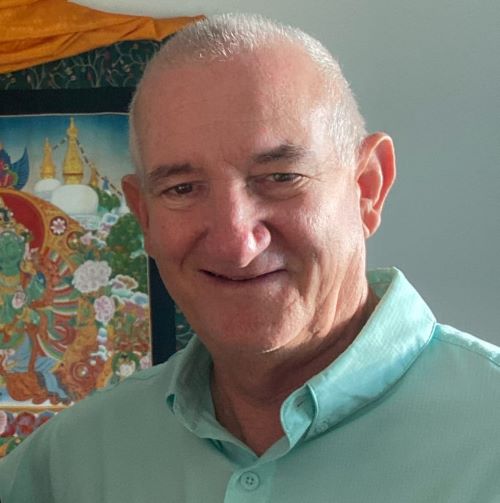
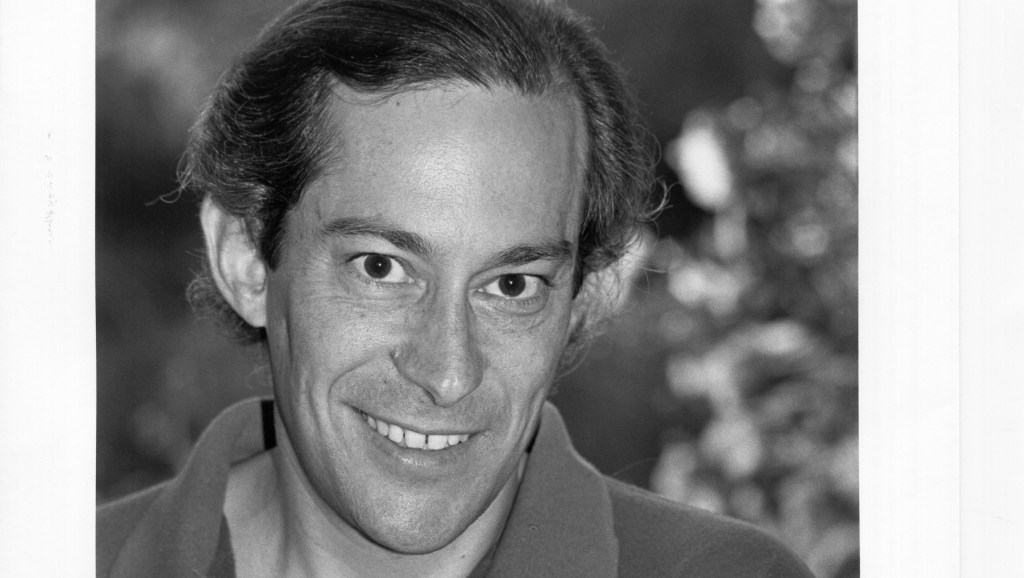
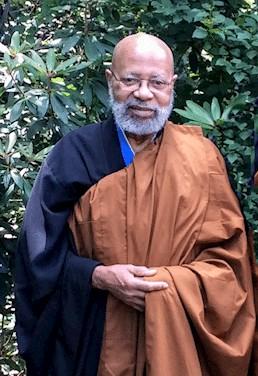
Sallie Jiko Tisdale

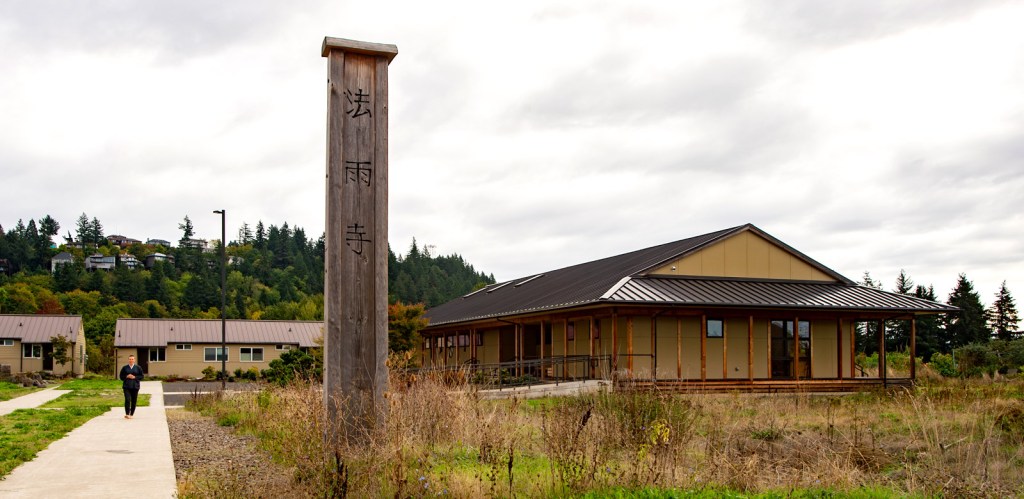
Dharma Rain, Portland, Oregon –

When I was in high school, I became involved with the Mormons for a bit. It had nothing to do with religion and everything to do with a girl, but I acquired a basic knowledge of their belief system. It’s hard to believe someone attracted to it would also be attracted to Buddhism, but, I guess, it happens.

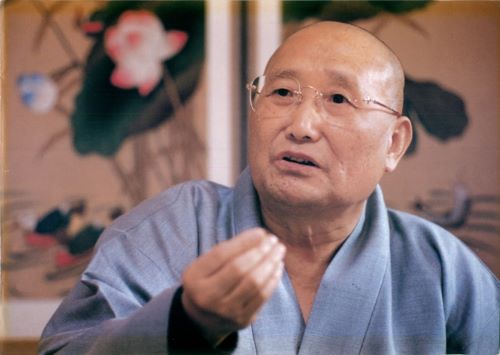
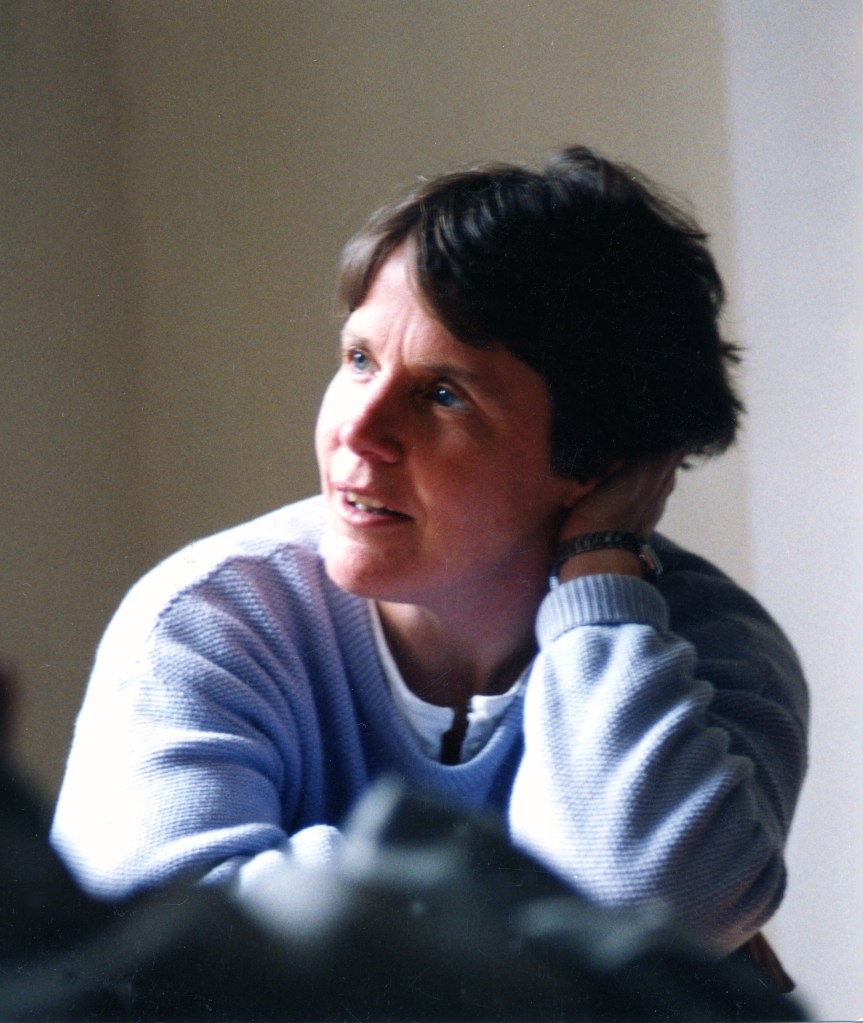
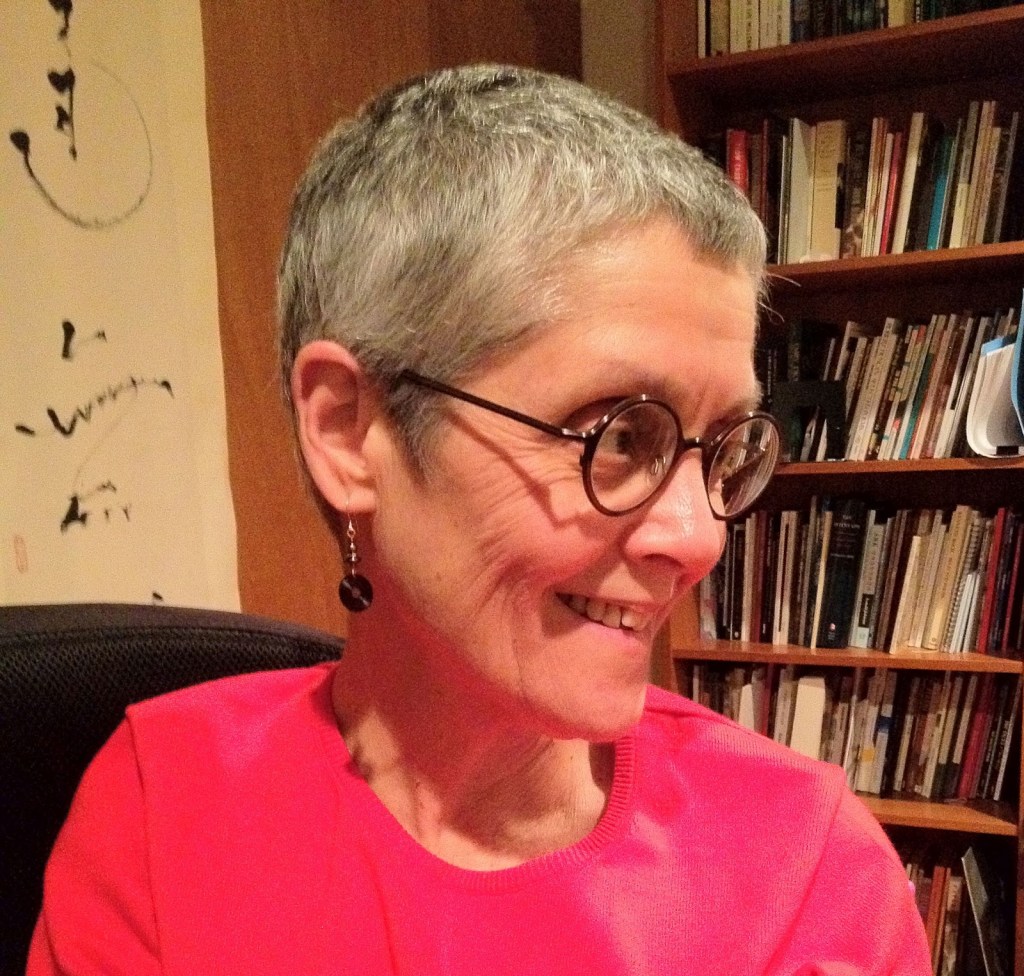
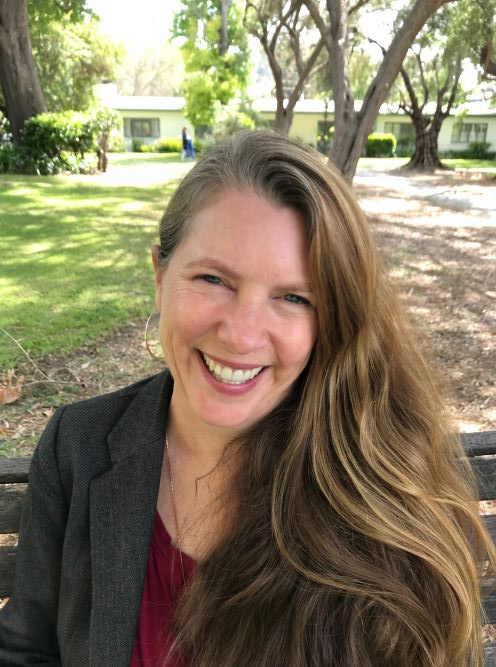
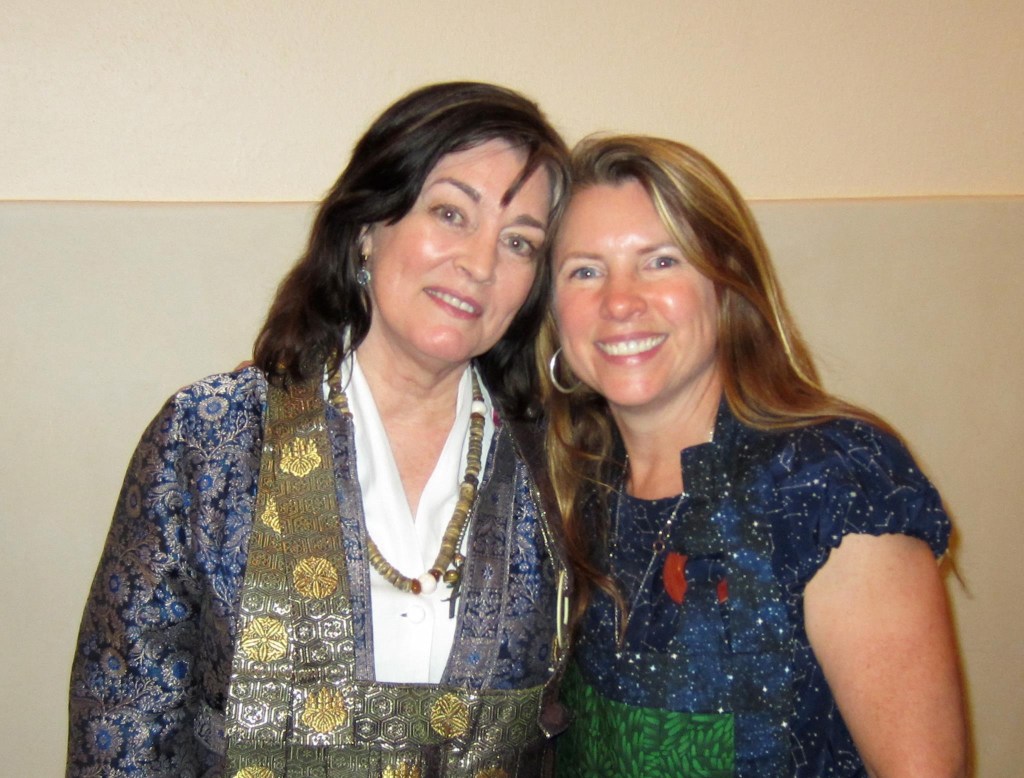
Jiko Tisdale is the godo at Dharma Rain in Portland, Oregon. The godo, Jiko, explains, “is essentially the head of teaching. Traditionally you divide it into the teaching side and the operations or administrative side. The abbot – Kakumyo Lowe-Charde – oversees all of it,, and I oversee the teaching. We also have a kanin who oversees the operations side. So I facilitate our Dharma council which is a group of about eight seniors whose job is to make sure that we don’t deviate too much from the teaching that we offer, and that we keep our mission clear and don’t get too diluted. So we look at work practice, Dharma talks, classes, as well as what’s the temperature and tone of the sangha’s character right now. Are workshops going okay? It’s all kinds of little stuff like that. I give Dharma talks; I lead classes; I teach seminary classes, and I have formal students of my own. We have six or seven active teachers right now, and I keep an eye on what everybody’s doing to make sure that we’re not duplicating, we’re not missing things.”

Godo and kanin are traditional terms for positions within the Soto monastic system. They are usually reserved for people who are ordained. Jiko, however, is not. “I have lay Dharma transmission which enables me to give the Precepts, take formal students, and transmit other lay teachers. And it allows me to continue a lineage within my own traditional Soto Zen lineage.”

I ask how she first became involved with Zen.

“I was very young,” she tells me with a laugh. “I was in my very early 20s. I was in nursing school and really stressed and depressed, and I knew something was missing. And I didn’t know how to figure out what was missing, but some deep, wise voice told me that I needed religion. I had been raised kind of a milquetoast Lutheran by parents who had left their churches to compromise on the Lutheran Church, but it was very much an Easter and Christmas kind of thing. No passion. And when I was twelve, I converted to the Mormon Church, which was quite a shock to my parents. And then by the time I was in college, I became active politically in radical and progressive causes. So I kind of went from the Mormon Church to the Church of Politics, but it was always about a passionate belief in something greater than myself. And I was seeking a community, a community of fellow travelers. And by the time I was in my last year of nursing school, there was still something missing, and I decided that I wanted a religion. I didn’t know what it would be; I was open to any possibilities. So I opened the yellow pages, and I started with the A’s, which was the Adventists. And then when we got to the B’s, there was Buddhism. So I knocked on the door of this unprepossessing little rental house here in Portland, in a neighborhood I’d never been in before. And there was a Swiss guy with curly hair who said he was the priest, and he gave me a cup of tea. I had no idea what he was talking about, but now I say that it was like I’d heard the language when I was a baby. It felt like I knew this language even though I didn’t speak it. It felt like going home just immediately, and I had no idea why. But I kept coming back. And I started sitting zazen because they told me to do that.”

The unprepossessing rental house was the Oregon Zen Priory, a satellite of Jiyu Kennett’s Shasta Abbey. After the Swiss monk returned to Europe, Kyogen and Gyokuko Carlson  were appointed the guiding teachers, and Kyogen became Jiko’s formal teacher.

“I plunged in with both feet and became just a passionate practitioner from the beginning with no idea what I was doing. Going down to the abbey for a ten-day winter Jukai with no idea of what a retreat meant, what a sesshin included. And I just kept plugging away. And then after a couple of years, the Carlsons separated from the Abbey and became independent, and we started our own temple, and eventually I knew what we were talking about. And I’ve been here ever since. I’ve been to other places, dropping in as a friend or just seeing what was up, but I never felt any need to explore any further. Soto Zen was the right fit for me from the beginning.”

“You said you were ‘stressed and depressed.’ What were you depressed about?”

“You know, I would say now that I was at a transformational point in my life where I had to make some decisions about who I was going to be. But at the time I didn’t understand that. I was agoraphobic, but I was in my senior year of nursing school and had to get up early in the morning to do hospital clinicals, and I had a kid. And so there was this collision. My need to slow down and be quiet and listen to my interior life bashed against a time in my life when I had to be very outward and very ‘on.’ By the time I graduated nursing school I had pneumonia, and I was just kind of a wreck. But I grabbed hold of Soto Zen, and – you know – Soto Zen is so interesting because it doesn’t give you anything to grab onto. There are no mantras. There are no mandalas to look at. There are no exercises to do. All I was given was, ‘Go stare at the wall for half an hour.’ If I had encountered Rinzai Zen first, I might have become a very competitive koan student. If I’d encountered Vajrayana, I’m sure I would have been seduced by the music and the color and all that other stuff. But I got lucky in finding Soto Zen because there’s nothing, no crutches, nothing to grab onto at all. I don’t know why I stayed. I mean, I was bored; I was confused. But I kept going back. For some reason it was what I needed.

“And I loved the monastery. I was immediately entranced by the very plain, pure form of Soto Zen. I was drawn to the plainness of it, I think, because I have a very complex brain going on up there all the time so there was something about the ascetic nature of it. It was a good balance. A lot of people I know in Soto Zen are Type A personalities, lawyers, psychotherapists, physicians, people who are pretty powerful and intense in lay life but are somehow drawn to this place where there’s nothing to be competitive about, where there’s nothing to grab onto and make concrete. You’re just stuck with yourself, and we somehow seem to recognize that we need that balance.”

“What is the function of Zen? What’s it for?”

“What is it for? It doesn’t have a function. It isn’t for anything. I’m in it; it’s not in me. We have this saying: ‘Zazen doesn’t care.’ And I’ve always really liked that because the idea is that it’s just there. It’s available for me if I partake in it. But zazen doesn’t care if I sit or not; zazen doesn’t care if I like it or not, or if I’m bored or tired or whatever. Zazen doesn’t care. Zazen is a space that exists, and it’s a place where there’s enough room for me to have whatever I have.” She pauses a moment, then says, “I’m very suspicious of too many words here.”

“You said that the godo is the head of teaching. What does a Zen teacher teach?”

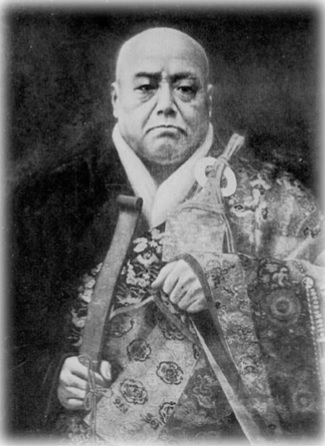
“Nothing much,” she says chuckling. I’m used to getting that kind of answer to the question, but then Jiko actually goes on to list specific things involved in teaching. “That’s the pat answer. But I do teach Dharma. I’ve studied for decades to understand the basics of Dogen’s Zen, and Dogen is something I’m very passionate about. I’m facilitating a sutra study group in the spring where every week we’ll study a different sutra in overview. There’s plenty of history. The next Dharma talk that I’m going to give is about Keido Chisan Koho Zenji, who was Jiyu Kennett’s teacher and is considered one of the founders of our temple. I studied the Japanese language for a few years. I can’t speak Japanese, but I’m not entirely at sea. I’ve travelled to Japan. So there is a whole academic or intellectual side to what we teach. That’s about half of what our seminary program is, which is advanced studies for senior students.

“But the other half is practice and personal integration, and that you can’t teach. All you can do is make a space for it. Invite and welcome people and offer them a little bit of guidance. I think it was Jack Kornfield had this image I really like of it’s like you’re standing on the ground and you’re watching somebody climb a cliff. And you can see where the handholds are, and you’re saying, ‘Go right! Go right!’” She laughs gently throughout this description. “And they’re going left, and you just keep yelling, ‘Go right!’ There’s a certain bit of that involved. But I think one of the most important functions you have – especially with the students you work with intimately – is you get to know them over time and you function as a mirror. Because it’s often easier for another person to see your patterns than for you to see them from inside. So the teacher-student intimacy allows a teacher to see patterns and call them out. To say, ‘We’ve been here before’ or ‘I’ve seen you have this reaction before, this response pattern.’ And working really hard to make it safe to be yourself, to be authentic and whole. It’s not about suppressing parts of ourselves that we don’t like or ignoring things or trying to be a different person. It’s really about integrating oneself into a whole. You need a big space for that to happen, and you need time for that to happen.”
“So studying Dogen,” I say, “studying sutras, looking at patterns in one’s life. It brings me back to the question I asked earlier. To what end? What’s the purpose – the function of all this activity? What’s it gonna do for me?”

“Well, I’ll tell you one thing it’s done for me. I started out depressed and thinking about driving off a bridge, and I felt anxious all the time, there was just this sort of free-floating dread. I haven’t been afraid in a long time, and I haven’t been depressed in a long time.

I ask how, then, it differs from psychotherapy.

“Oh, it’s quite different. I said this in a talk recently: Zen has plenty of room for psychology. Psychotherapy is great. Counselling is great. I think almost everybody can benefit from therapy. But therapy isn’t big enough to contain Zen. We have to not get confused. Psychology is part of the self, and Zen has room for every part of the self. But Zen is bigger than that. Zen is an inter-being with all things. And it is a kind of freedom and liberation from the patterns of the self which we may heal and strengthen through therapy. But there’s a space that’s much bigger than that. And I’m not going to say a whole lot about this, Rick. But we touch that space sometimes. You can’t chase it, and you can’t make it happen, but once you touch that space, people are conditioned forever by that moment of freedom. And I knew the moment I touched it my life was never going to be the same. And that sense of freedom, that sense of fearlessness has never left.

I ask if she’s willing to talk about that moment, and she shakes her head. “No. I don’t know if it was Shunryu Suzuki, maybe it was Maezumi, but one of them said, ‘Once or twice in a lifetime there is the big liberation, but there are a million moments that make you dance.’ And I think those million moments are as important as one or two iris-openings. You know? A million moments that make you dance! What else could we want? Marvelous! And I do feel that even in a down time or a hard time or irritation or frustration or sadness . . . I mean, the world is burning; of course I’m sad. But I can close my eyes and feel a root that goes all the way down into the ground of being, and it stabilizes me. And I think one of the most important things we get from this practice is stability of self. An equanimity, an undisturbedness beneath superficial disturbances. The ocean has lots of waves. Our everyday awareness and consciousness can be very roiled. But the deep ocean is very still. And if you can put an anchor down into that ocean, you’re going be very stable.”

In addition to being a Zen teacher, Jiko is also a nurse and a writer, but everything in which she’s engaged is connected, inevitably, to her Zen practice.

“Nothing is not connected. It’s like a gestalt. Zen is a way of being in the world; it is a way of seeing the world and being in the world. It’s a way of interpreting things. I notice right now with what’s happening globally and politically that I’m conscious of having an equilibrium that many people do not have. That doesn’t mean I don’t feel enraged at times. It doesn’t mean I don’t feel a little anxiety about what my grandchildren will have to cope with. It doesn’t mean I don’t have emotional reactions. But I don’t feel knocked off my feet. I don’t feel unstable. And I do feel grateful. I’m very aware of the kind of privileges I have and the safety I have as a white, educated American citizen in a fairly peaceful part of the world. I’m aware of the tremendous good luck and privilege of that. So Zen is never not talking to me, reminding me – as my teacher would say – to look up.”

“What is zazen?”

“It is a matter of simply being as present and aware of what’s happening in this moment as possible. So it’s what’s happening in your body and what’s happening in your mind and what’s happening in the room, and not chasing any of it or judging any of it or grasping on to any of it or pushing any of it away. It’s a matter of cultivating this deep presence and attention without valuing parts of it. We do a lot of pushing away and grabbing onto, and they’re both clinging. They’re both attachment. This is fundamental Buddhism, the Four Noble Truths. So zazen is a way of cultivating a space in which everything can arise and fall, including myself, without entanglement.”

As the time we have available begins to draw to an end, we talk about changes which have taken place at Dharma Rain since she first found the Oregon Priory in the yellow pages of the phonebook.

“When I first came there was one teacher, and three people would come to sit, and we would listen to a recording of a Dharma talk by somebody else. Last Sunday there were sixty-five people in the zendo. We have a flourishing children’s program. We have a pre-school – a Montessori pre-school – on campus and a pretty strong family practice. So it’s a thriving community, and post-pandemic – to our surprise – we’re seeing a lot of younger people. People just like me in their early 20’s, lots of questions, really wondering what to do and seeking a way forward. So I feel a lot of gratitude for the yellow pages.”

After having a chance to see this profile online, Jiko sent me an email in which she wrote:

“So what is really missing for me is enlightenment. For you, too, I think! I really avoided that! When you ask, what is the function of Zen? My answer is about zazen, which is avoiding the question. Like any good Zen teacher would! Let me just say this: There are not enough words, no adequate words, to explain awakening. We don’t wake up to language, we wake up to reality. It happens in an indefinable moment, the iris opens, we can see the whole of it. Then the iris closes, and we are forever changed. Zazen is an opportunity to visit a space without judgment or separation. A space where dualism can disappear. Most of the time, we are just cultivating the ability to be present and aware. Plowing the ground and planting the seeds. Good Zen requires this effort, as well as character development – moral development – and then we open our hands and let go. Awakening is our birthright and sooner or later, each of us will find the way. I deeply believe in this promise.”

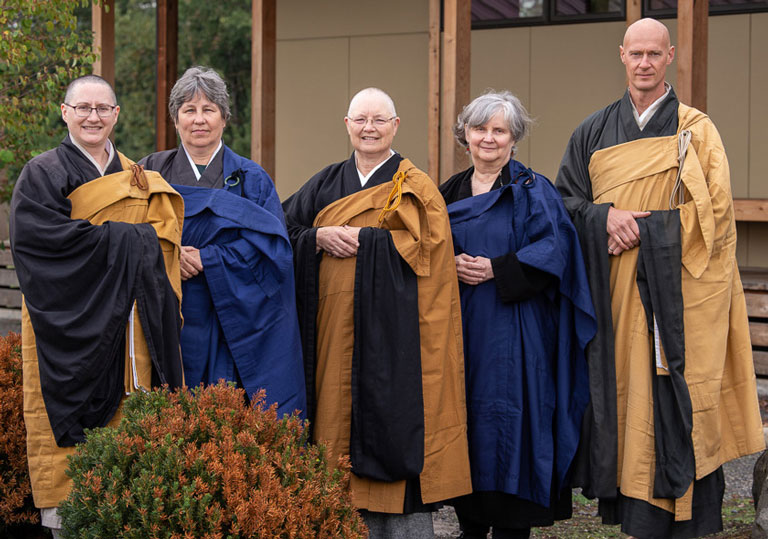
Dharma Rain teachers Jyoshin Clay, Jiko Tisdale, Genko Rainwater, Kengan Treiman, and Kakumyo Lowe-Charde

Sr. Madeleine Tacy

Day Star Zendo – Wrentham, Massachusetts

I met Sister Madeleine Tacy in 2016 when I visited the Day Star Zendo in Wrentham, Massachusetts. That visit is described in the final chapter of my book, Catholicism and Zen. Seven years later, she is now the guiding teacher of Day Star. The group had been started by Father Kevin Hunt, a Trappist monk as well as a transmitted Zen Master, now retired. He was succeeded by Cindy Taberner who withdrew from teaching for health reasons.

“I know this is still new for you,” I say, “but what do you think the community is looking for from you?”

She considers the question a moment.

“Well, I think they want things to continue. And nobody seemed to say they were leaving because, ‘I don’t want her as teacher.’ Some of them I’ve only met on Zoom, to be honest. The pandemic did that. And there’s a group that have known each other for longer than I’ve been around. Which is fine. So I think it’s a responsibility to carry on what was started with the group. And do the best I can do; that’s all I can do.”

“That doesn’t really tell me what they’re expecting from you. What is it they look for from a teacher?”

“Well, I hope it’s not the answers, because they have the answers. I don’t. I think maybe it’s somebody that’s going to point the way, but they have to find out for themselves. You know the old koan about don’t confuse the moon with the finger that points at it. I think the people that are there are serious about their practice. Maybe they’re looking for encouragement. Maybe also a little prodding to go beyond. Whatever that means.”

Cindy Taberner, Kevin Hunt, and Madeleine Tacy

Madeleine is a sister in the Dominican order, and she tells me she entered the convent after high school. Her mother was supportive from the start, but her father was less so. “He tried to bribe me. If I didn’t go, he would buy me a car. And at that time – that was ’57 – so that would have been a real status symbol, but – no – I went.”

1957 was still well before Vatican II, and the Catholic church was very traditional, especially in rural areas like the one where Madeleine grew up. She remembers her father, for example, kneeling by his bed at night with his prayer book before turning in. After the council, she became curious about other forms of spirituality and did a master’s degree in history “on the historical development of the hesychast tradition and Chan Buddhism in China which happened – time wise – about the same era.”

Hesychasm was a form of monastic life in the Orthodox Church which sought divine quietness (“hesychia” in Greek) through which one can attain experiential – as opposed to theoretical – knowledge of God. The hesychast “Jesus prayer” – in which the phrase “Lord Jesus Christ, have mercy on me” is repeated silently in sync with one’s breath – became popular in the early 1960s in part because of a 19th century volume called The Way of the Pilgrim which was described in a couple of New Yorker stories by J. D. Salinger and later brought together in a book entitled Franny and Zooey.

“How did you become interested in hesychasm?” I ask.

It began, she admits, through reading, although I suspect it wasn’t reading Salinger. And then there was the impact of the Second Vatican Council.

The council was convened in 1962 by Pope John XXIII, who declared that it should “Throw open the windows of the church and let the fresh air of the spirit blow through.” It was a broad renewal of every aspect of church life. John died before the council was completed, and his successor tried to moderate some of the enthusiasms that first arose, but it still brought about enormous changes and led to new experiments in spirituality.

“After Vatican II there were a lot of Houses of Prayer that sprang up all over,” Madeleine tells me, “and I went to one of them in Round Lake, New York, about half an hour north of Albany. It was a small community made up of various and sundry women religious. There was a core group. I think there were five of us who were part of the core group. And the person in charge was trying to make a synthesis of or a hybrid of Integral Yoga and Catholicism. She had studied in New York with I think it was Swami Satchidananda. And so we used that, and we also used the Jesus Prayer. And so I lived there for three years, and then decided it was time for me to leave. So I came back to our community in Dartmouth, Massachusetts, and have lived here since ’76 . And there was an opening for a campus ministry over at the local university – the university of Massachusetts at Dartmouth – and I was hired there, so I stayed there for 37 years.

“Of course, I went back to school – you had to go back to school – and got a master’s in counseling. And then I was part of a couple of counseling centers for a while. It was an inter-faith counseling center. I think I was the only Catholic on the staff. Anyway, there is a small college, Andover Newton, near Boston, and I went there and did a master’s in religious studies, and then I continued and did a D. Min. afterwards. It was a good experience. But it was not a place to learn to nurture your spiritual life. It was a lot of intellectual input.”

I ask why she left the community at Round Lake. She tells me she’d probably got what she needed from it and felt it was time to move on. Then, a little reluctantly, she admits she did have one reservation about the community.

“The person in charge, the woman who started it, she was also a Dominican sister, but she was from Cuba, and she had grown up in a well-off family. My brother and I at one time realized we had grown up poor. We didn’t know it at the time, but we were poor. So I understood the difference between living a life of poverty – basically Zen people would say ‘not attached to your stuff’ – and talking about it. I don’t know exactly how to explain it, but there’s a difference. I knew what it meant because I had lived it, and she knew what it meant intellectually. She really tried to live out of it but then would do things you couldn’t do if you were poor. So I didn’t go too well with that.”

The difference between theoretical and experiential knowledge or understanding is a recurring theme in our conversation.

“But the thing I learned up there was we used to have a morning sit and an evening one when we came back from work. We cleaned houses for a living. And I kept that meditation practice when I left there.”

In addition to sitting with the Jesus Prayer she took advantage of other opportunities as they arose, including a Zen sesshin which the Jesuit, William Johnston, held at Fairfield University. “That was my first long-term sitting.” And when on sabbatical in 1999, she spent two months at Daido Loori’s Zen Mountain Monastery. “It wasn’t any kind of culture shock because the lifestyle they had was what we lived in the novitiate. So that was a no-brainer.”

But essentially she practiced by herself – or with one other sister – for around twenty-five years. Then she did a Zen retreat with another Jesuit – Father Robert Kennedy – on Long Island. “And I spoke to him afterwards and said I was looking for a teacher, and he gave me Father Kevin’s name. And then I became a part of the Day Star Sangha, and now there was a group to sit with.”

I wonder if the formalities of Zen practice were ever problematic for her. She assures me they weren’t. “You know, people get all bent out of shape because somebody’s bowing to the Buddha, and yet their house is filled with their ancestral pictures. So, you know, go figure. Right? I had no desire – still don’t – to convert to Buddhism. It’s not what I’m looking for. Somewhere in your book” – Catholicism and Zen – “I think it was Yamada –who said there are two kinds of Zen. There’s the Zen Buddhist who is a strict Buddhist, and then there’s Zen. And I agree with that. It doesn’t have to be an either/or. I mean Catholicism has picked up all kinds of stuff in its history. This is a technique. And there are some things that are similar to Christianity, and there are some things that are not. Why try and reinvent the wheel if somebody’s already invented it? Outside of the Jesus Prayer, Catholicism does not have a structured tradition that goes from one century to another. They have a lot of traditions that have gone from one century to another like Benedictine spirituality and Carmelite spirituality, but they don’t have that continuity. They have the continuity of wanting to have a relationship with God – that’s there – but there are different ways that gets worked out. So that was one of the attractive things about Zen.”
I tell her about Elaine MacInnes,  another Catholic nun, who was the first Canadian – indeed one of the very first Westerners – to be officially authorized to teach Zen. “She told me that she had been drawn to the mystics while doing her novitiate, but there had always been the question of how, nobody could tell her how to develop that kind of prayer life. And when she was sent to Japan and met Yamada Roshi, and what he gave her was the technique. He gave her the how.”
“I would agree with that,” Madeleine says, nodding her head. “I would agree with that.”

“What does the technique do?”

“For me what the technique has done and continues to do is being a way of practicing being in the present right now. I think that’s the most important thing because we don’t live our lives in the present. We live them in the past or we live them in the future. We don’t live in the present, and the present is all we have. If we’re not living in the present, when we come in contact with people and things and situations, we always have our agenda about how it should be, and we miss seeing how it really is. And Zen provides a technique to deal with that. The more I’ve practice, the more simple things have become. Shugen Arnold one time gave a talk at Zen Mountain Monastery on the difference between training and practice. And he said, training is what you do in the zendo. Practice is what you do in the kitchen. And there has to be a transfer of learning, as the educators would say. If there’s no transfer, it’s like learning the multiplication tables and then never using them for anything. And so for me, it’s not just being in the zendo that’s important or sitting every day. That’s not the thing that’s important. If it doesn’t change how I relate to the world and how I relate to people, it’s pretty useless. You need to put into practice what you say is important, otherwise – I think – you’re wasting your time sitting on a pillow because that’s all you’re doing. You’re not living in the present. You’ve got all kinds of opinions about how things should be, and you haven’t let go of those things.”

“You say it impacts the way in which you relate to other people and to the world. Does it impact the way in which you relate to God?”

“It does. I was just looking for something on the computer, and I found an article about Meister Eckhart and his teaching on the fact that we have to let go of God in order to be in relationship. And what he’s talking about is that we have to let go of the God that we’ve created. That’s the piece that’s important because we all create our own God or our version of who we want God to be. You know, this is the only quote I know from Greek philosophy, so don’t be impressed. But Heraclitus said that if an ox had a God, God would look like an ox. And that’s what we’ve done. We’ve turned God into something that we can manage. And so the old cover of Time Magazine that said, ‘Is God dead?’ Well, that’s a real question, because our image – in my experience – has to die. Our image of God has to die, which is not a denial of God. It just simply means that – and this is what Eckhart was saying – God is beyond our ability to know who God is. You know, he says that the Godhead is unknowable. It’s because we don’t have the capacity. Which is different from saying God doesn’t exist. So to go back to how does it have an effect, you can tell by looking at the things that irritate you in life and the judgment that you make on them. For example, before icemakers there was always one cube in the ice try because the last person who used it didn’t fill it up. There was always two sheets of paper on the toilet roll because no one changed the toilet paper. There are always dishes in the sink because someone didn’t do them. And if you look at that in your life, people usually have some very strong thoughts about how they’re always the one that has to pick up after someone else. And that’s a marvelous example of not living in the present. The present is ‘this needs to be done,’ and so you do it. You do it without any judgment about why it’s there and who did it and what I’m going to say to them when I see them.” She smiles. “I can tend to want things to be reasonable and orderly in my life, but life is not reasonable nor is it orderly.”

As we come to the end of our conversation, I mention, that we’d talked about what the community she now leads might expect of her, but what – I ask – is that she hopes for them.

“I hope that they develop their practice to a point where it becomes not just a practice but a way of life. I don’t know how to explain that any further, but it’s not just something that I do, but it is something that I am. It’s part of a person’s being.”

The community remains a group of people who largely self-identify as Catholic but who have also found Zen helpful in the practice of their faith.

“There’s somebody in your book, I looked for it, but I couldn’t find it, but somebody” – Yamada Koun – “says it takes two hands. And I thought that was a wonderful analogy, that you work much better with two hands than you do with one, and the one is not jealous of the other. It gives you stability. I’m aware of that because I broke my arm in December and did a really good job at it. So it was a reminder, one hand is good, but you really need the other one to function. The way I would say it is that there’s one Truth with a capital T. All the other little truths, they’re true, but they’re not the whole thing. I don’t think we can ever understand the whole thing. We might be able to experience it, but I don’t think we can ever really understand it in the traditional meaning of what it means to understand something because I think it’s beyond – well, I know it’s beyond – our ability to express it. And so I think it’s the journey that’s important and not in a Western sense of I read the book, and I take the test, and I pass so I know it. It’s like making bread. Someone asks you how to make bread, so you tell them. And they say, ‘Well, how do you know when the dough’s ready?’ And I tell them, ‘Well, it feels right.’ You can’t get that in the book. And that’s what our practice is like. We can’t get it out of a book.”

Catholicism and Zen: 15-16, 168-80

Nyogen Senzaki

Adapted from The Third Step East

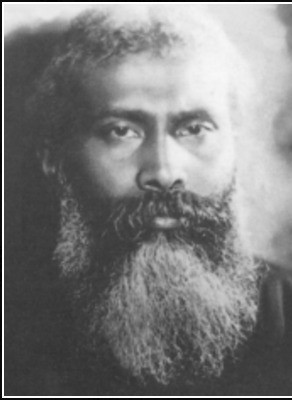
The story is told that in 1876, a Japanese fisherman—or possibly an itinerant Kegon monk— named Senzaki came upon the body of a recently deceased woman on the Russian Kamchatka peninsula which extends southward towards the archipelago of Japan. At the woman’s breast, there was a newborn child which the fisherman rescued and brought back to his homeland. The dead woman had clearly been Japanese, but the baby grew up with Chinese features as a result of which Nyogen Senzaki came to assume that his natural father had been from either Siberia or China.

The child was officially adopted by the fisherman and registered as the first-born son of the Senzaki family. His given name was Aizo. His adoptive mother died when he was five after which he was sent to the house of his grandfather, who was the abbot of a Buddhist temple in the Pure Land Tradition. There he was educated in classical Chinese and Buddhist literature.         

The grandfather was a devout man who instilled a strong moral sense in his grandson, but he was also a man who lamented the degraded condition to which Buddhism and, in particular, the clergy had fallen. When he sensed that his grandson was drawn to religious life, he encouraged the boy to live by the Buddhist Precepts but discouraged him from becoming ordained. When Aizo was sixteen, the grandfather became ill and his last words to the boy were: “Corruption among Buddhist priests keeps getting worse. Although you have always wished to leave secular life and seek the great Dharma, entering monkhood may, ironically, hinder your goal. Beware of joining that pack of tigers and wolves called monks.”

Aizo returned to his adoptive father’s house, where he began a course of study intended to prepare him for a medical degree. He remained drawn to Buddhist studies, however, and, by the age of eighteen, had read the entire traditional collection of Buddhist scriptures called the Tripitaka. Around this time, he also read the autobiography of Benjamin Franklin and took up Franklin’s habit of maintaining a journal in which he daily recorded his deeds, both good and bad, marking the bad deeds with a black dot. The young Aizo was saddened by the frequency of black dots in his diary. Attracted to the highly disciplined lifestyle of foreign missionaries then proselytizing in Japan, he briefly considered becoming a Christian.

He felt a strong sense of obligation to the members of his grandfather’s temple; their donations had provided the old man with an income and, thus, helped pay for Senzaki’s education. He wondered how he could repay the debt he owed them and, despite his grandfather’s warning, kept coming back to the idea that he might best do so by entering religious life.

He first learned of Zen through a friend who composed haiku and introduced him to the poetry of Matsuo Basho. This led him to investigate other works on Zen. In his reading, he happened upon the story of Tokusan, a student of the Diamond Sutra. Tokusan realized that his academic study was not furthering his spiritual development so one day burned all the notes he had gathered on the Diamond Sutra and began his formation anew under the direction of Zen Master Ryutan. Inspired by this example, Senzaki gave up his medical studies and sought ordination as a monk. His head was shaved, and he was given the Buddhist name Nyo Gen, “Like a Phantasm.”  The name came from a passage in the Diamond Sutra which states that all “composite things” are like phantasms, like figures in a dream.

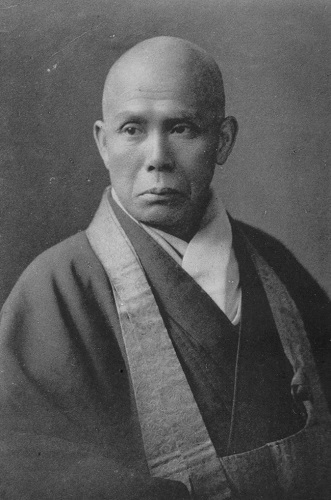
Soyen Shaku

After his ordination, he began a correspondence with Soyen Shaku who had recently been elevated to the post of abbot of Engakuji Temple, and, in 1896, Senzaki traveled to Kamakura to study with Shaku.

At their first meeting, Shaku was concerned by the physical appearance of the young man who presented himself at the temple. A physician was consulted, and it was discovered that Senzaki had tuberculosis and needed to be kept in isolation. His first year at Engakuji was spent quarantined in a small hut on the temple grounds. From time to time, Shaku would visit Senzaki, whose condition continued to worsen. On one occasion, he asked Shaku, “What will happen if I die?”

“If you die, just die,” Shaku told him.

Once Senzaki’s health improved, he did koan study with Shaku for five years but, at some point, became disturbed by the disparity he saw between the Buddhist vow to “liberate” all creatures and the secluded and comfortable life monks led far from the daily cares of lay life. He was also disillusioned with many of the Buddhist priests he met who, in contrast to the austere lives exhibited by Christian missionaries, paid slack attention to the precepts. He never questioned Shaku’s commitment to the Dharma nor the sincerity of his teacher’s vows, but Senzaki saw little of that same zeal among the majority of priests in the Zen establishment. He recalled his grandfather’s last words and found himself in sympathy with the criticisms common during the Meiji Restoration about the Buddhist clergy. In a commentary on a koan he wrote many years later, Senzaki derided those who proclaimed “themselves Zen masters, just because they passed several hundred koans in the secret rooms of their teachers. They teach their students in their own secret rooms and produce similar Zen teachers. It is a sort of school for magic and tricks. It has nothing to do with the understanding of Buddha Shakyamuni and Bodhidharma. The whole matter is nothing but a joke. No wonder most Zen teachers in Japan now have wives and children. They drink and smoke and accumulate money for the comfort of themselves and their families.”

Senzaki aspired to live the life not of a married priest but of a celibate monk in the manner of the earliest followers of the Buddha. But even as a monk, he did not feel it was his calling to remain sequestered from the world at large. In a letter to Shaku, Senzaki explaind his reasons for wishing to leave Engakuji: “Though it was my original vow to attain Buddha’s Dharma for the benefit of all beings, the present flood of corruption does not permit me to focus on the eternal. I believe I must sacrifice my own practice to work in the here and now.” 

Soyen Shaku supported his disciple’s decision to return to his village in order to set up a primary school, which he termed a “Mentorgarten.” His intention was to create an environment in which both students and teachers were mentors to one another. Although he remained a monk, he did not operate the Mentorgarten as a religious institution but rather as a secular school where he hoped students would have an opportunity to develop both their intellectual and spiritual capacities.

It was a struggle to find the funds necessary to operate the school, and Senzaki was disappointed by the lack of support he received from the community he sought to serve. The Buddhist establishment, in spite of interventions on his behalf by Shaku, was equally unsupportive and considered the school heterodox. Senzaki was also disturbed by the increasingly militaristic atmosphere in Japan which was then engaged in the Russo-Japanese war. Unlike Shaku, Senzaki was openly critical of the Zen establishment’s support of the war effort.

Despite their political differences, Shaku invited Senzaki to accompany him as attendant when he accepted an invitation to visit San Francisco, and Senzaki gratefully agreed to do so. Their hosts in California, apparently not understanding the relationship between the Zen master and his attendant, took Senzaki on as a houseboy. His duties included doing laundry and general cleaning. The housekeeper, however, decided the new houseboy’s English was not adequate for his duties and soon dismissed him.

Senzaki gathered his few possessions into a suitcase and set out on foot to find one of the local hotels which catered to Japanese clients. Shaku, who had not intervened on his behalf, accompanied him, carrying the suitcase. When they came to Golden Gate Park, Shaku handed over the suitcase and told Senzaki: “This may be better for you than being hampered by being my attendant. Just face the great city and see what happens—whether it conquers you or you it.”  He instructed Senzaki to find work in the city which would help him learn as much as he could about the country and its people. “Do not utter even a syllable, don’t even pronounce the ‘B’ of Buddhism for seventeen years. You must come to understand these Americans before you will be able to teach them. Find work, no matter how modest; work in anonymity for at least seventeen years. Then you will be ready.”  After these final words, the two separated, and, although they maintained a correspondence until Shaku’s death in 1919, they never again met in person.

Following his teacher’s instruction, Senzaki worked for a while as a household servant. When conditions in San Francisco forced him to leave the city during the 1920 Anti-Japanese Crusade and Congressional Hearings on Immigration, he worked on a farm near Oakland. After the hysteria in the city abated, Senzaki returned and found employment in a hotel. He held a number of positions there: porter, elevator operator, telephone operator, and bookkeeper. He eventually became the manager and even, for a while, was a part-owner of a hotel. But he was not a natural businessman, and it didn’t flourish. When it failed, Senzaki became a cook. He was also a language tutor, teaching English to Japanese students, and Japanese to American students. In his spare time, he meditated in the Japanese Gardens in Golden Gate Park and spent long hours at the public library, reading American and European philosophy and improving his understanding of the written language. He later confided to Robert Aitken, “I enjoyed reading Immanuel Kant. All he really needed, you know, was a good kick in the pants.”  All the while, he continued to write articles on Zen which he sent back to Japanese periodicals, but he did not make any effort yet to teach Americans.

In 1919—the year Soyen Shaku died—Senzaki found a publisher in Japan for 101 Zen Stories. He included two stories about his teacher in the collection. 101 Zen Stories would eventually be translated into English with the help of Paul Reps and then be included in a small volume entitled Zen Flesh, Zen Bones, which also contained their translation of the koan collection known as the Mumonkan or Gateless Gate. Zen Flesh, Zen Bones would become one of the most influential books on Zen in America in the 1950s. The stories in it became some of the best-known Zen tales in the Western world.

Senzaki had not completed his Zen training in Japan, and he never received inka, or formal sanction to teach, but he took Soyen’s words to him in Golden Gate Park as authorization to do so after the specified time had passed. So when the seventeen year period of silence came to an end in 1922, Senzaki rented a hall and gave a public lecture on Zen. The subject was meditation although no meditation instruction was provided. He based it upon an earlier talk given by Soyen Shaku on the subject. From time to time after this initial lecture, Senzaki would present another. He had no permanent temple to work from and called this series of talks a “Floating Zendo.” 

His first audiences were primarily Japanese, but eventually a number of Western students also began to attend. As the number of American participants increased, Senzaki started holding separate sessions for them during which he spoke in highly accented English often having to clarify the word he was trying to say by writing it on a blackboard. His command of the written language would always be better than his spoken English. When he felt some of the members of his audience were ready, he began to instruct them in meditation.

In 1931, he moved to Los Angeles where he continued the practice of holding separate lectures for Japanese and non-Japanese audiences. He called the Los Angeles zendo the Mentorgarten Meditation Hall. By now, periods of zazen were a regular part of the evening’s activity.

Senzaki informed his students that the purpose of both Buddhism and zazen was to come to the realization that from “the very beginning we are all buddhas, for our minds as well as our bodies are nothing but Dharmakaya, the Buddha’s true body, with infinite light and eternal life. It is our delusion to see ourselves in the small cells of individual egos.”

This, however, was something each student had to discover on his own; it was not something one could acquire from another. He told them: “I am a senior student to you all, but I have nothing to impart to you. Whatever I have is mine, and never will be yours. You may consider me stingy and unkind, but I do not wish you to produce something that will dissolve and perish. I want each of you to discover your own inner treasure.”

During meditation, Senzaki’s students sat in chairs rather than on cushions. He assigned them koans and held sanzen interviews after the meditation periods. He used the koans of the Mumonkan but also at times assigned a passage from the Christian mystic, Meister Eckhart. Eckhart, Senzaki explained, “said, ‘The eye with which I see God is the very eye with which God sees me.’  We use these words as a koan to cut off all attempts at conceptualizing. When you work on this koan, you will see that there is no God, no ‘me,’ but just one eye, glaring eternally. You are at the gate of Zen at that moment. Don’t be afraid, just keep on meditating, repeating the koan in silence: ‘The eye with which I see God is the very eye with which God sees me.’  There is no reality other than this one eye.”

He insisted that their practice needed to continue beyond the periods set aside for formal meditation. One also practiced by being mindful of the everyday tasks with which one was involved: “—no matter what your everyday task may be, it will turn into Zen if you quit looking at it with a dualistic attitude. Just do one thing at a time, and do it sincerely and faithfully, as if it were your last deed in this world.”

Hazrat Inayat Khan

Senzaki recognized that Zen did not have a monopoly on spiritual insight. He respected Eckhart and other Christian mystics, and he told the following story about his visit with the Sufi master, Hazrat Inayat Khan. The meeting took place at the home of a western Sufi instructor, a woman identified as Mrs. Martin. A psychologist, Dr. Hayes, was also present. The meeting began with pleasantries, Dr. Hayes asking the visiting Sufi master his opinion about America.

Then the Sufi asked, “Mr. Senzaki, what, please, is the significance of Zen?”

Senzaki smiled at the master; the master smiled back. Their dialogue, as Senzaki expressed it, was over.

Dr. Hayes, however, thought Senzaki was having difficulty finding the appropriate English words to use, and he explained, “Zen is the Japanese expression for the Sanskrit term dhyana, which means meditation.”

The Sufi raised his hand and shook his head, silencing the psychologist. Mrs. Martin got up, saying, “I have a copy of a book written in English which I believe gives a very good introduction to Zen.”  But the Sufi told her it was not necessary.

Senzaki and Hazrat Inayat Khan smiled at one another once more.

Senzaki’s lifestyle was almost ascetic; he tried to live as much like a mendicant monk as was possible in America, although he avoided the outward trappings. He did not shave his head and came to have a distinctive and distinguished head of white hair in later life. He did not wear special garb and was critical of the Japanese Zen priests who came to California and made a show of their robes. He viewed with suspicion and kept separate from both the official Zen hierarchy in Japan and the one being established in North America.

He seldom had any money even when he was working, and, whenever students tried to give him some, he tended to pass it on to others. If students left money in the meditation hall, it was Senzaki’s habit to discover who the donor was and invite them to dinner at a café he enjoyed patronizing.

On one occasion, Senzaki took his dirty clothes to a laundry in his neighborhood but did not have the money to reclaim them. Shubin Tanahashi—the woman who operated the laundry with her husband—saw him walking by their establishment one day and ran out to ask him why he had not picked up his clothing. When Senzaki explained that he could not afford to do so, she made an arrangement with him. Her son, Jimmy, had Down’s Syndrome and was confined to a wheelchair. He was non-verbal and needed extensive personal care. Mrs. Tanahashi offered to do Senzaki’s laundry without charge if he would occasionally assist them with the care of their son.

The boy was thought to be incapable of speech but with gentle patience Senzaki taught him to repeat, in Japanese, “Shujo muhen seigando.”  This is the first of the four Bodhisattva vows: “All beings, without number, I vow to liberate.”

The Tanahashis were so grateful for the care Senzaki provided their son that they offered him accommodation in their home, and Mrs. Tanahashi became his first disciple in Los Angeles.

Paul Reps

Although Senzaki often struggled with the spoken English language, he was a skillful translator, and a number of artists, poets, and members of the “bohemian” community were drawn to his Zen meetings. Among these was the poet and artist, Paul Reps, who had spent fourteen years in Japan studying Zen and haiku writing. Reps worked with Senzaki to translate 101 Stories into English, after which the two collaborated on a translation of the Mumonkan and the verses accompanying the series of paintings known as the Ten Bulls which illustrate the stages of growth in Zen practice.

In 1934, Mrs. Tanahashi showed Senzaki a magazine from Japan with some poems and prose passages written by a young Japanese Zen monk named Soen Nakagawa. The poet was reported to be living as a hermit on Dai Bosatsu Mountain near Mount Fuji. Like Senzaki, Nakagawa was openly critical of the lax moral lives and careerism of Zen clerics as well the vain ritualism that preoccupied temple life. Recognizing a fellow soul, Senzaki and Reps wrote to Nakagawa, sending him a copy of the translation work in which they were engaged. As a result of this initial correspondence, Senzaki and Nakagawa began an enduring long-distance friendship. In 1940, the younger monk made preparations to visit Senzaki in Los Angeles, but the outbreak of war between the United States and Japan prevented those plans from being carried out.

After the 1941 attack on Pearl Harbor, public attitude towards Japanese residents in America, particularly those living on the west coast, was highly charged. Anti-Japanese sentiment had been common in California for many years. There had been legislation segregating schools, banning inter-racial marriages, and preventing people of Asian descent from acquiring US citizenship. Senzaki had been so fearful for his own safety in San Francisco during his first years there that he had carried a pistol.

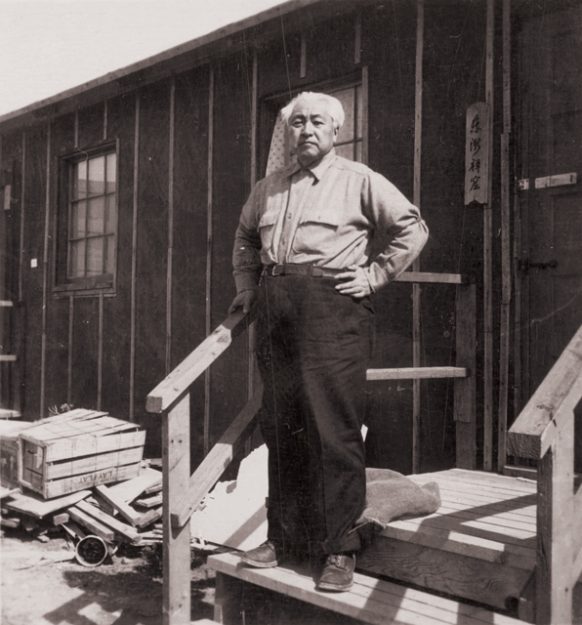
With the outbreak of war, all persons of Japanese descent were excluded from California as well as parts of other west coast states. Families were relocated to internment camps set up inland. Senzaki was sent to Heart Mountain in the Wyoming desert where he shared quarters with a family. He continued to host a meditation group in the small hut in which they lived, sometimes crowding in as many as twenty attendees.

When, after the war, the displaced Japanese returned to what had been their homes in the “exclusion area,” they often found their properties had been confiscated or foreclosed; former neighborhoods where they had dwelt were now occupied by people of other ethnic backgrounds. Many found themselves homeless. In 1945, forty years after he had parted from Soyen Shaku in Golden Gate Park, Senzaki had as little as he had had when he first arrived in North America.

Immediately after release, Senzaki spent two months in Pasadena at the home of one of his disciples, Ruth Strout McCandless, to whom he had given the Buddhist name, Kangetsu. He had entrusted her with his books when he learned he was being sent to Wyoming. Ruth McCandless had taken over from Paul Reps the responsibility of acting as Senzaki’s editor, and she and Senzaki would collaborate on two books published after the war, Buddhism and Zen in 1953 and The Iron Flute in 1961.

After spending two months with the McCandless family, Senzaki returned to Los Angles. He rented a small apartment in Little Tokyo over a hotel which was a popular rendezvous point for prostitutes and their clients. His rooms consisted of a bed-sitting room and a small kitchen. Here he continued meeting with his Japanese and American students seated on wooden folding chairs he had purchased from a funeral home. The formal part of the sessions consisted of an hour’s meditation, a short talk, and the recitation of the four vows. Following this, the members of the group shared a cup of tea, then departed. There was little socializing, and, if members tarried too long, Senzaki would gently encourage them to leave.

Senzaki had remained in America in large part because he thought the American psyche was suited to Zen; he considered it “more inclined to practical activity than philosophical speculation. Because Buddhism is not a revealed religion, its wisdom is not derived from any Supreme Being, nor from any agents of His. The Buddhist believes that we must attain wisdom through our own striving, just as we obtain scientific and philosophical knowledge only by independent effort. To attain prajna [wisdom], we strive in meditation and avoid conceptual speculation.”

He felt that the American mind, “with its scientific cast,” was naturally drawn to Zen. “The alert adaptability of the American mind finds in Zen a quite congenial form of spiritual practice.”

After years of correspondence, Senzaki finally met Soen Nakagawa in 1949 when the younger man visited him in Los Angeles. Nakagawa stayed almost six months. Senzaki had hoped to entice him to remain in America and become his heir, but Nakagawa felt obligated to return to Japan.

In 1955, accompanied by Ruth, Senzaki made his only return visit to Japan after fifty years in America. He visited Soyen Shaku’s grave and Soen Nakagawa, who was then the abbot of Ryutakuji Temple. Because it had been so long since Senzaki had been in Japan, Nakagawa was concerned that he might be uncomfortable with—among other things—the traditional Japanese latrines over which one squatted. So he drew a diagram of a western-style toilet and had the monastery carpenters build one. They were not able to connect the toilet to running water, but it did provide a seat for the visitor.

Nakagawa recognized that his friend was becoming more feeble with the passing years, and he kept apprised of his condition after Senzaki returned to America. In 1958, Nakagawa asked one of his younger monks who spoke English, Tai Shimano, to go to America to act as Senzaki’s attendant, but before Shimano was able to leave, they received word that Senzaki had died on May 7.

At his funeral, Japanese priests chanted the traditional funeral rites. Before the ceremony ended, a recording was played. On it a woman, Seiko-an, read a document which Senzaki had entitled his “Last Words.” Senzaki himself could also be heard laughing in the background and cheerfully correcting Seiko-an’s pronunciation from time to time.

I imagined that I was going away from this world, leaving all you behind and I wrote my last words in English. Friends in the Dharma, be satisfied with your own heads. Do not put on any false heads above your own. Then, minute after minute, watch your step closely. These are my last words to you . . . Each head of yours is the noblest thing in the whole universe. No God, no Buddha, no Sage, no Master can reign over it. Rinzai said, “If you master your own situation, wherever you stand is the land of Truth. How many of our fellow beings can prove the truthfulness of these words by actions?”

Keep your head cool but your feet warm. Do not let sentiments sweep your feet. Well trained Zen students should breathe with their feet, not with their lungs. This means that you should forget your lungs and only be conscious with your feet while breathing. The head is the sacred part of your body. Let it do its own work but do not make any “monkey business” with it.

Remember me as a monk, nothing else. I do not belong to any sect or any cathedral. None of them should send me a promoted priest’s rank or anything of the sort. I like to be free from such trash and die happily.

Nyogen Senzaki’s ashes were divided in two. Half were buried in Los Angeles. The other half was reserved and would eventually be mixed with a portion of Soen Nakagawa’s ashes and buried at the Dai Bosatsu Zendo established by Tai Shimano in the Catskill Mountains of New York.

Nyogen Senzaki compared himself to a mushroom—without a deep root, no branches, no flowers, and probably no seeds. He underestimated the legacy he was to leave behind. He never acquired the celebrity which D. T. Suzuki attained, but through his students—several of whom went to Japan to study with Soen Nakagawa—the practice of Rinzai Zen obtained a foothold in North America.

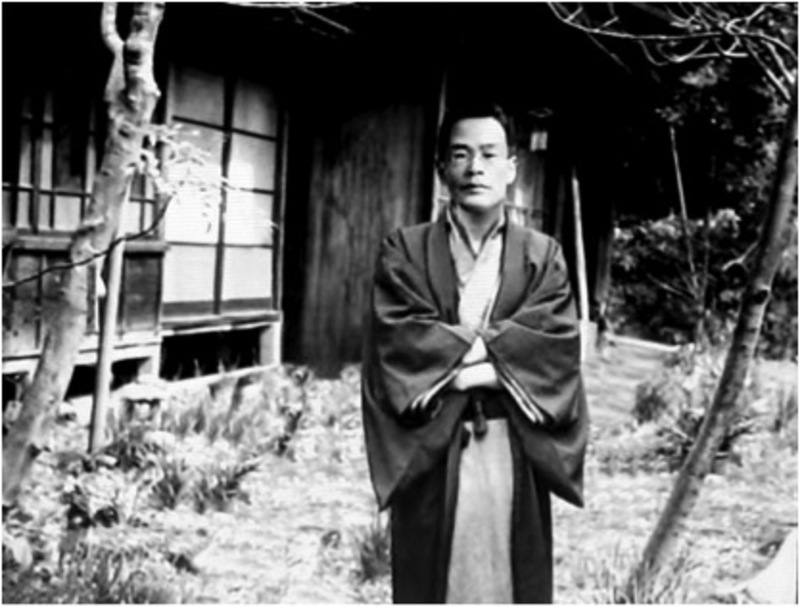
Soen Nakagawa, Nyogen Senzaki, and Ruth McCandless

The Third Step East: 41-56; 9, 59, 61, 67, 69, 102, 111, 113, 114, 115, 116, 122, 127, 138, 148, 149, 150-52, 156, 161, 163, 168, 172

The Story of Zen: 5-6, 229-43, 266, 269, 280-82, 305, 320

Dae Bong Sunim

Mu Sang Sa Temple, Korea

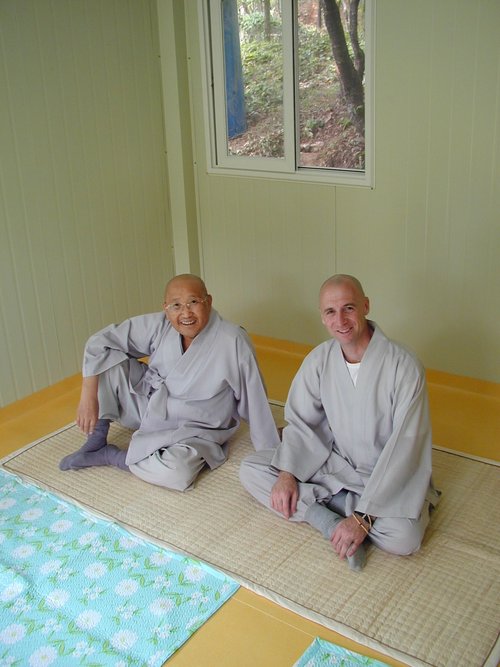
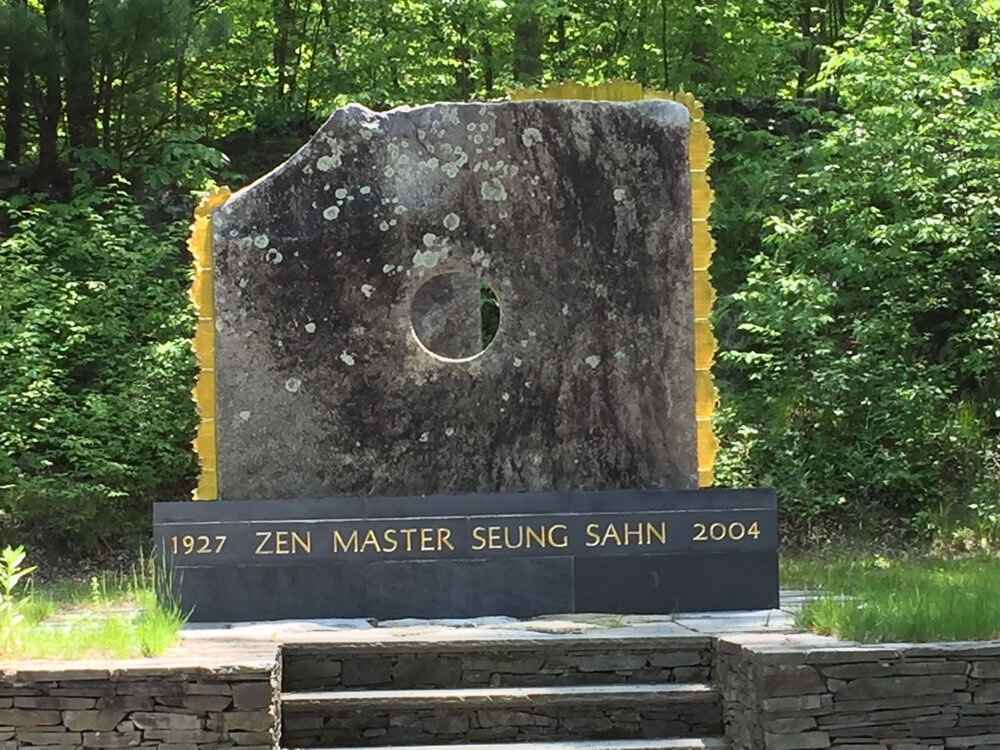
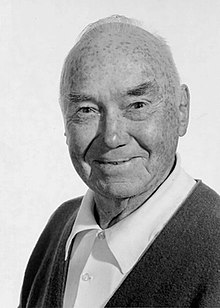
When I was gathering background material on the Korean Zen Master, Seung Sahn – founder of the Kwan Um School – I was advised to interview Dae Bong Sunim, the former abbot and current guiding teacher of Mu Sang Sa Temple in Korea. I only had his Dharma name, so I wasn’t expecting the person who appeared on screen for the videochat to be a 73-year-old white guy from the United States with a strong East Coast accent. “It’s good to have surprises,” he tells me.

Before discussing Seung Sahn, I ask Dae Bong how they first met.

“I was interested in Buddhism when I was quite young, and when I was teenager I became interested in Zen because of a story I’d heard.”

“Maybe we better establish where and when this was,” I suggest.

Dae Bong turns out to be one of those people who need little prompting.

“Okay. I was born in 1950, and in 1976, in America, I was working in a shipyard as a welder. I had thrown away my career – which was just beginning – in psychology a year or so before that. And I really began to be very interested in finding a spiritual group that I could practice with. I was on the east coast of the United States in Connecticut, and I saw the New York Times Sunday magazine section. On the cover there was a picture of an American Japanese Buddhist monk. He was American but – you know – it was a Japanese tradition, and I realized, ‘Oh, there’s Zen in America.’ ’Cause I wanted to find a teacher who could teach in a way that was not dependent on culture. And when I read the article, it was about the opening of Dai Bosatsu, Eido Roshi’s place in the Catskills in New York. And I don’t know; I wasn’t attracted to it. It struck me as a little cold. And so at some point around the end of the year, with one of the guys that I worked with, I drove up to central Massachusetts and just drove around on a Sunday, asking people and looking for signs for a Buddhist Center, and there were some Tibetan groups up there – Buddhist groups based on Tibetan Buddhism – but I was particularly interested in Zen. And then I remembered that I’d heard that there was a Zen Center in Providence, Rhode Island. So on a Sunday in January, I drove up there and managed to find it.”

By then, I was hooked. I steered the conversation back to Seung Sahn but made a note to do a follow-up interview with Dae Bong on his own story.

He was born Larry Sichel in Philadelphia and grew up in in a largely Reform Jewish neighborhood.

“I went to synagogue. Not all the time but a lot. My family had belonged to the synagogue for a few generations. And I was bar mitzvahed and have a big family. One side of the family would gather on the big holidays. Forty people or so at my grandmother’s for the Seder and for breaking the Yom Kippur fast. What I liked the most . . . I think I have a religious mind. I wasn’t into the theology at all, but my favorite holiday, just recently passed” – we are speaking in October – “is Yom Kippur because it’s purely spiritual. You know, many of the Jewish holidays relate to some historical event, and then there’s all of this theological-spiritual meaning that comes out of it. But I just liked this, ‘How have I turned away from God? And turn back.’ That’s it. I’d stay in the synagogue in the evening, all day long, and my family would come and go. Even when I was like 8/9/10, I’d stay there all day. And around 10, I started to understand what was happening. Basically you’re just saying the same two things over and over in different ways. I turned away from whatever . . . Buddhism. Your True Nature. You know? I’ve indulged in ‘I/my/me.’ And . . . now turn back. And that holiday is all between you and God. It’s not like, ‘What did I do bad to other people?’ And then you turn back, and you’re back on track for a year. I didn’t think about things this way then, but it’s called the Day of Atonement. So if you break it down in English, ‘at-one-ment.’ Becoming one again. This is Zen Buddhism! But they add on all this other stuff.

“So, yeah, grew up American Jewish. What happened to me one time . . . And I know this is before 1988 because we were in front of my parents’ house, and I’d been living in the Zen Center about eleven years – I’d been a monk about four years – and two of my father’s old Jewish friends who knew me since I was a baby sort of confront me.” He speaks in an exaggerated accent. “‘Are you still Jewish?’ And I said, ‘Come on, it’s, like, in the DNA, it’s in culture, it’s in character.’ And they’re like, ‘Are you Jewish? You never come to the synagogue. Are you Jewish?’ And finally what I did, I had stretchy pants on. I went like this.” He acts as if he going to pull his pants down to show them that he’s circumcised. “And they got it. The oddest answer to them; it just took away all their thinking. I learned that style from doing koan interviews with Soen Sa Nim. So then, of course, they’re old Jewish guys; they don’t give up. They dropped that question, and they started sayin’ to me, ‘Well, when’re you comin’ back to the synagogue?’ And I said, ‘I like the Zen Center.’ They kept going on, and then I had this thought – I remember – like a boxer. Sometimes a boxer will go down low, get in really close, and hit them in the belly. So I said to them, ‘Actually, I wanna be a rabbi.’ And then their reaction was perfect. One of them said, ‘Don’t do that! Don’t do that! People only tell you their problems. It’s a real headache.’ The other guy says, ‘And they don’t make much money.’ They never questioned me like that again. Whenever I’d run into them, they’d say, ‘You still doin’ that Buddhist thing?’ ‘Yeah.’ ‘Ya like it? They give you enough money?’”

He tells me he first became interested in Buddhism when he was eleven and took part in a cultural exchange to Japan.

“I grew up in Philadelphia; went to public school. A very good public school. I was very aware of the American history of slavery and the relationships between African Americans and White people. I couldn’t digest how people could do that kind of thing to others. And now people are still doing it in various ways. Also I was struck that although the street I lived on was nice – 1960, everybody had a car – I knew there was lots of suffering in the houses. It hit me that economics is important – people should have shelter, clothing, food, medical care, and education – but it didn’t take away all suffering. This was on my mind a lot in primary school. I didn’t know anything about Buddha. Then in Japan we visited Kamakura; there’s a big outdoor Buddha. I saw it and immediately felt deeply inside, ‘This person understands suffering and what to do about it.’

“And then I think I told you how my brother told me that story about these two monks.” The story relates how two monks come upon an attractive girl stranded on one side of a stream, unable to cross over without ruining her kimono. So one of the monks picks her up and carries her across. Later that night, at an inn, the other monk complained “Monks are not supposed to touch women, especially young and attractive women.” The first monk responded, “I put her down by the stream. Are you still carrying her?” “I was 16/17 when my brother told me that story, and I thought, ‘Zen has wisdom.’”

In college, he first studied physics. “I wanted to know what is the true nature of the universe, so I wanted to study theoretical physics. I remember in elementary school reading the simple explanations of relativity. I remember sitting in class and thinking, ‘If the universe is infinite, what does that mean?’ And about time, ‘Where’s the line between Tuesday and Wednesday? We know on the clock there’s a line. And on the calendar there’s a line. But in nature, where is the line?’ Actually there’s no line between day and night. That’s something we make up. There’s light and then a little less light, less light, then dark, darker, darker, less dark, less dark, and a little light, more light. There’s no divisions. It’s all continuous. So I got this sense that there’s no division in anything. We make it up. This is true about our body. I talk about this in Dharma talks with people. I’ll say, ‘So, yesterday you ate some rice, and you called it rice. Today it’s part of your skin, it’s the energy of your emotions. It’s your hair. It’s you. And tomorrow you go to the bathroom, and – boom! – something comes out. It’s shit. So rice is you, and you are shit. And then in the old days, the shit goes on the field, and it becomes rice.’ Thich Nhat Hanh talks somewhat like that as well. What are you? I started to realize the whole universe is just one living being.”

I suggest we’d probably skipped ahead a few steps. “So let’s back up. You’re in college. You’re studying physics. How’d you end up becoming a welder?”

“So I switched in my second year from physics to psychology.”

“No wonder you became a welder.

“Yeah. I started university ’68; I finished ’72. I became a welder in ’75.”

“Did you actually practice as a psychologist?”

“I worked as a student on the psychiatric ward of a city hospital as a nurse’s aide to begin with. I had to work in college, and my last two years I got a job working three evenings a week and sometimes nightshift on the weekends, and it was excellent because when you study psychology, you study psychopathology and personality theory, and then I’d think, ‘Yeah. Human beings are like this.’ And then I’d go to work, and my understanding would get blown apart. And then I’d get another idea, some other theory, and I’m like, ‘Oh, they’re like that.’

“After I graduated, I traveled around a little bit, and then I came back to the East Coast, and I got a job in the Whiting Forensic Institute which was a psychiatric hospital on the grounds of the state psychiatric hospital, but it was part of the prison system. I worked there only four months. A friend of mine had a full-time job at the University of Connecticut Hospital on the psychiatric ward as a counselor, and, when he quit, he recommended me, and I switched over there. I did that for two years. Then I realized I’m not psychologically clear enough or strong enough to really do this as a profession, and I don’t think I can get the wisdom I’m looking for going to graduate school. So, that was 1974, and when the hippie movement had somewhat passed, gotten discouraged, but there was still a lot of that sensibility around, and people were getting into ‘back to the land’ and crafts. I decided I wanted to learn pottery.”

“Of course you did,” I sigh, and we both laugh.

“Yeah! Yeah! And my hair was down to here then. So I learned pottery, and I loved it, but I realized, ‘I’m not a potter, and it’s not really addressing the great concerns I have about life’ which I couldn’t quite put in words. Then I needed to work and make money, and I saw a sign that the government would support a four-months program in learning to weld. And my pottery teacher, who was a woman, knew how to weld, and I thought, ‘Well, I’ll learn how to weld, and then I’ll make some money.’ But in terms of life-direction, I was lost. And so I learned how to weld, and all those guys were like from my wrestling team in high school. None of them went to university; many of them were ex-soldiers from Vietnam. Young guys. I knew how to get along with them. The only job I got hired for was at Electric Boat which builds submarines for the Navy. So I worked there for a little more than a year. And socially I learned a lot. My close friends from childhood were all getting Ph. D.s in psychology or finishing law school, and they were going to do poverty law, legal aid, and everybody’s like, ‘What are you doing?’ I just said, ‘I don’t know.’ During that time – I was about 25 – I finally got serious about looking for a Buddhist meditation group. I wanted to practice Zen.

“So one Sunday, I’m talkin’ with one of the guys I worked with. He was a welder also. I don’t know how we connected, but he had been reading Dharma Bums and On the Road by Jack Kerouac. I said to him, ‘I’m going to drive up to Massachusetts and look around for a Buddhist place. You want to come?’” So we drove up there, we drove around all the college campuses, and I asked people if they knew of any Buddhist centers in the area. We spent the day and then we went back home.”

In the days prior to the internet, that’s what you had to do.

“A couple of weeks later, I remembered I had heard there’s a Zen Center in Providence, Rhode Island. I didn’t know anything about the tradition, the master or anything. So on another Sunday in early January, I took my friend and we drove up there. The Zen Master wasn’t there, but his students were having Sunday evening practice, and they always have a Dharma talk Sunday afternoon. One gave a short talk, and another answered questions. We hung around afterwards eating popcorn, and it seemed . . . I liked it. It wasn’t intellectually deep. It was very kind of ordinary. Afterwards, when we were eating popcorn, nobody was talking about Buddhism or anything. Just normal stuff. Then, as I was leaving, somebody said to me, ‘Are you comin’ back?’ And I said, ‘Yes!’ I was surprised that I said it kind of strongly. I meant it. My friend was not all that interested. A month and a half later, I thought, ‘I’m going to go again.’ But there was a branch center closer to where I lived in New Haven, Connecticut. I drove over there on Sunday and after the talk – which was similar, just everyday life – but the point was, ‘Don’t hold your idea’ and ‘What am I? Do you know? What are you?’ Buddha’s ‘Don’t know,’ Bodhidharma’s ‘Don’t know.’ So it was pretty down to Earth. And I asked the guy who gave the talk to teach me how to sit. He said Zen Master Seung Sahn was coming in two weeks to lead a three-day retreat. I decided to sign up for it. I met Zen Master Seung Sahn the night before the retreat when he and a student gave a public dharma talk. He’d been in America about five years, and he could speak English, but it was . . .”

“I notice how all you guys make fun of the way he spoke,” I tell him. “Last time you said it was because it was cute.”

“Well perhaps because he was quite strong, humorous, clear and charismatic, so people were drawn to . . . Sort of like Dylan. People start playin’ and sounding like his voice. In any case, I think I told you somebody asked him, ‘What’s crazy, what’s not crazy?’ He gave an answer that I felt cut across everything. It was just beyond any kind of academic explanation. ‘If you’re very attached, you’re very crazy. If you’re a little attached, you’re a little crazy. If you’re not attached at all, that’s not crazy.’ I thought that is better than my eight years of studying and working in psychology. Then he continued, ‘So everyone in the world is crazy. Because everyone is attached to “I.” But this “I” doesn’t exist; it’s just made by thinking. If you want to not attach to your thinking “I” and realize your true “I,” you must practice Zen.’

“The next day during my first private interview, the Zen Master said, ‘Your before-thinking substance, my before-thinking substance, somebody’s before-thinking substance, the substance of this stick, the sun, moon and stars, all universal substance is the same substance.’ At that moment I thought, ‘I have been waiting my whole life to hear that.’ And I felt he got that 100%. It wasn’t thinking. And I can learn from him how to realize that myself.

“But I didn’t know what to do if you realized your true nature. Later I asked the Zen Master about it. ‘If you attain your true nature and it’s empty, what happens? Do you just disappear? Do you kill yourself?’ Soen Sa Nim would often say, ‘That is only halfway to correct enlightenment. No longer attachment to name and form but if you attach to that, then you’ll make many problems for yourself and others. That’s where you cut your thinking. You just become one with the situation.’ He said, ‘Then you must enter “just do it.” When you’re eating, eat. When you’re talking, talk. When you’re with your family, family mind. When you’re driving, driving mind. Moment-to-moment only help others.’”

I drag the conversation back to his biography. “Somewhere along the line you decided to move into the Zen Center. You said you lived there before becoming a monk.”

“Yeah. I had three retreats with Soen Sa Nim while I was working, and the day after the third one, I quit my job, I went home, and I tried to figure out what to do. I called up the Zen Center in Providence and said, ‘I want to move in.’ They said, ‘Well, come up.’ They knew me because some of them had been at the retreats I did. And they said, ‘Stay for two weeks, and then we’ll see.’ So I moved up there, and I moved in. Then I had to work to support my life there. There was a four-story old building, and there was an American monk there, and he was going to paint the outside of the building during the summer. I remember I moved in on May 6th, 1977. It was also my grandfather’s birthday. But it is really important to me because I was beginning to find my direction. They asked me if I would stay for the summer and help the monk paint the building. I did not have to pay to live there during that time. So I did.

“The Zen center had a pretty strong daily practice. Two hours every night or something like that, and, of course, we got up at – I think 4:30 – 108 bows and sitting forty-five minutes, and chanting for about forty-five minutes. Then breakfast and then most people would go off to work or school. A couple of people stayed in the center. Evening practice was chanting for thirty minutes – or later it became an hour – and then an hour or two of sitting, and extra practice on the weekends and group work periods. So you couldn’t have much social life. But it was okay to me because I’d been through some relationships, and I wanted to understand the practice.”

Dae Bong and Seung Sahn

“So you move in, they put you to work as a painter, you have to get up at 4:30 to do 108 prostrations, and then somewhere along the line you decide that’s not enough, and you want to become a monk.”

“After about a year, becoming a monk kept coming up in my mind. Again it was like I don’t know why I became a welder. I don’t know. I think – for me – this was the way to really attain the truth of the universe, which, of course, was what I was always interested in. What is the truth of our life and how can I help others? I wanted to devote myself to this way. Also I had made a very strong connection with Soen Sa Nim. He had given me good advice about two very difficult things in my life at that time.”

The two things were that he had a son by a woman he had broken up with, and he had recurring thoughts of suicide.

“I signed the paternity papers; I signed an agreement to send a certain amount a month, money every month through the Connecticut Child and Family Services. But that really hit me. I want to be a good person, but I am not raising my own child. When I left this woman, I started having thoughts of suicide.  Somehow I struggled my way through the next few years. Then I met a Zen group and a Zen Master.

“When Seung Sahn returned to the Zen center after traveling for two months, I’d been living there and practicing two and a half months. I asked to talk to him, and I told him two things. First I told him, ‘I think about killing myself a lot.’ His response was very interesting. He said,” (Dae Bong speaks softly and once again imitates Seung Sahn’s accent) “‘You did that last life. But that wasn’t your idea. Somebody put that idea in your head. You practice, practice, practice. Then one day you can take that idea out. Then no problem.’ That’s interesting. Then I told him, ‘I have a son who’s about three-and-a-half years old, and I am not raising him. I’ve seen him once since he was born.’ Soen Sa Nim said, ‘Oh, then this karma already cut.’ And he looked at me, and he said, ‘Oh. Not cut.’ Then he said, ‘Any child when they’re nine or ten, they think about, “Who’s my father?” When they’re 15/16 and have some energy, they will look for father. You practice hard. Then when he comes looking for you, you can help him that time.’ So I don’t know if other people talked to him about things like that, but he gave me very helpful advice. I don’t know anything about past lives or not, but I had the motivation to try, not because of finding our true self, but because I did something that was a big, a very big problem. I left a woman with a child. And I left this child.”

“And did your son seek you out as Master Seung Sahn predicted?”

“Yes, kind of at first. When he was around 9, his mother was almost in a car accident. Her father was dead; her mother was an alcoholic. Her sister was far away, and she had broken up with a nine-year relationship, and she suddenly thought, ‘What happens to him if I die?’ And she found me through the Zen Center. I was living in a Korean temple in LA then – 1983 or something – and she called me up. And I thought, ‘Okay, here it is. It’s not him. It’s her, but he’s only 9.’ She told me this, and I said, ‘I’ll raise him if anything happens to you, don’t worry. He can live with me, and I will raise him.’ Then I told Soen Sa Nim about it, and he said, ‘You bring him to see you. Don’t you go visit them.’ But they wouldn’t come, even though I pay for it, so I went to see them. I realized the Zen Master really understood my karma. If I go back into that situation, I’m gonna get fucked up again and that won’t help them or anyone. Anyway I went to visit them, and we met a few times.

“A year later I became a monk and soon after became Abbot of our Zen center in Paris, France. My son’s mother got married, changed her name, and moved. Then I couldn’t find my son and he couldn’t find me. He was 12 at that time. When he was 32, he found me through the internet – he was already married – and we had a great talk for hours, and we’ve been in touch ever since. He has come to see me, and I have him. And we have a good relationship. The first time I visited, I stayed with him and his wife for a week. Before I left, his wife said to me, ‘You guys never lived together? DNA’s incredible. You guys never lived together, but you’re so similar!’” He chuckles. “It’s interesting.”

I ask how he came to be the abbot of the French Center.

Dae Bong’s Transmission Ceremony 1999

“We had just built a monastery behind the Providence Zen Center, past the pond and up a hill. The idea was that the monks and nuns would live there, and we would start to hold our three month retreats there rather than in the middle of the busy Zen Center where people were often coming and going. I went to England in the Spring to visit my brother. There is a French nun who had recently come from Korea to France to start a Zen Center. I went to Paris to visit her for three days. They had just signed a lease for a building; they asked me to stay for a while. I stayed for a week, and everything broke in the new place while I was there. The biggest problem was the toilet on the third floor. The vent pipe for the toilet was underneath the kitchen sink on the first floor. All the shit backed up and came out under the sink. The nun and her friend ran out. I cleaned it all up. Then they called Soen Sa Nim and asked if I could stay in Paris. He said, ‘Tell him to decide.’ They talked to me, and I said, ‘How can I decide? I’m supposed to go back to the monastery. Another monk and I are going to sit a three-month retreat there soon. Nobody else is coming to the retreat.’ So I called Soen Sa Nim. I said, ‘Sir, I’m supposed to go back to the monastery soon where this other monk and I are gonna start . . .’ He said, ‘That monk likes to be alone. One monk’s enough.’ So I said, ‘Okay. I’ll stay for the next two months to prepare for your visit.’ There was a Korean woman who Zen Master Seung Sahn had invited to Paris to be a Guest teacher. She attracted a lot of people. She came and . . . It’s a little complicated. She got along fine. She trusted me. So when Soen Sa Nim was about to leave Europe, and he asked me, ‘What’s your plan?’ I said, ‘I’m going to go back to America. I owe my brother $1000, and I know at the monastery you don’t want me to work. If I stay in the Zen Center, I can work for a couple of months, do house-painting or something to pay him off, then I’m free.’ Then Soen Sa Nim called in a monk who had some money and said, ‘Write a cheque to his brother for $1000.’ My friend gave me the cheque, I said, ‘Thank you.’ Then Soen Sa Nim said to me, ‘So go back to America, go to Korea, stay in Europe. You decide.’ There were no monks in our school in Europe, and I understood what the Zen Master wanted to do there. So I said, ‘Okay, I’ll stay in Paris. How long should I stay?’ Soen Sa Nim said, ‘One year.’ So I stayed, no job, just living and practicing in the Zen center. One month later, the French nun who was abbot ran away. So we called up Soen Sa Nim who said, ‘Okay. You are abbot.’ So I became abbot and stayed three years.”

And in 1993, he took up residency in the Mu Sang Sa Temple Korea, which means he’s been there now for thirty years, although he admits he also “ran off” twice over that time. “I think a mixture of cultural shock, and cultural shock from the Western monks too.”

I tell him that I used to prepare young people to do short-term work assignments in developing countries and that I would explain to them that they probably wouldn’t experience culture shock when they arrived at their placement because they will be expecting things to be challenging. Rather, they would experience culture shock when they returned home.

He nods his head. “That’s true. It wasn’t the Korean culture. It was the Western sunims who shocked me. They had a kind of arrogance. It kind of fit in with the traditional – now changing – Korean Confucian hierarchy. A kind of arrogance towards lay people and towards women. The younger Western sunims at our temple now don’t have that arrogance.”

He did, of course, return to the temple, eventually served as Abbot and continues as the Guiding Teacher.

Megan Rundel

Crimson Gate Meditation Community, Oakland, CA –

Megan Rundel is a Dharma heir of Joan Sutherland and the guiding teacher of the Crimson Gate Meditation Community in Oakland, California. She grew up in Houston, where her father was a member of the Physics Department at Rice University. The family religion, she tells me, was science.

“Both of my parents were kind of actively anti-religious and anti-spiritual. They believed that everything in life could be explained by science, and that logic and reason and scientific reasoning were the highest ways to use one’s mind and the best way to know truth.”

“And did you share that point of view?” I ask.

She pauses for a moment. “I always had . . . I knew that that wasn’t the whole truth, but, of course, as a child I couldn’t articulate why. Actually, I was a wall-gazing kid. I would sit in my bedroom as a ten-year-old – I think I was feeling over-stimulated probably – but I would stare at the wall and kind of just let things settle, and I knew there was something bigger that I wanted to make space for. But it took me until I was in college to start to be able to articulate to myself what this other way of knowing could be.”

It began with a course in world religions she took at Wesleyan University. I ask why – given her family background – she had enrolled in the class.

“I was fascinated. I had an identity already as not a scientist and a bit of a rebel in the family. You know, I was an English major.”

“God forbid!” I had also been an English major.

“So I was trying to find my footing in a – I guess – low grade rebellion. And in this world religions class, we used Houston Smith’s textbook, The World’s Religions, and the section on Buddhism really lit me up and excited me. I thought, ‘This is what I’ve been looking for.’”

“Okay. Life sucks; it sucks because you want things; the only way to stop it sucking is not to want things; and then you won’t be reborn again. What was the allure in that?”

“Yeah. I don’t think it was that exactly. It was more the kind of expansiveness. The feeling that the world . . . that the universe is so much larger and stranger than what’s in front of us, and that there are ways to explore that facet of reality.”

“How is that different from the way in which a physicist approaches understanding the world? Might they not describe what they’re doing in much the same way?”

“I think that’s very astute, and I think I did absorb something from my father, a fascination with theories of everything. Wanting to understand the big picture. So I do think I had that quality of mind certainly from my family, but I inclined it in a different way. I think I leaned into the mystery rather than trying to figure out the mystery.”

For students who were interested, the professor for the World Religions course hosted a zazen group before class.

“That required getting up at the ungodly hour of 8:00 a.m.” Megan tells me.

I ask what drew her to it – especially given the ungodly hour – and she considers a moment before answering.

“Here’s the true story about why. I sometimes hesitate to tell it, but it’s the truth. Just a few weeks before I began this religion class, I had taken psychedelic mushrooms.”

“I’m shocked.”

Megan laughs. “I know. But I had what I now recognize was a very deep mystical experience which I didn’t have much way to make sense of. And I knew that I needed to keep working with it. I needed to find a way to lead it into my life in some way, and I had no idea of how to do that. And so when I got to this religion class and had the opportunity to sit zazen, they synced up beautifully. The zazen really gave me that chance, and the teachings worked so well with the experience that I had had that it all felt of a piece to me.”

“It isn’t a unique story,” I mention.

“Yeah. I know.”

“So what you were looking for was a way to understand the experience that you’d had with the mushrooms. And perhaps integrate it?

“Integrate it? Yeah. That’s the language we would use now, for sure. I just knew that I wanted to live a life that was informed by that experience. And I knew I couldn’t take mushrooms all the time. I also had a work-study job in the university library. So I could go into the stacks, and I read every book – I think – by D. T. Suzuki. There wasn’t a lot out there at that point, but I read everything I could get my hands on and just felt really inspired. It opened up a world to me that felt important. So when I graduated from college and moved to San Francisco in 1988, I started to attend sittings at the San Francisco Zen Center. But it was kind of sporadic. I was also young and enjoying life in the city. Then a few years later I moved to Madison, Wisconsin, because my husband was in graduate school there. And I found myself kind of lonely and depressed, and I found – not too far from where we were living – the Madison Zen Center, which was an affiliate of the Rochester Zen Center.”

There was no resident teacher in Madison, but Bodhin Kjolhede from Rochester visited regularly. “People who had a teacher were working with Bodhin. So it was just a small, local basically sitting group affiliated with Rochester, and I really dove headlong into training, doing every sit that they offered and before too long starting to do sesshin in Madison and in Chicago and in Rochester. And that’s where I started koan practice, and my first teacher was Bodhin. And as you know, it’s a style of Zen – at least back then, maybe it’s changed – which was pretty vigorous and Japanese in style. And that kind of worked with my temperament at the time. It was the early ’90s, and I was in my 20s. I had so much energy and angst and stuff at that point in my life that it was good for me to have that discipline. The intensity kind of met my intensity.”

After her husband finished his degree, they moved back to California.

“For a while, I went back to Rochester for retreats, but I realized that that was a long way. And I asked Bodhin who I should study with in the Bay area. I wanted to continue my koan work. I had been working on Mu for a few years at that point and was very deeply involved and wanted to continue that, and Bodhin suggested John Tarrant. So I looked him up. John’s group was in Santa Rosa, but there’s an affiliate group here in Oakland, and I just took to it. And it was so different from Rochester, the culture of Rochester. It totally blew my mind. It was so much more California,” she says with a laugh. “Creative and free and expansive and sometimes psychological and really with an emphasis on the creativity that’s inherent in the koans. And, again, I think the timing was perfect. I had benefited from the intense discipline in Rochester, and then it was so wonderful to feel this freedom that John’s teachings offered. And I just kind of exploded out from that.

“John is charismatic and a koan genius in a certain way, and his vision of Zen and the koans and the practice is incredibly beautiful and inspiring. And that was very important and meaningful to me, personally, and to a lot of other people as well. I don’t think it’s a secret that he can be problematic personally, but those initial years of just feeling the possibilities, just the joy of the koans with him was an incredibly valuable teaching.”

John had not yet established the Pacific Zen Institute, and his group at the time was known as the California Diamond Sangha. Joan Sutherland was a senior student when Megan began practice there.

“I adored her. I thought she was wonderful. I loved having a woman teacher, and I loved that she combined some of the beauty and the creative energy that John brought without the drama. And I really just kind of fell in love with her. She started to teach maybe a year later, and I was one of the first people in line to be her student. And after I started working with Joan, she very quickly became my primary teacher.”

“You said you ‘loved’ having a woman teacher. Does it make a difference?”

“It sure did to me. Probably a man could be similar in some ways, but Joan brought a way of teaching to groups and in one-on-one dokusan that was just so warm and engaged. It was something I hadn’t experienced before, and it felt – I don’t like the word ‘feminine’ exactly – but it felt . . . It had the qualities that I would feel in other female relationships. A certain warmth; embodiment; kindness. Combined with her incredibly keen intellect and prajna. You know? That combination was so profound. It really met me exactly where I wanted to be.”

Megan was in graduate school at the time studying clinical psychology.

“So I had a period of time in the ’90s when I was in grad school – I was getting a doctorate, so it was a long time – and I had the flexibility to do a lot with Zen, go to all the retreats and so forth. And I was studying psychology, and those two endeavours really informed each other.”

“Did you formally give Joan the box of incense and all that?” Presenting a box of incense is a traditional way of asking a teacher to accept one as a student.

“Uh-huh. I think that was probably ’96.”

“Her approach to koans – as you pointed out – very different from the Rochester style.”

“Oh, yes! Oh, my gosh! I felt like it was the first time that my subjectivity was part of it in an authentic way where I felt there was interest in me as an individual human. And that really felt important to me. I felt like I needed to be met on a human-to-human level.”

Joan Sutherland and Megan Rundel

“Okay. So you formally become her student in 1996, and then somewhere along the line she identifies you as a person whom she could entrust with carrying on this tradition.”

“I have no idea how that happened. I mean, I worked with Joan for a long time, and I just felt so fortunate. I did not at all think of myself as anybody who could carry on the tradition or teach. I really didn’t. I didn’t have interest in that or confidence that I could. I sort of actively didn’t want to. For lots of reasons it didn’t feel at all like a natural fit.”

“What changed your mind?”

“I guess a couple of things. Joan seemed to think that I had the qualities needed for the role, and I trust her. So part of it was just trusting Joan. And the other thing is that I’m the last person that she named as a teacher before she retired. And I knew that she was about to retire, so I really knew that I had two choices. I already had my little group here in Oakland and was kind of operating, I guess, as a meditation instructor. So I could try to struggle on in that role, which didn’t seem likely. I could just find another group, which around here is just dominated by the San Francisco Zen Center, and I knew that’s just . . . Or I could take her up on the offer.”

“What was your reservation about Zen Center?”

“It’s very formal. And I really loved koans which they don’t do. I felt engaged with that and I really liked the more expansive and free feeling that it brought out in me. As somebody who can be kind of shy and interior, I liked the expansive quality of Joan’s lineage.”

She tells me that her group in Oakland – Crimson Gate – is largely made up of fellow psychologists. “Not all. But everybody kind of knows – you know – it’s a psychologically-minded group.”

“So tell me what the difference is between what a psychologist/psychotherapist does and what a Zen teacher does.”

“Traditionally a psychologist helps a person look at their story, question aspects of it, and heal past wounds. And a Zen teacher helps a person get beyond their personal story and expand into what I guess we might call ‘big mind.’ So I guess psychologists specialize in helping us with our ‘small minds,’ which does relieve a lot of suffering, and Zen teachers help show us the realms of ‘big mind.’”

“What draws people to Zen practice? What makes somebody wake up one morning and search out Crimson Gate on Google?

“Well, as I said, most of the people who come to our group are psychologists or therapists.”

“Okay then, so what is it that psychology doesn’t offer them that they hope to find in Zen?”

“It depends on the person, but I guess I could say a few things. One is just a break from the hecticness of modern life. And especially maybe in the Bay Area where things move really fast. Everybody’s really busy. It’s an intense place. So I think a lot of people just want a break. Want the quiet, a way to be quiet and to just drop all of the speed and the burdens and the complications. And then I think a lot of therapists have the intuition that there’s something beyond the personal story. And I think we regularly get glimpses of that and intimations of that as therapists, but our training doesn’t really offer us any way to work with that or explore it in ourselves or our patients. So I think the Zen practice offers a way to . . . You know, Freud has this great note – Freud was always best in his footnotes – and he had this one in The Interpretation of Dreams about the dream navel which he said was the place where any dream opens out into the unknown, the unknowable. So I like to imagine it as a sort of corridor where on one side you can see into the dream world, and the other side is just this mystery. So sometimes I think of Crimson Gate as sort of a way of being in that dream navel with one eye on the world of dream and play and the other eye on the vastness. And I really think people have a craving for finding a way to get to know that place and to do it together. Joan’s tagline for her group used to be, ‘We all wake up together, a conspiracy of friends.’”

“On the webpage for Crimson Gate you say that the practice helps us ‘heal dualities.’ What do you mean by that?”

“Modern life and language encourages divisions in the mind. Like good and bad, right and wrong, success and failure. And it’s so easy to get trapped in those dualities and have your entire life run by trying to get from one to the other or feeling polarized. And Zen practice is a way to see into the ‘no-self-ness’ of those qualities – the non-existence of those qualities – and that is a healing experience.”

“And yet you chose to work with a female teacher in order to avoid the drama associated with a male teacher. Is this not duality?”

“‘Emptiness is form,’” she says, quoting the Heart Sutra, and we both chuckle.

“Well, let’s consider that,” I suggest. “We chant these things: ‘Form here is only emptiness, emptiness only form / Form is no other than emptiness / Emptiness no other than form / Feeling, thought and choice, consciousness itself are the same as this.’ We chant it, but that doesn’t necessarily mean it makes any sense to us. How is ‘form emptiness and emptiness form’?”

“I love that there’s really no paradox there. That’s truly my experience. I always think of it as having binocular vision. With one eye we can see emptiness or the vastness – as Joan would call it – and with the other eye we have a firm grip on reality and how the world works. So it’s a ‘both and.’ It’s both true that there is no gender, there is no practice, there is no duality, and, at the same time, having a woman teacher was profoundly important to me as a woman. I grew up at a really interesting point in history. My mother was having her consciousness raised when I was a little girl. And I think she was in the League of Women Voters and kind of in that wave of feminism, and I think I really learned from her early on that it’s important for women to speak up, to not just absorb the patriarchy but to own our differences but also our strengths. Joan, I think, was an amazing role model for that.”

“Let me make sure I’m following you here: You seem to be suggesting that one first has to recognize the dualities? So in my case, as a white, cis-gendered male there may be a whole bunch of things I might take for granted, and the first step is to be aware of those assumptions, and the real differences that exist?”

“Absolutely.”

“Okay. And, at the same time, what? If it’s important for me to be aware of the dualities, especially being this highly-privileged individual . . . And I’m out-numbered in my family. Most of the people in my family are female; one is trans-sexual; I have three Filipino grandchildren; I have a First Nations great-grandchild. So . . . ‘Form here is only emptiness, emptiness only form?’”

“So in your family there’s differences, there’s markers, there’s gender, there’s ethnicity, there’s sexuality, and you’re in the same family, and they’re both true.”

“Okay, then the website goes on to say: ‘More than ever our Way helps us heal dualities, cultivate a kind and open heart, and make way for inquiry into our true natures.’ What is our false nature?”

“Well, our false nature is ‘I’m right and you’re wrong.’” We both laugh.“That’s the world of ignorance. And our true nature is, ‘It’s really nice to meet you, Rick.’”

“That doesn’t really clarify anything, does it? Say I come across this on your website, and I’m curious enough to come by the center. If you start talking about ‘true nature,’ in order to make any sense out of what you’re saying, don’t I have to have some idea of what my false nature is?”

“I would probably say, ‘The stories that you have about yourself are false, and there’s more to you in your life than that. And you have to find out about that for yourself. I can’t tell you that. But if you come and sit in meditation with us, you’ll discover something for yourself.’”

“So, again, how is that different from if I came to you as a psychotherapist?”

“In psychotherapy we move into your story and try to help understand the story and to make sense of it, and to help you have – maybe – better stories. More effective stories that work better in the world. And in Zen, it’s about dropping the story and seeing what’s bigger than that.”

“And what is the value of doing that?”

“It helps us be wiser and kinder and more aware of our place in the world.”

 One really can’t ask for more than that.

Shaku Soen

Adapted from The Story of Zen

The transference of Buddhism to the west began in the post-Darwinian period at the end of the 19th century when rationalists began to have difficulty accepting the absolutes of the Christian creed but still  wanted to believe that there was a spiritual dimension to human life. As a result, even the educated became susceptible to a bizarre range of new beliefs such as in the existence of fairies, spiritualism and communication with the dead, various forms of psychic phenomenon, and even telepathic communications with mystic spiritual masters in the Himalayas. In popular culture, these ideas were often associated with the “Mysterious East,” a region where it was imagined exotic powers were common and life was free of the more restrictive elements of Christian morality.

It was a period of serious academic research as well, and, by the end of the 19th Century, Asian studies had not only acquired a degree of respectability in western universities they also attracted a popular interest unimaginable a few decades earlier. Sir Edwin Arnold’s verse biography of the Buddha – The Light of Asia – became a late Victorian best-seller. The same year Arnold’s book came out, the Oxford scholar, Max Müller, released the first in what would be a fifty-volume series entitled The Sacred Books of the East, a collection of translations he and others had made of Hindu, Buddhist, Confucian, and Daoist texts, as well as works from the Muslim, Jain, and Zoroastrian traditions.

The form of Buddhism with which the West first became familiar was the austere doctrine of the Theravada School as found in Sri Lanka. There a British civil service officer, Thomas Rhys David, translated works which would be included in Müller’s series. Rhys David would go on to found the Pali Text Society, committed to preserving the literary heritage – including the Tripitaka – of what was then known as Ceylon. As documents became more accessible in the West, some thinkers began to wonder if non-theistic Theravadan Buddhism might not be a faith system better suited to bridge the growing rift between science and religion than Christianity.

Knowledge of Mahayana Buddhism came later, when missionaries and philologists began the process of translating Tibetan texts; however, the consensus of scholars like Rhys David was that the Mahayana – with its lurid artwork and suspiciously papist pantheon of Bodhisattvas – was a decadent corruption of the Buddha’s original teachings.

The eventual dominance of Mahayana teaching in the west is largely due to the spread of Zen, but Western knowledge of Zen is historically comparatively recent. The first Zen teacher to set foot in the Americas did not do so until 1893.

Shaku Soen was born in 1859, just six years after American warships had opened the previously isolated Japan to the west. As a child, he was enrolled in a temple school where – according to his own assessment – he learned to be filial to his parents, helpful to his siblings, loyal to his country, faithful to his compatriots, and respectful of the Three Treasures, Buddha, Dharma [what he taught], and Sangha [the community of his followers]. When Soen was 12, he became a monk, which wasn’t an unusual age for that step.

After working with two prior teachers, he eventually came to study with Imakita Kosen. He mastered the koan system quickly and easily and received inka from Kosen when he was only 25 years old. Normally after receiving transmission, a monk would undertake a pilgrimage to other Zen temples throughout the country to have his understanding tested and deepened, but Kosen encouraged Soen, instead, to enroll in the newly established Keio University in Tokyo.

Soen spent three years there during which he learned about other forms of Buddhism and developed a desire to deepen his understanding of the breadth of Buddhist thought by traveling to Ceylon in order to explore Theravada teachings. Before the opening of Japan to the West, travel restrictions had prevented Japanese from leaving the country and such a journey would have been impossible, but, now that these had been lifted, he was free to undertake the voyage.

It proved to be more challenging than he had anticipated. He admired the lifestyle of the Ceylonese monks and their commitment to the precepts; however, he was never able to communicate with them very well, and he realized that they would be bewildered if he attempted to explain Zen with its emphasis on personal enlightenment. An even greater frustration was the climate. Unused to the heat and humidity of the tropics, he didn’t have the physical endurance to take part in the begging rounds by which the monks traditionally supported themselves. In a letter he wrote to Kosen, he remarked that things in Ceylon were so different that only the barking of the dogs seemed familiar.

Imakita Kosen

Shortly after Shaku returned to Japan, Kosen died, and Soen succeeded him as the abbot of Engakuji.

Like Kosen, Soen was a political conservative and generally accepted the social and economic policies of the Meiji government. He was a product of his era and environment and, as such, took for granted the belief that the Japanese people were the unique descendants of a sacred royal household.

His education, which had trained him to be loyal to his nation and faithful to his compatriots, led him to support the country’s military incursions into China and Russia, and during the Russo-Japanese War [1904-05], he took leave from his duties at Engakuji to serve as a chaplain in the First Army Division. Later he would later argue that the Japanese victory was due, in part, to the strength the nation derived from Buddhist culture and specifically from Zen training which instilled a “Samurai spirit” in the population.

The 1893 Chicago World’s Fair – also known as the Columbian Exposition – was a celebration of the material progress humankind had made in the four hundred years since Columbus’s arrival in the islands of the Caribbean. 27 million people attended the event which was unashamedly an expression of American Exceptionalism. No mention, naturally, was made of the negative impact of the arrival of Europeans on indigenous populations or of other social, environmental, and human costs associated with the march of human progress.

A group of Protestant clergymen saw the fair as an opportunity to hold a World Parliament of Religions in the city at the same time. The Parliament organizers intended to demonstrate that, rather than casting doubt on religion as the evolutionists appeared to have done, modern scholarship – which had now resulted in English translations of most of the world’s scriptures – proved that humankind had been guided by “divine providence through all ages and all lands.” In the same way that the World’s Fair presented America as the pinnacle of material success, the Parliament sought to demonstrate the superiority of Christianity over all other faith traditions. In the closing ceremonies, the Chairman of the Parliament, John Henry Barrows, confidently proclaimed that it had “shown that Christianity is still the great quickener of humanity . . . that there is no teacher to be compared with Christ, and no Saviour excepting Christ . . . I doubt if any Orientals who were present misinterpreted the courtesy with which they were received into a readiness on the part of the American people to accept Oriental faiths in place of their own.” One of those visiting Orientals to whom Barrows referred was Soen.

Soen had only been abbot of Engakuji for a year when he received the invitation to take part in the Parliament. Other, more experienced, abbots advised him to refuse on the grounds that the barbarians of the United States couldn’t possibly understand or appreciate the Buddhadharma. After careful consideration, however, Soen decided to take part. He composed two papers to be presented at the Parliament but, because he had only a rudimentary knowledge of English, asked one of his students, Teitaro Suzuki, to translate them for him.

Paul Carus

His principal paper dealt with Buddhist teachings on “cause and effect” and was read to the participants by Barrows. It was received politely but without the enthusiasm which the audience demonstrated for some of the more charismatic Asian presenters. One attendee who was impressed by Soen’s paper, however, was Paul Carus, a publisher and editor intrigued by Asian philosophy. Soen’s paper piqued his interest, and Carus asked the Zen abbot if he would consider remaining in the United States a while longer to participate in a project to prepare translations of Buddhist – in particular, Mahayana – texts for publication in English. Soen demurred, stating that he was not qualified to do so and that his duties at Engakuji prevented him from taking on other responsibilities; he noted, however, that the young student who had translated his paper into English might be up to the task.

So it was that D. T. Suzuki came to Illinois in 1897, and – with him – Zen would arrive in the West.

D. T. Suzuki

Portrait of Shaku Soen by Molly Macnaughton from “Zen Masters of Japan”

Zen Masters of Japan: 295-99

The Story of Zen: 213-23, 229-34, 337

Jim Daikan Bastien

Howling Dragon Zen, Vermont –

A book on physics first drew Jim Bastien to Zen Practice. He was working at Boys Town – the Catholic orphanage in Nebraska – “when I came across this book called The Tao of Physics by Fritjof Capra. I don’t know if you’re familiar with that book, but he wrote it back in the 1970s. It’s a treatise on the parallels between Eastern religious views and modern science, particularly quantum physics. And when I read that book, it was like, ‘Okay. Now I have found a way to reconcile my scientific training and a way of thinking with my spiritual sense without having to buy the traditional conventional Christian viewpoint.’”

Jim had been raised in New England in a working-class family plagued by alcoholism and trauma. He mixed with a group of kids who were deemed delinquent and was placed on probation by the time he was 16. “About a year later I got into a fight on a Friday night after drinking and broke this kid’s collarbone. And the Chief of Police told the judge, ‘I want him to go to Westfield State Training School because he’s incorrigible, and he’s got issues, and I’ve had enough.’ Plus the kid who I broke his collar bone, his mother was a big deal in the town. So she made a big stink about it. Anyway, I was already on probation, and so my probation officer basically said to the judge, ‘Hey, he’s a good kid. He’s on the football team. He’s an A student. But he comes from a home where there’s not a lot of supervision at times. There’s no point in putting him in a training school.’ So the judge listened to that, and I got two years’ probation until I was 18, but I was allowed to stay out of the training school.”

He managed to turn his life around and became a product of the times. He was one of the 400,000 people who attended the 1969 Woodstock Music Festival; he experimented with LSD and marijuana, studied Skinnerian philosophy, and got a Master’s Degree in social work, which earned him the job at Boys Town.

Gordon Becker

“It was a big epiphany to learn that Zen actually had an empirical basis to it. And once I read that book, I said, ‘I’ve gotta find a Zen Center somewhere.’ So I opened the Omaha, Nebraska, phone book, and I flipped to the last page, and, sure enough, Nebraska Zen Center. So I called them up, and I said, ‘How do I do this?’ And the guy who ran it was this physics professor, of all things, at the University of Nebraska in Omaha. His name was Gordon Becker, and he was affiliated with the Minnesota Zen Center under Katagiri Roshi. There were about five of us that would sit in his living room every day, Monday through Saturday, and do zazen, and on Saturday we’d go out to breakfast afterwards. And every once in a while, we’d travel up to Minnesota to the Zen Center there. And they also had a place called Hokyoji which was like a retreat center. That was it. I would get up every morning at 5:00 and drive the thirty minutes across town in Omaha, sit two periods, and then drive back home. Shower, shave, etcetera, and go to work. Yeah, I did that – like – for three years.”

It wasn’t something he talked about with others. “I kept it on the down-low because when I was doing this it was back in 1980. I moved to Nebraska in 1979, and I started sitting in 1980. And in those days, you couldn’t go into a bookstore and find a book on Zen. You might find Alan Watts’ The Way of Zen and one D. T. Suzuki book, but that was it. And Omaha, Nebraska, of course, is right in the heart of the Bible-belt. Very, very heavy Christian culture there. And I’m workin’ at Boys Town, which is like the preeminent Catholic charitable organization for kids, right? So I’m kind of like this closet Zen practitioner. But eventually I started to come out, and it wasn’t as big of an issue as I thought it was.”

“What drew you to the practice?” I ask.

“I think it was my first taste of what I call the mind of not-knowing, that what was going on in my head was not everything, was not the whole thing. And that there was this part of myself that I’d probably lost touch of going way back that was present and welcoming and still and essentially the medium through which experience came through. But it wasn’t just the experience. It was something that was bigger than that, and I was very interested in exploring that, seeing where that would go. And another thing – and I don’t know where this comes from – but I actually love the forms. I love the bowing; I love the chanting; I love the sitting. I just really, really like it. And so I did it from 1980, and in ’85 or ’86 I did jukai with Katagiri.”

I ask what Katagiri Roshi was like, and it turns out that Jim is one of those people who don’t need prompting. Once they start a  story, they just run with it.

Dainin Katagiri

“Well, here’s the deal with Katagiri. I met him only twice basically. Actually three times. This guy, Gordon Becker, decided to build a zendo onto his house. He moved out of his living room and moved into the kind of addition he built and turned it into a zendo. And Katagiri came down to initiate the zendo, and there was a bunch of ceremonies that went with that. And so I got to meet him for the first time. And it was during that visit that I asked him if he would be willing to accept me as a student. And he knew I had been very conscientiously practising all these years so he said, ‘Yes.’ But he said, ‘You’ll have to come to Minnesota, and you’ll go through a weekend retreat there, and then you’re also going to learn how to sew a rakusu.’ So I went up there and did a two-day retreat and completed that. And then when it was time to go through the ceremony, it was scheduled for the Sunday after the seven-day Rohatsu sesshin, which was the first week-long sesshin that I ever attended. I had a pretty major kensho that was confirmed by Katagiri. And it was interesting too because he gave me the name ‘Daikan,’ which means Great Tolerance. And in the after-party, he came over to me, and his name was Dainin, which means Great Patience. And he took my rakusu, and he took his rakusu, and he went, ‘Look at that.’ And then he gave me a big hug. And the interesting thing about it, the kensho experience I had occurred when I heard a cough that he had made. And when the cough happened it was – this is the term that’s used – ‘body and mind dropping off.’ It was very, very powerful. But it also turned out that that cough signified the fact that he had a rare form of leukemia. And so when I met with him, after he had confirmed the kensho, I said, ‘Well, what should I do now?’ And he said, ‘What do you want to do?’ And I said, ‘Well, I think I would like to ordain as a priest.’ And he said, ‘Tell me about your family.’ And I said, ‘I live in Nebraska. I’ve got three kids, and I work at Boys Town. And I have a wife, etcetera.’ And he said, ‘What I want you to do is for the next two years, I want you to make your work and your family your practice. And if at the end of two years you still want to be a priest, I’ll ordain you.’ I said, ‘Thank you,’ and that was the last time I ever saw him because he ended up deteriorating pretty rapidly. Five or six months later, he passed away.

Bobby Rhodes

“About the time that happened, there was an opportunity to start a Boys Town in New England in Rhode Island. So I was tasked to go and lead that project, and I moved my family out of Nebraska to Rhode Island. And there weren’t any Soto Zen sitting groups anywhere nearby, so I started training with the Koreans in Cumberland, Rhode Island, the Kwan Um School of Zen. I did koan study with Seung Sahn, the great Korean master, for about four years. They call it kung-ans, a little different than the Japanese. And my primary teacher was Soeng Hyang, also known as Bobby Rhodes. She’s a hospice nurse, and my sister’s a hospice nurse, and they knew each other. So I did koan study with her, and then after a few years we moved out of Rhode Island and back to Western Massachusetts. And I still went to the Kwan Um School of Zen periodically, but then I decided because I was closer to Zen Mountain Monastery, I thought, ‘I think I’ll take a ride over there and see what that’s like.’ And I went over for a weekend retreat, and  Daido Loori was still there. And so I then started training with them as a lay person who didn’t live there. I wasn’t in residence. And I did that for a couple of years. Probably went to three or four retreats of varying lengths. And then one day I’m reading the local newspaper back in Amherst, Massachusetts, and I see an article indicating that Bernie Glassman has just moved into the town five miles from where I live. Because I’d been following Bernie since my days in Nebraska with Katagiri because ZCLA and Minnesota Zen Center and San Francisco Zen Center were like the three where the original teachers came from Japan. So I knew about them. I read their magazine that they would send out. And it turns out, he’s right here in my backyard. Right? So I called up there; I said, ‘What’s goin’ on? How can I get involved?’ They said, ‘Well, Bernie’s not taking any more students.’ But they said, ‘We have these things called Zen Circles, and you can join a Zen Circle.’ It was like a bunch of people got together. It was like one of his upayas, skillful means. You know, Bernie always had these upayas. And so I did that for about a year or so, and then Bernie decided to have this big sesshin. It was the first one he’d done in five years. And he did it at the Kripalu Yoga Retreat Center in Western Mass. And Peter Matthiessen was there; Bernie was there. Enkyo O’Hara was there. Eve Marko was there, and – you know – it was kind of like the Who’s Who in the Zen Peacemakers. And it was kind of a cool retreat because at dokusan you could go to a different teacher on every day. So I saw Peter, and I saw Eve, and I saw Enkyo. And then I got to have a meeting with Bernie. And by then, I’m running a large residential treatment school for youthful sex offenders, essentially emotionally disturbed kids, and juvenile delinquents. So I’m running this 120-bed alternative high school and grammar school. So I meet Bernie, and he says – first thing he says is – ‘What’s your practice?’ I said, ‘I do zazen, etcetera, etcetera.’ He said, ‘Well, what do you do?’ And I said, ‘Well, I’m the vice president of residential services running this big treatment centre.’ And he goes, ‘That’s great. How would you like to work for me?’ And I said, ‘You’re kidding.’ And he goes, ‘No. No.’ And I said, ‘A long time ago, I wanted to ordain as a priest and I’ve always kind of held that as something I wanted to do.’ And he said, ‘Well, I’ve disrobed, so I can’t make you a priest. But if you want that – you know – I can figure out a way for that to happen. But,’ he said, ‘I actually don’t think that’s the best path for you. ’Cause of your long history; the things that you’ve done; the education that you have. Your commitment to social service since you were a kid. You know, that whole thing.’ Which is what the Zen Peacemakers are kind of known for. And so I quit my job; I gave up my vice-presidency. My in-laws almost died when that happened. It was all soft money, and I just took a launch. And originally I was President of the Board and then I became the Chief Operating Officer. And essentially I was with Bernie every day for, like, five years. You know, we’d meet in the morning; we’d smoke cigars and plan the day. At lunchtime we’d go down to Subway or a pizza place because he loved eating Subway and pizza.”

Jim Bastian and Bernie Glassman

“What good is Zen?” I ask him.

“It’s good for nothin’.” We both chuckle, then he says, “I’ll answer the way I always heard Bernie answer. Zen is life. You know, people ask what Zen is, and he says, ‘It’s life. Life.’”

“In that case, what’s the point of all those forms – which you tell me you love – or taking steps like sewing a rakusu or even possibly becoming ordained?”

“Because I think the practice reveals to us what the path out of suffering is. And one of the things that came out of the realization I had is an extremely powerful sense of wanting to help other people. That the actualization of realization is love and compassion. Even against all odds. And it’s not an idea; it’s not a concept. It’s something you know now has to happen and be part of your life. And what is it that you realize? You know, you’re never gonna get an answer to that question because realization is beyond conceptual solutions.”

“Is Zen about realization?”

“Not anymore than eating breakfast.”

“I’m trying to get a sense of what you mean when you use terms like ‘practice,’ a sense of what Zen is.”

“Well, the question is already a problem. If you have to put it in words, it’s always a bit of a problem. You know, in the Soto sect, we’re taught that we’re already enlightened. We don’t have to do anything to become enlightened. And the degree of our enlightenment is oftentimes kind of measured by the extent to which we’re actually in service to other people. So there’s a realization of one’s own enlightenment – okay? – and then there’s the actualization of that realization. And what is that realization? In the simplest words, I would say, it is the oneness and interconnectedness of all life and all things. And once one has . . . I don’t want to say ‘experienced,’ because that turns it into an event. But once one is living out of this oneness and this interconnectedness of life, then everything you’re doing is Zen practice. Everything you’re doing is Zen practice. You know, the Sixth Patriarch, Huineng, a lot of his teaching was about being completely present in the moment without judgment, without fixation and just doing what you’re doing while you’re doing it. Right? Now that sounds simple, but it’s a very, very hard practice to actually do that without getting caught up in our conceptualizing mind which is always going constantly and is in many ways – actually in the most important way – the obstacle to realization. So learning to have a new relationship with your thinking/conceptualizing mind is very important because, as Seung Sahn used to say, the mind is before thinking, before conceptualization. So what are you before conceptualization? That’s the question. And carrying that forward from moment to moment to moment. And this is why I was attracted to Bernie Glassman as a teacher because Bernie had a very, very deep – in my view – understanding. I think more than most people sometimes gave him credit for or realized. Because he was criticized when, like, he started a bakery. Zen students who had worked with him in California when he was with Maezumi Roshi, when he left California and went out his own and started the Zen Center of New York, and eventually the Greystone Bakery and that whole thing that he developed, they left him because he insisted sitting in the zendo doing zazen is equivalent to working in the bakery making donuts if there’s no separation between you and what you’re doing. And a lot of people left him. And they said, ‘Well, that’s not Zen.’ But from my perspective – you know – he had a much deeper understanding of what practice is. Practice and service are not two in my view. Bernie would say, ‘If everyone’s already enlightened, how do I know to what extent I’m enlightened?’ And his answer would be, ‘To the extent that you are in service to others.’”

“Okay,” I say, “so that’s an attitude, a perspective. What I’m wondering is how one acquires the insight whereby I can recognize that the time I spend in the bakery is as valuable as the time I spend in some form of spiritual exercise. What is the process for acquiring that perspective?”

“Well, there’s no formula for this. People used to ask Bernie, ‘How do you determine who your Dharma successor is? What kind of attainment do they have to have demonstrated in order for you to confer Dharma transmission?’ And he had a very interesting answer. His answer was, ‘It doesn’t matter to me how many koans they’ve passed. It doesn’t even matter to me how strong their sitting practice is.’ He said, ‘All that matters to me is the degree to which they are demonstrating in their life the oneness and connectedness of all of life.’”

“Is Zen a belief system?”

He shakes his head. “No, it’s not.”

“So what distinguishes someone who self-identifies as a Zen Buddhist from other forms of Buddhism?”

“It has a lot to do with the practice that speaks to them and that they subscribe to. There are many forms of Buddhism, obviously, and there’s even a number of variants of Zen Buddhism. So one of the metaphors that my teacher used to talk about is it’s like we’re climbing to the top of this mountain – right? – and you got Christians, you’ve got Jews, you’ve got Muslims, you’ve got Zen Buddhists, you got Theravadan Buddhists, you got Nichiren. You’ve got all these different folks that are climbing this mountain and hopefully when they get to the top, they’re all going to have this great epiphany and understand everything and be deeply realized. But when they get to the top of the mountain, they still see it in their own way. But that doesn’t mean that their way is the only way. Even the Dalai Lama once said, ‘It doesn’t matter what religion you practice. What matters is that you practice it.

“You know, Bernie used to ask, ‘What raises the Bodhi-mind, the mind that wants to practice?’ Right? Well the first thing is probably this kind of experience that one has through their life where they keep looking for things that are going to fulfill them in some way, kind of make sense to them, or make them feel more complete. And they achieve those things, but they very quickly realize that they feel empty again. And they kind of go around this wheel over and over and over again. And some people, they just kind of stay on the wheel, and that’s what they do. But there are other people who start to raise a kind of a doubt within themselves, ‘Is the way I’m living all there is? Is this it? Or is there something more here? Because I have a sense that there may be something more here. I don’t know why I feel that way. I don’t know where it comes from, but I’ve got a strong sense that there’s got to be something more than just this process that I go through and I see other people go through.’ And also an understanding and recognition that that process at some level results in suffering. Kind of continuous suffering whether it’s dramatic, moderate, or low level, but there is this feeling of existential angst. And so you might read stuff. These days you can see all kinds of stuff. You can go on YouTube and, like – boom! – it’s all there. But I think what led me to work with a teacher was to see how that teacher was in their moment-to-moment life. I remember when I was at the Nebraska Zen Center, and Katagiri Roshi came down for the weekend. And I remember the first time he came, after morning zazen I went out the front of the house, and Katagiri was standing about five feet in front of me, and there was this big golf course across the street with big, tall pine trees. And it was early in the morning, and there was beautiful sunlight trailing down through the trees, and he was just standing there and staring at this presence. And – you know – being a new Zen student it was like, ‘Ooo, I wanna get a moment with Katagiri.’ Right? So I took two steps towards him, and he took two steps away from me, but never looked back or anything. And it was like a super powerful teaching for me. It was, ‘Whoa!’ You know? This was not about scoring points with the Zen master. Just be with this now,” speaking each word distinctly. “That was powerful for me. And just seeing the grace with which he conducted himself. He was kind of shy. We went out to dinner at this Japanese restaurant, and we had some sushi, and he happened to sit across the table from me. And I’d never had sushi before, so I was a little perplexed; I didn’t know exactly what to do. And he took that . . . I forget the name of it, it’s that green stuff, really potent . . .”

“Wasabi?”

“Yeah! And he mixed it in some soy sauce for me and gave it to me. Never said a word. Just this very elegant, beautiful, graceful presence. And I thought, ‘I wanna get some of that.’”

“So it seems you’re suggesting that Zen is not just some kind of technique – a methodology – to get from one place to another?”

“Yeah, well, I mean sitting zazen is a technique. Koans are techniques. Chanting is a technique. Bowing’s a technique. Working with a teacher – you know, the dialogue back and forth – these are all what Bernie called upayas.”

“And working at the bakery is another upaya?”

“Exactly. If you’re relating to it in a certain way. If you’re not relating to it in a certain way, it’s just – you know – whatever you’re doing, not really a spiritual practice.”

“Tell me about Howling Dragon Zen.”

“What would you like to know about it?”

“Well, first, what it is?”

“Well, right now it’s . . . I have a zendo at my house. I live in a very rural area in Vermont up a dirt road in a little hamlet near a big dairy farm, and I have a big garage. And so I built a zendo over the garage. There’s enough zafus for maybe fourteen people. And so the idea was eventually I would start having a regular practice schedule and begin to work with students. But I’ve held off on that. And the primary reason was that I kind of see Zen practice as my daily activity. So I was working full-time at the VA as a clinical social worker or doing my private practice in the evenings or working on the faculty of the Engaged Mindfulness Institute. I also have board responsibilities on the Orange County Restorative Justice Center. I’m the board treasurer. I see all of those activities as practice activities not as jobs. So I got transmission back in 2011 from Bernie, and I really wanted to spend some time just really practising in the world in everyday situations, and to really work that kind of practice before getting into a formal sitting schedule and students and interviews and that kind of thing. So now that I’m retired, the plan has been to begin that process since I have more time available to start putting together a schedule and making it available to people and making it known that the zendo is here. But I’m also a little bit ambivalent about it because I realize that that’s a big-time commitment. And I look at some of the famous adepts of the past – like Layman Pang and Shantideva and Vilamakirti – they didn’t really have students. That wasn’t their thing. It was about being in the world. I always liked the Ten Ox Herding Pictures, that last frame, ‘Coming Back into the Marketplace,’ and being with people in a way that the flowers come into bloom. That’s kind of what I find is closest to my heart in terms of what practice is, not that I have a bunch of students or have a lot of retreats or that kind of thing.”

“But kind of like Gordon Becker, you built the zendo even though you haven’t taken the step of opening it up to others.”

“I sit there every day. I mean, I’ve been sitting there every day for eight years.”

“What would it take for you to accept students?”

“You know, people contact me from time to time. And I get letters every once in a while from folks in prison. I don’t know yet.”

“How do the folks in prison know about you?”

“Howling Dragon Zen is listed on a kind of list of Zen Centers in Vermont. So you can find that online.”

“And when people ask about the zendo?”

“I say I’m not accepting students currently.”

“So that brings me back to what it would take for you to do so?”

“I don’t know yet. I really don’t know. It’s gonna come from within myself, and it’s a little bit like a koan. I mean, I could do like Ben Franklin, reasons for/reasons against. But it’ll come to me. The answer will appear at some point.”

One hopes that it will. My impression is that Jim would make a powerful teacher.

Mary Mocine

Clear Water Zendo – Vallejo, California

In 1875, a Russian woman named Helena Blavatsky and an American Civil War veteran, Colonel Henry Olcott, established the Theosophical Society in New York City. The term “theosophy” was coined from the Greek words theos (god) and sophia (wisdom) and was intended to convey the idea of a “divine wisdom” universal to all world religions. The movement was largely based on teachings Blavatsky claimed to have received telepathically from secret “Masters” hidden in the mountains of Tibet. As unlikely as Blavatsky’s claims were, the Theosophists contributed significantly to the introduction of Buddhism to the west. Chapters were established in major centers around the world, and, in it’s more mature form, it had three stated goals: 1) To establish a universal brotherhood of all humankind without distinction of race, gender, or creed; 2) To promote the study of comparative religion, philosophy, and science; and 3) To investigate “unexplained laws of nature and the powers latent in” human beings.

Mary Mocine’s parents and grandparents were Californian Theosophists. “My grandparents got interested in it – my dad’s parents – probably not too long after the turn of the last century. It was a time when people were interested in the occult. I don’t know how they came to it, but they did. So my dad was raised in it.”

I ask if it had been meaningful to her.

“Yeah. For a while. I think it’s not in my bones so much anymore, but it was for a long time. I left when I was about 18 or 19, so the way I think of it now is I have a Sunday School understanding of it.”

Mary was born during the Second World War, in 1944, and her parents eventually stopped attending Theosophical gatherings because of their official pacifist stance, but Mary and her sister continued. “But I think my parents didn’t change what they believed particularly. They weren’t hostile or even questioning of the doctrine. My sister is older and started going there before I did. So they certainly didn’t discourage us. They told me, you’re welcome to go if you’d like to. And probably around nine, I decided I wanted to go, and there was a family friend who used to pick us up and take us and then bring us home.”

She remained involved until 1964, when she was 18. It happened that she overheard one of the group leaders using racist language. “I was just appalled and shocked. I grew up in a liberal Adlai Stevenson-loving family, and we didn’t talk like that. I didn’t know anybody who talked like that.”

“Did the theosophy itself had any long-term impact on you?”

Mel Weitsman and Mary Mocine

“I think so, in a way. God is not an issue for me. It isn’t something I think about. We thought of Buddha as a great teacher, and we studied him sometimes. We read Edwin Arnold’s Light of Asia, a long narrative poem that’s about the life of Buddha, but it was closer to Hinduism than to Buddhism, I think. We studied the Bhagavad-Gita, and I don’t remember what else. So the issue for a lot of people, the painful thing for a lot of people, is struggling with some concept of God. But it just doesn’t come up for me, and I think that’s because of how I was raised. And I had a concept of reincarnation growing up. In the Theosophy I was taught you have a soul, and you are reincarnated, or your soul gets refleshed from time to time. Lifetime after lifetime. And your purpose or your goal was to . . . Oh, how do I say it? . . . Well, to become perfect; to perfect your soul. So I was comfortable with words like ‘karma.’ Karma was pretty much ‘your own comes back to you.’ That was the slogan. I remember telling my Zen teacher,  Mel Weitsman Roshi, years later, ‘I get the idea of anatman and no-self and so on, but in my bones I believe in reincarnation in the sense of being reborn and having a soul and a self.’ And he said, laughing, ‘That’s the biggest heresy in Buddhism.’ So I did feel troubled by that. I didn’t struggle with the notion of no-God, but I did struggle with that aspect of no-me. And I still struggle with no-me,” she says, chuckling. “But it’s at a deeper level I suppose I could say.”

She graduated high school when only 16 and began her college education at Los Angeles City College, where her father was in the English faculty. “And I met this young man. And he was a socialist. I don’t know if I’d ever met a socialist before. What was really interesting about him – one of many things – is that his parents were both Trotskyists. Does this mean anything to you?”

I admit that I had visited Trotsky’s house in Mexico City.

“Good. Well, they – this boy’s parents – went down there and actually stayed there. She was his secretary. They were there to support him and be of assistance, but also somewhat – I think – as bodyguards, but they weren’t there when he was killed. So they were committed Trotskyists. Then they came back here, and the husband became a member of the Socialist Workers Party and his wife stayed a Trotskyist. But they stayed married which was unusual if you know anything about the rat race on the left. Anyway, their son was my boyfriend, and he got me involved in Fair Play for Cuba. So I was started on that path, and then when I went away to Berkeley, I was involved with the Free Speech movement. And that radicalized me to some extent because I would be at a demonstration, and then I would read about it in the San Francisco Chronicle the next day, and it would be inaccurate. They would say something happened that didn’t, or they would cut the crowd size in half and whatever. So I was much more engaged in radical politics; I wasn’t thinking about spiritual things. Then I wound up in law school at Hastings and stayed somewhat engaged in radical politics, but I also got involved with Women’s Liberation. We formed something we called the Hastings Women’s Union. So that’s the stuff that I was engaged in. But Buddhism was sort of in the background. I mean, I always felt comfortable with it.”

Then while pursuing a career as a Union-side Labor Lawyer, Mary took a college extension course. “Drawing Buddha. It was an extension class at UC Santa Cruz, and I had time, so I went and took it. And the guy who taught it was a Zen student. And I was drawn to his – I don’t know – his aspect or something.”

“A course on Drawing the Buddha?” I ask.

“Yeah. He taught us how to draw . . . I think it was a Buddha head.”

“There was a course calendar, and one of the options was ‘learn how to draw the Buddha?’” Well, she was in California, it was the early 1960s, and Buddhism was in the air.

‘It was an extension class. He taught us the aspects and the relation of eyes to the chin and whatever. And he talked about the head and the topknot and the third eye. It was interesting, but it was just something about his presence, his presentation of himself or something that was attractive to me. That didn’t make me go anywhere or do anything about it. It just was interesting. And years later I lived in a communal house. There were three people who bought a house, and they were looking for three more roommates, and I was one of them. And one of my housemates had a good friend that had been a longtime Zen student and had left because of a dispute with Dick Baker, and he would talk about the San Francisco Zen Center a lot, and I found it interesting. I sort of felt drawn to it. But it also kind of demystified Zen for me, which was probably a good thing. I didn’t do anything yet. I was working, and I’d moved there because I needed to have cheaper housing because I was starting a labor law firm after I left the Farmworker’s Union. So then years later, I split up with the man I’d been living with – as happens to people – and I started seeing my friends more, and one friend was involved with Al-Anon. And I am the adult child of an alcoholic. My mother was an alcoholic. So it interested me, and she invited me to a meeting, and I went to a meeting, and I got involved with Al-Anon. And it’s a spiritual program, and I started thinking to myself, ‘I don’t believe in God – I don’t really believe in a Higher Power – but what do I believe in?’ And it came down to that I’m part of something bigger than me. And then my law partner and I went to Green Gulch to have a day-long office retreat.” Green Gulch is the organic farm operated by SFZC. “That was the first time I’d ever been at Green Gulch. I’d heard of it. And I wound up on a mailing list – because if you sneeze anywhere around San Francisco Zen Center, you’ll be on the mailing list – and I got a brochure for a women’s retreat led by Yvonne Rand. It said, ‘On Being Awake: A Mindfulness Retreat for Women.’ Something close to that. That was in March of ’88, and I went, and it just felt like I was coming home.”

Yvonne Rand

She had been to a meditation workshop previously in which there had been too much emphasis on proper form and strictly adhering to the protocols of the zendo. Yvonne Rand, on the other hand, provided “a much more gentle introduction. She started us off in a meeting room and gave some instruction. I think she started us off sitting for about ten minutes. And we sat a little longer the next morning, and at some point – I think – she took us into the zendo, and there was nobody else around, and introduced us to the tans [platforms] and sitting in there. And we probably sat a little longer. And then a little longer. And then on Sunday morning she said you could go do walking meditation in the garden or you could go to the public 9:30 zazen. And I wanted to go to zazen, but I was still in that mode of feeling, ‘Oh, my God! What if I do it wrong?’ And there was a woman standing next to me, and she turns to Yvonne and says, ‘I really want to go to zazen, but I’m afraid I’ll make a mistake.’ And Yvonne roared with laughter, and she said, ‘I hope you’re prepared to make lots of mistakes.’ And for me, this burden lifted off my back. And so I went and sat zazen, and it was wonderful. And I found out there was a Berkeley Zen Center right near my house, and on Monday I went and found out where it was and how to get to it, and on Tuesday morning I started sitting. And that was that.”

In a short bio on the Clear Water Zendo website, she wrote that her “involvement grew and by 1989 I took three months off and spent a time of intensive residential practice at Green Gulch. I never really returned to the practice of law.”

“Well, that’s the shorthand version,” she admits to me with a laugh. “I mean, a lot of my work was hard, representing a union, ’cause you lose a lot, and I don’t like all the paperwork. I almost said I didn’t like fighting, but I do. I like arguing. It wasn’t that I didn’t like the law so much as I loved Zen.”

“So it wasn’t so much that you left the law as you took up Zen.”

She nods her head. “A balance had shifted, and I started saying to myself, well what do I do? Then I encountered Tassajara [Zen Center’s retreat center in the Ventana Wilderness Area] and Green Gulch and so on, and that starts to sort of fit into me. And I started sitting at Berkeley, Mel Weitsman’s community, sitting more, and started doing one-day sits and stuff. I just was more drawn to it.

“After that first weekend with Yvonne, I wrote her a long letter about how wonderful it’d been. When we started that workshop, she went around and said, ‘What brought you here?’ And I heard myself say I thought it was time to begin. And you know when you say something that you deeply mean and you had no idea that you were thinking that, and you want to say, ‘Who said that!’ So it was there but I – I don’t know – I discounted it or something. And then I’m in Berkeley, so that would have been March of ’88, and I went to Tassajara in September of ’90. I did a six week/eight-week practice period at Green Gulch in the summer of ’89. My parents died in the beginning of ’89, close to each other. And that gets your attention. Or it got mine. And . . . I don’t know . . . I had trouble . . . People would ask me, ‘Why don’t you take the Precepts? Why don’t you sew a rakusu? Why don’t you do jukai?’”

A rakusu is the bib-like garment some Zen practitioners wear. It represents taking on the Buddha’s robe. Taking the Precepts – jukai – is the process of agreeing to abide by the rules governing the Buddha’s community. These are steps traditionally taken to formally become a member of the community, to become a Buddhist. Mary was initially reluctant to take that step.

 “I felt wary because there had been a lot of turmoil in my work, and I felt like I’d got burned by that. So I was wary of Zen Center. I was hesitant at first, but I finally went to Mel and I said, ‘I want to sew a rakusu, but I don’t want you to ask me why.’ And he said, ‘Okay. How?’ And we both laughed. And I said, ‘With Blanche,’ and so I went ahead and did it. But I wound up having to work through a lot of stuff about commitment, my own stuff about commitment.”

Blanche Hartman

Blanche was Blanche Hartman, the first woman abbot of the San Francisco Zen Center.

After telling Mel she wanted to sew a rakusu, Mary had difficulty getting down to doing the actual sewing. So she considered going to Tassajara to be with Blanche and work on the sewing there. I have not been to Tassajara but many people have described how remote it is and how difficult the road is. As she considered making the journey, Mary began to feel nervous. “It’s a dirt road over a pass,” she tells me. “I was experiencing a great fear and I kept saying to myself, ‘Fourteen miles down a dirt road. Fourteen fucking miles down a fucking dirt road.’ And I was just terrified. And then I found a sesshin as fast as I could, and it came to be one that Reb [Anderson] was leading.” Reb Anderson succeeded Richard Baker as abbot of Zen Center. “And I talked to him about it, and he said, ‘Well, maybe it’s too soon for you to go to Tassajara. You don’t have to go. Why don’t you undecide? You don’t have to decide to go. Just set that aside and just practice. So I did. And I spent the rest of the sesshin kind of letting the ‘no’ part come up. And I sat with it, and talked to my analyst and blah, blah, blah, and worked through a lot and went to Tassajara as I kind of knew I would.”

Mary tells me that she did not think of jukai so much as a matter of becoming a card-carrying Buddhist as a matter of “deepening your commitment and saying, ‘I want to be of use.’ It’s about, ‘I vow to live the way of the Precepts.’ It’s not that it’s not about becoming a Buddhist or becoming a formal Zen person or whatever, but I just don’t think that’s the most important thing. And so I had a calling. That’s all. I didn’t know it when I told Yvonne it was time to begin, but that is what I meant. I didn’t understand it. And it was the matter of working through the commitment that I really want to do this. That I really mean it, I guess. And I talked with Mel about it a lot. Then I told him, ‘You know, this keeps coming up. This word ‘priest.’ And he’d say, ‘Do you want to talk about it?’ And I’d say, ‘No.’ But I’d be in dokusan with him, and inside me it would be going, ‘Priest, priest, priest.’ And unless I said something about it, I couldn’t let it drop.

“It got to a point where there really wasn’t much question that Mel would say ‘yes’ if I asked to be ordained. But I hadn’t asked yet. And I remember taking my hair and saying, ‘I know that I’m projecting onto my hair. I know it’s not about my hair. But I just don’t want to cut my hair.’ And that was the last thing. And we talked about other things, and at the end of that dokusan, he said, ‘Sometimes the way to make a decision is to act as if you’ve already decided. For example, why don’t you cut your hair.’ We used to laugh a lot, and I doubled over laughing, and I said, ‘Fuck you!’ We laughed some more, and I left. And I went and sat in the zendo. Nobody was around. It was the summertime. And I cried. And then it was done. I was ready. I went and found a friend, and I asked her if she would buzz my head, and she did, and that was that.”

“What’s the role of a priest?” I ask. “When someone comes to you in your role as a priest, what are they looking for from you?”

“There’s a lot of reasons why people come to Zen. The people here – the Clear Water Zendo – are looking for support in their practice and support in remembering zazen in all aspects of their lives. So we talk about a lot of different things in dokusan. And my job, I think – the way I see it – is to help them to practice with whatever. You know, to turn towards it. To be kind to themselves when they turn away from it, as we do. And to remember to turn back towards whatever and to stay with their bodies, which is important. A really important teaching to me that comes mostly from women like Yvonne: it’s the body.”

“Can you explain zazen to me?”

“Our form is called ‘just sitting,’ and it means that as you sit up straight and breathe gently through your nose, you start out by following your breath. And then at some point you let go of that, and you’re just present in your body, and you let your mind be your mind. Uchiyama Roshi calls thoughts ‘brain excretions’ – a great way of thinking about them – understanding that they don’t have any more significance than your stomach gurgling.”

“So what does that mean? I’m not trying to stop my thoughts. I’m doing what then? Ignoring them?”       

“No. You’re not ignoring them either. You’re just allowing them to come and go as they will. You don’t get entangled with them. Suzuki Roshi used to say, ‘Don’t’ invite them in for tea.’ I like to say, ‘Don’t get on the train.’ A mind is like a popcorn machine, and that’s what it’s gonna do; it’s gonna think. So just let them come and let them go. They arise, abide, and pass away, if you will let them.”

“And why would I do this?”

“What do you get out of it?”

“Yeah. What would I get out of doing it?”

Mary laughs. “Damned if I know!” And then, after a pause, “Maybe what you get is that you don’t get anything, but maybe you could say you ‘get’ not being so concerned about what you get. I really don’t know. You have to do it; you have to experience it to find out what it is.”

“And do you have a sense of how Zen is evolving now? For example, is the Japanese envelope still important? I see that you no longer shave your head, so how important are things like that?”

“I don’t know. I mean, I am in the process of semi-retiring. And something has shifted. I didn’t set out to do this, but I just don’t feel like shaving my head anymore. It hasn’t been this long since I got ordained in ’94. But I don’t want to anymore. I don’t know. I’m wearing earrings for God’s sake! Someone asked if I’d be excommunicated, and I said, ‘No. I know lots of Zen priests who are women who have hair and wear lipstick and earrings.’ But I think it’s becoming more lay, and in a lot of places it’s becoming a lot less formal. It’s pretty formal here. And the students may think it’s really, really formal, but they don’t know what it looks like at Tassajara or City Center.”

“There had been a reluctance in San Francisco for a long while to do lay transmissions,” I point out.

“Yes. I’m about to – well, I’ve already done it – I’m going to do three people this fall. I know how Blanche felt about it, that it was kind of like City Center was the flagship for maintaining this tradition. They are partly a community, but largely they are training priests, training teachers. And I remember Yvonne saying that because Blanche was maintaining the forms at City Center, Yvonne could go out and experiment and do other things. But there has been a hesitation to offer lay transmission, and I know Mel told his lay transmittees that they’re not allowed to ordain people or to offer the precepts, and so on. But that’s been changing even at Berkeley.”

“I’ve heard it called ‘lay entrustments,’” I say. “Is this one of the ways Zen is evolving? Away from the ordination model?”

“To tell you the truth, I don’t know. I think so. But . . . I’m almost 80, and I don’t care anymore.” We both laugh. I’m not as close to 80 as she, but it’s on the horizon. “I don’t know. It’s going where it’s going. And it’s okay. I am wondering about how much authority to offer my lay transmittees. The one I did a while ago, we didn’t talk enough about what it meant. And I realized that I had a lot of assumptions that she didn’t share, that she didn’t know about. So what I’ve said to them is ‘You can start a sitting group, and if you find there’s somebody who wants to take the Precepts, you can – you know – do it with a priest.’ And that’s as far as I’ve gone.”

“What did you mean by saying you’re ‘semi-retiring’?”

“Well, this place is ending at the end of the year.

“Is there no heir to take over?”

“There are those three transmitted people I consider my heirs. The problem is, I went out on my own because I wanted out of Zen Center, and because I liked the idea of starting a place. And a friend lived here. But Vallejo is not fertile ground. So it’s been hard. People get trained, and then they move away.”

“So when you retire, this community – Clear Water – will . . .”

“It will end as we know it. And the expectation has been, and the hope is, that one of those three will start a sitting group in his home not far from here but in a more settled community that is probably much more fertile ground than here. I have students that we’ve been together for twenty years. So it’s not like people leave the practice, but they leave the area. And the people that I was interested in having as successors are not interested in living here.”

The first of what Buddhism calls the Three Characteristics of Existence is annica – impermanence. All things, including Zen Centers, are by their very nature impermanent.

San Francisco Zen Center

Shunryu Suzuki and Richard Baker

In 2013, a small inheritance allowed me to undertake a pilgrimage to some of the major Zen Centers throughout North America. I had written a book – The Third Step East – about the pioneer figures who brought Zen to this continent, and although they were now all dead, their immediate successors were still living and I would be able to visit them. The result was my fourth book, Cypress Trees in the Garden.

I began my tour in San Francisco on March 21, 2013 and gradually worked my way east across the continent to Halifax, Nova Scotia. The process – which is still on-going – has been a substantial learning experience for me. When I set out, I had little idea of how to conduct an interview; I’ve been told I’ve become good at it, but it wasn’t a skill that came naturally. More significantly, back then I had a naïve concept about the nature of Zen in America. I had thought that the centers I arranged to visit might vary in size but would otherwise be similar to the Montreal Zen Center where I was practicing. As soon as I stepped through the door at the San Francisco Zen Center’s primary site on the corner of Page and Laguna Streets – called City Center – I realized how wrong that assumption was. Elsewhere I have described the difference to be similar to that between a Quaker Meeting House and the Vatican. It’s an exaggerated analogy, but it accurately describes how it felt at the time.

SFZC is huge. City Center is one of three main practice centers along with their mountain retreat at Tassajara and an organic farm, Green Gulch. At one time, they owned many of the residential buildings in the neighborhood. It has become smaller, but it remains the largest and wealthiest Zen community in America.

I had arranged to meet the then current Central Abbot of Zen Center – Steve Stücky – and two of his predecessors, Blanche Hartman (co-abbot from 1996 to 2002) and Mel Weitsman (co-abbot from 1988 to 1997). I arrived early and was told that the abbots and other community members were in the Buddha Hall for the noon chanting service. There were no noon chanting services in Montreal. I wasn’t aware that there are any chanting services held outside sesshin in Montreal.

I was shown a place to wait in the foyer where I could peak into the Buddha Hall and see people doing full body prostrations. There were banners and paintings on the walls depicting Shunryu Suzuki, the founder of SFZC. There are no portraits of his immediate successor, Richard Baker (abbot from 1971 to 1983). Baker and SFZC had parted ways in 1983, and, at the time of my visit thirty years later, the relationship was still strained.

In Cypress Trees in the Garden, I compare Baker’s role at SFZC to that of Saint Paul within Christianity. Shunryu Suzuki was the founder, but it is clear that on his own, SFZC would have remained a much more modest operation. When Baker first came to Zen Center, it had an annual budget of less than $5500, and they had $2,304.24 in the bank. Under his leadership, that grew to more than $4 million. Zen Center real estate holdings were valued at $20 million.

Shunryu Suzuki is a fascinating figure still beloved by those who knew him, and yet his own children, when they came from Japan to visit him, were confounded by the number of loyal students he had amassed in America. They respected their father but had thought of him as little more than a small-town priest of no particular stature. They were surprised to discover that he led two thriving monastic communities in America with numerous students who obviously revered him. Likewise when Suzuki’s American students travelled to Japan they were surprised to find that their beloved teacher was quite an insignificant figure in Japanese Soto circles. Suzuki had been a relatively ordinary figure in Japan, but Zen training can mold individuals of impressive character, which contributed to him becoming an extraordinary figure in America.

Before coming to American in 1959, he had been the resident priest of a rural Soto temple where his duties included conducting funerals and memorial services, carrying out ritual activities, and chanting sutras on behalf of the community. Within the Soto structure, he was an abbot, and students were occasionally sent to him for training. Few, however, had any serious interest in the Buddhadharma; they were simply preparing to take responsibility for family-run temples, as Suzuki himself had done. He came to feel that the Zen tradition had grown stale and was in need of revitalization.

“It’s very clear,” David Chadwick tell me. He was not a big deal at all in Japan. What made him a big deal here? In America? You know what Taizan Maezumi said? He said, ‘We don’t know why Suzuki Roshi was so successful, but all we know is he was.’”

David is the author of Crooked Cucumber, the standard Suzuki biography. He is also an archivist who maintains the massive cuke.com and shunryusuzuki.com online.

“Maezumi was here in Los Angeles four years before Suzuki came to San Francisco, and he said, ‘I’d been trying to get a Zen group going.’ Other people have been trying to get something going, but there was no real practicing group. Maezumi said it didn’t happen until Suzuki came and all of a sudden it happened around him. We can’t say why. But then it started happening elsewhere. And he said Suzuki Roshi made all this possible. I like his point of view.”

There were a handful of centers operating when Suzuki incorporated SFZC in 1962. In New York there was the First Zen Institute of America in New York established by Alan Watts’ mother-in-law. It offered meditation programs, but its primary focus was translating primary sources into English. And in Hawaii, Robert Aitken and his wife, Anne Hopkins, had established the Diamond Sangha. But while practice centers were scarce, interest in Zen as a concept was high as the result of books by authors like Watts and D. T. Suzuki. (Suzuki is a common Japanese name and Shunryu Suzuki at times called himself the “small Suzuki” in contrast to the “big Suzuki,” the scholar, D. T. Suzuki, who can be credited with first introducing Zen theory to the West.)

Old Sokoji building

There were, however, mission temples. Soto authorities in Japan had established temples in Los Angeles (Zenshuji, 1922) and San Francisco (Sokoji, 1934) for the benefit of Japanese families in California. The priests at these temples came from Japan, and when – at the age of 55 – Shunryu Suzuki had the opportunity to be posted at Sokoji, he accepted it with alacrity. The temples were largely cultural centers, places where Japanese traditions and values were retained and respected. They were not meditation studios. Meditation – as far as the congregations at both Zenshuji and Sokoji were concerned in the 1950s – was something monks, not lay people, did.  

As far as the congregation at Sokoji were concerned, the new priest’s duties would have been much the same as in Japan. However, as David tells me, “Suzuki Roshi landed in the middle of the Alan Watts Zen boom. Another priest at Sokoji took him to a class at Watts’ American Academy of Asian Studies. He meets people there and picks up his first three non-Japanese students there, like the first week.”

The non-Japanese students had read Watts and Jack Kerouac. They came searching for Zen with a capital Z. They wanted meditation and often had romantic ideas about awakening to their True Natures. Awakening wasn’t something Suzuki spoke about, but he came to have so many non-Japanese practitioners that the congregation compelled him to find an alternate location for them. The new building was the former Jewish girls’ residence I visited on the corner of Page and Laguna Streets.

City Center

I ask David what Suzuki Roshi was like.

“I’ve interviewed a lot of people,” he tells me, “and I’ve heard what a lot of people have to say. Not everybody was turned on to him as a teacher, but the most common thing to hear people say is, ‘I never met anybody before that really understood me.’ Or they’d say, ‘I never met anybody who was so unjudgmental and so open and so ordinary at the same time and so humble.’ Something happened to him when he came to America. He loved the hippie thing; he loved the Beat thing. He didn’t participate. He didn’t want people getting high when they came, but he saw that people who had experimented with psychedelics had opened up their way-seeking mind to a great extent. And so he appreciated it.”

Richard Baker was one of the young people who came to sit with Suzuki at Sokoji in the early ’60s, and he developed a deep and loyal affection for his teacher. By 1966, Baker had ordained and was on his way to becoming Suzuki’s right-hand-man.

David Chadwick was with Suzuki at Sokoji, before the move to City Center occurred. “I had some time there in its smaller form, then we were gearing up to buy land in the woods down south to build a monastery. And so I got involved in that. And then we heard there’s this place near the land we’re trying to buy called Tassajara Springs, and it’s really cool. So when we go there, it’s actually contiguous with Tassajara Springs, the same land. And we can walk there in about an hour. So that was great. And then at the last minute I hear, oh, we’re buying Tassajara instead of the horse pasture. And that doubles the money. We were raising $25,000 as a down payment on $150,000 then all of a sudden we’re raising $300,000. That didn’t mean much to me, but Zen Center’s whole annual budget, I’ve heard different figures, $8,000 a year, $12,000 is the highest I heard. So everybody got in the action, but Dick Baker’s genius came out and his energy.”

Baker proved to be a gifted organizer and a more than effective fund-raiser. He orchestrated a capital campaign which engaged people like Alan Watts, the beat poet, Allen Gingberg, and the Grateful Dead. “But what really did it,” David says, “was Dick and Suzuki going to the East Coast and meeting very wealthy donors. Chester Carlson who invented Xerox, a great philanthropist, wonderful man.” Carlson had brought Philip Kapleau to Rochester and funded his center there. “There was also Edward Johnson, not really the founder of Fidelity, but what he took over as Fidelity was not at all what Fidelity became. He made it what it became. So we had the CEO of the biggest mutual fund company in the world helping.”

The money was raised, and the Tassajara Zen Mountain Center became the first Buddhist monastery to be established outside of Asia. Although, as David points out, it was unlike any other monastery elsewhere.

Shunryu Suzuki and Richard Baker

“I learned a lot watching Dick Baker relate with Suzuki Roshi. Dick was just relating to him like another person. They were talking about what would work, what would not work, how to run the place and everyday things. And I’d see them disagree on things. Like about women. I didn’t hear this, but Dick told me. There’d never been a monastery with men and women together. But Dick just said, ‘No women, no Tassajara.’ You know? He gave Suzuki Roshi an ultimatum. And families. Dick was responsible for humanizing Tassajara a great deal because Suzuki didn’t know some things. A couple of women who were pregnant very early on had very hard experiences because they thought they should keep practicing and their husbands thought they should practice. A lot of these rigid ideas that Suzuki didn’t want people to have.”

By the end of the 1960s, both Tassajara and City Center were filled to capacity primarily with young people committing themselves to Zen practice. Suzuki had established something monumental, but, in order to ensure it would continue, he needed to identify a successor, needed to give “transmission” to a worthy heir. There is evidence that he had intended to give transmission to several students, all of whom might then have had equal authority. But in the end, only one student – Richard Baker – received transmission.

Part of the difficulty that followed may have been because Suzuki’s students understood transmission differently than he may have. The students had no doubt that their teacher was a fully enlightened and officially transmitted Zen Master although Suzuki had not claimed to be either. For Suzuki – as was common in the Soto tradition – transmission was more a matter of authorizing another to teach. Often it was conferred as a matter of course to ensure that a son inherited his father’s temple; Suzuki, for example, conferred transmission on the son of a friend during a visit to Japan even though the young man had not studied with him. Suzuki’s students, on the other hand, saw transmission as an acknowledgement of achievement, a recognition that the recipient was also now a fully enlightened teacher. When Suzuki’s chosen heir later exhibited what others considered unenlightened behavior, it became problematic.

The reason no other student received transmission was that Suzuki was dying. In March of 1971, he had an operation to remove his gall bladder which a routine biopsy revealed was cancerous.

Suzuki turned Zen Center over to Baker, and, the following November, Baker was installed as the second abbot of the institution. He was 35 years old. Suzuki died just two weeks later, on December 4th.

“Why did people turn against Baker?” I ask David.

“Well, not everybody did, but a lot of people did. He just got too high. And I’d say too much of a sense of entitlement, and he didn’t have enough peer . . .  I don’t want to say pressure, but you know.”

“Presence?”

“Peer presence, right? He was like on top of an ivory tower, and that’s very, very hard to live with. And he was very young to be in that role. But you know, Suzuki took over his temple at around 30, 32 or something – 32 maybe – and people were saying he was too young. But he was Japanese. They’re just totally duty bound. They don’t get distracted by everything else. Anyway, Dick did a great job in many, many ways. And a lot of people really appreciate what he did. I’m very close with him now. He’s 87. He’s still teaching and giving talks, and we have a nice relationship. His group in Germany, I’m more comfortable there than with any Zen group. It’s great, and he has really good students. Germans, they’re not as neurotic as Americans. They don’t become true believers and fall in line and all that, at least the ones I’ve known. And also, he’s learned, he’s gotten older, and he learned some from his mistakes, but he still has a lot of the basic characteristics that create enemies, and he’s had detractors in Germany, but not on the scale he had in America. In America, everything went up too high.”

I ask about those characteristics that create enemies.

“I call the period of Richard Baker as abbot the imperial period of Zen Center. But let me tell you, I was talking to somebody earlier today. And Blanche Hartman wasn’t allowed to die in City Center because her care was getting too complicated, and they didn’t feel comfortable, and she had wanted to. And the woman I was talking to, who goes way back to Dick’s time, said, ‘That wouldn’t have happened under Richard Baker.’ He was very good about a lot of things. But it’s really dangerous for somebody to become a teacher and not have enough feedback and get higher and higher above other people and have a higher standard of living and have all these perks they don’t have. I think what Baker did overall has had a lot of good effect, a lot of good teachers came out of it. That’s the nature of transmitting practice and wisdom and everything. It’s done by imperfect people doing it imperfectly, and it’s messy. Anyway, he brought it on himself, but that helped Zen Center evolve into its next stage. I don’t know if it’ll survive without an imperial person in charge because he knows how to make things survive. And he’s held that German group together incredibly well. But we’ll see. I mean, it might all dissolve and evolve into other things and not be the groups we’re used to.”

David Chadwick (second from right) with Suzuki and Baker at Tassajara

To some extent it doesn’t matter why Baker and SFZC parted ways. What does matter is how it came about. Monasteries are not traditionally democratic institutions either in the East or the West. The Asian precedents were clear about this. If students have difficulty with a teacher or abbot, they go somewhere else. What happened in San Francisco is that the board and membership asserted their right to place restrictions on the abbot’s behaviour, and when the abbot could not accept the restrictions, he resigned. From that point on, American Zen took a distinctly Western step towards democratization.

At the end of my 2013 conversation with Steve Stücky, Blanche Hartman, and Mel Weitsman, I had asked about the relationship between the center and Richard Baker at the time.

“We had a fiftieth anniversary celebration here last year,” Steve told me. “Zen Center was officially organized as an institution in 1962, so in 2012 we had our fiftieth anniversary. I invited him to come. Blanche had invited him here earlier. He came and gave a talk and participated in our ceremonies. I also invited him to come again last fall to visit Tassajara; so we have a pretty good relationship. But it’s also true that his memory of things that happened during the time he was here and his opinion about the ethical aspects of it and other peoples’ points of view are not all in accord. But I feel that we are in a very respectful relationship.”

“Has there been a reconciliation?”

“That may be . . .” He does not finish his thought.

“Premature,” Blanche said after a moment.

“I don’t think we’re not reconciled,” Steve pointed out.

“We’re working in that direction,” Blanche said.

Later, as she waited outside with me for my taxi to arrive, she expressed regret that Zen Center had not been able to reconcile with Baker. “But,” she told me sadly, “he couldn’t admit that he had done anything wrong. But if you really want to know about Zen Center, you need to speak to him.”

Ten years later, David Chadwick tells me, “I gave a talk at Green’s once to Zen Center donors and stuff in 2000, and I started off by making a toast to Richard Baker, I said, ‘Without whom, none of us would be here.’”

Dosho Port tells me that during dokusan with Baker once he told him, “A teacher has to survive being made into an archetype by his students.”

All three of the abbots I spoke to during that first interview are now dead. Steve Stücky died just a few months later from pancreatic cancer that he hadn’t realized he had at the time of our conversation. Blanche Hartman died – not in residence at City Center as she would have chosen – three years later, in 2016. Mel Weitsman died in 2021, at the age of 91.

Since that day in March 2013, I have conducted more than 220 interviews. However, as much as I would like to have heard his side of the story about the San Francisco Zen Center, I have not been able to interview Richard Baker. It is the interview I most regret not being able to do.

Post script: I finally managed to do two interviews with Richard Baker in September and October of 2025. The profile is here.

The Third Step East: 125-44; 9, 20, 86, 90, 102, 105, 107, 152, 167, 168, 169, 201, 217, 220-22, 224, 225, 226, 229, 233

Cypress Trees in the Garden: 16, 25-27, 31, 32, 33, 35, 59, 149, 242, 276, 277, 279, 410

The Story of Zen: 5, 6, 263-69, 266-270, 276-77, 279, 280, 286, 299, 301, 306-07, 309, 312-20, 337, 345, 346, 351-53, 354, 355, 378, 424