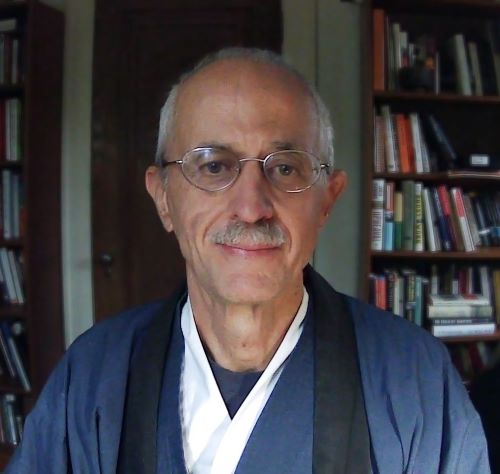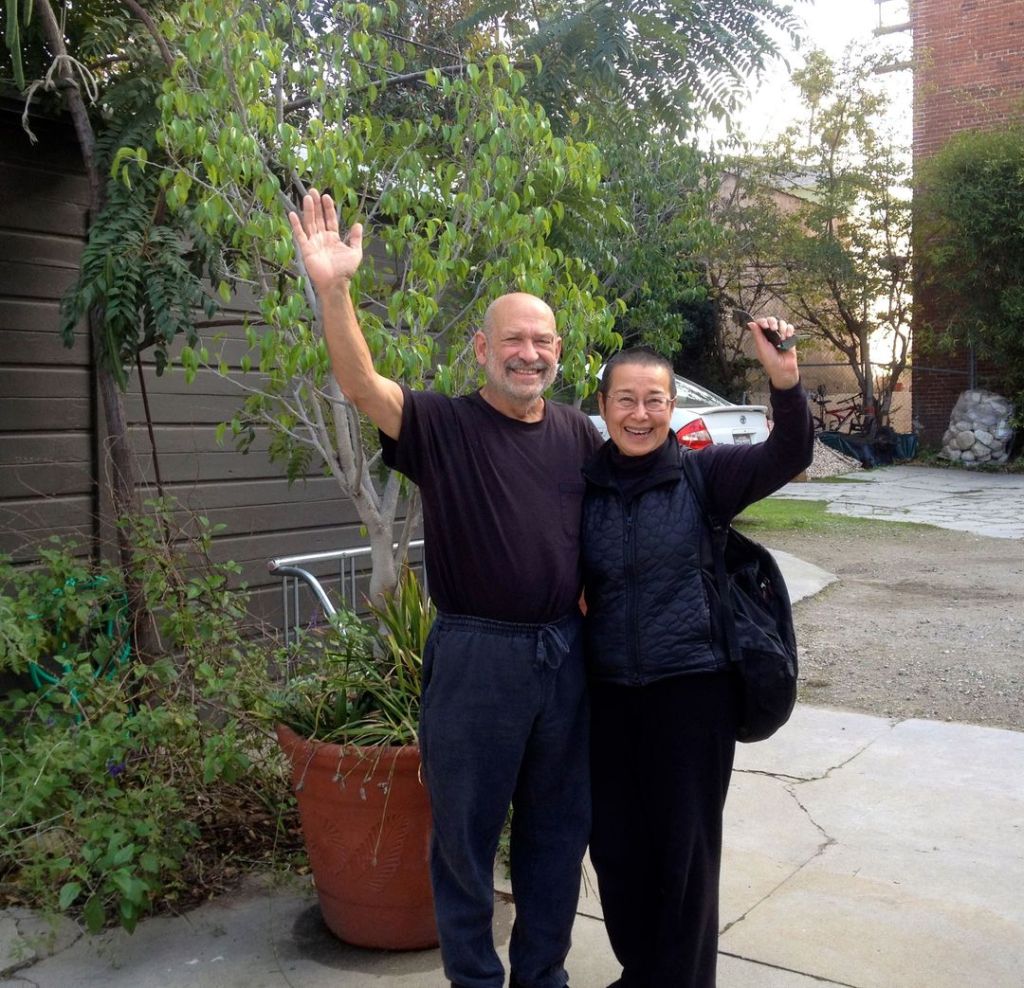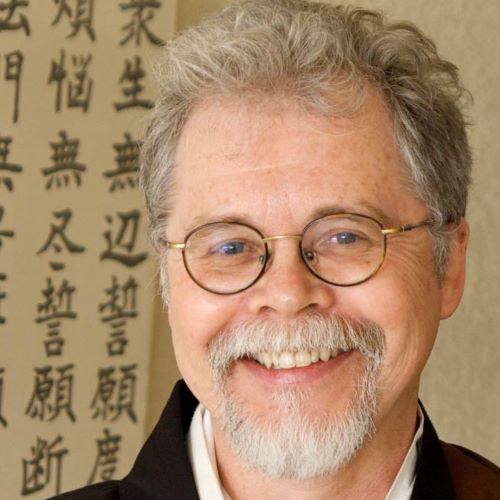
Matthew Juksan Sullivan

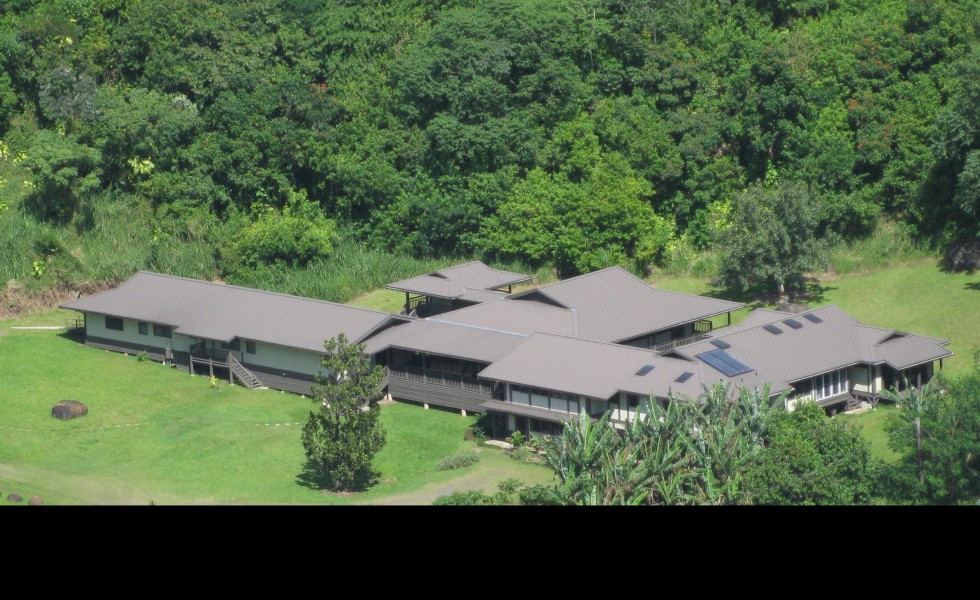
Awakened Meditation Center, Toronto –

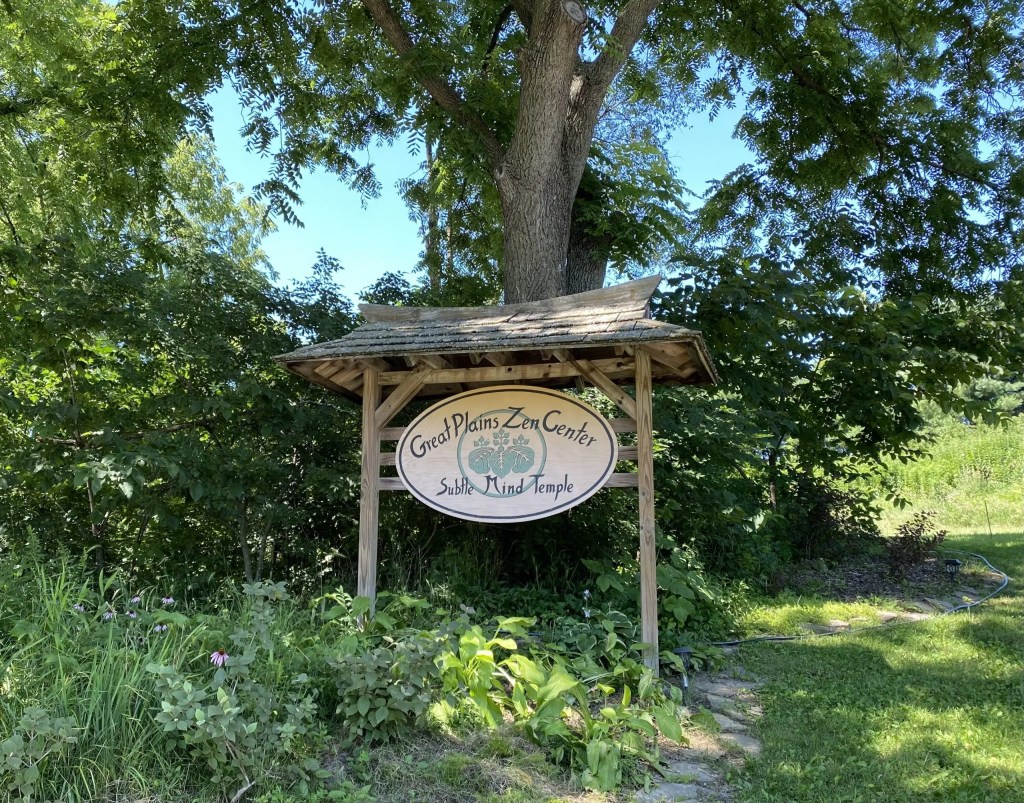
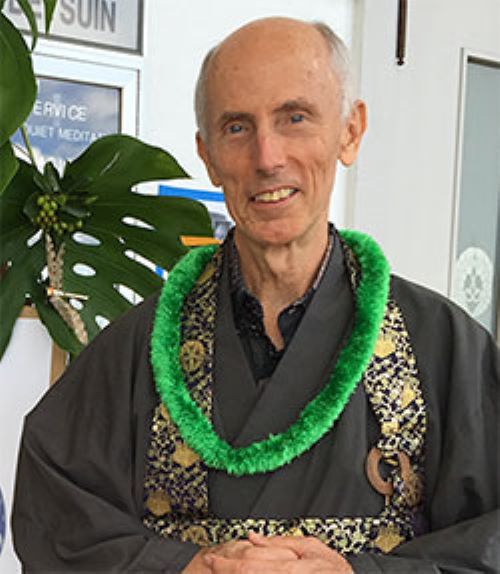
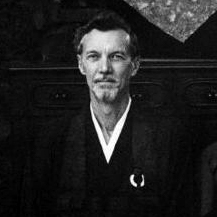
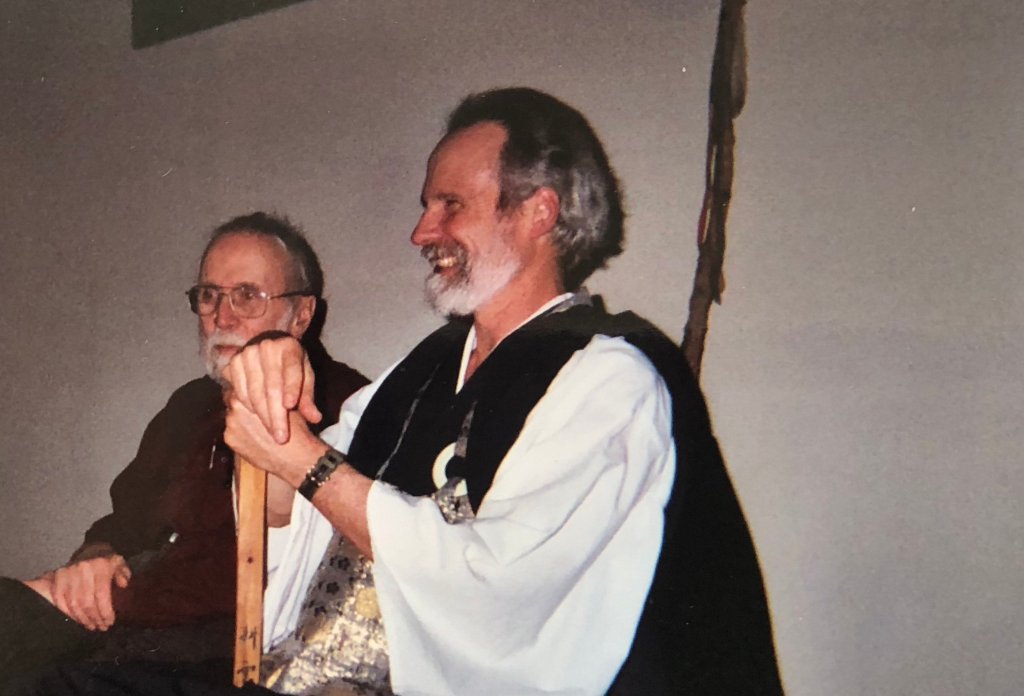
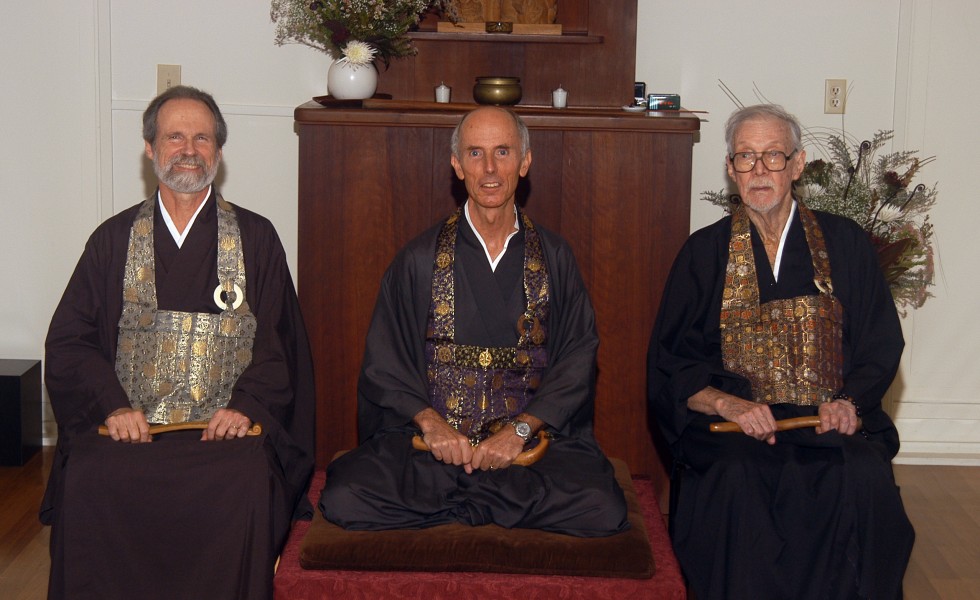
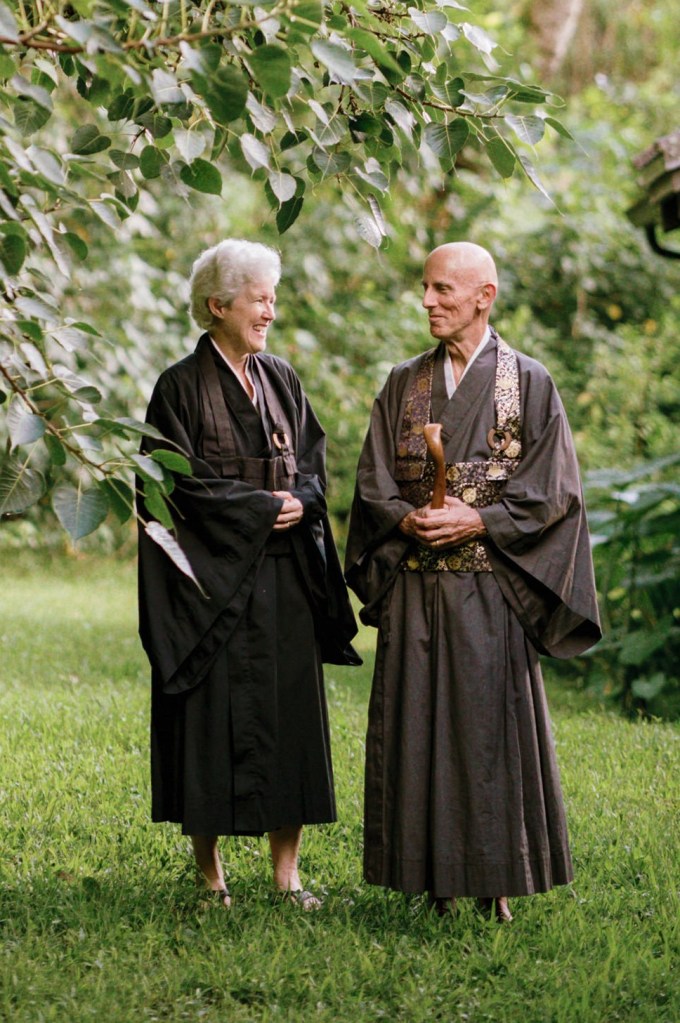
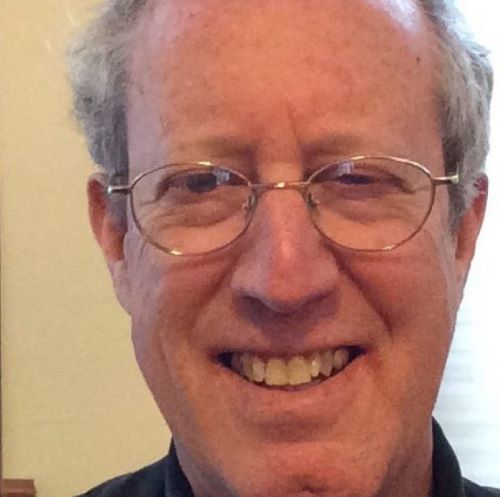
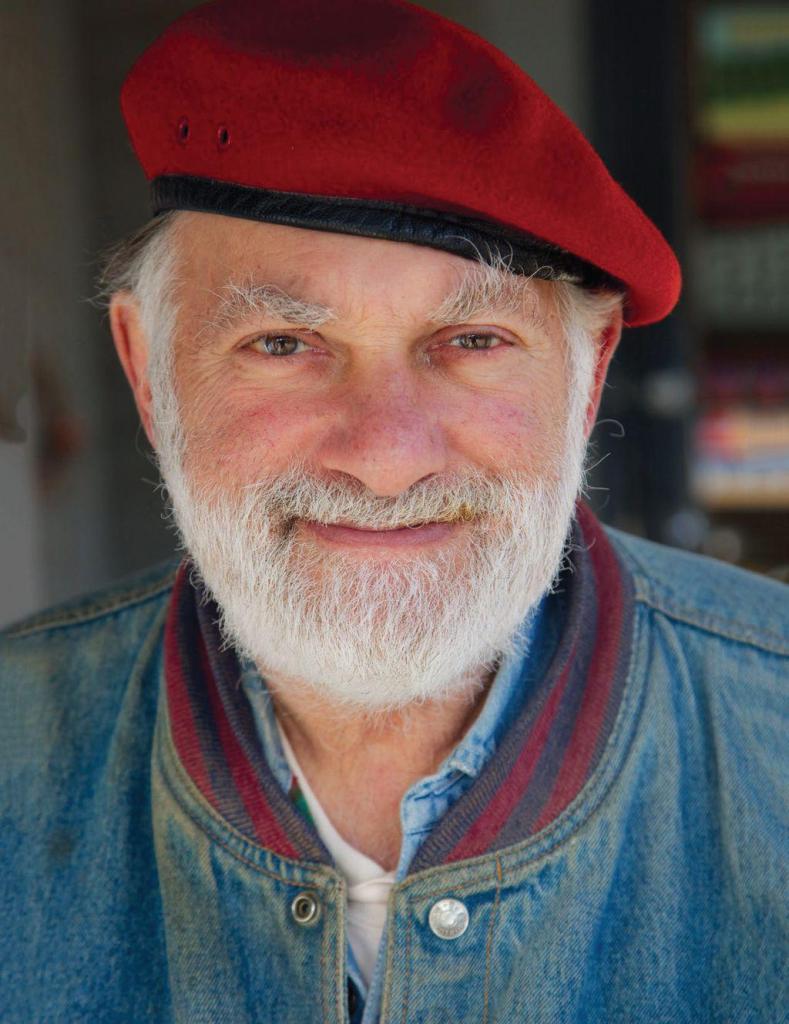
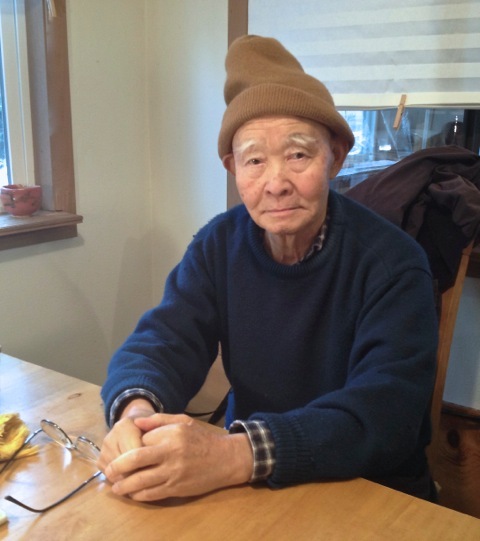
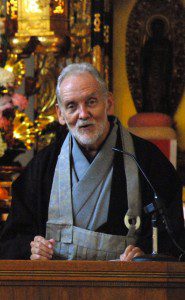
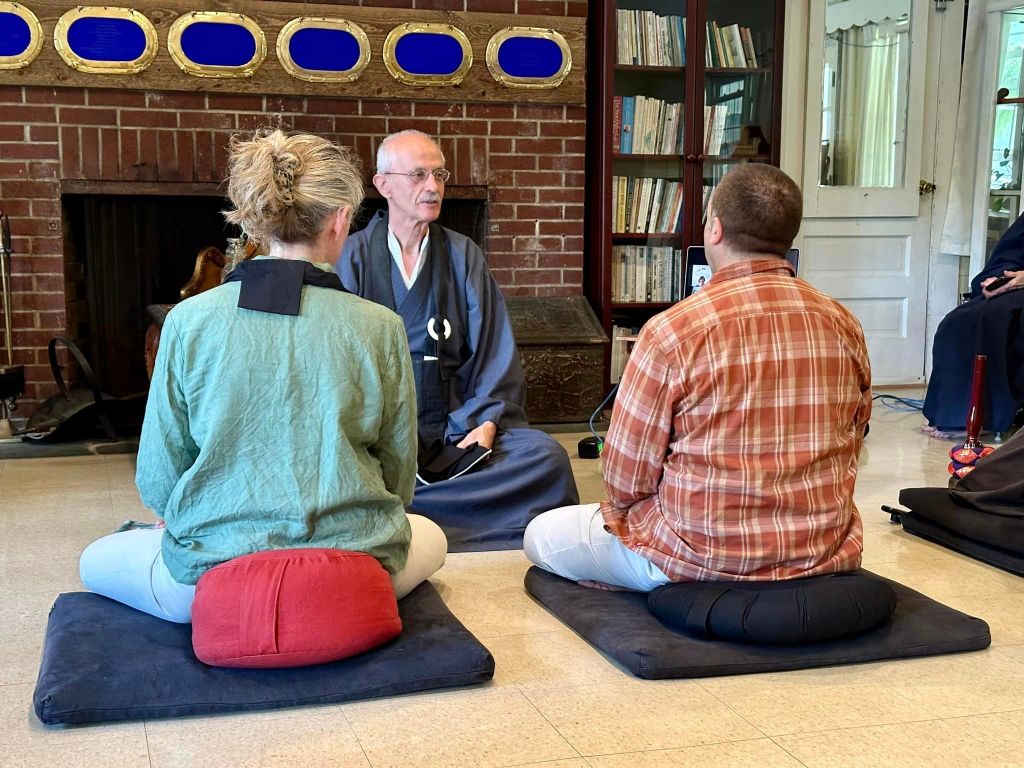
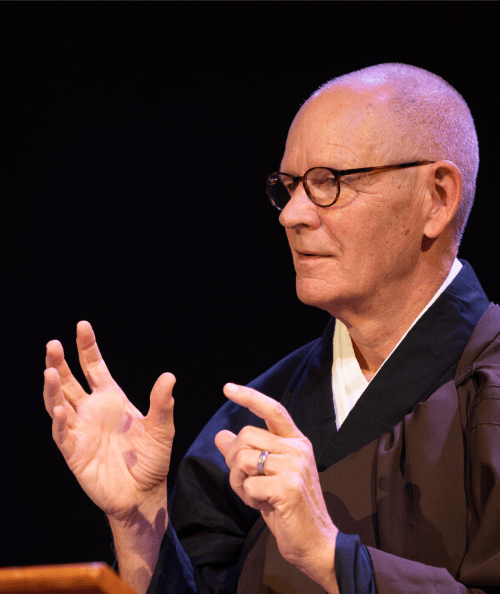
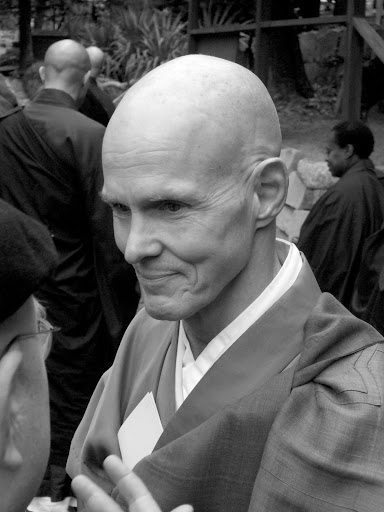
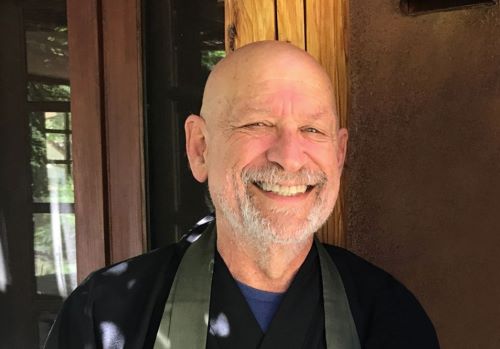
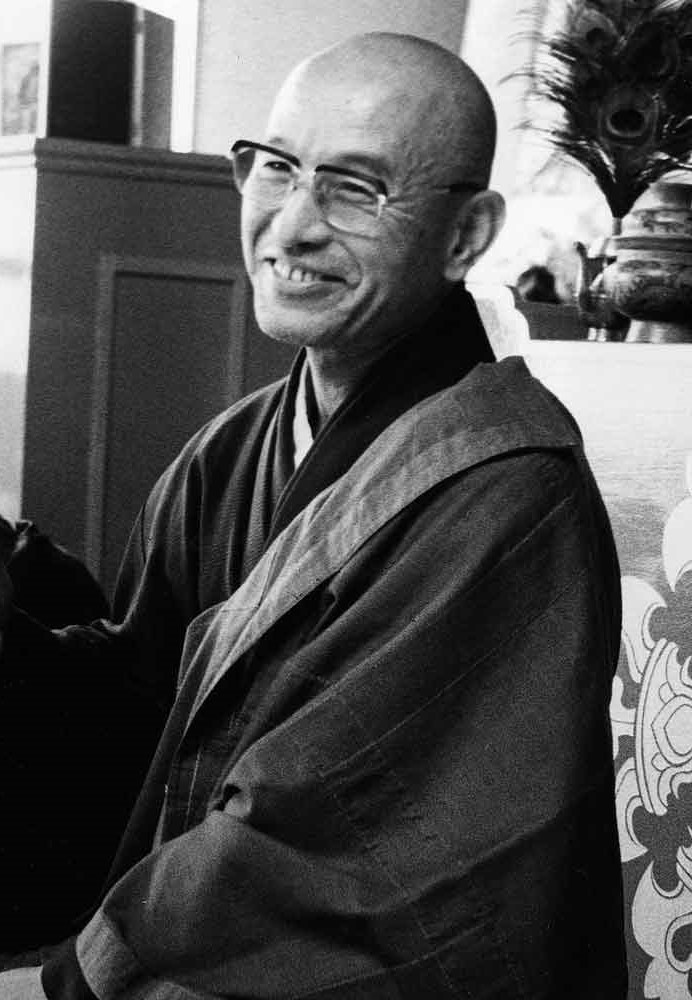
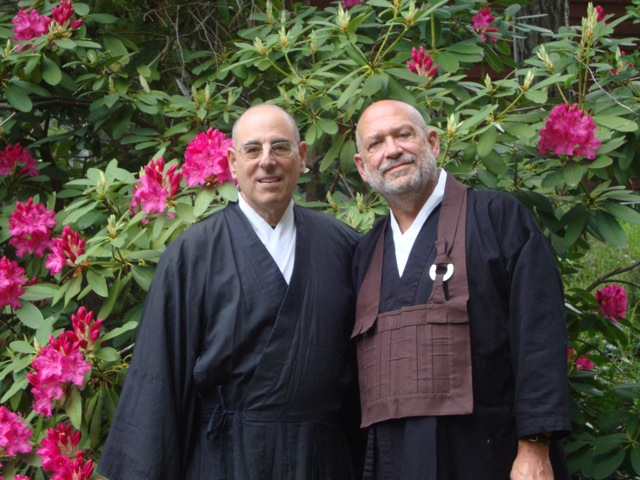
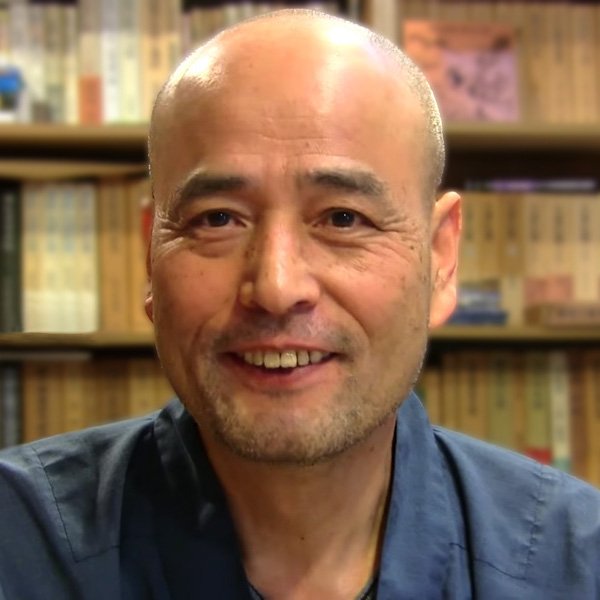
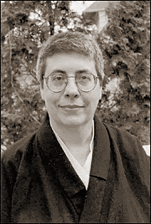
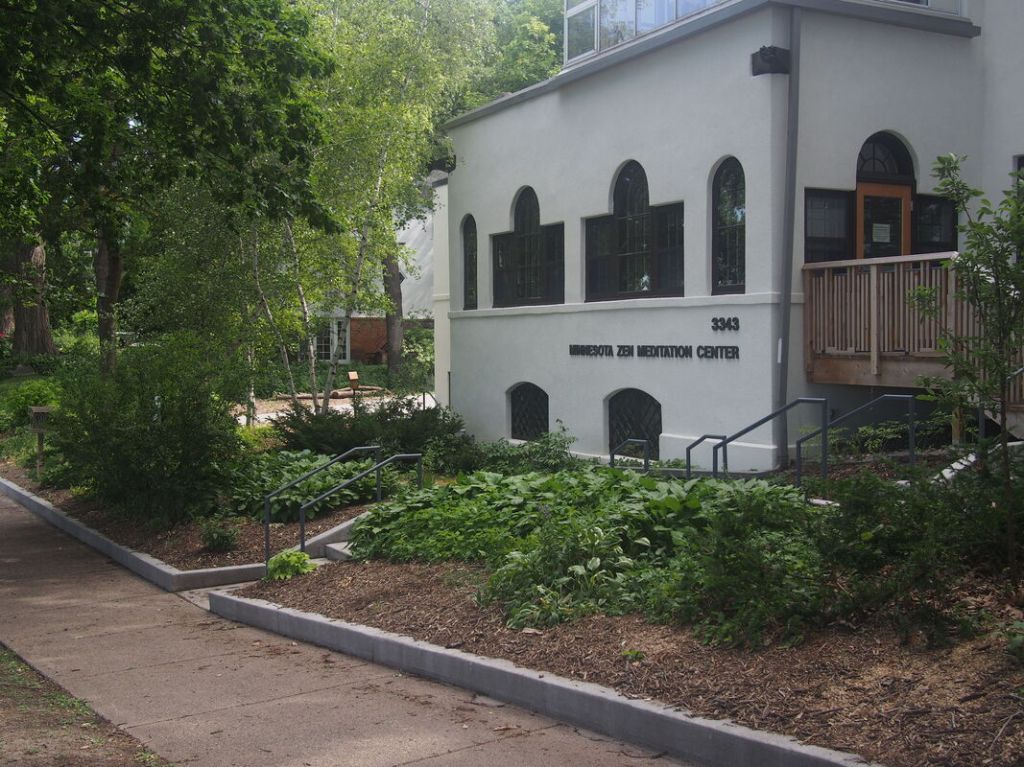
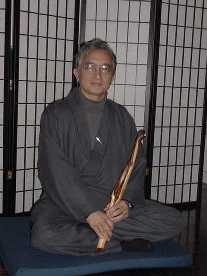
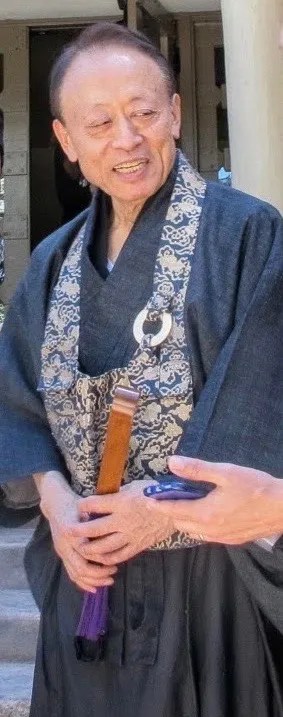
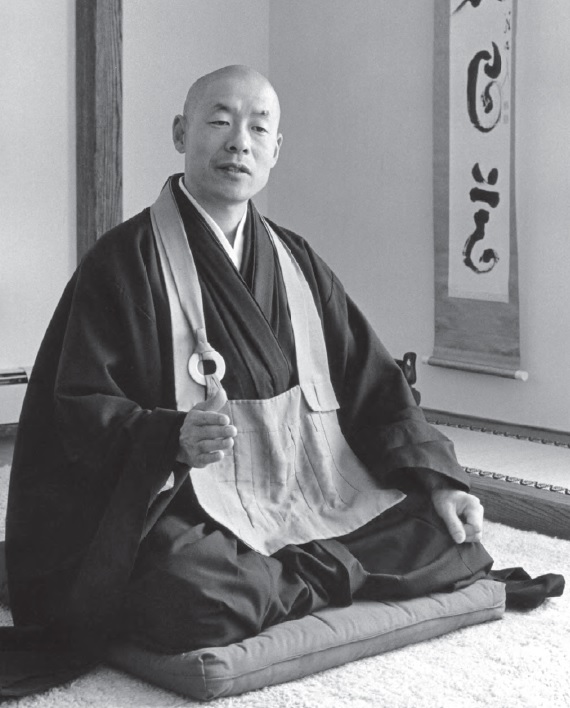
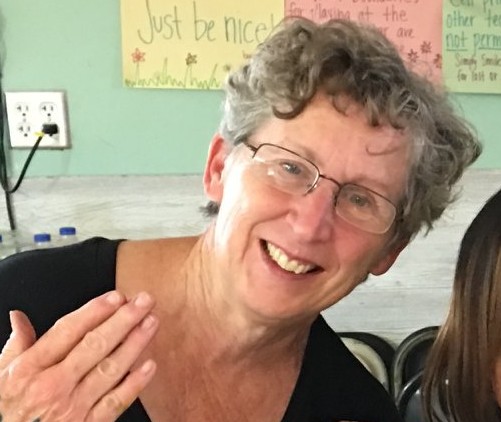
Matthew Sullivan is a Zen Master in the Korean Zen (Soen) lineage of Hwasun Yangil Sunim and a Dharma Teacher at the Awakened Meditation Centre in Toronto.

“What I talk about when I’m teaching meditation to new students – what remains true for me – is there is no particularly good reason to go into Zen,” he tells me. “It’s not something you do for a goal. It’s not something that you can accomplish. It’s not something that you do for any collateral benefits. I think I was originally drawn to the suchness of Zen. At the time, it was the one thing in my life that had ‘suchness.’ You do it for its own sake. And that’s a wonderful thing to encounter.”

When he was a child growing up in Southern Ontario, his family “skirted around faith. My mother was a Protestant and would take us to church every once in a while, but my older brother decided very early on that he was an atheist. And he would get into these big arguments with my mother when she would try to take him to church on Easter or Christmas, but they would come to some interesting compromises. One year he allowed himself to be dragged along to an early morning service as long as he could wear a placard over his sweater that said in big letters, ‘I AM AN ATHEIST.’ Another accommodation my parents made with him that I thought was very sweet was because he was a Communist at the time – I mean, he was about eleven – we agreed that we would have borscht for Christmas dinner every year, and that is a tradition we have maintained for the last thirty or forty years. I still have borscht every Christmas.

“My father introduced me to Buddhism because he became very interested in meditation as he got older – he was never particularly religious when I was growing up – as he got older he started meditating a little bit, and – you know – the thing that I think really drew me towards Buddhism as a young person was he had a copy of Thomas Merton’s translations of Daoist poetry.[1]

Matthew’s father had grown up in a small town, an “outport,” in Newfoundland called Brent’s Cove; it’s current statistical information states that it has 119 persons living in 64 dwellings. “It was extremely isolated. And my dad grew up in a very big, very devout Catholic family. They were so isolated they didn’t have a priest on a regular basis, so my grandfather would be the one who would go to church and say the prayers, lead the congregation in . . . What would they say? I guess it was the Hail Mary. My grandfather owned the big town store. I think the Sullivans’ claim to fame is they opened one of the first salmon canneries in Newfoundland. So my father had been brought up Catholic, but, by the time he was an adult, he had shaken it off.”

“Do you know what got him interested in meditation?” I ask.

“I don’t to be honest. I wish I had asked him that. I suspect it was stress both with work and with – without delving too much into my parents’ life – I mean, he had a difficult time with my mother, and so I think meditation gave him some mental space to help deal with that.

“I was about six and somewhat anxious as a child. I remember working myself into this kind of tizzy when Dad started meditating, and I thought, ‘Well, where’s this going to end? He’s going to run off and become a monk. I’m going to be abandoned!’ Much later I learned there is a term for this, ‘the Dharma widow.’ I guess I was afraid I was going to become a Dharma orphan, but my fears were premature, and all he ever did was meditate in a chair for fifteen minutes a couple of times a week.”

After high school – where he was introduced to Tai Chi – Matthew went to the University of British Columbia. “I took Religious Studies at the University of BC. Mainly what I was studying was Christianity, the origins of Christianity and Judaism. Which had a big impact on the way that I would eventually approach Zen.”

“In what way?” I ask.

“Well, when you study religion in university you begin to understand that there are two ways of understanding any religion. There’s the way within the religion, the internal theological approach, and then there is the external, historical, and sociological approach, what at the time we called the phenomenological approach where you just look at the religion as a fact rather than inquiring into whether it’s good or true or useful. And that would play out, for example, when you’re studying Christianity with inquiries like, ‘Who was the historical Jesus?’ Getting beyond the picture that we have from the way the gospels are cobbled together and told as a unified story. What can we ascertain about the historical figure? Did he exist in the first place? If he did exist, how did he understand himself? How did his contemporaries understand him? How did he operate in the context of his society at the time. And also how do you critically read the sources that we do have – like the gospels or Josephus – how do we read those sources critically in order to be able to separate what was later religious or rhetorical accretions from what have been more reliable historical facts. So that dual way of looking at religion has had a big influence on my approach to Zen because I’ve tried to look at Zen both ways. I’ve practised within the religion, but I’ve never been able to remove the lens of looking at it phenomenologically, so I’ve always been interested in how to critically read our ancient texts to understand how they would have been understood at the time. I’ve tried to be always sensitive to what in Religious Studies we call the redaction history of documents, that is to say the way that they are edited over time. You have some kind of an original kernel of a story. A great example is Zen Master Linji’s koan about ‘there is a true man of no rank going in and out of the red portals of your face,’ which climaxes with Linji’s fantastic exclamation of, ‘The true man of no rank, what a piece of shit he is.’ That story has a redaction history that we can trace, where it actually starts out much more simply and less punchy, and over time it’s edited and in someways lengthened and in someways shortened to become this extremely memorable, pungent koan that I think is one of the great treasures of our tradition. But it wasn’t spoken that way by Linji. If it was spoken by him at all, it was a very different thing. So all of that is to say I’ve always had a foot in each side of the divide, and it’s given me this kind of weird 3D glasses half-in/half-out way of approaching the Zen tradition.”

While in university he “borrowed” another book from his father, Lawrence LeShan’s, How to Meditate. “I loved that book,” he tells me, “and I used it to teach myself meditation.”

I ask why.

“Well, I did it because I was very unhappy. I don’t know if I was any more unhappy than most undergraduates, but I was unhappy. And I was lucky enough to find this book and start using it at the same time that I started attending some cognitive therapy sessions through the university. And that was a real life-altering combination for me. I found that the two things worked very well together.”

“Do you mind telling me what prompted you to take up therapy?”

“I mean, I was quite unhappy. I had a tumultuous relationship with my first serious girl friend. That relationship was a proving ground for a lot of emotional literacy for me, and if it prompted me to get into therapy and take up meditation, that is something I’m deeply grateful for because it’s a wonderful combination, and it worked extremely well for me. And it really converted me to the joys of both things. The joys of good, crisp, purpose-oriented therapy and the joys of meditation as a way of understanding your own mind.

“So that made me very curious about Buddhism. And I did a year-exchange program at the University of Glasgow where I continued to study the origins of Christianity and Judaism, but I also started attending regular meditation classes associated with the Friends of the Order of the Western Buddhist. I got to go on my first meditation retreat. I was never tempted to get too deep into that particular organization, but I was grateful for the instruction that I got from them. And the pivotal entry for me was, before I left for Glasgow I married my first girl friend – the one with whom I had the tumultuous relationship – and then, while I was in Glasgow, we broke up. So it didn’t take. But I was very upset about this, and I returned to Vancouver to try and patch together the relationship.”

“She had not gone to Glasgow with you?”

“She had not.”

“And that hadn’t seemed problematic at the time?”

“Yeah, in hindsight it seems so clear. So I went back to Vancouver and was not able to patch together the relationship, but what I was able to do was a friend of mine had found a retreat centre – by chance almost – on Salt Spring Island, which is one of the Gulf Islands off the coast of British Colombia. And when I came back to Vancouver, I thought, ‘Well, I really need somewhere to put my head on straight.’ So I contacted them and asked if I could come just for a couple of days, and it was a life changing experience for me.”

It helped him gain insight into the relationship which allowed it to end well. It also introduced him to the idea that “the Dharma isn’t something that is only carried by people or books. It’s also carried in place. Sometimes places are a teacher in themselves. It was a Tibetan Buddhist retreat center in the Shangpa Kagyu tradition of Kalu Rinpoche. He had founded this retreat center to be one of the first places in North America where western students could complete the enclosed three-year retreat that is necessary if you want to become a lama in that tradition. It’s almost at the top of a pretty small mountain overlooking the water on Salt Spring Island. Very isolated. To get to it, you have to climb up a long logging road. And it has the imprint of decades of devotion. Students have built retreat cabins and retreat spaces up there. All the buildings just have a lot of love in them, and so it was a really special place to find. When I first went there, it was even more special because it didn’t have electricity. If you wanted to see in the dark, you needed oil lamps. And it’s a magical experience to rise in the morning for group meditation and light your oil lamp and go into the shrine room. A wonderful introduction for me. I really fell in love with that place.”

His first visit was only two days long. Then he did a week-long retreat. “And after that week, the lamas invited me to come up for a summer and pay for my stay by working in the kitchen and doing other tasks around the retreat center including being the librarian.” He stayed three months and considered an even longer stay, but he finished his undergraduate work and practicalities took over. He decided to return to Ontario and go to law school at the University of Toronto.

“But I wasn’t very happy in Law School. So I thought what I should do was take a year off and go on retreat back to Salt Spring Island.” The school “with some grace” allowed him to interrupt his studies for a year, and, at the age of 25, he spent a year on retreat. “Cooking. Meditating. I don’t know how well you know the Tibetan tradition, but there’s a long preparatory practice called the ngondro which involved things like doing 100,000 full body prostrations as well as doing visualizations and that sort of thing. So I took the year to do the ngondro and also learned to cook, which was probably more useful.

“But it was an immensely influential year for me. If you read my book,[2] you’ll see that even though I’m writing about Zen Buddhism, a lot of the reflections arise out of things that happened to me during the year, realizations that I had during that year. Perhaps the most important realization I had during that year was I did not want to become a monk, that I was more suited to lay life. But it was a wonderful experience. And I returned to Toronto after it, graduated law school.”

He found work at the Department of Justice where to this day, twenty-two years later, he works as a research lawyer in the Litigation, Extradition and Advisory Division. And he felt the need to find a sangha in Toronto.

“I also realized that as much as I loved the retreat center, and as close a bond as I had with the two teachers who taught there, doing the ngondro showed me that Tantric Buddhism wasn’t my bag. And so I decided to look around to what other kind of teachers I could find in Toronto.”

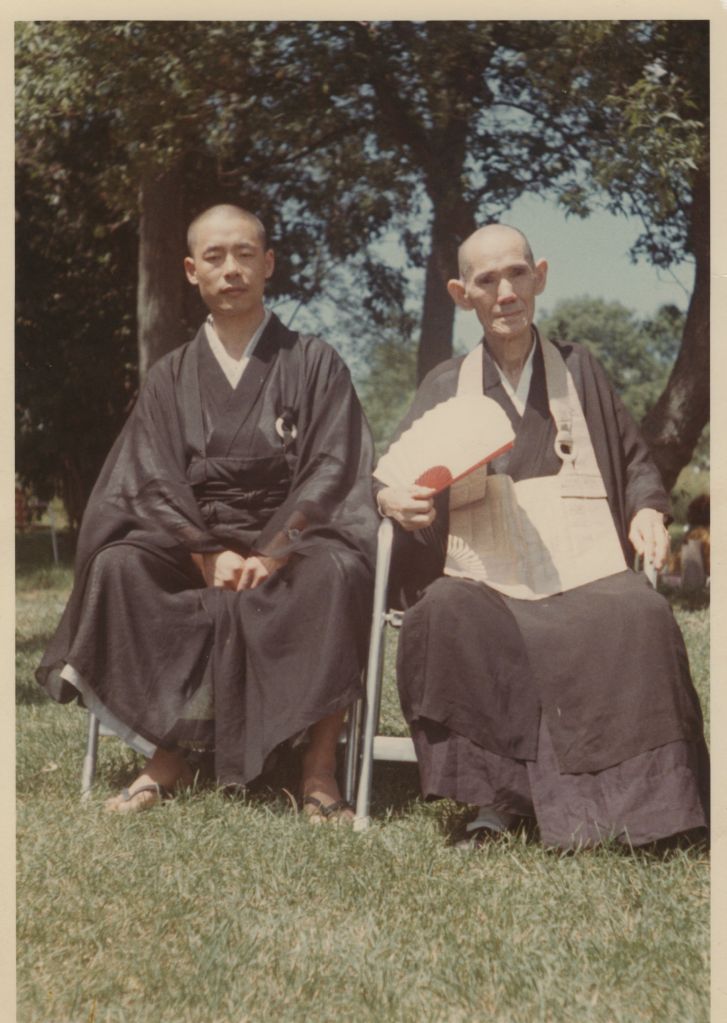
Yangil Sunim

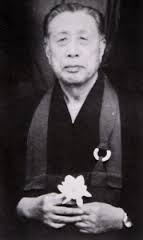
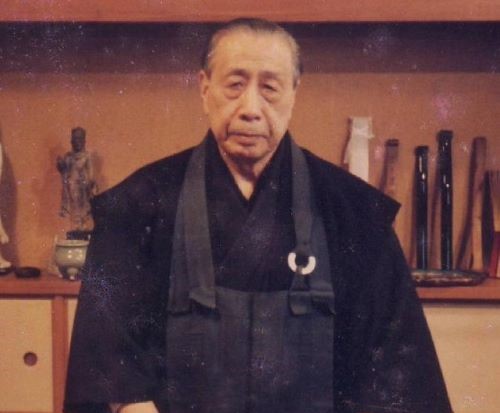
The teacher he found was Hwasun Yangil Sunim. “He’s a Zen monk born in Korea who immigrated to Canada in the mid-80s and started his own temple. And when I met him, I almost immediately realized, ‘This is my teacher!’ And I have been in and around his temple ever since.”

“What struck you about him?” I ask. “You said you liked the Tibetan teachers you’d met on Salt Spring but didn’t stay with them. What did Yangil Sunim have that they didn’t?”

He reflects a moment before answering. “Sunim[3] is a teacher of great charisma, as many teachers of his generation were, and almost as soon as I met him, I felt like he had something to teach. He had a Dharma, and he had a Dharma that he could transmit.”

“A sense of authenticity?” I suggest.

“It’s more than just authenticity. He has authenticity, but he also has the thing that I now realize is indispensable in Zen, which is you have to have your own take on it. It’s not a generic teaching; it can’t be a generic teaching. It’s only real teaching when it is put inside a vessel of its own shape. And when I met Sunim, I immediately realized this man is a vessel of his own shape, and if I stick around him long enough maybe I will be able to form my own shape.

It was at this point that I asked him what the function of Zen practice was, and he told me that it had none.

I take another tack. “You’re still a lawyer.”

“Part time.”

“So I’m guessing you occasionally come across people who say things like, ‘I hear you meditate; I hear you’re involved with Zen.’ If you’re talking with someone who has some familiarity with the tradition, you might be able to talk about its ‘suchness,’ but how do you explain it to someone who’s just curious?”

“It is you, Rick, who should be the lawyer. You’re doing exactly what a good cross-examiner would, which is pinning me down. And now that I am pinned down, I will absolutely confess Zen practice, attending a temple, studying under a teacher has lots of collateral benefits, and these are all collateral benefits, I admit, that I enjoy. I enjoy the sense of community. I enjoy the collateral benefits of meditation which are being happier, understanding your own mind better. A satisfying sense of transcending the worst parts of day-to-day existence and enjoying the best parts of day-to-day existence. I enjoy Buddhism because it’s changed my whole way of thinking about very important useful things like boredom, like a lack of self-improvement, like embracing your own very faulty nature, all those things I learned through Buddhism. Those are all marvelous collateral benefits. I mean, it’s fun just watching the mind pivot, and this is something that anyone who likes learning understands. But anyone who studies Zen will understand even more. It’s like learning to do yoga exercises that move your mind in ways you didn’t know your mind could move. And merely making those motions is itself a delightful experience. And so those are all collateral benefits that have kept me in Zen, but, counsel, I return to my original point which is that it has no purpose.”

I know a little bit about the Kwan Um School of Zen, and the various stages of authority people who become teachers pass through. Matthew tells me that Yangil Sunim had been influenced by that model but had also modified it. “So, like in their tradition, he would ordain someone as a Dharma Teacher first. I believe I was the first person to be ordained by him as a Dharma Teacher. Lots of people would subsequently be given that designation. And then he would ‘transmit his Dharma’ and designate people as a Zen Master. I believe he did that with me in 2016.”

“Does anyone ever get Dharma transmission and then not use it? Does not go on to teach.”

“Well, his method is very interesting. I mean, he put very few institutional requirements on any of us, I would say. Certainly not official ones; certainly not regular patterns. The strength and the weakness of the Awakened Meditation Center under him is that it is very informal. I love his Dharma partially because it has this lack of stricture. I think it’s one of the reasons why he came to North America and one of the reasons why he stayed. He doesn’t actually have a ton of time for institutionalizing things. And in fact my Zen temple right now is in a bit of a twilight period because last year Sunim announced he was retiring, and he was going to return to Korea and never coming back. His western students – myself included – would take over teaching westerners, and a new Korean monk would come from Korea to attend to the needs of the Korean congregation because his temple had always that kind of dual role. So we said tearful farewell, and then within four months he was back at the temple because he just didn’t like living in a monastery, I think. So he’s largely retired but not exclusively, and so, as I say, we’re in this liminal period where he’s still kind of the boss and yet he’s both just devolving and undevolving responsibilities to us. He has named people Dharma heirs and not everyone who does that teaches. A few people who have received that transmission have gone off on their own and done their own thing, not under the umbrella of the Awakened Meditation Center.”

“As teachers?”

“Yeah. He’s transmitted to about eight people now. Somewhere around that number. And at our temple now are three or four who regularly come who have received transmission, and three of those four take an active teaching role, myself being one of them.”

“What does a Zen teacher teach?”

“That’s an excellent question.”

“Since it has no purpose.”

Matthew laughs. “I think the most important thing we do is teach newcomers the basics of sitting. I love doing that, and it’s nice when they come back. But I just like putting it out into the world, and if I never see them again that’s just fine.”

“I’m guessing that’s most of them.”

“Yeah, but it’s enough to just put it out there.  And then at my temple, we always begin every class with a tea ceremony which has always been a big part of Sunim’s Dharma. In fact, he doesn’t give Dharma talks very often, but the last one he gave at the last retreat we had was about the unity of tea and Zen. So we always have a tea ceremony, and then we give instruction to those who are new. We sit in a group, and then one of the teachers will give a short Dharma talk usually talking about a koan or something like that.”

He explains that the Korean approach to koan introspection differs for the Japanese tradition in certain regards.

“We don’t really graduate through koans. There is no program or curriculum of koans. It would be very normal for someone to have one koan for their entire life. And the koans we use – I think this is also true in the Kwan Um School – the koans we use are often not derived from Zen stories. Often they’re just simple questions like ‘What am I?’ or ‘What is this?’ or ‘Put it down.’ That sort of thing. Someone might use one of those koans for decades.”

“What is the value of koans?” I ask. “I mean the more traditional koans like Gutei’s finger or the turtle-nose snake on the South Mountain. What do they do?”

“I think koans are the great treasure of the Zen tradition, and what they will do for us is give us a new way of reading. Instead of reading in order to gather information or to acquire information, koans are much more like poetry in that the purpose of the koan is to evoke something in you. But unlike poetry which is meant to evoke an emotion or a feeling, koans are more like what we spoke about earlier, the motions that your mind makes in Zen. The point of a koan is that when you read it – I won’t every koan but many koans – the point is that when you read it and you stub your toe on it, you’re frustrated with it. And sometimes that encounter, that hard encounter, is a long grueling ‘What-in-the-name-of-Jesus-H.-Christ-does-this-mean?’ kind of encounter, and sometimes it’s a very short, sharp, instantaneous stubbing of the toe. You know, you read something, and your mind just stops for a moment. But however it happens for the individual, the point is that your mind doesn’t work the same way as you want it to work. The koan has shoved you into a different stream. And our first instinct, of course, certainly before we study Zen – but even for most Zen students – is that you want to get out of that new rut. You want to get back into the world of understanding, or you want to get back to the way of digesting this as some information that you can assimilate into yourself. But what Zen hopefully teaches you is that, no, this getting knocked into a different route is itself precisely the point. That is a motion of your mind. And the more that you get to experience that, the more familiar you get with those kinds of abrupt, strange motions, the more interesting life becomes.”

“Okay. What is ‘awakening’?”

“Overrated,” he says with a laugh.

It’s such a delicious answer, I consider stopping the interview there.

“Coming to the realization that awakening is overrated is central,” he continues. “It’s extremely helpful. In the Blue Cliff Record it says speaking about these things isadding frost to snow. But, of course, awakening is real. It happens. It’s good . . . Until it’s bad. But it’s overrated, and there are other things to do, like sitting or being nice to people.”

This brings us to a discussion of the role of compassion (karuna) in Zen practice, as well as to the role of the Precepts – which are very important in the Kwan Um School – in Yangil Sunim’s tradition.

“That is an excellent question, and, taking a step back, I would say that is one of the great tensions within Zen. It is easy to judge a lack of compassion in Zen practice, and I think it is a mistake because it cuts you off from the great realization that ‘egoless’ and ‘compassion’ are ‘two words the same thing.’ Real compassion – not, like, abstract ‘loving every human being’ – but actual practical compassion is sort of the answer to meditation, to getting high on emptiness and that sort of thing. So it’s a very important tension. In my tradition, I can’t say that we follow the Kwan Um School as closely, which is to say that Precept instruction has never been a big part of Sunim’s teaching. I remember once asking him some question about what to do in an ethical situation, and he said to me, ‘Sometimes your Precepts are open, and sometimes your Precepts are closed. Don’t ask me when your Precepts are open and when they are closed.’ And that was the extent of his teaching on the Precepts. And this is quintessential Yangil Sunim. When he thought you were developing as a student, when he thought you were a serious student, he would also arrange to have a big formal Precept-taking ceremony for you, and everyone would gather, and there were congratulations, and it was a sweet moment. But we never knew what the Precepts we were taking were. And once you looked at the form he would give us – listing the Precepts we’d just agreed to – they would always be things that none of us would do, and he knew we would never do. I’ve sworn a Precept to never use money and never sleep on a bed higher than six inches off the ground. That’s his way. That’s what makes him what he is. And in its own way – I mean it’s wacky – but it also gets at one of the essential truths about the Dharma, which is it’s deceiving. The Dharma is a trickster, and you can’t get too attached to it because, on the one hand, it’s the most important thing in the world, and on the other hand it’s a bundle of lies and chicanery.”

“Oh,” I say, feigning to be scandalized, “are you going to tell me that Shakyamuni didn’t really twirl that flower?”

“Well, what an excellent hook-back to what we were discussing earlier about my early education in the origins of Christianity. One of the things I do in my book is I am very interested in both celebrating and talking about the myths of Buddhism, the essential myths of Zen. The Flower Sermon is one example. It was news to me, but I felt very important, when I discovered that the Flower Sermon wasn’t mentioned I think before the 11th Century.”

“Nope,” I say. “Not in the Pali Canon. It’s like when the Protestants translated Bible into the vernacular and discovered that things like indulgences weren’t in it.”

“Exactly! But unlike Martin Luther, I think we Zen students – mature Zen students – can be flexible about what this means. It doesn’t mean that I don’t teach the Flower Sermon. It doesn’t even mean I don’t revere the Flower Sermon. It just means the Flower Sermon joins just about everything else in that it is both sacred and an invention.”

“In the way most people,” I suggest, “acknowledge that their lineage charts which are supposed to go back to the Flower Transmission and Mahakasyapa aren’t actual historical documents that stretch back with any accuracy much beyond the 9th century.”

“That’s right. But at the same time, I think lineage is extremely important. I mean, I agree with you, and yet I think lineage is important because I think it’s good to know where someone is coming from; I think it’s instructive to know who their teacher was and how they have shaped their teacher’s Dharma into their own Dharma. And it’s useful to know if someone has had approval from a teacher in order to teach themselves. All those things are very useful.”


[1] Thomas Merton, The Way of Chuang Tzu, 1965.

[2] The Garden of Flowers and Weeds. 2021.

[3] “Sunim” is an honorific title for a senior monk.

Jiyu Kennett

Adapted in part from The Story of Zen

The history of the transition of Zen to the West is a tapestry of concepts, personalities, and events. One of the most distinctive elements is the story of a Japanese-trained Englishwoman who appeared in San Francisco in 1969.

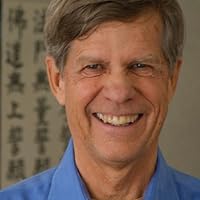
“I’ve been trying to reconstruct Jiyu Kennett Roshi’s history,” James Ford told me during the first of our several conversations. “There’s this whole hagiography machine around her at Shasta. There’s what I knew, and then there’s what I learned from secondary sources since. It’s still pretty much my belief that she had a mandate to do something in London, and she had swung by San Francisco in 1969 because it was the first successful outreach to the gaijin.  And you can say many things about Jiyu Kennett – some really good – and among those was, she was real smart. And she arrives in San Francisco. She thinks about London. She decides she’s going to put her business up in California. And she moved into a flat on Potrero Hill, and now she was receiving, and I was her first student. Now there is another fellow who claims he was her first student, but he arrived there on a Thursday, and I was there on a Wednesday.

James Ford

“So I started sitting with her. I mean I had an actual teacher right there I could see every day, and I would spend all my time there. But then her parents had both died while she was in Japan, and she had an estate; not much of one, but there was something to wind up, and she had to go back to London. She brought two students with her, and I was invited to move into the flat on Potrero Hill and pay the rent. With the proviso that I marry my girlfriend. So we got married. And it caused sadness for both of us.” The marriage didn’t last, and James still feels resentment about being forced into it.

“But we moved in. And – you know – I was a residential practitioner from that point on. After Kennett Roshi had been in England – I forget, a couple of months? – she sends a note saying she’s bringing sixteen people. We better move. So we acquired a very large house in Oakland, and I ordained in Oakland. Unsui. Then it really went fast. Acquired the property on Mount Shasta within the year, and I received transmission up in Mount Shasta.”

“How old were you?”

“Twenty . . . I can’t remember now. Twenty-one or twenty-two. Yeah. A child.”

Gyokuko Carlson also received transmission from Kennett in the ’70s. “Roshi Kennett transmitted extremely early,” she tells me. “It boggles my mind how quickly she transmitted people.”

“And this gave you the authority to teach?” I ask.

Gyokuko Carlson

“Which is why it’s staggering that it came on so early. I think it might be influenced by the fact that she was transmitted so early herself, that that early transmission felt kind of normal to her.”

“How old were you?”

“When I got transmission? I’d only been ordained two years.” She calculates the dates in her mind. “Uh . . . 1977 . . .”

“That would have made you 28.”

“Yeah,” she says, echoing James. “A child.” Then a little later, she adds, “You know, when I was ordained by Roshi Kennett, she didn’t know me.”

“Did you think of her as your personal teacher?” I ask.

“What I identified as my teacher was the abbey itself and the schedule. There was a novice master, and I was allowed to talk to him about questions I had. He was a little bit imperious and not super-approachable. You could sneak questions to other seniors as needed, but I almost never had any kind of conversation with Roshi herself. She gave lectures. She would attend teas sometimes. But she was kind of off in the distance. Before I was ordained, a couple of times, she would address me by some other monk’s name. You know, ‘round face girl.’ There are a bunch of them; they can all go by one name.”

I ask her what she meant by saying the abbey and the schedule had been her teacher.

“Well, I felt that I was being immersed and disciplined into a way of life that was structuring my mind. We sometimes say about the meditation posture is that you’re using your body to direct the mind. And I felt that everything in the schedule and the method of being, the deportment, it was all there to direct the mind.”

Peggy Kennett had been born in Britain in 1924 and studied medieval ecclesiastical music at Trinity College. For several years, she was a church organist and admitted later in life that she’d felt drawn to the priesthood; unfortunately, that wasn’t yet an option for women in the Anglican Church. That discrimination caused her to question gender roles both within the church and in society in general. It also provoked a growing dissatisfaction with Christianity as it was currently practiced.

Her father had belonged to Christmas Humphrey’s London Buddhist Society when it was still associated with the Theosophical movement. Kennett joined as well in 1954 and began a correspondence course on Theravada Buddhism through the Young Men’s Buddhist Association in Ceylon. Her interest in Zen began when she met D. T. Suzuki during one of his visits to London. Then, in 1960 the Society asked her to organize the visit of a Soto priest, Keido Chisan Koho. He was pleased with her work on his behalf and invited her to come back with him to Japan. She agreed although it took another two years before she was able to join him at the prestigious Sojiji Temple in Yokohama.

Peggy didn’t have an easy time at Sojiji. There hadn’t been a female student there since the 14th century. More traditional members of the community resented her presence not only as a woman but as a foreigner, and they made her stay difficult. With Chisan Koho’s support, however, she persisted and even achieved kensho. In her biography, she said it came about in part because of the frustration she felt with the way she was being treated. Once she let her sense of self drop, she achieved awakening and felt only gratitude for those who had tormented her.

Chisan Koho gave her Dharma transmission in 1963, and for a period she served as abbess of Unpukuji in Mie Prefecture where she worked with non-Japanese students. Koho expected that she would return to England and sent a letter to the Buddhist Society informing them that Kennett was to be the Soto bishop of London. Humphreys was surprised and wrote back, tactlessly, that they would prefer a “real Zen master.” Koho was angered at having his authority questioned and ordered his secretary to “write to this man in England and tell him he obviously understands nothing whatsoever about true Zen.” Humphries didn’t appreciate the tone of the letter, and Kennett was no longer welcome in the London Buddhist Society.

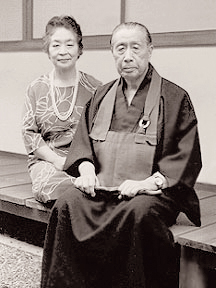
Chisan Koho

She left Japan after Koho’s death in 1967. Her health wasn’t strong at the time, and the animosity of the conservative Soto community continued. She may have hoped to establish a teaching center in England regardless of the Buddhist Society, but as it happened she undertook a lecture tour in the United States which gave her an opportunity to visit the San Francisco Zen Center in 1969. Impressed by what she saw there, she was inspired to remain in the city. She found an apartment in the Potrero Hill district and began receiving students. Within a year, she and a number of disciples she’d gathered – including James Ford – moved three hundred miles north of the city to the township of Mount Shasta.

Shasta Abbey – as her community became known – could house fifty monks, a term indiscriminately used for both males and females. At times Kennett referred to the members as “he-monks” and “she-monks.” Her experience both with the Anglican Church and in Japan made her determined to ensure that men and women were equally respected in the community. The writer Sandy Boucher noted in her book, Turning the Wheel: American Women Creating the New Buddhism, that in her personal experience – not just as a Buddhist but as an American woman – her visit to Shasta Abbey was the first time she felt she was “in an environment where women were equally visible and equally responsible with men.”

Kennett fell seriously ill in 1975. She consulted a traditional Asian healer who diagnosed that her condition was due to stress. He warned that she would be dead within three years if she didn’t change her lifestyle. So in 1976, she took leave of her position as abbess and went into solitary retreat. Over the next nine months, she claimed to have meditated both on her present and past lives and as a result had a series of forty-three visions comprised of both Christian and Buddhist elements.

It isn’t unusual for people engaged in prolonged meditation to have visions. The Japanese term for these is “makyo,” which essentially means hallucination, and they aren’t generally considered to be more significant than dreams. Kennett, however, considered her visions a form of kensho and believed they were genuine revelations. The fact that she overcame her illness – and lived for almost another twenty years – was, to her mind, evidence of their validity.

In some ways – as the content of the visions demonstrated – Jiyu Kennett never wholly abandoned her emotional ties with the Anglican church. She claimed that Chisan Koho had told her to develop Western forms for Zen practice in order to make it more accessible to Americans and Europeans. Taizan Maezumi had said something similar to his heirs. The controversy with Kennett was the way in which she chose to carry those instructions out. In the early days, the clerics of her order wore Roman collars, were addressed as “Reverend,” and resided in “abbeys” or “priories.” The chants were translations of traditional Soto texts but were sung in Gregorian plainsong with organ accompaniment.

Unlike many Soto teachers, Kennett insisted on the importance of kensho, maintaining that it was fairly easily attained through committed zazen practice provided the student remained focused on the “intuitive understanding which the teacher is always exhibiting.” Stephen Batchelor, writing about Kennett, explained:

“All theories, ideas, concepts and beliefs have to be discarded. In their place one ‘must have absolute faith in the Buddhanature of the teacher.’ Therefore, she concludes, ‘Zen is an intuitive RELIGION and not a philosophy or way of life.’ She deplores how for centuries Buddhism has been denied as a religion: ‘this was because [people] feared saying the Truth lest they set up a god to be worshipped. The Lord is not a god and He is not not a god.’”

Although the initial kensho experience, according to Kennett, was equally accessible to lay and monastic, if one wanted “to go further than that” a deeper commitment was required which was – she later insisted – not consistent with an active sex life. So, in spite of having compelled James Ford to marry earlier, she now asserted, “If you’re married, the singleness of mind, the devotion, the oneness with [the] eternal can’t take place, because you’re dividing it off for a member of the opposite sex or a member of the same sex, or whatever.”

Kyogen

Gyukuko met her future husband, Kyogen, while at Shasta.

“We formed an attachment that roshi was informed about, and she first said, ‘Oh, great. You two are so perfectly suited.’ Later she decided, ‘No. We’re going to be all celibate. You can’t do that.’ She would run hot and cold with us for three years. But the rule at that time was that if you were forming an attachment and wanted to pursue it, you had to leave the abbey for at least three months to get over the hot and heavy part of it. And then you could come back and live separately after that. Well in one of these hot and cold periods with roshi, she told Kyogen, ‘If you want to marry that girl you have to understand you’ll never be abbot of Shasta.’ And he said, ‘I don’t want to be abbot of Shasta.’ I can’t imagine her being speechless, but she didn’t have much of a response to that.”

“I understood that early in her career she, in fact, encouraged students to marry,” I mention. “In at least one case I know of even pressured couples to do so.”

“Yeah. Shuyu and Gyozan Singer, for example, were married by her and ordained at the same time. So, yeah, she was for it. And early in her career she wrote an article saying that any time there is an effort at control from one institution over the small branches of the institution, then religion flies out the window. So she was backtracking on a lot of her original teachings.”

Most Soto priests in Japan are married.

James was the second person to receive transmission from Kennett, the first was Mark Strathern, one of the Englishmen who came to the United States with Kennett after her visit to Britain. Like James, he too eventually left Shasta. In an on-line personal reflection,[1] Strathern points out that when he was first with her, “What Jiyu taught was a very orthodox Soto with some minor adaptations to western needs. She was a powerful and authoritarian figure but had a few personal foibles, a minor paranoia about English and Japanese authorities persecution amongst them. But nothing that got too much in the way of our training which followed the lines of her own training in Sojiji.”

Mark Strathern,

When his visitor’s visa expired, Strathern returned to England, where he eventually founded, with Kennett’s guidance and authorization, Throssel Hole Buddhist Abbey. During a return visit to the US, Strathern noted that in his absence Kennett had become more erratic and autocratic.” She and some of her disciples now claimed to have been able to experience former lives.

“I did not see the relevance of this to Soto Zen, or any Zen for that matter,” Strathern writes. “But, whatever, who was I to know so I threw myself back into things and took the advice I had given to others on a number of occasions – that is to set a time limit at some point in the future and to suspend disbelief and judgement till then and see how I felt at that later time. However as time went on the experiences became more and more outlandish. I believe it was Eko[2] who had been Jesus, others including Jiyu had been, Bodhidharma, St John of the Cross, Teresa of Avila, and any number of inmates and guards from German World War II concentration camps. My touchstone at the time was, ‘Does this lead to the truth?’ and this sure wasn’t leading me on the path to the truth; it was blocking it.”

As her methods and perspective moved further from traditional models, Soto authorities in Japan became less at ease with her and eventually chose not to acknowledge her order or the validity of the transmissions she authorized.

Regardless, she left a legacy. She died in 1996 at the age of 72, but Shasta Abbey continues. As does Throssel Hole Abbey. Although so does the controversy.

“Some years ago,” James tells me, “a former inmate of Shasta Abbey who, when he left, went on to become filthy rich in the computer industry, offered a retreat, a little gathering in Portland for anybody who had received Dharma transmission from Jiyu Kennett and had left. And if you could get to Portland, he’d put you up in a hotel, and there were meetings. It was kind of a lovely event. I still have the ragged remains of a t-shirt which said, ‘I spent blank years at Shasta Abbey and all I got was this lousy t-shirt.’ The other thing I still have, there was a portrait of Jiyu Kennett, some official photograph, cut up and turned into a jigsaw puzzle.”

James fell away from Zen practice for a while after leaving Shasta, then resumed study with John Tarrant from whom he received transmission in 2005. He is now at the head of one of the most significant Zen lineages in North America.  Gyokuko and Kyogen Carlson became the founders of the still vibrant Dharma Rain Zen Center in Portland, Oregon. And both James’ and the Carlsons’ heirs can claim affiliation with the Soto lineage through Jiyu Kennett.


[1] http://obcconnect.forumotion.net/t134-my-experience-and-leaving-mark-daiji-strathern

[2] Eko Little was Kennett’s assistant for many years and succeeded her as abbot. He was later asked by the Shasta Board to resign his position because of matters of personal conduct and he returned to lay life.

“Zen Conversations” Epilogue

The May 2024 issue of Tricycle magazine includes an abbreviated description of the personal experience which eventually led me to Zen practice. I provided a fuller account of the event in the epilogue to Zen Conversations:

Epilogue in Island View

There is a story Elaine MacInnes is fond of telling about a Little Salt Doll who went on a journey to explore the world. She had many new experiences and saw many interesting places. “Then one day she came to the edge of the sea and was quite astounded by the restless surging mass of water. ‘What are you?’ she cried. ‘Touch me and you will find out,’ answered the sea. So the little salt doll stuck her toe in, and had a truly lovely sensation. But when she withdrew her foot, the toe had disappeared. ‘What have you done to me?’ she cried. ‘You have given something of yourself in order to understand,’ the sea replied.

“The little salt doll decided that if she really wanted to know the sea, she would have to give more of herself. So next she stuck in her whole foot, and everything up to her ankle disappeared. Surprisingly, in an inexplicable way, she felt very good about it. So she continued going further and further into the sea, losing more and more of her self, all the while understanding the sea more deeply. As a wave broke over the last bit of her, the salt doll was able to cry out, ‘Now I know what the sea is. It is I.’” [Elaine MacInnes, Zen Contemplation: A Bridge of Living Water (Ottawa: Novalis, 2001).]

There is a room attached to my garage which a previous owner had used as an art studio. The property is located on a high, steep bank overlooking the river that the First Nations community – to which my great-granddaughter belongs by virtue of her father’s family – call the Wolastoq, or Beautiful River. The people refer to themselves as Wolastoqiyik, People of the River.

I use the room as a private zendo. It is also used for winter storage and for several months of the year includes lawn furniture and bikes as well as my meditation cushion and mat. There is a wood stove, which I seldom have to use because the sunlight coming through the large windows warms the room even in winter. The tree tops I see through the north window as I sit are actually rooted fifteen to twenty feet further down the bank. Eagles frequently glide by on the air currents over the river, as many as a dozen at a time. Wildlife biologists suggest they are always on the lookout for food, but it’s hard to escape the notion that they are just frolicking for pleasure.

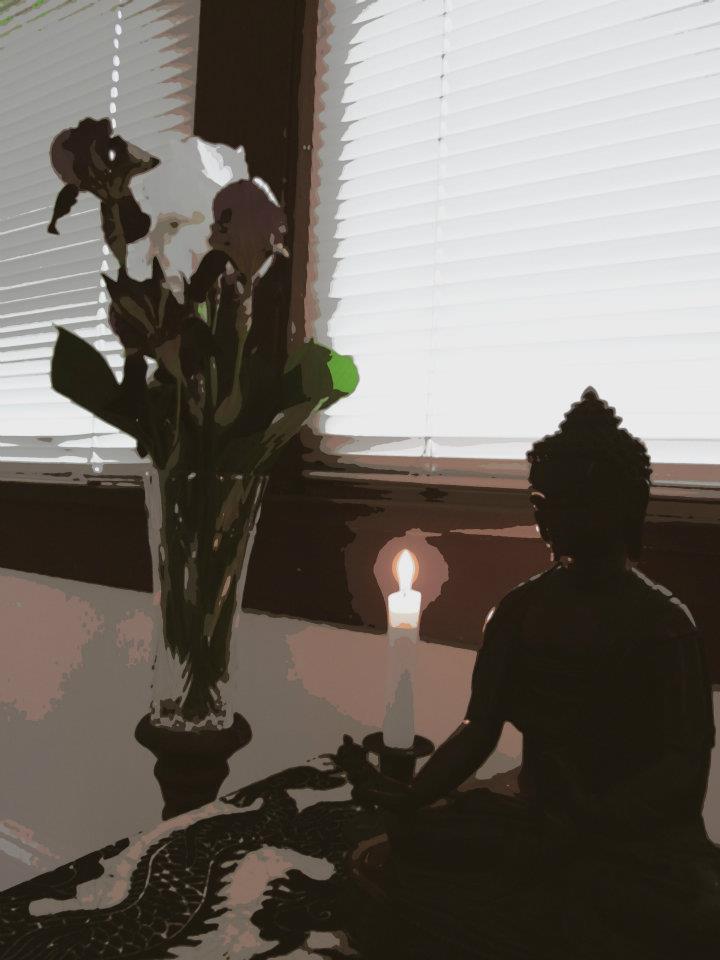
Every morning – except for, as Rinsen Weik put it, the ones I don’t – I come out here. On some winter mornings, it is dark enough that I need to light a candle. There is a Buddha figure placed not so much on an altar as on a shelf beneath that north window. There is also an abstract Haitian statue of the Virgin at the foot of the Cross, a “Stabat Mater” which I acquired when I was doing fair-trade importing. I light a stick of incense without any ceremony, then sit on the cushion, fold my legs, and sit in zazen until the incense stick expires. Outside, there is a set of wind chimes which frequently accompanies my sit along with the occasional sound of critters scurrying about in the rafters. And most morning – except for those I don’t – I look forward to this time.

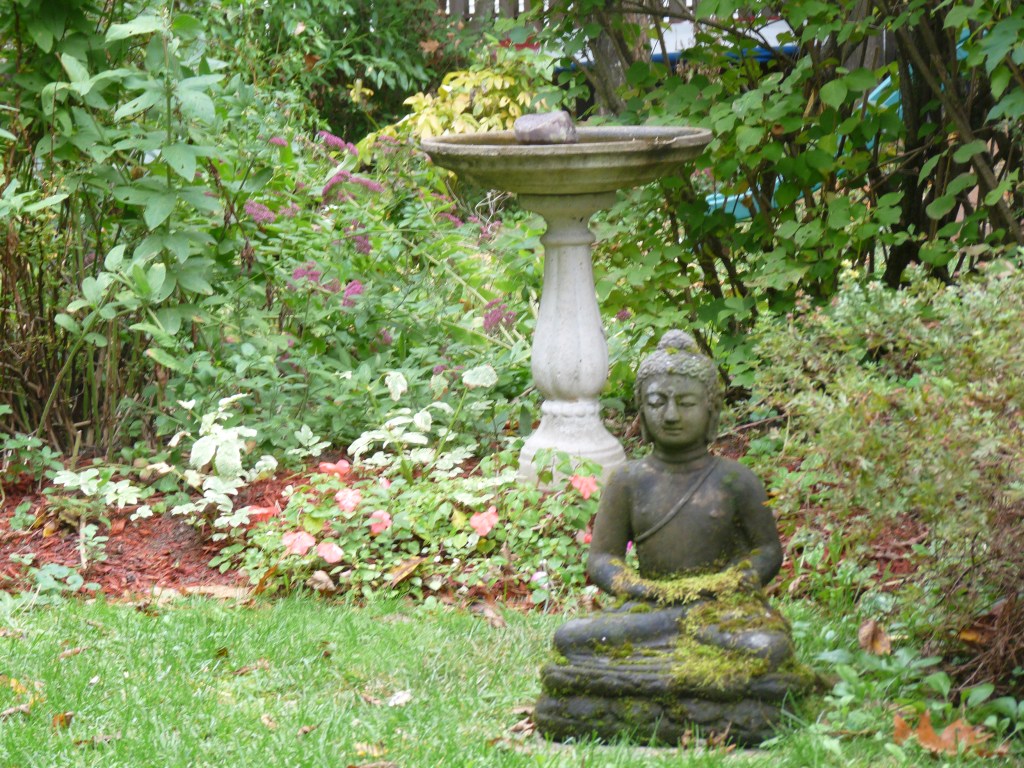
In the flower bed outside, below the south window, there is a large garden Buddha now partially covered by moss. Like most of the Buddha and related figures I have, it was a gift from someone. I know only a handful of people in central New Brunswick who formally practice any form of Buddhism, but most of the people I know are aware that I seem to. They tend to be tolerant and treat it – if I may use Patrick Gallagher’s term – as an eccentric habit. It’s too difficult to try to explain that I don’t consider myself a Buddhist but rather a Zen practitioner. It isn’t a distinction that even always makes sense to those few professed Buddhists I know.

I have mobility problems, so I have not attended sesshin since Albert Low’s death. I do, however, still host the small sitting group which he asked me to organize in Fredericton. It has a core membership of about eight. The local Shambhala community has – for almost twenty years now – graciously allowed us to use their center one night a week. When Koun Franz’s Thousand Harbours Zen holds extended sits in Halifax, I try to attend. Both of these were, of course, suspended during the pandemic, so for over one full year my practice has been solitary except for bi-weekly Zoom conferences with Dosho Port with whom I am inching my way through the koan curriculum. I’m not in a hurry, and at my current pace it will be another decade before I complete it. Given that I have passed the biblically allotted three-score-and-ten-year lifespan, it’s possible I never will.

On rare occasions I will be asked about my practice. The question is usually posed something like, “What do you get out of it?” And the honest answer is, “I don’t know.” This is something I have been engaged in now for fifty years. I have no idea how my behaviour, my way of viewing things, my attitudes and values would have been different if I’d followed another path.

No one’s experience in Zen is the same as anyone else’s, although there tend to be – as these interviews have demonstrated – some commonalities.

When I was in my 20s, before I knew anything about Zen or Buddhism, I had a spontaneous experience. I had carelessly endangered another person through an act of gratuitous cruelty. I regretted my actions immediately and spent the rest of that evening, with some others, working to rectify the situation. It was nearly dawn before things were resolved, and I was able to return home. I was living in a small cottage, called Birkenbrae, on the outskirts of Fredericton. It was on a two-acre plot filled with wild flowers, fruit trees, and abandoned goat sheds. There was a wrought-iron bench in front of the house, and when I returned I was too exhausted to go to the door and unlock it, so I sat down on the bench. I was thoroughly ashamed of what I had done and felt disgusted with the type of person I had become.

And then it was as if I was just too tired to maintain the effort of being “Rick” any longer. I simply let go of that effort, and, immediately, it was like finding a clear signal on the radio dial. You move closer to the source of the signal as you drive or you nudge the dial just a bit and the static drops away and a signal comes through with absolute clarity – a signal which had always been there, but which you couldn’t pick up until the conditions were right.

It was an overwhelming feeling of connection with the entirety of Being and a sense that everything that exists is united in some way by love in the on-going process of creation which science calls evolution. That was how I expressed it to myself at the time. It was also absolutely clear to me that this was what people – although they weren’t aware of it – meant when they used the word “God.” It would be more than a year before I encountered the concept of Dao and recognized that, if a designation was needed, it was a more appropriate one.

I didn’t doubt the validity of this perception, but I did question what I had done to deserve it. In some ways, it was consistent with – although more intense than – experiences I’d had on psychedelics, which, perhaps, made me more open to accept it. I was also pretty sure that I couldn’t be unique; other people must have had similar experiences. The event redirected the academic work I was engaged in at the time and eventually led me to books on Asian spirituality in which I recognized a similar perspective. For a long time, I had an inflated sense of my own – wholly unearned – spiritual accomplishment. Many of the faux spiritual leaders of the period – like those whom John Negru encountered about this same time – had similar conceptions of their self-importance. Some even gathered disciples.

I, instead, was fortunate in discovering Zen practice. My Birkenbrae experience was acknowledged to have been an awakening, but it was also made clear to me that by itself it was of negligible significance, was little more than what Koun Franz referred to as a “burp of the mind.” It was only the first step in Torei Enji’s Long Maturation. That maturation remains an ongoing process, through which I have cultivated several qualities I treasure.

There is a sense of wonder that anything at all exists, a continual amazement at the reality of the universe and the fact that consciousness is inherent in it.

There is a sense of awe at the interdependence of Being in all its beauty and horror.

There is a – at times overwhelming – feeling of gratitude.

And there is sense of reverence, perhaps similar to what Rinzan Pechovnik referred to as tenderness with its connotation of “tending to.”

I may well have acquired these ways of understanding the world and my place in it without Zen; my initial insight, after all, came about before I had any awareness of Asian spiritualities. Nor am I proselytizing. But it remains the case that I have a sense of being understood when I speak of these matters – as I seldom do – with people engaged in Zen practice.

It is also possible that we are just journeying in tandem.

Above the river, two eagles are in synchronized flight, almost wingtip to wingtip, flying in giant loops over the water. Perhaps they are looking for food, but it seems as if they are just having fun.

Alice Cabotaje

Empty Cloud Zen, California –

Alice Cabotaje is Director of Spiritual Care Services at Stanford University in California. She is also an ordained Protestant minister in the Metropolitan Community Church, which (on its website) describes itself as “a diverse group of people with different perspectives and opinions.

“Many people within Metropolitan Community Churches,” the article continues, “consider us to be a Protestant Christian denomination.  We also consider ourselves to be a spiritual movement . . .  We have many straight people who are part of MCC, and they are important and cherished members, leaders, and clergy of MCC.  Most of our members, however, are from the LGBTQ+ community.  In fact, we are unique among all Christian denominations because we’re the only denomination that is primarily made up of LGBTQ+ people, has a focus on LGBTQ+ and Queer understandings, and this has been true of us for over fifty years.”

Alice is also a Zen teacher and Dharma heir of Father Greg Mayers.

She was born in the Philippines and lived there until she was in her 30s. Her father, a physician, belonged to the Methodist Church; her mother was engaged with an evangelical group. The image of God she derived from her religious education was that of a being who “was constantly looking over my shoulder.” She had a sense that the God who was addressed as “Father” actually fell short compared to her own father. And while on the one hand, she had what she describes as a desire to “merge” – a feeling that arose, for example, as she stared at the night sky as a child – she also had a profound sense of separation from God. “There was a deep pain, not only in my heart but in my soul.” In part it was due to that fact that very early on she realized she wasn’t heterosexual. “I had crushes on the girls and not the boys.”

While only 13 years old, she came upon Thomas Merton’s Raids on the Unspeakable in the school library. “There was a paragraph that said something like ‘to have an identity one has to be awake, and to be awake one has to know vulnerability and death – not for its own sake; not out of stoicism or despair – but one has to know the invulnerability of one’s vulnerable self.’”

She pondered what it meant to be vulnerable in this way, and what it meant to die. And then, in the normal course of things, members of her extended family did die. These reflections came to a head when, at the age of 16, she was on a bus which almost crashed into a ravine. At the time, she was surprised to find that her reaction was not as she might have supposed it would be. “Everything stopped, and everything just became clear. All of a sudden, I was not afraid of death. It was just this clarity, this stillness, and I felt like, ‘Okay.’”

After that experience, she felt a need for a spiritual practice which was more than “the usual Protestant services. Something that was akin to silence. I had no idea what that was.”

At university she majored in philosophy and found Chinese Chan [Zen] interesting but could make little sense of it. She also came upon literature that suggested her homo-erotic tendencies “would pass” as she matured, so at 18 she tried having a boyfriend. It didn’t work. “So I had a conversation with God, and I told God, ‘Let’s assume that this is the only life I have to live, I want to live it in a way that I am true to myself. And if you are going to send me to Hell for it, I’ll take it.’ So I severed my relationship with God at that point.”

A few years later, some friends introduced her to yogic practice and meditation. She attended a lecture by a feminist instructor who said, “In the end the only way to really transform a person is to have a change in consciousness. And the only way to change one’s consciousness is through the practice of meditation.” Although her Protestant background made her leery of meditation, she was “initiated” into the practice and given a mantra. Through the practice, the pain she had felt as a result of severing her relationship with God seemed to lessen.

She stayed with the practice for eighteen years and tells me that it helped lay the groundwork for her eventual Zen practice. “That really set for me the foundation for sitting in the Zen tradition. In the yogic tradition I would sit an hour twice a day. So that created the discipline that I needed for Zen.”

Her parents, however, were worried about her apparent interest in Hinduism as well as her sexuality, and – when she was in her 20s – they had an uncle lay hands on her to rid her of these tendencies. “In order to drive away the evil spirits. Nothing happened.”

She spent some time in India and then worked as financial journalist in Hong Kong. Eventually she and her partner relocated to San Francisco. Throughout all of this, she tells me, she found herself returning to the questions she’s first had as a small child looking up at the night stars – “wondering who am I, what am I here for?” And then one morning, when she was 39, she woke up feeling, “There is no God.” “I was dumbfounded. I fell into a deep abyss. Never-ending darkness and depression. And I thought, ‘If there is no God, what is life for?’”

She considered suicide. “Fortunately my partner had an acquaintance who talked about this Zen-Christian group over at the Mercy Center in Burlingame. It was a group led by Father Thomas Hand.”

Thomas Hand was a Jesuit who had studied Zen in Japan and introduced North Americans, especially Catholics, to the practice after he returned to the US. Alice and her partner attended a weekend retreat, and, at it, “A part of me healed a bit.”

Hand provided her an example of how one could practice both Christianity and an Eastern meditative tradition. She and her partner also began attending the Metropolitan Community Church.

During a later Zen retreat, she had an “experience of everything exploding. I just felt there was no ‘I.’  At the same time whatever exploded was also ‘I’. I was also everything.”

While other meditators went to breakfast, she stayed behind doing prostrations in gratitude. “And also asking forgiveness for all the pain and suffering I had caused.”

The next retreat she attended was facilitated by Greg Mayers, who confirmed that her experience had been kensho. He recommended that she begin koan practice in order to integrate that insight in her life. He became her official teacher in 2004 and fifteen years later he recognized her as a teacher and gave her transmission.

Catholics like Thomas Hand and Greg Mayers have found ways of retaining their Christian practice and priesthood at the same time as they are engaged in Zen, in fact they found that Zen enhanced their understanding of Christianity.[1] Alice – in spite of the fact that she is now a Metropolitan Community Church minister – readily admits to me that she isn’t a theist. I ask how she is able to reconcile a lack of theism with her role as a Protestant minister.

“There are contemplatives in the Christian tradition,” she tells me, “like the mystics who have reached the point where the concepts and even the form of God has just gone. Although when I speak within the Christian tradition, I address God as God – the Divine – I use that language in order to be understood and in order to be able to connect.”

“Are you suggesting that God is a metaphor for something else?” I ask. She seems unsure what I’m asking. “You say that you use the term to be understood, so is how you understand the term ‘God’ different from the way the members of your congregation might understand it?”

“Yes. It’s possible that they may have an image of an anthropomorphic God or however they understand God to be. People have different experiences, different understandings, use different names. They may call the Divine the ‘Creator.’ And it takes time – depending on their practice; depending on their motivation – to further go beyond that if they wish.”

“Is there something you personally identify as ‘Divine’?”

“Everything.”

“That’s a good Zen answer,” I say chuckling.

“Because it is,” she insists. “I cannot separate what is sacred from what is ordinary or what is the physical from the essential.”

We talk about the functions of Zen and Christianity. She tells me that the intent of Zen practice is assist one encounter one’s true or essential nature. When I ask about the purpose of Christianity, she tells me, “More and more, I think it is to truly understand the example and the teachings of Jesus outside institutional interpretations. I see Jesus as a wisdom teacher. And to me, I won’t say it is the invitation to ‘love your enemies,’ but the invitation to know what it is to truly love. That to me is so profound and demanding.”

She doesn’t have a congregation as such but receives frequent invitations to speak at churches. Just before our conversation, she had given the Ash Wednesday homily at the Stanford Memorial Church.

“Because it was around Ash Wednesday, one draws on the scriptures or the readings in terms of developing one’s message. But my goal both with my Christian colleagues or members of a Christian church and my Zen students is for me to be able to share with them my understanding and realization of what Ultimate Reality is. It is to live a life that honors the sacredness in one another, honors the essential nature I see in them. That’s what I try to do when I preach and when I give teishos.”

I ask if there is much difference between preaching and giving Zen teishos.

“It depends on the context. If it’s a very Christian – like over at Stanford, it’s an ecumenical service – I would lean more in citing scripture or staying within the Christian theme. But then I would still bring in concepts that are generally understood outside the Christian tradition. A Zen colleague of mine, for example, recognized I was coming from my experience in Zen. It’s just the words. But if I’m leading a Holy Week retreat over at Mercy Center, I know there will be some Christian attendees. So I will bring in both scripture and some koans maybe. I may refer to a Zen koan along with scripture. And then if it were like a Zen retreat, then I would just stick to koans or expounding on a Buddhist principle.”

“You said that Greg Mayers told you that in order to integrate the kensho insight into your life you needed to do koans. Do you believe that’s the case?”

“I do. For me, koans were the next step. My awakening experience came from my sitting practice and doing shikan taza. But koans helped me integrate that experience into daily life. They deepen my appreciation and my understanding. When I started with Mu, I could see how concepts arose, how my thinking came up, and I came to that space where everything just breaks down, falls away, and there’s nothing else. The sudden understanding or ah-ha! moment of the koan. And then each koan that I go through provides another lens or another perspective or another way of appreciating or expanding that awakening experience. For me the practice of koans is not just a question of getting through each koan. When I quote/unquote ‘get’ the koan, I sit with it. I marinate in it. I see how, ‘Okay, what does it mean?’ And I sit with it for at least another week or two before I move on and sit with another.”

She has a group of students with whom she meets online and at retreats facilitated at the Mercy Center,  all of whom work with koans. “It has to be koan work not just sitting.”

“So if they weren’t interested in doing koan work, you wouldn’t be a good fit for them? There are, for example, some Soto people who are hostile to the idea of working with koans.”

“I’m more in the Rinzai School because I have experienced and seen the growth I’ve had as a practitioner through koan study.”

“People engaged in Soto practice will sometimes argue that koan work simply creates a ‘gaining’ mind.”

“Well, I see koans more like a tool. You know? It’s another way of experiencing. It’s another way of breaking habits of perceiving or thinking or experiencing . There’s something about koans for me that when one quote/unquote gets it, or gains it – whatever language one wants to use – the fact is it opens. It’s a paradox. One may be trying to work to get it, but when it finally opens, you’re, ‘Oh, wow!’ You realize that there was nothing to gain. And so they say, ‘There is no achievement. There’s nothing to gain.’ And yet it requires effort as well. It requires dedication; it requires discipline. It even requires a desire or a motivation to gain. That’s just the paradox of the practice.”

“What do we mean by ‘transmission’?” I ask. “When we talk, for example, about you receiving transmission from Father Greg, what is it that’s transmitted?”

“Well, my experience with Father Greg when he made me his Dharma heir, it really got to a point where we recognized that his mind and my mind were . . . We were of one mind.”

“Do you mean you felt you perceived or understood or intuited things as he did?”

“Yes. Him and others. When I hear about the old Zen masters whether through koans stories, it’s like, ‘Yes! Yes!’ Or realizing through the koans, ‘Oh, yeah! I know what that person meant when he talked about that.’”

“The koan tradition doesn’t really date back all that far in the history of Buddhism,” I point out. “The stories themselves are Chinese, not Indian, and the actual practice as we’re familiar with it only goes back about 900 years or so to Japan. And yet we’ve got these transmission documents which go all the way back to the Buddha himself who passed something onto Mahakasyapa who passed it onto Ananda who passed it onto somebody else, and eventually it wound its way to Greg Mayers who passed it onto you. How realistic is that?”

“The term ‘passing on,’ for me, is a misnomer. Because there’s nothing to pass on. There really is nothing. I think for me it’s more of a recognition. Like, let’s say, when the Buddha twirled that flower and Mahakasyapa smiled. It was like he exactly saw what the Buddha saw. He saw or realized he was seeing the same thing.”

“Are you suggesting there has been a consistency of perception – a uniformity of perception – over these 2600 years?”

“The same level of realization? I don’t think so. I think over the centuries there has been in some cases a watered-down transmission. Even if we go back to Joshu. Did he really have a Dharma heir? I mean, I think his standards were so high that he would not just make someone a Dharma heir. So I think it really depends on the teacher. In my case, I think about it. I have five students; one of them has received transmission in the Soto Zen. And when I think, ‘Will I have a Dharma heir?’ The person would have to be outstanding, even better, exceeding me.”

“Since the Meiji era, it has been a matter of Soto policy that awakening – kensho – isn’t a requirement for transmission.”

“Yes. Which to me is sad. Japanese priests who have temples in Japan, they may inherit the practice but have not necessarily had a realization about their essential natures. And realizing or experiencing one’s essential nature can be just a glimpse. It’s a lifelong, daily, moment to moment practice. For me, when I had that experience at the Mercy Center, that was when I felt that the real work began. That’s when the hard work began.”

As our conversation draws to a close, we talk about the special focus that the Metropolitan Community Church has working with LGBTQ individuals. Given the intolerance still prevalent in certain Christian communities, I understand the importance of a denomination which specifically addresses this matter. But I have also recently encountered LGBTQ Zen chat groups. I ask Alice how important these are for Zen practitioners who may not identify with normative culture.

“For me,” she tells me, “Zen is a practice that encourages a smashing, a letting go of concepts of how things should be. So I would say, it would be a very attractive place for people who feel they don’t belong anywhere else.”

“That’s my question. If that’s something Zen practices provides as a matter of course, then is there a reason why, within that practice, there still need to be opportunities for people who don’t necessarily identify, for example, as heteronormative to come together?”

“From the practice itself and from an essential point of view there really are no distinctions. And yet we are expressions, unique expressions of Essential Nature. And in our uniqueness there are feelings of wanting to belong, feelings of wanting to be understood, feelings of wanting to be on the same wavelength. This is something that one desires. So for me, yes, I would feel very comfortable being part of – I may not necessarily seek it – but I would be comfortable being part of an LBGTQ group because there were be certain . . . either from language, from engagement certain things that would require less explanation. That’s one. Secondly, there is a sense of safety and comfort. A feeling of belonging. As a person of color, I feel more comfortable being with other people of color. There’s a level of understanding of the pressure we go through, the discrimination. At the same time, there are certain values that we share that don’t have to be constantly verbally articulated. There’s an intuitive understanding.”

She goes onto say, “There’s a sense of freedom that comes from the practice of Zen. There’s a sense of a lack of fear.”

“Freedom from?”

“From expectations. In other words, I can truly be myself in the unique creation that I am. So, in other words, both the essential and the formal come together. Being able to live my life that way is so liberating! It means I am able to fully accept who I am and others as well. And with that, I believe, comes true understanding, compassion, and kindness towards the other. I don’t want to use the word ‘love,’ because – you know – it’s overused. But at least in terms of one’s behavior, a true embrace of the other.”

Greg Mayers (seated) with Nona Strong, Tony Tackitt, and Alice Cabotaje

[1] The number of “Christian Zen teachers” has began significant. James Ford provides a partial list on his “Monkey Mind” blog: https://www.patheos.com/blogs/monkeymind/2022/10/christian-zen-teachers-a-list-in-progress.html 

Barry Briggs [Zen Master Hye Mun]

Cochise Zen Center, Bisbee, Arizona –

Barry Briggs – Kwan Um Zen Master Hye Mun – first encountered Buddhism through a girlfriend. “She practiced in the Tibetan Buddhist tradition with Sogyal Rinpoche, who died several years ago.” Barry was studying the Philosophy of Religion at the time at university. “I’m interested in human behavior and what motivates it. And at least in the 1970s, there was a lot of interesting philosophical work to be done in the field of religion and belief. So that attracted me. I worked a lot on the ‘problem of evil,’ how to reconcile the existence of evil with an all-powerful, all-good, all-knowing deity.

Sogyal Rinpoche

“In the early 1980s I practiced with Sogyal Rinpoche – ‘practiced’ in a loose sense – for five years. When he came to Seattle, I would go to a weekend retreat. My recollection – perhaps not to be trusted – is that he would talk a lot for two days. I remember being fascinated by it, how he would describe human mind, how mind functioned. And then, at the end of the two days, he would say, ‘Now go home and practice.’ And, of course, I didn’t. Or not for very long,” he adds with a chuckle.

“What did he mean by ‘practice’?” I ask.

“He would teach meditation over the weekend, but these were not meditation retreats as I understand it now. Perhaps it would be more accurate to say that these were ‘Dharma retreats.’ And at the end he would say, ‘Now go home and practice this meditation that I taught you.’”

“And you didn’t.”

“Well, for a few days. Maybe. You get a little bit of Dharma gasoline, and you can go for a short distance. And then you run out of gas. Then a couple of years later, my best friend invited me to go to a Zen retreat with him. And that was almost like the inverse of Rinpoche’s retreats. Very little talking and a lot of practice. A lot.”

The retreat was in the Korean Soen tradition.

“There was a Korean nun who had a hermitage in the foothills of the Cascade Mountains outside of Seattle, and we went there in January. I remember very clearly that she didn’t heat the place. There was snow on the ground. It was bone-chilling cold, and all we did was practice: bowing, chanting, and sitting. And I found out that I loved practice. Not talking about practice but actually doing it. It’s what I wanted.”

“What was it about it that you found appealing?”

“It was embodied. Although I was a philosophy student and – for a time – quite intellectual, I’ve always been somebody who has used my body a lot. I’m old now, so it’s different, but in my 20s and 30s I was a rock climber, a cyclist, a professional modern dancer, and just physically very active. People might not think of sitting in meditation as physical activity, but for me it was physically very active. Plus, in the Kwan Um School tradition, we do 108 prostrations every day and lots of chanting. Very physical practices.”

“It takes energy to sit still,” I point out.

“It does, and I loved it. I wasn’t looking for a spiritual practice, but when I went to that Zen retreat, I said ‘Oh, I want to do this. This is something I understand.’ There was a small sitting group in Seattle – a Kwan Um School sitting group in Seattle – at that time. Maybe ten people. Of the ten, maybe three were interested in Kwan Um School style. Some were Glenn Webb’s students or had been his students. Most of those ten eventually wandered off to various Japanese forms of practice available in Seattle at that time. So really it was just a few of us. Then it started growing. We moved around from place to place.”

Glenn Webb was a professor of art history at the University of Washington who had trained in the Obaku school of Zen in Japan and introduced many Western students – including Genjo Marinello – to formal practice.

Bob Moore

The group was small and not formally organized. “We had a set schedule, and we just showed up. Our guiding teacher was a man named Bob Moore, now known as Zen Master Ji Bong, who lived in Southern California. He would visit several times a year, along with other Kwan Um School teachers.”

“And if someone at the time had asked you what you were getting out of this practice, what would you have told them?” I ask.

“Hmm. I would have made up a fairy tale about becoming more calm and centered, blah, blah, blah. Like that. I would have invented a story because, particularly in the first ten or twenty years, how could one possibly know? Obviously, training has impact on peoples’ lives, but any attempt to describe a benefit most often just leads to a fairy tale. At least in my experience. The Zen tradition has enough fantasy wrapped around it, at least in the West. So perhaps it’s best to keep one’s mouth closed and encourage others to find out for themselves.”

And so those ten or twenty years passed. He remained faithful to the practice and worked in the software industry. “I retired in 2005. Then I was asked to become a teacher in 2012 and that happened in 2013.”

“Who asked you?”

“In the Kwan Um School, when a practitioner seems ready, a committee is formed to assess that person. My primary teacher at the time was Timothy Lerch Ji Do Poep Sa Nim and my sponsoring teacher was Zen Master Bon Haeng, Mark Houghton, who lives in Massachusetts. If the committee agrees, then the individual receives inka, teaching authorization. For me that was in 2013.”

In 2015, he was invited to leave Seattle and move to the Cambridge Zen Center in Massachusetts.

“They asked me to be their resident teacher. It’s a wonderful Zen Center, an incredible Zen Center. It’s one of the oldest and largest residential centers in the United States, founded in 1974, I believe. And at any given time, thirty or so people live there, right in the heart of Cambridge. The Kwan Um School has quite a few Zen centers within two hours of Cambridge so there was a lot of teaching to be done.”

He was the Resident Teacher and later Co-Guiding Teacher with Jane Dobsiz, Zen Master Bon Yeon.

Jane Dobsiz

I ask what his responsibilities had been.

“The Zen center has formal practice every morning and every evening, seven days a week. I showed up every morning and every evening, six and half days a week. I took Sunday evenings off. On a regular basis I offered kong-an interviews, talks, and workshops. I met informally with residents and members of the non-residential community. But the primary responsibility I took upon myself was to show up for practice every morning and every evening six and a half days a week.”

Also during that time, he traveled extensively, teaching in central Europe, Russia, South Africa, Malaysia, Singapore, Hong Kong, Korea, and throughout the United States.

On the other hand, as much as he loved the Cambridge Center, he didn’t feel at home in New England.

“I still have good relationships with people in Cambridge, but New England was not my home. I really missed the west. In the winter of 2016-17, I said to myself, ‘I’m going to rent an Airbnb in Southern Arizona and be warm. And do a kind of loose retreat.’ Sit in the mornings and the evenings. Walk in the mountains during the day. And as I was scheming that out, a friend in Seattle wrote and said, ‘What are your plans?’ I told her and she said, ‘I own a house in Bisbee Arizona. You could use my house.’ So, okay. I’d never been to Bisbee, but – as happens to many people who come to Bisbee – I came here, and I liked it. So, I hatched a plan to move here. As it turned out, there was already a Zen center in Bisbee. It had been here for fifteen years but had never had a teacher or a formal affiliation. It was simply organized and operated by local people who wanted to practice.”

“And did they welcome you with open arms?”

“Almost everyone was happy to have somebody who had an actual credential,” he says, chuckling. “Some of the people who welcomed me with open arms maybe weren’t so welcoming later as they realized I was an ordinary person.”

Bisbee is a small community, with a population of less than 5000 people, and yet the Zen Center has twenty-five active participants. In Zen circles, this is huge.

“I’m astonished, to be honest with you,” Barry tells me. “I’m astonished. It’s amazing. We’re the only organized meditation group for a hundred miles, so if somebody wants to practice, they come to us. For this reason, I try to keep the community very spacious in welcoming people regardless of affiliation or background. We’ve had Transcendental Meditation practitioners, somatic body work people, Tibetan practitioners, and lots of non-Buddhist types practicing with us. We welcome them all. Of course, I wear formal Zen robes and speak from my tradition when I give talks. I’m only authorized to do what I do, and so that’s all I do. I can’t pretend to be a different kind of person. But because of our unique situation, I hold the forms very loosely. When I was at Cambridge Zen Center, there was a Buddhist Center about every other block or so. If somebody didn’t like our center, they could go to Insight Meditation which is literally about six blocks away. It’s no problem. But here in Bisbee, that’s not an option for people. For this reason, I keep the forms loose. And if somebody’s not following the forms, I usually keep my mouth shut. I want everyone to feel like this is their practice home.”

Seung Sahn

There may be substantive differences between Japanese Zen and Korean Soen, but Barry is reluctant to address the issue. “I don’t know that I can speak to that with authority because I don’t have direct experience with Japanese Zen.” He is, however, willing to outline his understanding of the Korean tradition as it was organized and taught by Zen Master Seung Sahn.

“I’ve heard that when he came to America in 1972, he was a very high-ranking teacher in Korea. And according to the story, in the Korean version of Life or Look magazine, he read about hippies in America and said, ‘Oh, I can teach those people.’ So, he moved here, not speaking any English. I wasn’t around in those days, but apparently his original idea was that he would create a monastic order in the West. But Western people didn’t go along with that idea. ‘Monastic order’ in the Korean Buddhism means the traditional 250 or so precepts. I’ve heard the words ‘monk’ and ‘nun’ are used in a certain way in Japanese Buddhism; sometimes ‘priests’ is used also. These terms have a different meaning in the Korean tradition where they refer to celibate monks and nuns who live very restricted lives. So when Zen Master Seung Sahn came to America, most of his American students were not willing to follow in that path.”

“He wasn’t able to follow that path himself when he got here,” I point out.

“That’s my understanding,” he agrees. “But I wasn’t around when that behaviour occurred, so I don’t really have anything to add to what you’ve probably already heard. But despite those issues, he interpreted his Korean heritage in a way that seemed to make sense in the West and built a lasting framework for practice. And those are the same elements of our practice today. Recently I talked with someone at a Rinzai center, and they said, ‘You know, the view we have in our center is that the Kwan Um School is “Zen-lite” because you don’t do a lot of sitting.’ And I said, ‘Oh, that’s interesting. How long is your longest intensive retreat?’ He said, ‘Seven days.’ I said, ‘Well, take that seven-day retreat and do it for twelve weeks consecutively as a silent meditation retreat. That’s what we do every winter at centers around the world. And if you go to Korea, we do it every winter and every summer. Monks and nuns in Korea are in intensive meditation retreat for six months a year. Maybe that’s Zen-lite. I don’t know.’ So, we sit a lot. We chant a lot. We do 108 prostrations every day, although my body is old, and I can’t do full prostrations any longer. And we work with kong-ans. So those are the four elements of our practice.

“But underneath all of that is what I call ‘vow.’ Why do you practice every day? Only to get a good feeling? Or to have some calmness? Is that the only reason you practice? That’s what I ask. Zen Master Seung Sahn used to say, ‘Why do you eat every day? Why did you get out of bed this morning? Because your body is hungry? Or your alarm went off. Is this why you got up?’ Underneath everything we do is ‘vow.’ Why do you have a human body? What are you going to do with your human body? If that’s clear, you don’t need to practice. These are the elements of our tradition as I understand and teach them.”

I ask if he’s ordained.

“No, I’m not an ordained monk. In the Kwan Um School – I know this sometimes can be confusing for those trained in Japanese traditions – in the Kwan Um School the precepts path and the teaching path are independent. Somebody can have 250 precepts as a fully ordained monk or nun but never become a teacher. They’re just completely different paths.”

“So what’s the function of the precepts path?”

He answers without hesitation: “Living an upright life and helping this world. Serving as a model for helping this world. The function of the basic Five Precepts is to bring yourself upright. The next five precept are about community relationships, how to function harmoniously in community.”

As they were explained to me by Judy Roitman [Zen Master Bon Hae], the First Five Precepts in the Kwan Um School are: 1) to abstain from taking life; 2 to abstain from taking things not given; 3) to abstain from misconduct done in lust; 4) to abstain from lying; 5) to abstain from taking intoxicants to induce heedlessness.

These are followed by: 6) vowing not to talk about the faults of others; 7) vowing not to praise oneself and put down others; 8) vowing not to be covetous and to be generous; 9) vowing not to give way to anger and to be harmonious; 10) vowing not to slander the three jewels (Buddha, Dharma, Sangha).

I ask Barry if any of the students with whom he works in Bisbee have taken the Precepts.

“Yeah. When I came here, of course, they never had a teacher or formal affiliation, so it’s taken a while to migrate the community to the Kwan Um School tradition. Now we have . . .” he pauses to reflect a moment “. . . seven or eight people who have taken the first Five Precepts, and then three long-time practitioners in the Kwan Um School who are part of our community who have taken the Ten Precepts. We call these folks Dharma teachers; not Dharma teachers in the way that you and I might use that term outside the Kwan Um School, but they have taken on the responsibility of leading practice, giving instruction – meditation instruction – and generally being of service to the community. They’re not teachers in the way I’m authorized to be a teacher.”

“What’s the function of all of this?” I ask. “You said, ‘to lead an upright life.’”

“The function is liberation.”

“From?”

“It’s a good question and if you and I were talking less formally and you knew nothing about Buddhism, I would frame the question in terms of the ordinary challenges we have as human being. Problems with our partner; problems with our children; problems with our parents; problems at work. Like that.”

“You’re going to liberate me from all that?”

“No. You’re going to liberate yourself from that,” he says with a laugh. “I’m not going to do anything.”

“And how is this practice going to help me liberate myself from all these problems I’ve got?”

“You have to find that for yourself. And there’s no way of sugar-coating that if somebody’s honest. You’re the only one who can find that out. If I were going to give a nice explanation about it, I would talk about it in terms of awareness and mindfulness and watching the feelings and emotions and perceptions and impulses arise in the mind and making skillful choices about them. That’s a nice explanation. But you’re the only one that can find it. You’re the only one who can find out what it means for yourself.”

One of the issues I’ve been fascinated about as I conduct these interviews is the way what draws people to Zen practice has changed over the decades. It isn’t an exaggeration to say that a majority of those seeking out teachers in the 1960s and ’70s were on a quest for enlightenment. It was in part driven by insights often acquired through psychedelic drug use, but the search was largely for enlightenment, kensho, satori.

Barry admits that these are not words “in favor these days in the Western Buddhist world. I talk about it, but I tend to use the word ‘awakening’ – or ‘awaken’ – rather than ‘enlightenment.’ It’s a word that’s a little less loaded. When most Western people – in my experience – think about ‘enlightenment,’ they’re thinking about pixie-dust falling out of the sky. People and objects glowing with auras. But ‘awakened’ just means being awake. And there are good metaphors that connect with this. One I use is that at night, when you’re sleeping, you have no awareness of your body even though your body’s always present. And even if you’re dreaming about your body, it’s not your actual body; it’s a dream body. But the minute you wake up in the morning, you’re not confused. There’s your body saying, ‘Let’s go pee.’ You get up and you pee. You’re not confused. You’re awake. Your awakened nature – your enlightened nature – is always available, but we don’t know that because we’re dreaming. All we have to do is wake up to what’s always there.

“In Diamond Sutra,the Buddha says in various ways, over and over, that when he got enlightenment he didn’t get anything. If he’d gotten something it wouldn’t have been enlightenment. So each of us already has it. We just need to wake up to it.”

“Regardless,” I persist, “I suspect when people come to the door for the first time, they don’t say ‘I want to be awakened.’”

“Rarely.”

“So, what do they say?”

“Oh, I hardly ever ask that question. If they need instruction, I give them some instruction. And then they practice and either stay or don’t stay. You know, a lot of people don’t come back a second time.”

“Still, you have some sense of what drew them.”

“Yeah, they’ve usually got a life problem. Maybe their spouse is not cooperating or maybe their body is not cooperating. Bisbee is a town of mostly older people, and so we have a lot of loss in our sangha. People are dealing with that. Most members of our community are right up against some of the hardest things in human life. And I think that’s one of the reasons we have a large community in a small town. People have no time to waste. Just this last year we lost our board president at age 85. We lost the person who ran our weeknight practice for over a decade. He was 81. We’re all there right up against it. I’m 77. So, local people are hungry for a community and practice which helps them investigate what their life is actually about.”

“Are you saying one of the things that draws them is a desire for a community?”

He nods. “When people come to the Zen center, they’re joining a community. That’s a very important function of a Zen center, to provide community. To provide support.”

“The traditional Three Treasures,” I suggest.

“Yeah, a cornerstone of the Three Treasures. Exactly. And this last year I’ve found myself more than ever sitting with people who are dying. Or sitting with those whose partners or friends have died. This work is a little beyond my training but, really, all you have to do is show up. It’s just like practice; you just have to show up. That’s the main thing.”

There are young people in the community as well, who he encourages to take part in longer Kwan Um practice retreats at the Providence Zen Center in Rhode Island. These retreats – called “kyol che” – can be up to three months long. “‘Kyol che’ is Korean term that means ‘tight Dharma.’ If people are young and able to engage in that kind of practice, I suggest it. But I don’t encourage somebody who is 75 or 80 years old to do that kind of practice. Not that they can’t – maybe they can – but they have different concerns, most of them.”

“What is it that the people at the Cochise Center look to you for?”

“The first thing is I show up. We only practice twice a week, so I show up twice a week. I’m always there, except for the rare occasions I’m out of town. People depend on the consistency, although less than I might think that they do. To be honest. I think people are quite self-sufficient now in the community.”

“There’s more than one key to the door?”

“There are many keys to the door. Last October I was in Korea for a few weeks, and people came in, turned on the computers, ran practice. Everybody came. Nothing changed. But in some ways, they depend on me to show up. They depend on a model of the practice and the practice life. They ask me to create a safe place for people to practice. Physically safe. Emotionally safe. Spiritually safe. They depend on me to give talks that speak to real human needs and provide some clarity about what it is to be a human being.”

“And what is your hope for the center?

“The center stayed together for fifteen years before I showed up. It will continue after I die. It will grow or shrink. I can’t control that. All I can do is pour my love and commitment into the community as best as I can. Lately I’m investing a lot of energy in the younger practitioners. They’re working on kung-ans; they’re working on personal life issues. It’s not that I’m turning away from the older people at all – there’s a lot to do there as well – but I’m really encouraging the younger people to step forward. And they are.”

Barry believes that it has been a benefit to the center to be formally affiliated with the Kwan Um School.

“When I first moved here, of course, nobody knew about the Kwan Um School. Among the various Western Zen traditions, we’re perhaps less well-known than some. People knew that I practiced in a Korean ancestral tradition, and that was okay with almost everybody. They were willing to adapt the forms.

“When the pandemic started, we closed down physical operations and moved everything to Zoom. And I had the idea that rather than me giving the Dharma talk every Sunday, we would invite teachers from the worldwide Kwan Um School community and have them give talks and answer questions. And it was a real eye-opener to the community in Bisbee to realize that there were all these different people around the world teaching the same bone of Zen but with their own personal way of expressing it. People in Asia, people in Europe, people in America all teaching from the same tradition. This has had a big impact on people. Because the Kwan Um School has an online sangha, local people who practice here also practice via Zoom at Empty Gate Zen Center in Berkeley or with our center in Fairbanks, Alaska, or Boise, Idaho. It’s been a surprise to people. It’s been a surprise to me how much people have taken advantage of that network.

“It’s one of the great gifts of the Kwan Um School. We’re a school; we’re not a loose tradition in the same way that some of the Japanese lineages are. And part of Zen Master Seung Sahn’s gift is that we encourage practitioners to study with many different teachers. We say in the Kwan Um School that Zen Centers have guiding teachers, but students don’t have guiding teachers. Students can study with whoever they want, and we encourage that. As a result people develop a very broad view of the Buddhadharma, as it comes through our lineage. And I think that’s been a great gift to the people here in Bisbee and around the world as well.”

Joshu Sasaki

Adapted from The Story of Zen

In his history of American Buddhism – How the Swans Came to the Lake – Rick Fields recounts the story of the time Rinzai master, Joshu Sasaki, gave a talk at the Berkeley campus of the University of California. One of the people in attendance asked if there were a place in the San Francisco area where one could get Zen training. Sasaki appeared to give the question a moment’s thought then said he wasn’t aware of any and suggested that if the inquirer were serious he should arrange to visit Sasaki’s center in Los Angeles.

There was a surprised, audible reaction from the audience, many of whom were students and friends of Suzuki-roshi’s San Francisco Zen Center, which by then had more than one branch in the Bay area, and Sasaki’s translator, a Japanese-American doctor, hastened to add, “The roshi means that there is nowhere else where one can study his particular line of Zen.” [Rick Fields, How the Swans Came to the Lake (Boston: Shambhala, 1992), p. 247.]

It is possible that Sasaki was making a distinction between Soto and Rinzai Zen; the Zen community in the United States, even in its earliest days, was divided along sectarian lines. It is also true, as Fields adds, that “it certainly appeared – to some at least – that the roshi had rather enjoyed the stir his blunt answer had caused.”

Sasaki is sometimes identified as the fourth of four Japanese missionaries – following Suzuki, Taizan Maezumi, and Eido Shimano – who helped establish Zen practice in America. He was two decades older than Maezumi and Shimano, although they came to the US before him, and only a few years younger than Suzuki. He had been born in 1907, was ordained a monk at the age of fourteen, and became an osho – or priest – seven years later. He spent several years at Myoshin-ji in Kyoto, which remains one of the principal teaching centers for Rinzai Zen. In 1947, at the age of 40, he was given Dharma Transmission and became abbot of a small temple in Nagano Prefecture.

According to an interview Sasaki gave in 1969, he’d had no idea of coming to the United States until two American aspirants, Dr. Robert Harmon and Gladys Weisberg,wrote to Myoshin-ji requesting that an authorized teacher be sent to Los Angeles.

Up until that time, I had no dreams whatever of coming to the United States and furthermore the temple I belonged to was so poor that they couldn’t entertain any such ideas. However, Myoshin-ji said that I would be very useful in the United States so suggested I come here. [sasakiarchive.com/PDFs/19691220_Sasaki_Interview.pdf.]

He arrived in America, reputedly, with only the robes he was wearing, a Japanese/English dictionary, a Bible, and a small valise. He didn’t waste time but began receiving students almost at once in a one-bedroom house in a Los Angeles suburb. Within five years, the group moved to new quarters in what had once been a luxurious residence on the corner of Cimarron and 25th streets. The neighborhood had deteriorated, and the building itself had been condemned by the city as unsafe for occupancy. Sasaki’s students, however, refurbished it, and it was officially opened on April 21, 1968 – Sasaki’s 61st birthday – as the Cimarron Zen Center. Later the name would be changed to Rinzai-ji. 200 students took part in the opening ceremonies.

Three years later the community had sufficient funds to purchase another property in the San Gabriel Mountains east of the city. This became the Mount Baldy Zen Center. A third center – the Bodhi Manda Zen Center in Jemez Springs, New Mexico – was established in 1973. The three centers quickly acquired reputations as rigorous and austere practice centers. In a talk given at Bodhi Manda, Sasaki said: “The standpoint of this Zen Center is our own practice of Dharma Activity. Therefore we accept those who want to study Dharma Activity. Those who are not interested in Dharma Activity should leave immediately.” The training provided wasn’t easy nor for the faint of heart. Sasaki’s type of Zen has been described as Samurai. Those who couldn’t cut it were invited to “leave immediately.”

Many did. More to the point, there were others who remained and flourished. Within a few years, senior students established affiliate centers elsewhere in the United States, Canada, and Europe. Sasaki received invitations to facilitate sesshin at locations throughout North America including St. Joseph’s Roman Catholic Trappist Monastery in Spencer, Massachusetts.

His students worked with koans but instead of being chosen from classical collections these were often adapted to the condition of the particular student. One might be asked how he realized Buddha nature while driving an automobile. To the monks at St. Joseph’s, he assigned the question, “How do you realize God when making the sign of the cross?”

Leonard Cohen and Joshu Sasaki

Sasaki never acquired a very good command of English and had to make use of translators throughout his time in America, even so it was the impact of his personality which his admirers most frequently reference when talking about him. The Canadian songwriter, Leonard Cohen – who spent a period of residency at Mount Baldy in the 1990s – said that Sasaki was such an inspiring figure that were he to have been a Heidelberg physicist, Cohen would have learned German and studied physics. Cohen also admitted that he and other Sasaki students “were gravitating to teachers who were quite flawed as human beings, but that’s what we cherished. We wanted to see the dark side made bright.”

Seiju Bob Mammoser was at one time thought to be in line to become abbot of Rinzai-ji after Sasaki retired, although this never came about. When I spoke with him in 2013, I was struck by how reserved and even cautious he was when speaking except when talking about Sasaki, whom he always described in superlatives. He was “amazing” and “an utterly remarkable, unique man.” I asked in what way, and he told me, “You meet somebody who inspires you. Motivates you and moves you and demonstrates – in front of you, in his manifestation – exactly what he’s talking about. I hadn’t really met other teachers. I’d read books. I’d read Zen Mind, Beginner’s Mind. That was a beautiful book. But he was the first living teacher I’d met. He was sufficient. I didn’t have to go see somebody else. I knew what I was dealing with.”

Father Kevin Hunt, a member of the Trappist Community at Spencer and an authorized Zen teacher, was equally fulsome in his praise of Sasaki. “We had him in choir, and he had a room in the monastery itself. So he participated; he ate in our dining room. He gave a couple of talks to the community. There was quite a lot of interest in what he said. Basically he spoke of his experience in meditation and the Zen way of doing meditation. And, you know, a novice master had once said to me, ‘If there’s any rule in prayer it is that it will always become more simple. Less verbal.’ And so he addressed that aspect, that in Zen there’s no talking. That to speak a word in Zen is already a betrayal. And that was something that we could identify with because we had a rule of silence, and silence is very, very important in our practice. And he loved it, so somebody said to him something about coming back sometime and giving a weekend sesshin. And so he said, ‘Yes. I come back next year.’”

In fact he came back ten years in succession to lead retreats at St. Joseph’s.

Myokyo

He did not coddle his students. When I asked Zengetsu Myokyo Judith McLean  of the Enpuku-ji center in Montreal what Sasaki Roshi was like as a teacher, her immediate answer surprised me:

“He was cruel. He was strong. He was . . .”

I interrupted to ask what she meant by “cruel” and why that was the first thing she said. She explained that she hadn’t meant it as a criticism. “I was talking with a student here yesterday, and, it seems to me, it was a very effective tool for dissolving the ego.

“The strongest teaching he gave me,” she went on a bit later, “was that he gave me a lot of responsibility.” She had been head monk of Rinzai-ji in Los Angeles in 1992 during the Rodney King riots. Sasaki, himself, was away at the time. “That was a lot of responsibility, because we were hemmed in. There were fires all around us and so on. And never any comment about ‘job well done’ or how bad it was.

“And while I was at Rinzai-ji, there was a very, very difficult older nun. She was an alcoholic. Very difficult. She used to drive people away from the Zen Center. So I was in charge of her there, and I dealt with her in an okay way. Then the Roshi turned the tables on us, and he made her the head monk. And things went kind of crazy. Like really crazy. So that was a cruel situation. And he watched and watched and no comment. He watched to see how I dealt with that. So at the time, that seemed cruel to me. But he’s just cutting off any kind of attempt to grandify oneself or to even feel competent. Because we all had something more to learn in the sense of dissolving our self.

“His methods are very effective. I mean, when your whole world falls apart, then you learn from that. And if that keeps on happening, then you keep on learning. And so if I had someone who was just kind and helped me along a little bit, that wasn’t so interesting. So I think it’s a very particular kind of character that would study with a teacher like that. I was very stubborn, but there was never a doubt in my mind that this was the person I wanted to study with, that I was glad to be studying with. No doubt. Even when it was difficult and I felt he should really give me a break once in a while, still there was no doubt in my mind.”

Others have described him as “playful,” charming, and as having an infectious laugh. He advised his students – whom he accused at times of being too serious and humorless – to practice laughing as a spiritual practice.


When you wake up tomorrow morning, first thing, stand up, put your hands on your hips, and laugh five or ten times, and that will cure you of much of your illness. This exercise is even better than a long period of meditative sitting. As a beginner in meditation, instead of suffering a long period of cramped legs, it would be better for you every morning as soon as you get up to immediately stand in this position and laugh about ten times. This is really the best beginning of Zen. If during that time you are doing this exercise and laughing vigorously, I were to ask you “Where was God at that time?“ How would you answer? Then immediately your logic and your consciousness starts to work. That is what is bad. That is time and space learning. That is not Zen. Just simply laugh and you will begin to realize. [https://terebess.hu/zen/mesterek/Joshu-Sasaki-Roshi-About-Zazen.pdf]

Myokyo’s was the ninth interview I conducted when I began this series of conversations in 2013. I had particularly wanted to interview one of Sasaki’s osho – preferably a female osho – at the time because he had made headlines in the mainstream media as a result of reports about his sexual interference with female students that had been going on for decades.

As he drew media attention, his history was examined with greater scrutiny, and it was discovered that his claim to have come to America at the request of two students in California left out a number of significant details.

In 1944, he had been the fusu – or business manager – of Zuiryuji in the Prefecture of Toyama. Eight years later, it came to light that during his time in office he had embezzled funds intended for temple renovations in order to pay for what the judge trying the criminal case against him called “a pleasure spree inappropriate for a religious figure.” Sasaki took responsibility for his actions, telling police that no one else was involved. He also confessed that “with regard to women, this is my distress as a human being.” The guards who had charge of him during his detention before trial were impressed by his demeanour, particularly the way he sat for hours in full lotus posture on his hard bed. One even obtained a zafu for him to make the posture more comfortable. He was found guilty in 1954 and served an eight-month sentence.

When he returned to his monastery, his “distress” with women didn’t abate, and it was later reported that he had fathered at least two children for whom he assumed no responsibility. When the request came from America for a Rinzai teacher, the officials at Myoshinji may well have viewed this as an opportunity to rid themselves of a monk who continued to be an embarrassment. In Sasaki’s version of the story, he performed the ceremony for permanent departure from Japan because he intended to stay in America until he had brought Rinzai Zen to the country. Another interpretation of events is that he was sent into exile.

Yoshin

He was, however, an effective teacher, and students were drawn to him. Leonard Cohen and Seiju Mammoser were not alone in praising him. David Yoshin Radin   of the Ithaca Zen Center in New York told me that he had “had an immediate and very powerful bond to Sasaki Roshi as my teacher. His silence and poise were majestic. And his ability to teach that the self – my ‘self’ – was not identical to my body was direct and powerful. I had never seen anything like that before. Of course I’d studied the teachings, but it’s different when you get it live than when you get it from a book. It has the power to break through your own mental states. And that’s why all this kafuffle is of no interest to me. I mean, he gave me such a profound gift that everything else is dwarfed.”

By “kafuffle” he meant the controversies around Sasaki’s treatment of women, which hadn’t improved after his move to the US.

Complaints surfaced early and were dismissed on the grounds that Sasaki was an enlightened Zen Master and anything he did with his students was actually teaching. One of the chroniclers of Sasaki’s exploits reported that when

– a young woman who was Sasaki’s assistant (inji) at the time complained about Sasaki’s constant sexual advances, one monk replied that “sexualizing is teaching for particular women.” The monk’s theory, widespread in Sasaki’s circle, was that such physicality could check a “woman’s overly strong ego.” Sasaki claimed his sexual advances were in fact teaching non-attachment and emptiness, core Zen values.  [https://buddhism-controversy-blog.com/2017/07/16/ready-to-mine-zens-legitimating-mythology-and-cultish-behavior/#_ftnref16]


When male students did try to intervene on behalf of the women, Sasaki threatened to stop teaching if they questioned his methods. He also noted that having sex with young women helped him remain youthful.

Sasaki’s tendencies – although they were successfully concealed from the general public for a long while – became well known within Zen circles, and women who chose to study with him were often aware of the stories. Myokyo told me that she had been aware of the situation before she began her practice, and it hadn’t discouraged her from seeking to study with him. Even women who later complained about his behaviour often continued to admire him as a teacher.  One of the women who wrote to the Witnessing Council established in response to the “Sasaki Affair” stated that she

– stayed with Roshi because my experience largely was that he was a great and gifted Zen and koan teacher, and I believe I received great benefit from the other sanzen meetings – those unburdened by his sexual interests. I had met with other Roshis and teachers, but I felt he was absolutely the deepest and best teacher.

As the number of incidents grew, even some of Sasaki’s most ardent supporters came to have doubts. In 1992, one of his senior students – Gentei Sandy Steward – disaffiliated his North Carolina Zen Center from Rinzai-ji specifically because “of my objection to the sexual behaviour and sexual teaching techniques of the Head Abbot” and “my disapproval of the lack of action by the Head Abbot, board of directors or ordained persons of Rinzai-ji to help those who have suffered on account of this behaviour.”

Eshu

Things finally attracted attention outside the Zen community when in 2012 a former Rinzai-ji priest, Eshu Martin, published an open letter on the Sweeping Zen website which explicitly described the state of affairs in the community:

Joshu Sasaki Roshi, the founder and Abbot of Rinzai-ji is now 105 years old, and he has engaged in many forms of inappropriate sexual relationship with those who have come to him as students since his arrival here more than 50 years ago. His career of misconduct has run the gamut from frequent and repeated non-consensual groping of female students during interview, to sexually coercive after hours “tea” meetings, to affairs and sexual interference in the marriages and relationships of his students. Many individuals that have confronted Sasaki and Rinzai-ji about this behaviour have been alienated and eventually excommunicated, or have resigned in frustration when nothing changed; or worst of all, have simply fallen silent and capitulated. For decades, Joshu Roshi’s behaviour has been ignored, hushed up, downplayed, justified, and defended by the monks and students that remain loyal to him.

The letter spread through the internet, and its content was discussed on hard news sources like CNN and the New York Times. Seiju Mammoser spoke on behalf of the Rinzai-ji Osho Council in the New York Times article, admitting that he had been aware of the allegations against Sasaki since the 1980s and that there had “been efforts in the past to address this with him. Basically, they haven’t been able to go anywhere.” Seiju added:

What’s important and is overlooked is that, besides this aspect, Roshi was a commanding and inspiring figure using Buddhist practice to help thousands find more peace, clarity and happiness in their own lives. It seems to be the kind of thing that, you get the person as a whole, good and bad, just like you marry somebody and you get their strengths and wonderful qualities as well as their weaknesses.


In November 2012, Rinzai-ji cooperated with an Independent Witnessing Council made up of Zen leaders not associated with Sasaki or his centers. The council collected information from 25 individuals, half of whom experienced actual or attempted sexual contact with Sasaki. The findings were substantial and damning.

Seiju

This was all a matter of public record when I met Seiju in 2013, regardless of which he remained loyal.

“A  lot of people, in taking in all this stuff, have resolved it in their various ways,” Seiju told me. “What I found most difficult is that the propensity to get to a mind of judgment impedes understanding. Once I make a decision—‘That’s right; that’s wrong; this or that’—then I line up behind my judgment and act. I haven’t found a mind of judgment to be particularly helpful for a mind of practice. But the emotional urge to get to judgment, because there’s a lot of unpleasant stuff that has been talked about—and I can understand that—that would make people unsettled. But I’ve been on the inside for so long, I appreciate a great value that’s comes from studying with Sasaki Roshi. He’s a full-bore person. He completely does what he does. And in the human scope of things, everything becomes a thing. Things are entities. So Sasaki Roshi is a person. All right? You’re a person. That’s a dog. You know? This is a person. That kind of thinking. Very common. Very understandable. Very human. You know? That’s not what Buddhism teaches us. Everything is activity. Sometimes I manifest skilful activities; sometimes I manifest foolish activity. And sometimes I manifest selfish activity. I can be a loving parent, and I can be a terrible co-worker. And I can be both of those and all of those in the same day. And anything else. And in my experience around Sasaki Roshi, he’s been a remarkable, deeply committed teacher. Highly intense and highly demanding of his students. And also he can be very intense in these other areas. He’s completely consistent with his character, in terms of complete activity. And it seems that, at those times, we weren’t dealing with Joshu Sasaki Roshi; we were dealing with Joshu Sasaki, a Japanese man. And he could manifest both of those qualities. People presume that if you’re quote ‘enlightened’ end quote—whatever that means—or ‘awake’ or anything else, you can’t possibly do this other stuff. And I mean, I don’t know the answer to that. But it’s pretty obvious to me that the one person that I’ve spent time with who seems to come closest to what a lot of people would think of as an ‘awake’ person has also done these other things. And that, to me, is just skilful activity and unskillful activity. Which, again, we all do in our lives.”

Joshu Sasaki died on July 27, 2014, at the age of 107, without having named a successor. Rinzai-ji and Bodhi Manda and other centers associated with Sasaki continue to be maintained, according to the Bodhi Manda website, “by ordained Zen teachers (oshos), monks, nuns, and numerous lay practitioners.”

Myokyo was not surprised. “The tradition is that you must exceed your teacher in understanding in order to be named a successor. And I think for a lot of us, there was no one coming anywhere near that.”

When I began this series of interviews – when the news reports about Sasaki and others were casting a pall over the tradition – centre after centre I visited were struggling with the revelations and often reflecting on difficulties in their own pasts. These are issues I continue to discuss with those with whom I speak. The matter is often expressed in terms of the contrast between, on the one hand, the vows we chant – for example, to care for all beings without number – and the Precepts and, on the other, the behaviour at times of those who guide the community. Debra Seido Martin’s reflection stayed with me long after my conversation with her on this topic:

“Time to grow up, everybody. We can leave the naïve romantic chapter of Zen and become adults together. My teacher – Kyogen Carlson – was very humble about the expectations when I confronted him about the failings of [so many teachers]. As a woman new to practice, I was especially shocked when I first heard of male teachers’ sexual abuse of their female students. As an incredibly trusting new student, that I could be taken advantage of by someone in authority I trusted seemed awful. We have had much time to learn from this first generation and can now we can be adults. We can take responsibility for our own discernment and call out transgression when we see it. I wouldn’t say that teachers who transgressed had no respect for the Precepts, I think they were blind to their own shadow sides and left unchecked by an undeveloped institution around them. Kyogen said there were no guarantees as to the outcome of this practice for anyone. He was humble and said, ‘You know what? I’ve come to find out after thirty years of teaching, Zen inclines us towards wisdom, and it inclines toward compassion. That’s it. For everybody.”

On the Matter of “Transmission”

Conversations with James Ford –

James Ford was among the first twelve interviews I did in 2013 when I began this tour of teachers and centers. Our most recent conversation, ten years later, was the 231st I’ve conducted. James has transmission in both the Soto tradition – through Jiyu Kennett Roshi – and the Harada-Yasutani lineage through John Tarrant. In addition, he is a retired Unitarian minister. All of which places him in an especially good position to reflect on the matters of transmission and authorization.

Formal authorization is a matter of importance in the Zen tradition. Teachers are not self-proclaimed – or shouldn’t be self-proclaimed – but are identified and certified by predecessors who themselves have received recognition in lines of descent which are traced back in formal documents – kechimyakus – to the Buddha himself, although James estimates that the historicity of the lineages probably don’t go back further than the 7th or 8th centuries CE.

The concept of transmission implies not only an unbroken orthodox teaching lineage proceeding from the Buddha to the present, but – at least in its original iteration – a unbroken succession of insight. An 11th Century Chinese story recorded as the 6th Case in the Mumonkan gives the legendary background:

When the World Honored One was at Spirit Mountain with the assembly, he twirled a flower in front of them. Everyone was silent. Only Mahakasyapa broke into a little smile.

The World Honored One said, “I have the treasury of the true Dharma eye, the wonderful mind of Nirvana, the true form of no form and the subtle gate of the teaching. I now entrust this to Mahakasyapa.”

Mahakasyapa didn’t receive information or knowledge in this entrustment; rather, he was recognized as sharing the same insight into the nature of reality that the Buddha had. This can be called satori or enlightenment. More cautiously it is more likely to be called “awakening” today. The moment of realization – the moment of Mahakasyapa’s smile – can be called “kensho.”

While the primacy of an “awakening” is still maintained in koan traditions, it is no longer a requisite in Soto teaching. I didn’t realize that when I began this tour. I set out naïvely and erroneously assuming most Zen centers would be similar to the Montreal Center where I practiced. It was Mitra Bishop – the 14th interview I conducted – who explained to me that in order to ensure an adequate number of priests to serve the elaborate temple system it had established, the Soto sect “officially dispensed with the need for kensho in order to be able to teach early in the 20th century.” So James’s authorizations appear to be to differing ends.

They took place decades apart and were, he tells me, very different experiences.

Ordination with Jiyu Kennett in 1969 (James is on the left end of the middle row: “The kid with the ears”).

He had been a teenage high school drop-out when he met Kennett. During our first conversation, he described a workshop at the San Francisco Zen Center he attended. “Went in. Got a little talk. Then got formal instruction in how to do zazen. and then off to a formal interview, and my first formal interview was with Dainin Katagiri. ‘Sensei’ in those days. And, if I recall the conversation correctly, he says, ‘How long have you been sitting?’ And I said, ‘Five minutes?’ He said, ‘Good. Keep that mind.’” James chuckles at the memory. “And, yeah, that’s good advice.”

He didn’t stay at SFZC, however. “I wanted to ordain. They had expectations. I thought that was stupid.”

Then, as he puts it, “Jiyu Kennett blew into town.” Kennett was a British-born, Japanese-trained Soto priest who came to California in 1969 on a lecture tour. “I was her first student. Now another fellow claims he was her first student, but he arrived there on a Thursday, and I was there on a Wednesday.

“I was very young, and I really had no idea what was going on. I mean, I thought I had ideas, but they weren’t very congruent with any measure of reality. But I believed in a mystical transmission. I believed in enlightenment. I had some experiences that were proved to be authentic, but – as I think I have said consistently – if people came and reported my encounters to me as theirs, I would have been encouraging, but I would not have confirmed them in any manner.”

Unlike many in the Soto tradition, Kennett valued kensho. “A little floaty about what that precisely meant. But her official teacher was Chisan Koho, and he was one of the Soto people who had done extensive koan training. Though as I cast my memory back on those days, I don’t think she had a real grasp of koan work. But she was definitely interested in experiences. And I had experiences. But it was very cultish, and eventually the dime dropped even for me, and I left.”

Before he left, however, he received transmission from her, authorization to teach. He didn’t pursue it however and, in fact, fell away from Buddhist practice for a while. “I was casting about. I thought I was done with Zen. I liked the sitting. I continued sitting for a while, though it gradually fell away. And I looked around. So I went to the local Episcopal Church, I danced with New Age Sufis. Then I found the Unitarian Church. It was a great home. It had all the community stuff. It was light on the spiritual practice, but it had good community and a way to act in the world, a social-conscience thing that resonated deeply with my view of the world. And very soon after that, I resumed sitting.”

He doubted he would persist if he practiced on his own, so he started a sitting group. After all, he was authorized to do so. One of the members had some koan training, which intrigued James. “I badgered him even though he said he wasn’t authorized to teach. We worked with koans for a little bit. We did that for maybe a year, until he decided he didn’t want to do it anymore. It was beyond what he felt he might be useful for.”

By this time, James had returned to school and was working in a bookstore. In spite of his credentials, he still felt the need to identify a teacher for himself. “I checked out the local Soto guy on the hill, and there was no juice. And so I wrote this long letter to Robert Aitken. And the day I mailed it, this guy walks into the bookstore with a woman, and he says, ‘Do you have anything unusual in Orientalia?’ And I said, ‘Ha! We have a Lafcadio Herne ghost story with hand-colored plates.’ He said, ‘Let me see it.’ We went over, unlocked the thing. He said, ‘How much is it?’ I said, ‘It’s a hundred bucks.’ And this is thirty-five years ago. And he says, ‘I’ll take it.’ I said, ‘Oh! For yourself?’ ‘No,’ he said. ‘For a gift.’ ‘Who’s the gift for?’ As you can tell, I’m a pushy personality. ‘For my teacher.’ ‘Teacher of what?’ He said, ‘Zen.’” The book buyer was John Tarrant, who was the subject of the second interview I conducted in this series. “And he’s a student of Robert Aitken and he’s just come over to finish his doctorate. He had been doing this mixed extended and residential program. And – you know – we had a couple of meetings, and he’s a year younger than me. You could just smell the whiff of scandal in his aura.”

Receiving inka from John Tarrant, 2005

James eventually received transmission from Tarrant as well, although only after twenty years of training.

“It was a whole different set of circumstances. With Jiyu Kennett, I had the rudiments of monastic formation in the Soto style. It was, at best, only three years with her. With John, when I began I was already young-middle-aged at that point, and, with him, it lasted over twenty years. And with him, I was interested in a specific technology, koan introspection. It took me a little while to find out what that actually meant, and I thought it really worked for me. I was enormously grateful, and he gave me a lot more time than other people got. And it was blended with other things. I had to make a living. I was studying other things. About a quarter of the way in, I got an undergraduate degree. I went on to go to seminary and had all of that stuff going on at the same time. I would say that although I have had multiple mentors and teachers, John gave me the spiritual practice that continues to be the most important thing in my life. But I always consider myself responsible for my own practice even with him. And the process of acknowledgement of that was rather different and, to my mind, more real than with Kennett Roshi. I’ve come to believe transmission itself is myth and history. It is something. It’s several things. On the path of awakening, it is an acknowledgment someone has seen into the deep matter. That is, we, as ordinary caught-up-in-the-play-of-cause-and-effect humans, in this body, in this place, also see our at-one-ment, our wild boundless nature. At the same time. I believe John recognized I understood this down to my bones. And he authorized me from that place. Transmission, of course, in pure Soto at this point is simply a bureaucratic rank and has nothing necessarily to do with awakening. There is something real in monastic formation, but any actual insight and realization pops up because I think the forms incline people to realization. Realization just comes or it doesn’t come. What the Soto monastic system does do is it makes competent priests. Of course even for John, what I believe he could authorize was his sense that I had some critical insights, that I had seen into who I am, and that I had some facility with our tools, koans, et cetera.”

James continued his training as a Unitarian Minister while working with Tarrant. His first posting was to Milwaukee, “And when we moved to Milwaukee, John said it was okay to start a group. To give talks. Somewhere along the line, then, he authorized me to teach. It’s a system; kind of spins out of Robert Aitken. First there’s this kind of short-tether teaching permission where I could do koan work and such but I couldn’t give transmission. In 1990 or 1991 he presented me with a kotsu as a symbol of a Zen teacher and said to use the title ‘sensei.’ And in 2005, he gave me Inka Shomei, full authorization as a koan teacher within our lineage.”

When I first met James in 2013, he had already identified a number of successors who, through him, inherited transmission in both the Soto and Harada-Yasutani lineages. Ten years later, he had thirteen heirs, although one had given back his robes and resigned from teaching.

“Because of this blending of transmission lines,” he explains, “and reflecting the trend in North America and the West to give a two-tier transmission, I’ve come to offer three steps in Dharma transmission: denkai, denbo, and inka.  ‘Denkai’ means I think there’s something there. And, sure, try on spiritual direction, but we’re continuing, and you don’t have the authorization to identify someone else as a teacher.”

I interrupt him. “Is it just a matter of them having the potential to do spiritual direction or that they’ve attained some degree of insight?”

“It says that I believe they’ve had some insights. They’ve had kensho experiences. They’re moving in the direction that means I think they’re probably spiritual directors in the making.”

“And denbo?”

“‘Denbo,’ the way I do it, is, ‘You’re a teacher. You’re independent of me.’ I don’t make any harder claims on this, but I recommend you meet with people to deepen your practice. ‘Inka’ is they’ve been doing it for some years – and, for me, that ‘some years’ keeps getting longer – and in my best estimation, you’re a teacher. Good luck.”

Melissa Blacker (inka 2010) and David Rynick (inka 2011)

When I ask about numbers, he tells me, “I’ve given denkai to five people, denbo to four, and inka to four people. Most but not all of my Dharma successors have also chosen to ordain as Zen priests within the Japanese Soto transmission I received from Jiyu Kennett.” 

“Would you,” I ask, “give these ranks to someone you knew, right off the bat, was never going to be a teacher?”

“Um . . .” he muses. “There might be a reason to do that.”

“But you haven’t done that.”

“Everybody I’ve given denkai to, I’ve given denkai because I believe they’re in the chute, and their karma is to teach.”

“Okay. So authorization to teach. What does a Zen teacher teach?”

“I think the primary function of the Zen path and, therefore, the task of the Zen teacher is the project of awakening. And awakening, I believe, is a relatively narrowly defined thing. It is our direct, visceral insight into our wild openness, its manifestation within a wild interdependence, and its expression in each little temporary thing that arises including you and me.”

“Which doesn’t answer the question because you can’t teach awakening.”

“Well, you can’t. No. So the better teachers understand that. I do notice that people say they can or such. Zen teachers can teach specific disciplines that are associated with awakening. Zazen, shikan taza, koan introspection. I’m aware other people put a lot of emphasis on breath practices and similar concentration disciplines that, putatively, are going to put us in the way of our fundamental encounters.”

“There are, of course, various ways in which one can be a ‘teacher,’” I suggest. “One can teach a technique, so – as you said – teaching how to sit zazen or do some kind of breath practice. That’s teaching a technique, I guess like a guitar teacher teaching someone how to form a G chord. Or one can teach theory. Tibetans are big on that for example. Is it the role of the Zen teacher to teach theory, the philosophy – if you will – of Buddhism? Explain what a klesha is?”

“It is an interesting question. People who are authorized to teach often don’t seem to know a lot. And sometimes that’s okay because they have big hearts, and they have some taste of the intimate and maybe they can guide people with that and maybe no. But I do believe the Buddhadharma does require some – some – technical knowledge.”

He also tells me he prefers the term “spiritual director” to teacher, which perhaps more accurately conveys what someone with transmission is engaged in.

“I think the word ‘teacher’ pops up in our language because it’s a straight translation of ‘sensei.’ Or an acceptable translation of ‘sensei.’”

“And what qualifications do someone who is authorized as a spiritual director in Zen require?”

“I think the real problem in the institution of Zen at this point is that the purpose of the practice is that’s it’s associated with our awakening. And our awakening is itself incomplete. I’ve come to have this little slogan: ‘There’s waking up, and there’s growing up.’ And these two things need each other, but they’re not the same project. And a boatload of Zen in the west is unconcerned with the whole part of growing up. And I think we’ve seen that.”

“A large portion of the Zen community fails to take maturing as seriously as they should. Is that what you just said?”

“That is my view.”

“And the term ‘transmission’? What does it mean? What is being “transmitted”?

“So that’s kind of a delightful question. In China, transmission was this thing. It had nothing to do with ordination. It was conferred upon monks, nuns, and householders. Monks and nuns tended to own the franchise, but there are dramatic historical examples that this ‘thing’ happens. The rhetoric is grand. It speaks to the mind-to-mind transmission, the sense that there is something to apprehend, and people do it. So it becomes somebody claiming that somebody else has achieved that level of insight – that kind of insight – and it implies the ability to share that, to guide others in that direction as well. As you know, in Japan, particularly in the Soto school, there’s conflation of ordination and transmission which becomes a very low level on the ordination path. I’ve come to believe that transmission is a signifier that somebody within a lineage has confidence that somebody else has some depth of insight and believes that individual can share that with others. Clearly that’s flawed and people get transmission for all sorts of different reasons. But that remains the hope as I see it.”

“Calling it ‘mind-to-mind’ implies a sense of continuity, does it not?” I ask. “Which is what lineage chants claim. The Buddha passed it on to Mahakasyapa who passed it onto Ananda who conferred it to someone else who passed it on to Robert Aitken, who passed it on to John Tarrant, who passed it on to James Ford.”

“It does. And it’s a wonderful symbol, and I believe it points to some true things. And anybody who pays attention to the history of it knows that it’s a blending of history and mythology. It used to be more important than it is at the moment, I think. In my first twenty years on the Zen way, transmission was important if for no other reason it sorted out frauds and poseurs and people who just wanted some kind of authority over other people. Now that there are so many people with transmission and the quality and the expectations of what you need to receive it that I think it has become so diffuse we’re back to square one. I think it’s a necessary but not sufficient condition for somebody who’s aspiring to find the aspirations of the Zen way for themselves. One thing that the curricular koan system offers is at least one quasi-objective standard.”

Dosho Port, Inka 2015

The koan myth is that there is a continuous line of transmission going back to Buddhism’s roots in India 2500 years ago. The reality is that “transmission,” as currently understood, has a much shorter history.

“I’m not sure there was a transmission as we understand the word in India 2500 years ago,” James muses. “I think transmission, as we understand it, is a Chinese phenomenon.”

“So after Buddhism’s contact with Daoism.”

“Yeah. I know currently the tendency is to minimize the Daoist influence – Zen is definitely a Buddhist school – but there are Chinese influences there, and the influences are Daoist and Confucian. I think lineage is a Confucianist thing.”

“Is what is being transmitted now in North America the same as what was being transmitted in 19th century Japan?” I ask.

“I’m pretty sure that what Daiun Harada[1] transmitted, I received.”

“Cultural differences not withstanding? Or the fact that Daiun Harada was a Japanese imperialist?”

“Which opens that whole other question . . . Awakening is a very narrow thing, and it is not sufficient. That’s something that I was oblivious to as I threw myself into the project in the late 1960s, early ’70s. And I don’t know when the dime dropped, but today I would hope somebody would have a more holistic view. I’m interested more and more in what householder practice looks like. We live in a bourgeois democracy . . . well, an oligarchic democracy, but it’s more than pretentions currently, and I think citizens have an obligation to be involved. Earlier iterations of Zen occurred in very authoritarian cultures, and citizen participation was not welcome nor in fact invited. And you adapt to the culture that you’re in, but I believe that the insights that I have been gifted with and my obligations to family, community, and larger networks of humanity and the world have consequence. They’re not the same thing, but they intertwine.”

“And, of course,” I point out, “there have been numerous examples of people who had full inka transmission and yet still had troubled lives. So to what extent is the bequeathing of transmission not only a recognition of the experiential attainment of some level of insight as well as a recognition of one’s ability to elicit that insight in others, but also, perhaps, a call to be a kind of – I’m not sure of the term – role model? Something like the Protestant ministers you told me had been so influential on you during your childhood.”

“Well, you know, I think it’s a work-in-progress. As I said, I believe there are two separate but intertwining things I call the ‘process of waking up’ and the ‘process of growing up.’ And I kind of think they’re separated naturally because ‘waking up’ has been dominated by monastics who, in my experience, frequently have arrested growing up issues. So it’s all about this fundamental encounter with emptiness and our absolute identity with it, and what that looks like. Nothing about how to relate to other people. And it’s only in modernity and it’s only in the West that we’ve come to realize that, ‘Well, there’s this bigger world’ and it includes how to relate to each other in the ordinary course of things.”

“You’re saying these issues are a Western rather than an Asian concern?”

“At the moment it is mainly a Western thing. It has some Asian beginnings. There were two or three individuals in the early 20th century – late 19th century or beginning of the 20th century – two or three teachers in the Soto and Rinzai lines in the Japanese tradition who despaired of the monastic communities as simply funnels into temples and not about awakening. And once they turned towards working with householders, then instantly you have to deal with the fact that there is more to this than just the project of insight. There’s marriage; there’s work; there’s all this other stuff. So there’s a nascent beginning in Japan, but – you know – it’s here in North America and Europe where this has become the dominant form of Zen practice.”

Throughout my conversations with James it becomes increasingly clear that transmission is always transmission in a particular line of descent. And there is not necessarily recognition across lineages. As James told me on a different occasion, “There’s nobody who’s a teacher in the American Zen Teachers Association who would be qualified to be a teacher in every other group.”

Daiun Harada and Hakuun Yasutani were examples of people in the Soto school who despaired of monasteries and turned to householders. And one line of descent from them – which James calls the Mothership but in which he is not authorized – became the Sanbo Zen School. The analogy, it strikes me, is less with an academic degree – which, wherever it is obtained, authorizes one to teach in other academic institutions – than it is with Christian sectarian ordination wherein having authorization as a Lutheran pastor – or a Unitarian minister – still does not authorize one to administer Catholic sacraments

.
Rinsen Weik Inka, 2019

Rinsen Weik in Toledo is one of James’s heirs. “My view on this,” he tells me, “is that I have an experience, and my teacher had the confidence in me – all the way up to inka – saying your experience is worth sharing and trustable. And so I see my job not to say what’s true and what’s right but to share publicly my practice and how I view things. And there are other ways to practice, and I bow to them. Like lay teachers. I’m absolutely convinced that it can be, and I would have no idea of how to do that because I’ve been teaching as a priest. So I hold veneration for all paths that are worthy. I’m sure my approach has shadow sides and trouble spots like they all do, but if I am going to be authentic and honest and actually teach what I have, then my experience is the only guide I have.”

I ask him, in that case, what is it that distinguishes Zen from other Buddhist traditions? His answer is much what I would expect from one of James’s heirs: “The disciplines and rigors of sesshin, and the reality of kensho and awakening and satori as encountered and matured through the koan system. I mean, that is a completely unique thing. That’s not happening – you know – in the Tibetan and the Vipassana and stuff.”

“You also just blew off most of the Soto school,” I suggest.

“Kinda,” he laughs. “But not really, no. The forms we use are Soto. I like Dogen, and I hold the Soto line in the lineage of Jiyu Kennett Roshi. But, again, for me, I gotta teach according to my experience. For my entire training experience, I practiced with teachers who hold the Harada-Yasutani koan system either from Maezumi Roshi’s successors or my transmitting teacher, James Ford Roshi, and some of his successors.  So I think that if someone has Soto monastic training, thirty years living in the same space, breathing the same air, eating the same food as the roshi – yeah – I think that shikan taza coupled with a rigorous monastic life can produce a beautiful result, and I’ll never know what that is because that’s not been my trajectory. What I know is a full contact worldly life with a marriage, a child, a career and other interests and a mortgage mixed with kensho and sesshin and koans to refine and work with my life within a Bodhisattva’s Vow base. So that’s how I teach. That’s what I see, and that’s what I know.”

There are, in other words, real differences between lineages. And transmission may not mean the same thing to them. And, yes, they may not all be heading in precisely the same direction, but they are all ways of manifesting a common heritage, and – as James puts it – “People have got to accept each other’s lineage. We’ve got to stop pretending there’s only one true way. We’ve just got to bow to each other a little bit more.”

January 5, 2014 – Rinsen Weik and James Ford

[1] 1871-1961

Patricia Wolff

Monterey Bay Zen Center, California –

Patricia Wolff is a lay member of the teaching council at the Monterey Bay Zen Center. The other three members are ordained. She is also a chiropractor, a homeopathic physician, and a psychotherapist.

“I feel like I’m the eccentric aunt in the sangha. As a teacher, it is important to me to share how my Zen practice is not just on the cushion but is how I live my life, how I use this practice to bear the unbearable or to deal with difficult emotions. I’m kind of the same in my Dharma talks as I am with my patients, as I am with my children, as I am with my friends.”

She tells me she grew up in a family which was culturally Jewish. “We were the Jews that came out of the woodwork for the High Holidays.”

“Did it mean anything to you as a child?” I ask.

“What it meant for me as a child was I couldn’t understand the liturgy. I couldn’t understand why if God was all-knowing we had to keep telling him how great he was. It made no sense to me. I just didn’t get it. I was talking to my brother about it, and he said, ‘It’s like, “Hey, God! You’re lookin’ good; you been workin’ out?”’ So, yeah, Judaism was really cultural. It wasn’t until I was in college that I realized not everyone thought the Jews were the Chosen People; that only Jews thought that Jews were the Chosen People.”

“You hadn’t encountered any form of negativity growing up?”

“Well, yeah, but I always thought it was because everyone was jealous because we were the Chosen People.” We both laugh. “Maybe a little bit,” she continues more seriously, “but not much.”

She first encountered Buddhism in her senior year at Cornell College. “I needed an art class to graduate, and the only thing that fit into my schedule was Asian Art History. And I read Alan Watts, and we studied the Southern Sung landscapes which were these giant scrolls of mountains and gorges with the human beings as these insignificant little ants. And reading Alan Watts changed me.”

“In what way?”

“The whole concept that humans are just one part of the fabric of the universe, and God not being something out there that we worshipped but this collective . . . not deity, but just that God was in each one of us. It wasn’t something ‘out there’; it was part of us. In addition to not understanding the Jewish liturgy, another of the things that boggled my imagination was the notion of infinity. I would try to grasp infinity, and it would just bring me to tears because I couldn’t get it. I couldn’t understand it. And I think there was something about Alan Watts that helped me shift my relationship with the great unknown. As a child I thought that God and Mother Nature were married. That was kind of my creation myth. God and Mother Nature were married.”

It would be a while before she actually began a meditation practice.

She earned a degree in psychotherapy which helped her realize there was still some personal work she needed to do. A woman she worked with as a client told her about TM and a Tibetan practice she was engaged in. That planted some seeds. Then she went on what she calls an odyssey. “I went through Mexico down to Guatemala and Belize. I was on a sailboat for a month with people that I met on the coast of Belize. Got hepatitis and came back to California, because I had an old boyfriend that was there who had moved back to California when we broke up. And I ended up staying in California to become a chiropractor because I wanted to do mind/body medicine. And it wasn’t until I was in practice four years later that I had a patient who said, ‘You have to meet my gynecologist. You’d love each other.’ And she was from Zen Center of Los Angeles. And she had a sitting group for women. I never had anything to do with Zen Center of Los Angeles, but that was my first sitting practice.”

The woman, Renee Potik, was a lay teacher. “She was loving and accepting. And I became aware of my internal self-judgment. She kind of showed me a different way of being with my humanness. And then she moved away.”

Patricia and her partner had a son, and when the child was a year old, they realized they wanted to leave LA. That led to another odyssey which brought them, eventually, to Carmel Valley. And there Patricia met a friend who frequented the San Francisco Zen Center’s wilderness retreat at Tassajara.

Katherine Thanas

“She talked about Tassajara all the time. So once we settled there, I went to Tassajara for the first time. At the dining room, sat next to Katherine Thanas, who I didn’t know, and I said, ‘Oh, I just moved to the area. I’m looking for a sitting group.’ And she said, ‘Well, I just started a sitting group.’ So that’s how I ended up with Soto Zen. I don’t think I would have chosen Soto Zen if I hadn’t sat next to Katherine Thanas at Tassajara. I loved her. I always had an ambivalent relationship with the form, the patriarchy, the chanting in foreign language.”

“So what did you like about it?”

“The notion of facing myself and my life squarely. Really the Four Noble Truths. Also facing my restlessness as a meditator. How judgmental I was as a meditator trying to do it ‘right’.”

She describes her time sitting on the cushion as “torture,” so I’m still unclear what the appeal was.

She considers her reply before answering, speaking slowly and with care. “Because I felt that in the suffering I encountered tremendous self-knowledge and self-compassion. A few years into my practice, I discovered non-violent communication and studied that with my dear, dear friend Jean Morrison from Santa Cruz. Non-violent communication. And those two practices . . . I just felt like it was important in my life. It was the only meditation group that I knew of. Tuesday nights I got to leave my children and go to the Zen Center. No matter what happened, I’m off-duty, even if I didn’t go. Even if I just went into my bedroom, and they’d come and I’d go, ‘Uhn-uhn. This is my Tuesday night. Go find Dad.’ I loved the community; I loved my sangha brothers and sisters. I loved Katherine with all her human rough edges. She was very sincere, earnest, and honest. When she messed up, she was the first to say, ‘I don’t know how to deal with this.’ I found a sense of belonging I think; I found a community. I was new to the area; didn’t know too many people. And there was something that just rang so true.” She adds, however, “I think had I found maybe Insight/Vipassana, that might have been a better fit for me as a therapist and as a healthcare practitioner.”

But she stayed with the practice and eventually even undertook the Shugaku Priest Ordination Training Program – SPOT – offered by Steve Stücky at Tassajara. “I did the three-year teaching-training program which was wonderful. A deep dive both into the emotional world and the Buddhist world. But I think there were only two of us who didn’t become priest ordained. Everyone else did.”

“If only two of you didn’t ordain after that program, it was a choice you made.”

“Oh, I chose. It was a choice.”

“Why?”

“I don’t see Zen as religion. For me it really is a philosophy, a way of life, an invitation to see the world and ourselves the way we are with unconditional friendliness. Finding practices and cultivating skills of compassion, curiosity, and courage. I think in our very lay, house-holder community, priesthood sometimes separates in a hierarchical way.”

She studied other traditions, including the Yoga Sutras and Patanjali. “Much of what I study is not just Zen, and most of what I teach is informed by other traditions which resonate with Zen. It’s an important part of my life because I’m cultivating peace both internally and with all my relations. You know, Steve Stücky had his internal family systems and that is what he taught us a lot in our SPOT training, blending psychotherapy and Buddhist principles. The language that he used and the context of the Buddhist practices has become very important to me, peace-making with all our internal parts and each other.  Sp I use non-violent communication, meditation practices, heart-opening practices. And I do it all with the Monterey Bay Zen Center and the people I love.”

I ask if the Monterey center is affiliated with SFZC.

“Not officially. But I’m near Tassajara. So we’re back and forth.”

After Katherine Thanas, who founded the center, died without leaving a successor, a teaching council was formed which included Patricia. The fact that Patricia chose not to ordain was challenging to some, including Katherine, but – Patricia tells me – Katherine became less rigid about things at the end of her life.

“So, I have a green rakusu,” she tells. We both chuckle.

“You know, all these different centers just make this stuff up,” I suggest.

“When my son and daughter came to my lay transmission ceremony, we were in the little gathering area after the ceremony, and he said, ‘Mom, what does that mean? Is it like karate?’ And I said, ‘Well, it kinda is.’ I said, ‘Yeah. It is kind of. Different colours.’ And Katherine overheard me, and she got furious. ‘There is no hierarchy in Zen!’ At first I thought she was joking, but she wasn’t. And I’m thinking, ‘Of course there’s hierarchy!’”

She admits to feeling triggered by “the whole priest thing because the Suzuki Roshi lineage is very priest oriented, and I get upset that I am not allowed to do certain things, that I can’t transmit my own students because I don’t have the appropriate type of transmission. I can’t carry out certain roles because I don’t have the rank. I have the authority but not the rank.”

“But you’ve stayed with the community.”

And that, she says, raises an important question. “Why have I stayed with Monterey Bay Zen Center for thirty-three years?” She pauses a moment. “I don’t know. I love the sangha. Monterey is not a big area. There’s not a lot of other sanghas that meet.  But I don’t go every week anymore. I do lead a guided meditation on Zoom Mondays, Wednesday, Thursdays at 12:00. That’s free. That’s an offering to the community that I started in the beginning of COVID. So I’ve been teaching unofficially for years. Because parents of my son’s friends knew that I was a meditator, and they wanted to learn. So I would gather moms together just to teach them how to meditate. I brought it to the schools. The elementary schools and the middle schools and the high schools.”

“And if one of those parents of those school kids asked you, ‘What is meditation? What does it do?’”

Again she reflects a moment before answering. “Meditation offers us the opportunity to know ourselves deeply, to not believe everything we think, to witness the thoughts and emotions as they come and go, to be mindful, to access the great spaces of infinite potential, awareness of awareness itself. When I was leading meditation in the middle schools, the group that came to me for some bizarre reason was a group of six boys. It was lunchtime; they would tumble into the space, and they’d be pushing each other and farting and this and that. I said, ‘I don’t care if you push. I don’t care if you fart. I just want you to know you’re pushing when you’re pushing; I want you to know you’re farting when you’re farting.’ They would meditate for three minutes, maybe five minutes.”

“What instruction did you give them? What did you have them do in those three or so minutes?”

“Well, they just breathe, allowing thoughts to come and go without going on the rollercoaster of preferences and attachments. I usually have people start their practice counting their breaths, noticing sensations and sound. Opening to it all. Feel the air moving in; feel the air moving out. Feel the belly rising, the belly falling. Watch the thoughts as they arrive.”

“And what do people get out of doing that?”

“For me it really comes back down to deeply knowing myself and waking out of our trance. You know the quote, ‘In the beginning mountains are mountains, and rivers are rivers. And then mountains aren’t mountains, and rivers aren’t rivers.’ And then at the end of our cycle, mountains are mountains, rivers rivers, but in a different, more inclusive way. So it’s a process of deeply knowing ourselves, of opening to the entirety of our experience, and finding a place to settle besides our thoughts. I think that’s why guided meditation became really important to me because I didn’t know where else to go besides my thoughts.”
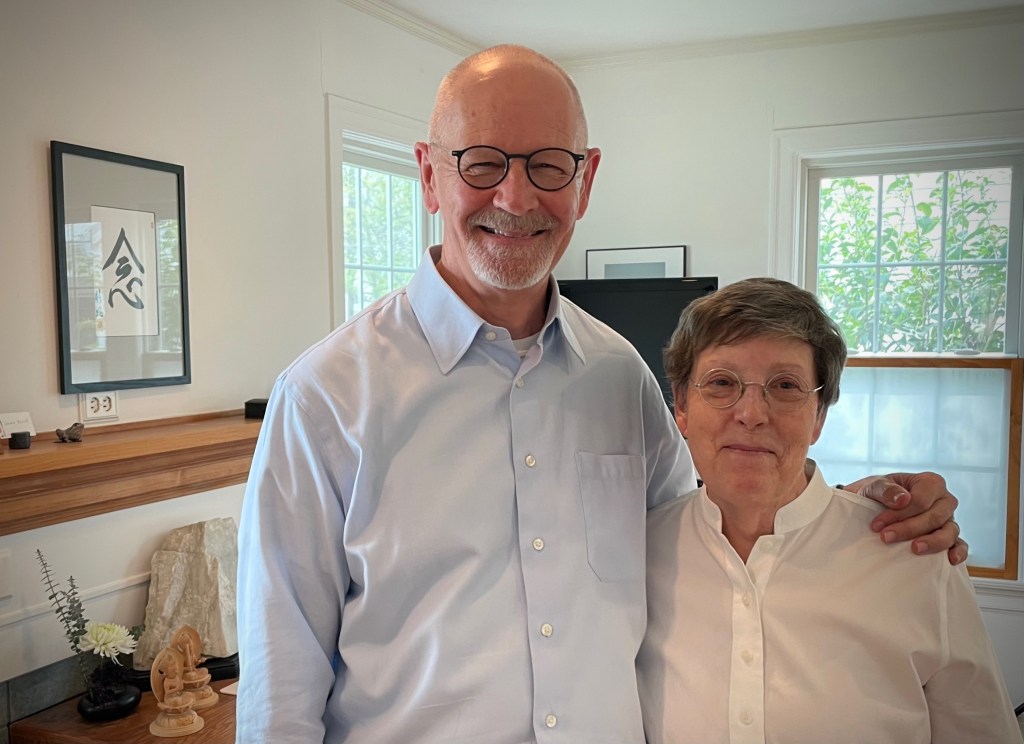
“And what is it that the members of the Monterey Bay Zen Center expect from you?”

“Honesty. Inspiration, perhaps, in how to work with difficult parts of their lives in skillful ways. And I think the invitation for unconditional friendliness with themselves.”
“What is it that brought them there in the first place? What did they come to the Center looking for?”

“Many come for a sense of community. A lot of people say that they don’t meditate on their own by themselves, but, coming to a group, they meditate. And I think the sangha is really important, being in community with people sharing the Bodhisattva vow. Some were looking for relief from their suffering, trying to find a way to bear the unbearable, to be with really difficult situations. Some people – especially the Catholics in our group – love the ritual and the ceremony and the incense and chanting in a foreign language, and the robes. You know, that really feels and smells like home. Some are looking for comfort. I think we’re all looking for comfort.”
“One thing you didn’t list, you didn’t say they came looking for awakening or enlightenment. That doesn’t seem to be the driving force it once was, the desire to find a practice that has the potential of altering the way one sees, understands, and relates to life.”
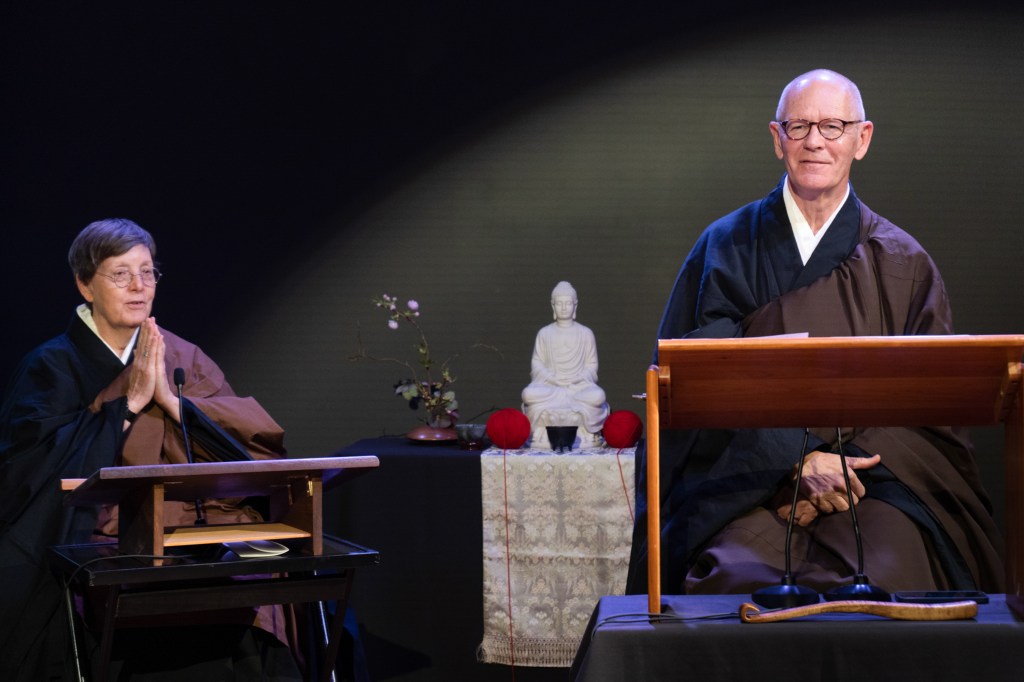
“I think that’s what I mean by unconditional friendliness, being with what arises, facing the entirety of our experience with wisdom and an open heart, embracing all parts of ourselves.”

“You said ‘unconditional friendliness to oneself’ earlier.”

“To yourself. I think that ripples out to the world, seeing no one as ‘other.’ That naturally flows. The more we can bring that, share that light of tender awareness on ourselves, the more we see our interbeing or – you know – our intrabeing, the sense that there is no other. And I do think that people come for enlightenment. It wasn’t what my search was. I think for me it was more because it made sense and offered relief from suffering. It was finally something that made sense of the world to me.”

“And how does Zen help relieve suffering?”

“I think wanting the world to be any different than it is is the definition of suffering, and Zen – or Buddhism – offers the invitation to really be with the world as it is beyond the world of right and wrong, good and bad, to recognize the comparative mind, to not be attached to our preferences , and to just see our constant internal chatter as an annoying radio station in another room. So for me, enlightenment is moments, moments of liberation. I’ve never known anyone that’s landed and stayed there. I don’t really know anybody that I would consider enlightened. I know people who are really wise and have deep understanding and have many moments of that peace. But everyone I know is pretty human as well.”

“So you’ve described an array of services you offer; you’ve talked about guided meditations, chiropracy, psychotherapy, non-violent communication. Where does Zen fit?”

There is another of her careful reflective pauses as she considers her response. “It’s not so much Zen as it’s Buddhism. The practice of meditation, of deeply knowing ourselves, of awakening out of our trance. I remember once talking to Bernie Glassman  at my first Lay Zen Teacher’s Association meeting and his last, and I said, ‘I don’t know whether I needed to have so many years of sitting on the cushion and suffering on the cushion.’ You know? Sesshins were horribly painful, and yet you’d go back again. And he said, ‘Well, I do my meditation now in the hot tub.’ And I still don’t know the answer to that question, whether I really needed – for my own self and personality – to face the suffering on the cushion and just to be with it. I don’t know. As a healer, I go to Tassajara every summer, and I treat the residents and the monks and the students, and – you know – I see a lot of injuries from sitting.”

“This is as a chiropractor?”

“As a chiropractor. As a doctor. I mean, I go as a psychotherapist, and I go with all my toolkit. But especially the young men – you know – there’s a lot of testosterone.” Speaking in a strained voice, “‘I’m such a good sitter I’m not moving even if my leg falls off! You can’t make me move!’ I was never that type of sitter. I was always afraid of hurting myself. And at one point Katherine Thanas, because there was some ambivalence about the forms . . . I mean, coming to our Zen Center is kind of off-putting because some people are such stickers for the forms. ‘No! You walk in with the left foot and then you bow!’ Really, I feel so bad for the new people. But Katherine Thanas did away with the forms for a while. We didn’t have any forms. We didn’t chant. And then we brought them back.”

“Why?”

“I think many people missed the forms. I was surprised that I missed some of the forms. It’s an opportunity for mindfulness. Whatever you’re doing with forms, it brings you into your body.”

“How important is all the Japanese stuff?”

“Very unimportant to me.”

“Then why is it still around, especially with Soto people? Why all these elaborate robes and shaved heads, rules about which foot you use to enter the zendo?

“I don’t know. I think the hierarchy separates, but for many, being a priest is their path of service. I feel you don’t have to be a priest to live a life of service. I think what keeps me with Zen Center is that there’s a sangha of people who love me and appreciate what I teach. Because I think many of the other offerings are more intellectual. Mine is more personal. I’m fairly self-disclosing within reason, and I think that’s helpful for people. And I think it’s important to have my voice and perspective.”

“They need that eccentric aunt.”

“I think so.”

Sokei-an and Ruth Fuller Sasaki

Adapted from The Third Step East

D. T. Suzuki was a scholar. Nyogen Senzaki was an effective teacher, but he had not been formally authorized as one. The first fully authorized, or transmitted, Zen Master to teach in North America was Sokei-an Sasaki.

He was the son of a Shinto priest who died when the boy was 15 years old. There was some expectation that he would follow his father’s career, but his natural inclination was to art, and his mother’s family arranged for him to be apprenticed to a sculptor at the Imperial Academy in Tokyo where he learned traditional Japanese woodwork and specialized in carving dragons.

As he matured, he found himself reflecting on issues which had troubled him since childhood. He later wrote: “At seventeen or eighteen, we open a doubtful eye: Why do we live? Where do we come from? Were we here before? Where do we go? If we have no such period of seeking, I should say that we are sleeping. This questioning comes to every young man’s eye.”

These concerns remained with him as he pursued his art studies. He learned samadhi – meditative absorption – not in a monastery but from an art teacher who instructed his students when they sought to paint the sea “not to sketch the waves on the seashore or to copy the waves in the ancient masterpieces. ‘Without brush or palette,’ he said, ‘go alone to the seashore and sit down on the sands. Then practice this: forget yourself until even your own existence is forgotten and you are entirely absorbed in the motion of the waves.’”

There were, Sasaki would discover, many kinds of samadhi, and Zen itself – as he put it – was an art form. “I found this knack of going back to the bosom of nature because I was an artist and worshipped Nature. From this feeling, I entered Zen very quickly.”

One day he set up his easel to paint but found himself stymied, unable to draw a line. He understood that it was time to put away his canvas and palette and seek a Zen teacher. The master he approached was one of Soyen Shaku’s disciples, Sokatsu Shaku.

Soyen Shaku

Soyen Shaku had assigned Sokatsu responsibility for overseeing Ryomokyokai – the Institute for the Abandonment of Concepts – which Imakita Kosen had established in order to foster the practice of Zen among lay persons. An old farm house outside of Tokyo, surrounded by rice fields, had been converted into a temple. There were two buildings in the temple enclosure. One was the teacher’s residence, the other served as the zendo. Here Soyen Shaku and Sokatsu carried on Imakita’s hope of revitalizing the Zen tradition by working with well-educated and culturally talented lay practitioners.

Sasaki was nineteen years old when he presented himself at the temple and asked to be accepted as a student. Sokatsu asked him, “What career do you follow?”

“I’m a sculptor,” Sasaki replied.

“And for how long have you practiced this craft?”

“Six years.”

“Very well. Carve me a Buddha.”

Sasaki returned to his studio and began work on a carving which, when completed, he brought back to Ryomokyokai and presented to Sokatsu. The Zen master took the statue and demanded, “What is this?” Then he tossed it into a nearby pond.

In that way, Sasaki’s Zen training began.

He was given the Buddhist name Shigetsu (Finger Pointing to the Moon) but remained a layman. He was still enrolled in the Imperial Academy of Arts and earned a modest living travelling about Japan repairing old temple carvings. After graduation, he was drafted to serve in the Russo-Japanese War and was sent to Manchuria, where he drove a dynamite wagon. The experience made him all the more aware of the precariousness of human life.

The war ended two months later, and, once discharged, Sasaki returned to Tokyo to continue his studies with Sokatsu.

Encouraged by Soyen Shaku, Sokatsu planned to take a small group of disciples to America in order to establish a Zen community there. He invited Sasaki to join them but insisted that he would need to be married if he chose to participate. So a marriage was arranged with another lay student at Ryomokyokai, a woman named Tomeko who was a student at Japan’s only college for women.

In September of 1906, Sokatsu and six disciples left for California where they purchased a ten-acre farm in Hayward. None of the Japanese had any agricultural experience, and the land was poor and exhausted. The enterprise failed after a single crop of strawberries was harvested. Sasaki and Tomeko left the farm to go to San Francisco where he enrolled at the California Institute of Art. While in San Francisco he met and was befriended by Nyogen Senzaki. The two would remain in contact throughout their lives though they did not always see eye to eye.

Sokatsu and the other disciples were unable to maintain the farm and eventually also moved to San Francisco where they established an American Branch of Ryomokyokai. At its height, it had about fifty members, most of whom were Japanese. Eventually, Sokatsu returned to Japan, and all of his disciples, save for Sasaki and Tomeko, went with him.

Sasaki then began to explore the United States. For a while, he was able to find work in California repairing statues for an importer of Asian sculpture. Then he hiked north to Oregon where he was able to make use of his wartime experience by dynamiting tree stumps for a farmer. He also worked as a janitor in a bar and for a time as a professional dance partner at a roller rink. In the evenings, he sat in meditation on a rock by the river with a dog to protect him from snakes.

Eventually he and Tomeko came to Seattle where he worked as a picture framer. He could not afford the studio and tools necessary for carving, so took up writing and began a series of humorous reflections on American life for Japanese periodicals.

Sasaki and his wife lived in humble circumstances. For a while, they stayed with the Salish people on an island in the Puget Sound. The Japanese couple had faced a great deal of prejudice elsewhere in America, and Tomeko felt more at ease with the Native Americans than she had anywhere else. By this time, they had two young children, and when, in 1914, Tomeko became pregnant a third time, she informed Sasaki that she wanted her children to be raised in Japan. She left him and went to live with her mother-in-law who was aging and had written to ask her daughter-in-law to come care for her.

Unencumbered by family obligations, Sasaki wandered about the United States for the next two years, arriving in New York City in 1916, at the age of 34, where he naturally gravitated to Greenwich Village.

Sasaki was fascinated with the wide variety of lifestyles he came across during his travels, ranging from the conservative values of small-town America to the sophisticated charlatanism of the Bohemian community he fell in with in the Village. There he encountered people like Aleister Crowley, the British occultist and self-proclaimed mystic. The essays Sasaki sent back to Japan about the people he met and the events he encountered were popular, and he began to acquire a literary reputation. He also wrote in English, making translations of classic Chinese Poetry.

He was welcomed into the artistic milieu of the Village and led a comfortable life, but he still had not resolved the issues which had originally drawn him to Buddhism. Then on a hot and humid day in July 1919, he came upon the putrefying carcass of a horse lying in the street. The sight struck him so strongly that he immediately made arrangements to return to Japan.

Sokatsu Shaku

He resumed his study with Sokatsu and even tried reconciling with Tomeko but remained restless and soon returned to the US. For several years, he travelled back and forth by steamship between Japan and America, studying Zen with Sokatsu at Ryomokyokai and working as an art restorer in New York. Eventually, during one of his return trips to Japan, he realized that if he were serious about his Zen practice, he needed to commit to it until he achieved full awakening.

Sokatsu assigned Sasaki the koan which demands, “Show me your original face, your face before your parents were born.” Sasaki had been reading German philosophy and, for a while during his sanzen meetings with Sokatsu, tried to reply to the koan in the light of his understanding of those writers. Often, however, he barely began to speak before Sokatsu rang the bell dismissing him. Finally Sokatsu bellowed at him, “Before father and mother there were no words! Show me your face before their births without words!”

Sasaki struggled for years before resolving the koan. Then, one day: “I wiped out all the notions from my mind. I gave up all desire. I discarded all the words with which I thought and stayed in quietude. I felt a little queer, as if I were being carried into something, or as if I were touching some power unknown to me. I had been near it before; I had experienced it several times, but each time I had shaken my head and run away from it. This time I decided not to run, and Ztt! I entered. I lost the boundary of my physical body. I had my skin, of course, but I felt I was standing in the center of the cosmos. I spoke, but my words had lost their meaning. I saw people coming towards me, but all were the same man. All were myself! I had never known this world. I had believed that I was created, but now I must change my opinion: I was never created; I was the cosmos; no individual Mr. Sasaki existed.”

When Sasaki next met with Sokatsu in sanzen, the teacher immediately recognized that his student had had a breakthrough. “Tell me about this new experience of yours,” he demanded.

Sasaki looked at him without speaking. Sokatsu smiled.

Sasaki was 47 years old when he completed his training and received inka – authorization to teach – from Sokatsu. To mark the occasion, Sokatsu also gave him the name Sokei-an. Sokatsu encouraged him to return to the United States, telling him that interest in Zen was diminishing in Japan; the tradition needed to be carried to North America if it were to survive. He instructed his student to be diligent in familiarizing himself with the people and culture of the United States because it would now be his responsibility to ensure that Buddhism was successfully transplanted there. Because of his reservations about the Zen hierarchies in Japan, Sokatsu wanted Sokei-an to remain a lay teacher. Sokei-an, however, felt that he would have more credibility in America if he were ordained. When Sokatsu refused to carry out the ordination, Sokei-an went to another priest who was willing to perform the ceremony. Sokatsu considered this a betrayal and the two remained estranged for the remainder of their lives.

To raise the funds he needed in order to return to America, Sokei-an worked in a factory for eight months. Then, in 1928, he returned to New York City, determining to be the first Zen Master to “bury his bones in America” and thus “mark this land with the seal of the Buddha’s teaching.” He supported himself by doing art restoration while he tried to determine how best to go about promoting the Dharma. He tried, like Christian evangelicals, going door to door offering to tell people about Buddhism, but that proved unsuccessful. He gave public talks in Central Park and at a bookstore on East Twelfth Street which specialized in Asian studies.

His first students were a group of eight Japanese businessmen who, in spite of the rupture between Sokei-an and Sokatsu, were successful in petitioning Ryomokyokai headquarters in Japan to authorize a branch in New York. They were incorporated in 1931 as the Buddhist Society of New York. Sokei-an tried, for a while, to teach his students to sit in full or half lotus posture and encouraged them to practice sitting that way at home. Even the students of Asian heritage, however, found the posture challenging so, instead, they used chairs during meditation sessions.

The focus of his teaching was the one-on-one sanzen interview – he called the sanzen room a “battlefield” – but he also gave powerful talks which could be witty and sharp. It was his physical presence, however, which most inspired his students.

Mary Farkas

One of these, Mary Farkas, described the format of the meetings of the Buddhist Society in an article published by the First Zen Institute of America in 1966. The gatherings took place in Sokei-an’s apartment where there was a small altar bearing only a stone. Sessions began with a short period of meditation. Farkas suggested it was Sokei-an’s silence which drew the participants into the meditation. “It was as if, by creating a vacuum, he drew all into the One after him.” Students working on koans were then called into sanzen in an adjacent room. During sanzen there were “no psychological or philosophical discussions, no worldly advice or explanations, just the business of Zen. When I was in recent years asked if we were given ‘instruction’ in Zen my considered answer had to be ‘no.’ To those of us who received Sokei-an’s teaching, the word ‘instruction’ must be a misnomer, for his way of transmitting the Dharma was on a completely different level, to which the word ‘instruction’ could only clarify the state of ignorance of the questioner. If I were to say he ‘demonstrated’ SILENCE, even that would be true but would give no indication of how he ‘got it across’ or awakened it, or transmitted it.”

Following sanzen, Sokei-an returned to the main room and took his seat behind a small desk on which he kept notes on the texts he was translating. He would read a passage from one of these then give an extemporaneous talk. He believed it was necessary to ensure that there were adequate Buddhist texts available for those who were serious about their pursuit of Zen, so he began an extensive translation project which included rendering the Platform Sutra of the Sixth Patriarch into English. He also translated The Record of Rinzai.

The group grew slowly but steadily. After seven years, there were thirty members. Sokei-an was not in a hurry. He reminded his students that it had taken hundreds of years for Zen to become established in China and Japan. What was required, he told them, was patience and perseverance. He told them of a monk he had once seen at a temple in Japan preaching to the rocks in the garden because there was no one there to hear him. Years later, when he chanced to pass the temple again, he found the same monk now preaching to a crowd of more than two hundred people. “I brought Buddhism to America. It has no value here now, but America will slowly realize its value and say that Buddhism gives us something that we can certainly use as a base or a foundation for our mind. This effort is like holding a lotus to a rock and hoping it will take root.”

In 1938, the Buddhist Society acquired an unlikely wealthy sponsor, Ruth Fuller Everett, the wife of a prominent Chicago attorney, Edward Warren Everett. Their daughter, Eleanor, was married to Alan Watts. Ruth had only been eighteen years old when she married Everett, who was twenty years older. The marriage was not a happy one, and, in self-defense, Ruth developed a forceful personality in order to resist her husband’s tendencies to bully her. Once she gained the self-confidence to stand up to him, Everett resigned himself to allowing her to pursue her own interests.

Ruth Fuller

In 1923, Ruth took her five-year-old daughter to a retreat at a country club outside New York City operated by Pierre Bernard, who called himself “Oom the Magnificent” and purported to be a master of yoga and a spiritual guide. Although Bernard was a fraud and a conman, the time Ruth spent with him fostered a genuine interest in Eastern Philosophy. When she returned to Chicago, she took up an academic study of Asian philosophy and languages at the University of Chicago.

In the 30s, she and Eleanor traveled to Japan where she introduced herself to D. T. Suzuki. He gave her some preliminary instruction in Zen but advised her that if she were serious she would need to practice with an accredited Zen master. He introduced her to Nanshinken Roshi, who, at first, was reluctant to accept her as a student. He had no other female students, and he doubted that pampered Westerners would been able to sit properly on cushions. Ruth persisted in seeking admission to the zendo, and finally Nanshinken arranged for a plush armchair which he installed in his house, telling her she could use it for meditation; however, only cushions were permitted in the zendo itself. Ruth learned to sit cross-legged and in a short time was practicing with the men in the zendo. Nanshinken came to admire her perseverance and eventually introduced her to koan meditation.

In 1938, Warren Everett was confined to a nursing home with arteriosclerosis, and Ruth moved to New York. She took an apartment in the city and arranged for her recently married daughter and son-in-law to occupy the one next to it. Learning there was an authorized Zen teacher in the city, she sought him out. She was not a passive student.

When Ruth met him, Sokei-an’s students were still meditating in chairs. From her own experience in Japan, she knew that westerners were capable of adopting formal meditation postures, and she took on the responsibility of teaching them how to sit on cushions. Soon she was tightening up other aspects of the Buddhist Society program.

Everett died in 1940, leaving Ruth more time to spend with Sokei-an. Part of their time together was work; Ruth remained a committed scholar as well as a dedicated Zen practitioner and, with Sokei-an’s help, she had undertaken to do an English translation of the eighth century Chinese Sutra of Perfect Awakening. But part of their time together was, to her daughter and son-in-law’s surprise, courtship.

In November 1941, just a few weeks before the attack on Pearl Harbor, Ruth arranged for the Buddhist Society to move into more spacious quarters on East 65th Street. With the outbreak of war, the institute drew the suspicion of government officials. Suited FBI agents kept watch over who came and went. That July, Sokei-an—like Nyogen Senzaki—was arrested as an “enemy alien.”

He was sent to an internment camp in Maryland. The camp commander turned out to be a decent man who had some sympathy for those in his charge; Sokei-an took up his old calling and carved the commander a staff in the shape of a dragon. Conditions in the camp, however, were harsh, and Sokei-an was not in good health. He lost so much weight in the camp that he was able to tighten his belt four notches.

Ruth used her social connections to intervene on his behalf and was successful in arranging for his release in August 1943. The following year, they were married, in part to provide him some protection from still suspicious authorities.

After his release, Sokei-an told the members of the Buddhist Society that it was probably still too early for Zen to take root in America. The lotus still needed to be held to the rock a while longer. “I love this country,” he is reported to have said. “I shall die here, clearing up debris to sow seed. It is not the time for Zen yet, but I am the first of the Zen school to come to New York and bring the teaching. I will not see the end.”

His health didn’t recover, and he recognized that he did not have long to live. He assured others that he was prepared. “I have always taken Nature’s orders; I will do so now.” He tasked Ruth with the responsibility of ensuring that a formally trained Rinzai teacher be found to work with the Buddhist Society after his death. He also encouraged her to return to Japan to complete her own training.

He died on May 17, 1945, after less than half a year of marriage.

After his death, the Buddhist Society was renamed the First Zen Institute of America and committed itself to preserving Sokei-an’s teachings.

Members of The First Zen Institute of America at Sokei-an’s memorial service in New York, 1945.

As Sokei-an had hoped, Ruth returned to Japan to continue her training. She approached Zuigan Goto, who had been a member of the group that had taken part in the feckless California farming venture with Sokatsu. Goto was teaching at Daitokuji, where Ruth was accepted as a lay student and given a small house within the temple grounds, separate from the monks who were all male and Japanese.

Sokei-an had also asked her to identify a qualified teacher to carry on his work in America, and, in 1955, after six years at Daitokuji, Ruth returned to New York with Isshu Miura.

In New York, Miura gave a series of talks on koans with Ruth acting as translator. These became the basis of a book they co-authored entitled The Zen Koan: Its History and Use in Rinzai Zen.

 In 1957, Ruth returned to Daitokuji, where Goto allowed her to add a small zendo to the side of her house. This was the first zendo in Japan specifically intended to receive Western students. The following year, she became both the first woman and the first Westerner to be ordained in the Daitokuji temple system.         

Isshu Miura

After Ruth’s return to Japan, Miura stayed with the First Zen Institute for a while, but he was not comfortable with the predominantly female board of directors. In 1963, he resigned his position, although he stayed in New York and maintained a small number of private students with whom he worked until his death sixteen years later.

One of the features distinguishing North American Zen from its Asian antecedents is the active participation of women in the sangha. Ruth Fuller Sasaki was the first of these, but she was not an easy person to work with. She was strong-willed, confident of her own opinions, and often inflexible. When she informed Zuigan Goto that she intended to add a dormitory to her small zendo, he told her he would rather she did not. She ignored his request and went ahead with the construction. In Japanese culture, it was unheard of for a student to disregard a teacher in this manner. It caused a rift between the two, and Goto disavowed her as one of his disciples.

Ruth gathered together a group of scholars in Kyoto to continue Sokei-an’s work of making Chinese and Japanese texts available in English. Several of these – including Philip Yampolsky and Burton Watson – later would become significant figures in the academic world. Working for Ruth provided these young men with an unparalleled access to rare documents, but they often felt that the specific tasks she assigned them were tedious and of questionable value. She was also quick to get rid of people with whom she disagreed or of whom, for whatever reason, she became suspicious.

Simple projects could balloon out of control under her direction. She began annotating the slim Zen Koan published with Miura, eventually adding over 150 pages of footnotes – in a smaller typeface – in addition to bibliographies, maps, genealogical charts and a “Zen Phrase Anthology.” By the time it was re-released as Zen Dust, shortly after Ruth’s death in 1967, it had swollen to a 574 page tome.

To the end, she remained a formidable personality, and often a generous one. Through her efforts, and those of the First Zen Institute, several Americans – including Walter Nowick and Gary Snyder – were able to travel to Japan in order to study Zen. In her way, she made as significant a contribution to the process of bringing Zen to North America as had her husband.

Gary Snyder, second from left. Ruth Fuller Sasaki, fourth from left. Isshu Miura seated in the center. Walter Nowick, second from right.

The Third Step East: 57-71; 9, 10-11, 73, 89, 100, 111, 127, 187, 188

The Story of Zen: 234-40, 251, 266, 280, 298, 424