Bluegrass Zen –
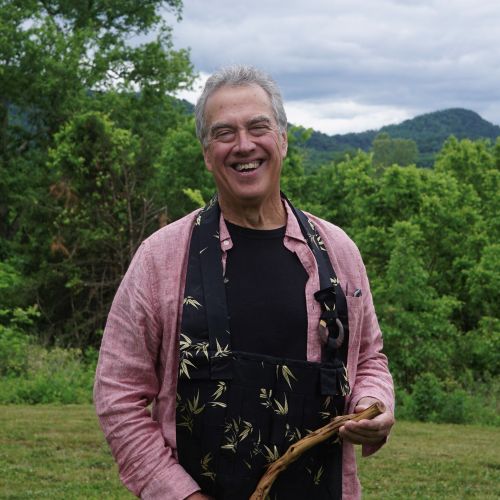
I was a member of an amateur bluegrass group while in university, so am charmed by the idea that there is Bluegrass Zen community in Lexington, Kentucky. It’s resident teacher, David Parks, was born in Phoenix, Arizona but grew up in Kentucky.
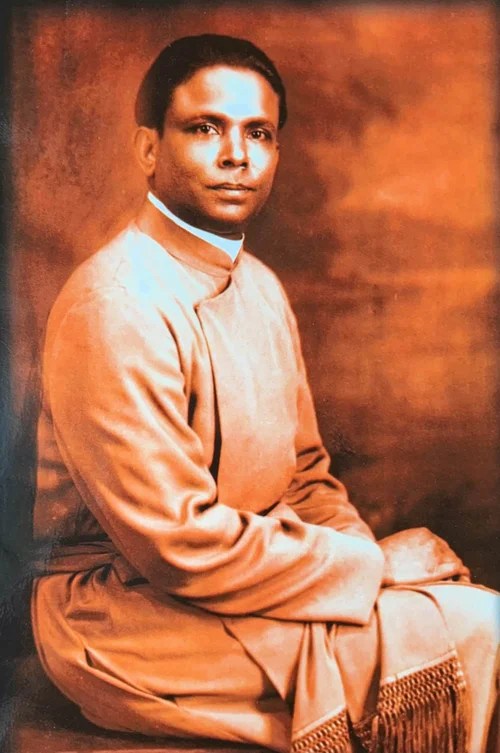
“When I was born, my father was a doctor with the Bureau of Indian Affairs on the Tohono O’odham reservation. Shortly after I was born, he went back to Boston to do a psychiatric residency. Dad was a spiritual sort of guy and fell in with the Vedanta Society at BU. Swami Akhilananda was the Swami there at the time. I look at Swami Akhilananda as my spiritual grandfather. My father wanted to become a Vedanta monk or a Hindu monk. And Swami Akhilananda said, ‘No, no, no, no, no. You’re Western; you’re a Christian, and maybe you should go to seminary instead of getting the saffron robes.’ And he considered that, but then he became the psychiatrist for the divinity students up at Harvard Divinity School. So, the spiritual search was important to my dad, and my mother too. They meditated before it was a thing. I grew up with people who were meditating every day. I look at that as an important formative thing. It was the norm rather than, ‘Oh, this is something cool we’re gonna try.’”
David’s father was a friend of Walter Pahnke who organized the Good Friday experiment in 1962 during which divinity students were given psilocybin to see if it were able to induce mystical experience. The test was supervised by the psychedelic pioneers, Timothy Leary and Richard Alpert (later Baba Ram Dass).
“So my dad was part of the early psychedelic thing before it was illegal. He was on the cutting edge of psychospiritual exploration. He became a leader in the United States in psychosynthesis, a transpersonal psychology not unlike Jung and positing a transpersonal self that linked everybody together. In the house where I grew up people were meditating, talking about spiritual growth, pondering what it is like to be human. Sometimes my dad would wander a bit far into the margins. My mother was always there to anchor him, ground him in his explorations. All that’s background. My upbringing was really eclectic spiritually and – this is important – based in experience. That was at home. At the same time, here in Kentucky, the religious environment is based on belief about right and wrong, heaven and hell – more or less a morality rather than a spirituality – and I grew up with all my friends around me convinced I was gonna go to Hell ’cause I hadn’t been baptized.”
“Was that environment meaningful to you?” I ask.
“It was meaningful, and it was certainly unique. I became a minister later; it was certainly unique among my minister colleagues. And somewhat unique among the Zen people that I’ve come across. As Zen has come into this country, Zen folks have a mystical/spiritual thing going on, to be sure, but often it’s through a psychological lens, and mine actually wasn’t like that. Even though my father was a psychiatrist, I felt myself tending more in the direction of the religious. The question for me has been, ‘What is this universe and how do I fit in?’ That seems to me to be a religious question. And most likely because of the religious environment I was in, that question moved me towards God, but not God as someone to believe in or someone at all, but as an experience of the wonder and mystery.”
His ministry was in the United Church of Christ, which – he tells me – is “a non-doctrinal, non-creedal liberal protestant church in the US.”
He explains that he felt drawn to the ministry while in college.
“I went to this small college in Kentucky – Centre College – and I met two professors there. You know, I’d been sort of in this conservative theological environment, and I got to Centre, and I thought, ‘Oh! People can think and be Christians too! So I hit the religion courses hard, World Religions, Bible, Native American Religions, Indian Philosophy. And I’d been meditating on a regular basis since I was 15 years old. That was still a part of my life. After college I thought, ‘What am I gonna do?’ And I said, ‘Oh, I’ll go to seminary.’ It was almost that simple. I wanted to study religion, so I decided to go to Yale. And I was there for four years; receiving two degrees, a Master of Divinity and a Master of Arts in Religion.
“Yale is an interdenominational seminary, but it was Christian. And given my background, my family and the sort of things I was interested in, it was bit conservative. Perseverance furthers and I graduated. And though I had spent four years in a professional school training ministers, I did not have a strong sense that I was going to enter the ministry. We have a koan that goes, ‘The great Way is not difficult, simply avoid picking and choosing.’ Well, I guess that is what I did. Without strong preference, a life-long desire, or even a ‘call,’ I eventually decided, ‘I’ll go ahead and be a minister.’ And I served for ten years in rural Pennsylvania. It was a fairly fundamentalist environment in terms of theology, but I knew the mind-set, being from Kentucky. And it was ten good years with the people of Pennsylvania. I’d married my last year of seminary, and we went there together serving half-time in a hospital chaplaincy and half-time in a parish. After Pennsylvania I was ten years in Massachusetts and then seventeen years in California.”
I wonder if the faith of the people he ministered to was the same as his own belief.
“Well, see that’s why I finally left the ministry in 2016. There were many reasons, but at root it came down to belief. I felt like part of the minister’s job was carrying everybody’s belief for them, whether they had that belief or not. But more importantly, I was carrying beliefs that I didn’t have for myself. And there were expectations of me to believe a certain way and act a certain way. And I said, ‘I can’t do that anymore.’”
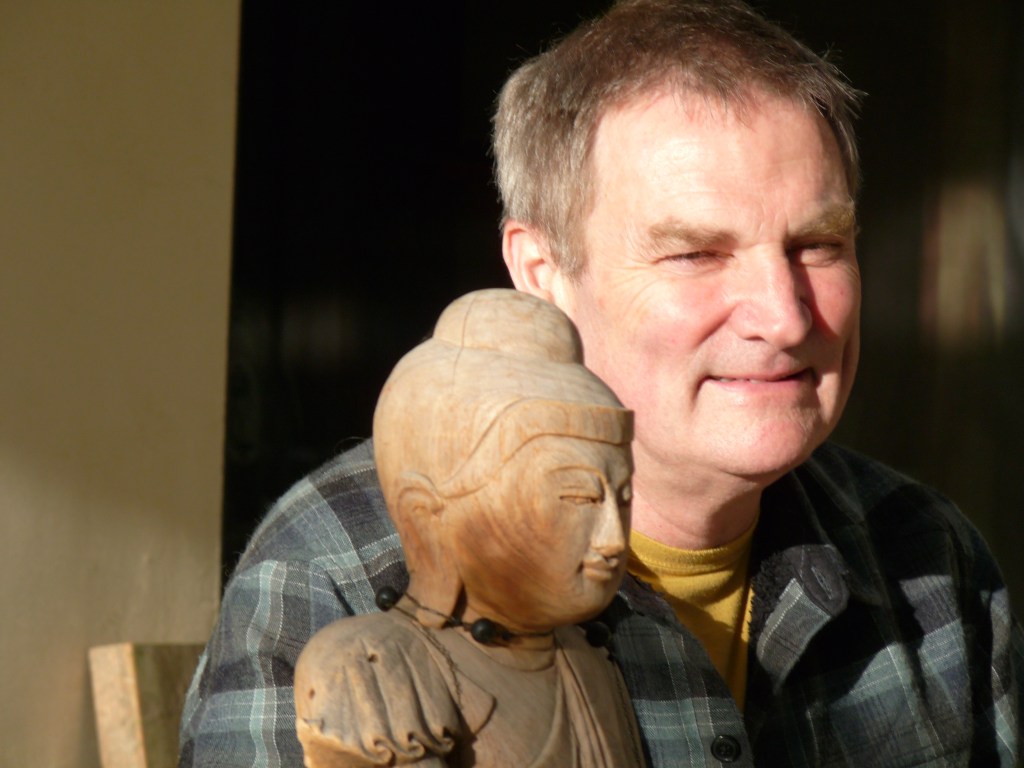
One of his postings had been at the First Congregational Church of Santa Rosa, California, where he served for fourteen years. He had already practiced for a bit with the Korean Zen teacher, Seung Sahn, during a posting in New England, but then became – as he puts it – “unattached to the Zen side of things for a while, but later it became important for me to find a sangha and a teacher. Along came Pacific Zen and John Tarrant right there in Santa Rosa.
“I found John very human, and most importantly, interested and available. John had time for me as I explored my life in dialogue with the koans. Whenever you go into the room for an interview with John, somebody had just been in before you, and you go in and he looks up from whatever he is involved with in the moment, and then he’s just totally there for you. I had gone through a rough patch in the early 2010’s, and I had weekly meetings with John. I’d bring him coffee and we’d sit together as I spun that week’s tale of woe. He was patient with me. The discovery was always to be my own. But he called the bullshit, the ways that I would get away with myself, attaching to whatever demons might show up. That was hard but I appreciate John’s unwavering alliance with my awakening. He can be hard, but he was uncompromising in the Dharma. But, as I look at it, whatever seemed hard, this path, it was because it was hard in my own heart, not because of the difficulty I was having with John. And that’s one thing I’ve found in my teaching is I’m here for the student even when the student’s not here for themselves in the deepest way.”
The Pacific Zen Institute focuses on koan work in a fairly informal fashion. David tells me that he found koans sometimes easy but at other times rather daunting.
“So I would pass them, and there was kind of a thrill, and, ‘I’m good at this.’ So right away there was the self image, ‘I am good at this.’ But something more subtle was going on, something that is hard to put in words. Something like a grammar of the heart, a vocabulary beyond the words of the koans, a vocabulary of spirit, if you will, was forming. The koans give you a pathway, a way of relating the vastness of things, an approach to my questioning, ‘What is this and how do I fit in?’ Koans are a relationship that always opens. They are trustworthy like that, and bottomless. I never fully exhaust what they have to offer. Because of this, when I work with students now it’s like – God! – I learn so much from what they say. The koan’s just limitless in terms of what it can offer. And so my relationship with you becomes my relationship with the koan becomes my relationship with myself. On the other hand, I’d sorta mastered the Christian thing, and I was doing pretty well with it. But it didn’t . . . You could see in the Bible and in the person of Jesus, even Paul, you could see, ‘Oh, he’s got something.’ But the gateways weren’t there.”
I ask how it was he returned to Kentucky.
“My father was sick, and my marriage was ending. And my church . . . I was beginning to think I was carrying things for them that I didn’t believe myself, and I was uncomfortable doing that anymore. Things were in transition, reaching an end. In 2016, my father’s second wife got a brain tumor and died. I was back and forth from California for much of that. After she died, my dad said, ‘Now my wife’s gone, what am I gonna do?’ I said, ‘Well, I could move here.’” He smiles at the memory. “Those words were a surprise to me. My life, as I knew it, had sort of disappeared. So I ended up back here in Kentucky. And I don’t regret it at all. It feels more like home.”
I ask if he still self-identified as a Christian minister when he made the move.
“That is a question that comes up again and again. People look for a label to hang on me. ‘Are you a Buddhist or a Christian?’ I usually stick out my hand as to shake and say, ‘Hi, my name is David.’ When I arrived here I had already been teaching. John had made a sensei, and I had a small meditation group at the church in Santa Rosa. Interestingly, while I felt committed to that small group, I did not feel a strong connection to my work at the church anymore. There wasn’t much for me to hold onto there. So I drifted away. The Unitarian Church in Lexington allowed me to run a Zen group, and that’s how Bluegrass Zen started. I knew there was a tradition of that, Zen groups finding a home beneath UU roofs. And so I went and asked them, and they said, ‘Sure.’ And eventually the minister became a student of mine. So I had a place, and then they sort of embraced it.”
“Why did you want to do that? Get a group started?”
“Oh, a couple of reasons, in no specific order. When I moved into Christian ministry, I said there was not a deep sense of call. Well, here there was. In retirement I needed something to do and there is something about the heart, when it is open it wants to reach people. If not that, what is all this for?”
“So you establish this group in Kentucky. What do you see your role as?”
“I see the teacher/student relationship as a mutual relationship. We each can live into the relationship as it opens to the heart of things. In our meetings, however, this mutual relationship is for the one, the student. I do not look to students for my spiritual growth. I have a role inside that group of people. I’ve experienced and studied. My whole life I have been oriented towards spirit. Either in person or on Zoom, I meet people in individual interviews, using the koans as a gateway for the conversation. Together we explore how deeply we can dive into the relationship as it opens into Life’s vastness or – as the Daoist might say – Way. This is a profound meeting beyond the reach of self-image or personality or any defining characteristic. My effort in this exploration, again, is for the student. I do carry a certain ‘authority’ culturally and personally for the student. Sometimes that might interfere as hearts open. But it becomes grist for the mill and then a gate for further discovery as we continue on the path to an open heart.”
“What is it that you hope for for the people who come to you?”’
“That they can touch grace. That they can touch love. That they can be present to their own lives.”
“You admit that you carry a certain authority both culturally and personally for the student. I’m guessing that’s because you’ve got the label ‘roshi’ now tacked onto your name.”
“There are assumptions that live in the culture about Zen and about teachers. Sometimes people think I have something that I can give them. There’s one guy who finally got disillusioned and said I wasn’t enlightened enough and quit. And so I guess he had some expectation of a perfectly enlightened being who could pass along whatever. What I hope that I can do is live an authentic life. It’s like you hear those stories of Suzuki Roshi where he’s just one of the gang laying the rocks in a wall or whatever. I’d like to be that sort of person. And I’d like to be the person that you can come to, and we can talk about the deeper things, and that we can enter into a koan together and see what it can do for us.”
“And what about the people there in Lexington who come to you. What are they looking for?”
“Well, enlightenment.” We both chuckle at that. “Nah, let’s be honest about it. They’re looking for peace. And the culture tells them, ‘Oh, yes, you meditate, and you don’t have thoughts, and you don’t get mad. You don’t do this; you don’t do that.’ They’re looking for that when they show up. And I say, ‘Well, that’s nice. You will have experiences in meditation where it feels like that’s the case. But then you go back into your life. What I’m interested in is helping you move into that life.’”
“I’m guessing at least some of the people who come to you still self-identify as Christian. What can Christians get out of Zen?”
“So there’s a place for Zen as a contemplative tradition in Western culture. I think it’s headed to the same place John of the Cross went with The Dark Night, going the same place that the anonymous author went with The Cloud of Unknowing. So there is a contemplative tradition within our western heritage, largely available to monastics, as it was in China and Japan. What I think Zen adds to the equation for us is its emphasis on practice. You can believe what you want, that’s fine. Only you’ve got to practice. I have found meditation and koan practice effective in my life, and I think – in our current Christian climate with its emphasis on belief and morality – it can be so for others. Zen provides a practice that is effective and one that can be transformative for religion in America. Currently Bluegrass Zen meets in a sanctuary of a Unitarian Church in Lexington. Musing one day with my Unitarian minister friend, I said ‘This is a practice for Unitarians. In Zen we don’t ask you to believe anything. We offer no certainties. Instead, we point you into the not known, the uncertain dark. Pagans will ask you to believe something; Christians do. But we don’t ask you to believe anything.’ There is the rich potential of that, and the nature of this world is that it always is coming towards us. Always coming. Calling to us to open our hearts. A phrase that I often use from the gospels is that part in the gospel of John where Jesus says, ‘I came that they may have life and have it abundantly.’ Taking the ego of Jesus out of that statement – which I believe it is safe to do – you can say that ‘the abundant life’ wants to be experienced. And as I live life, I find that I am a part of all this . . . uh . . . It’s even deeper than being a part of it, because that still denotes some kind of separation. There is no separation. When Dongshan was about to go on pilgrimage, he asked his teacher Yunyan what he should tell others about his teaching, Yunyan said, ‘Just this is it.’
“And koans . . . God, what a rich literary tradition! It’s like they’re really alive. You know, you’re walkin’ through a day and then all of a sudden one comes to you. And it’s like, ‘Okay. Thank you.’ And that’s what I like about the curriculum. It’s not like you go through it one time. The first time is like an introduction to a whole new set of friends. Three hundred friends, if you will. And you’re going to have a lifetime relationship with those friends. And they will change your heart. They will change your life. John uses the metaphor that they are like being with a dog. You know? The koans are just with you, following you around. When you’re with your dog, it’s a different life than when you’re not with your dog. When you’re with your koan, it’s a different life. And the wonder of it is what you discover in relationship with that koan. That dog? It is really just a relationship with yourself. It’s your life, and as you get out of the way, life opens. And as Bob Dylan said, ‘It’s life and life only.’ Only life, just this is it.”
 Richard Bryan McDaniel
Hi, Rick, I found this very interesting on many levels. It made me sad in that this man spent so much of his life in Christian churches and in many roles and never had the “experience piece” of his faith, it seems. It’s that experience of the reality of my Faith through the Holy Spirit that has been so instrumental in the deepening of my Faith.
And it encouraged me to get more serious about the meditation that clearly we are encouraged to do
So, thanks for this, Gail
“They will recount the glorious splendor of your majesty, and on your wondrous works I will meditate.” Psalm 145:5
“I will meditate on your precepts and fix my eyes on your ways.” Psalms 119:15
“Finally, brothers and sisters, whatever is true, whatever is honorable, whatever is just, whatever is pure, whatever is pleasing, whatever is commendable, if there is any excellence and if there is anything worthy of praise, think about these things.” Philippians 4:8 NRSVUE
LikeLiked by 1 person