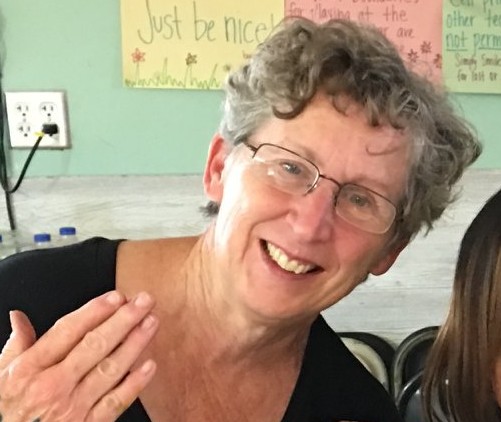
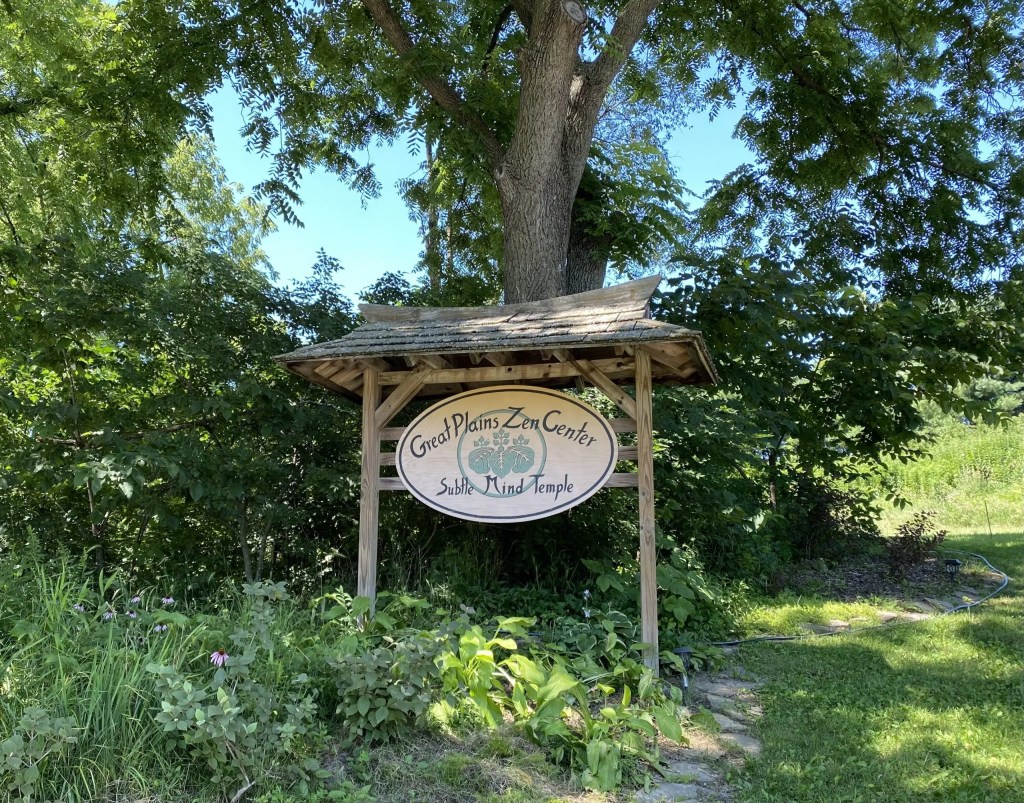
Great Plains Zen Center, Monroe, Wisconsin –
Susan Myoyu Andersen was the tenth person to whom Taizan Maezumi gave Dharma transmission. She later received full authorization – inka – from Dennis Genpo Merzel. Currently she is the resident teacher at Great Plains Zen Center in Wisconsin. She is also a good old-fashioned activist. After a career in social development work, I am glad to see that the flames haven’t gone out. She is a member of the Wisconsin Poor People’s Campaign Coordinating Committee, NAACP, Justice Overcoming Borders, and is active in advocating for the rights of formerly incarcerated people through WISDOM Wisconsin and other organizations. The Great Plains Zen Center has an active Racial Justice Circle and maintains an anti-racism resource list initially created by a group of White Plum Asanga members.
“As a kid I was pretty interested in Hinduism. I did a lot of reading about Hinduism, and Buddhism always sounded kind of scary to me.”
I ask where the interest in Hinduism had come from.
“I read the autobiography of Paramahansa Yogananda. My older brother and sister read a lot of interesting stuff, so that’s probably how I first came in touch with it. Clearly I was kind of a seeker, although I never would have described myself that way. I just thought, ‘Well, this is interesting, so I’ll read this.’”
“What else were you reading?”
“It was pretty much inner exploration of the self, the ‘who am I?’ question. When I went to Oberlin College, there was actually a Buddhist sitting group, but I thought it sounded really dumb and didn’t want anything to do with it. But then when I went to grad school, at UC San Diego, I needed a clarinet player for a piece I had written and ended up with a woman named Joan George who was a practitioner at Zen Center of Los Angeles, and she talked to me about ZCLA. We were in San Diego, a couple of hours from Los Angeles, and it sounded interesting, so I thought, ‘I’ll give it a try.’ When I first met Maezumi Roshi, I was surprised because I had thought he would appear special and holy, and he seemed kind of ordinary. I later came to appreciate that his power was actually in his ordinariness. After that, I returned every Saturday for the morning program with sitting and work and lunch. Soon, I went to sesshin and then began looking at how I could move there. I was still a graduate student in music. So I finished my master’s thesis while I was living in Los Angeles ’cause I thought, ‘I want to do Zen now, but I really should finish my music degree.’ And for a while I was part of a group of composers putting on concerts, and I taught music at a community college, but meanwhile I was just getting more and more involved at the Zen Center.”
“What was the allure?” I ask.
“What was the allure? I just knew it was what I should be doing with my life. I just knew this was an important thing to do.”
“Important in what way?”
“I guess I was looking for a way to appreciate life in a deeper way, and this seemed to offer the way to do it. In our lives we’re busy with what we’re supposed to do, what our roles are, who we are – blah, blah, blah – but it rarely occurs to us, apart from these roles, apart from these names, who am I? What is this? Who is this? And that is the question that began to grab me, and, of course, Maezumi Roshi – being the very clear, straight-forward teacher that he was – immediately connected with me in that way, and it was clear that this is where I belonged.
“So Zen is a practice that might seem extreme to people, and yet what it does is to focus us on that question of who are we really and what is really most important. That’s what it’s done for me. And what I’ve found is that one of the things that’s really important in my life is compassion and connection with other people. So when I learn about the suffering of other people, I can’t just say, ‘Oh, that’s too bad. That’s their problem.’ I realize I need to pay attention to that and address that because when they hurt, I hurt too.”
“And how did Zen help you accomplish all this?”
“I think Zen helped me see that I can’t just live my own separate little life and everybody else will manage the best they can. I think sometimes, not always, with other religious traditions, we may do charitable things but there is a sense of doing what we can when it’s convenient for us. Or we help from a sense of what we think is best for someone instead of really serving that person with what they need and ask for. Compassion in Buddhist practice is more like walking beside them and carrying some of their pain along with them. Not necessarily having all the answers, just being there with them and their suffering. My Dharma brother, Bernie Glassman Roshi, had a way of saying it that I think is really helpful. It’s like supposing my toe hurts. I can’t just say, ‘Oh, good. It’s just my toe. It’s not me.’ When my toe hurts, I hurt. So as I’ve gotten more and more into practice, when I am aware of injustice and disparity and the suffering of others I respond, and ask how I could be of service to them.”
“I’m still not clear about the ‘how.’ How does Zen bring that kind of perspective about?”
She reflects for a moment before responding.

“Okay. So basically Zen has three aspects, all of which are important. The first aspect that many people are familiar with is meditation. We don’t call it meditation, though, we call it sitting. When we’re sitting, we’re not meditating on something like a separate object. We are like a pail of water that’s not being sloshed around anymore. The surface of the water becomes very still. We can’t force the water to settle down; we can only put the pail down, stop stirring it around and let the water naturally settle. So when I’m sitting, my mind begins to just calm down and settle down, and I begin to see things more clearly. And I begin to see that this idea that I’m this person who’s independent of other people and I can do what I want and it doesn’t necessarily impact other people, I begin to see, ‘Whoa! That’s not actually true!’ When I breathe my carbon dioxide out, somebody else breathes it in. Or a tree breathes it in and breathes out oxygen for me. So, I begin to see my connectedness, and I begin to see that the source of my suffering is actually thinking and acting as though I am separate. And in particular my suffering comes from seeing only myself, what I need, and what I want, and not seeing the larger picture, not seeing myself as part of a community, as part of a family, as part of a world, as part of an interconnectedness with other things. As I begin to become aware of this, I begin to feel a lot more at peace, and at the same time I also begin to feel more of a sense of a larger responsibility toward the family, the community.
“So the meditation or the concentration that allows the mind to settle is one part of it. And then another part of it is Precepts which are very important in Zen because Precepts are a lens, a way of looking at things. For example, when I was younger, I was vegetarian, but I began eating meat again because a health professional told me I should probably eat meat for various reasons. But then living here in Wisconsin, I remember driving by these little white, plastic containers on farms and finding out that farmers put calves in there and that’s how they raise calves for veal. By putting the calves in there, making them live their lives in these little white boxes, the meat is very tender because they don’t develop muscles, and it’s just a horrible way for a calf to live. And after I saw that, I said, ‘I’m not eating veal again.’ And later on, I learned how cows are slaughtered for meat, and I decided that I did not want animals to go through that on my behalf and stopped eating animal meat. I realized it’s not really possible for me to avoid animal products altogether, but I could minimize the harm I caused at least a little by not eating animal meat.

“That’s just one example of how the Buddhist Precepts work. As we become aware of the consequences of our actions, we can choose not to do some things that cause unnecessary harm. Another example is becoming aware of not taking more than we need and thoroughly using what we do have. This is reflected in how we do our gardening, composting and our regenerative agriculture practices here at the Zen Center. Precepts are not like the Ten Commandments or a fixed set of rules – do this, don’t do this – they’re a lens to help you see that your actions have consequences, and that you can adjust what you do and how you do it.
“And then the third is the wisdom of waking up, just being awake and clearly seeing our life together as it is, not our ideas or concepts about it. When I’m awake, I can make better choices, be more fully present and see the inherent wholeness in everything and everyone, despite our flaws and weaknesses. They are part of our wholeness, too.”
I bring the conversation back to her biography and ask when it was that she moved to Los Angeles.
“So that was 1973 and I was 23. I was a second-year graduate student. I’ve come to understand that in many ways I was really immature, and I pretty much grew up at Zen Center of Los Angeles.”
“Chozen Bays told me ZCLA around that time was something ‘part monastery and part hippie commune.’”
“Yes. It was really the product of an era and a time; I think that’s what she means by ‘part hippie commune.’ I lived in a walk-in closet, and I got $25 a month as a stipend when I was on staff. I pretty much owned nothing, a few Zen books, a few clothes and robes. That was it. And I don’t think most people these days – even people coming to a monastery to practice as a monk – would live in that way. It was an era, and I don’t know if it was good or bad; I know it is not something I can reproduce at Great Plains Zen Center. Nor should I. Practice needs to adjust according to the time, place and circumstances. At the time, though, it produced an atmosphere where people could go deep into their practice. But – you know – there were personal consequences for me that I’ve often thought about. While I was there, totally enmeshed and deep in the practice, yes, it was very effective. On the other hand, I really wasn’t paying attention to my birth family very much. For example, I had a nephew who lost his father. He is bi-racial, and he’s told me he was subject to a lot of racism. I wasn’t there for him. And that was a consequence of my putting everything else in my life aside and being at that monastery. Other folks had different experiences. For me, it was an invaluable experience, but somewhat imbalanced in that, with such an intense focus on one aspect of my life, I was neglecting others. I’m still working on how to create the practice environment at GPZC where people can experience both intensely focused practice and bring all aspects of their life – family, work, everything else – into the practice arena as well.”
“Did you have an outside job, or were you a full-time monk?”
“I was full-time for quite a while, and I held so many different positions. I was involved with our in-house publishing company. I did a lot of work with liturgical positions for our services, gardening, and eventually cooking for retreats. And later on, the Zen Center could not support so many staff and it seemed like a good idea for people to have outside jobs and sources of income. I had learned accounting while I was at the Zen Center, so I did some work for an accounting temp agency. I wasn’t doing my music career anymore because that was something that would have required a lot of time and involvement to maintain. I had really switched careers to becoming clergy. It was hard to give up my music career, but I never regretted my choices, and music still finds its way into my life.”
“And somewhere along the line you got on the path to become a teacher.”
“So,” she says smiling, “something happened before that. I actually got married and had a child while I was at Zen Center. Which is interesting because I thought I would never have children. And then somehow my biological clock decided otherwise. So my son was born in 1987 while I was living at the Zen Center, and I can remember doing a seven-day sesshin when I was nine months pregnant wearing a nun’s robe.” She laughs softly at the memory. “This must have been very difficult for Maezumi Roshi because here I was, his picture-perfect nun who was supposed to live a celibate life, and suddenly I wasn’t doing that anymore. And to be honest with you, having children was one of the best things that ever happened to me. If you yourself have children, you know of what I speak. I mean, there’s nothing like the depth of love I have for my children and the joy they still bring.”
I tell her that I’m a great-grandfather.
“Wow. And I’m a grand-mom, and hopefully I’ll live to be a great-grandmother too. So that is the heart of my life in many ways. But the other thing was, as I say, I came to ZCLA when I was pretty young and immature, and I had difficulty seeing things from other peoples’ points of view sometimes. Especially the parents at the Zen Center I thought, ‘They have a spouse. Why can’t the spouse just watch the children and they come to sesshin?’ I was a little hard-nosed about it. I think having children helped me have much more empathy and compassion not just for other parents, but for people in all different situations. It also helped me learn how to serve others. As parents, especially of babies, we give up any hope of being able to do what we want when we want to do it.”
“Did you have a partner at this time?”
“I did, and he shared the responsibility, absolutely. In fact, he went to work which helped me to be the kind of mom that I wanted to be, which was to be there with our infant son all the time. And for the first time ever at the Zen Center of Los Angeles I wasn’t at everything always. It was a very different thing for me. I was a mom; I was with our baby a lot. And I think, too, I was a different parent than I would have been if I hadn’t been a Zen practitioner. There’s just no comparison. I wasn’t abused or anything like that as a child. It’s just that I had no idea about parenting, I had no idea how strong and deep the connection between parents and their children could be. I think I learned a lot just living at Zen Center of Los Angeles, watching various people have babies and parent their children. I got a whole different idea of how you could be a parent. So getting back to how I got to be a teacher: At that point, I was really pretty far along in koan studies. I was on the Precepts koans, which are the last part of koan study. Then, my husband and I decided we did not want to raise our children in Los Angeles. And at that point there was no internet; there was no Zoom, of course. So I continued koan study with Maezumi Roshi via snail mail.”
This was in 1987, after what she calls the “blow up,” when Maezumi confessed his alcoholism and his sexual affairs with students and went into treatment. “So the Zen Center was much smaller. It was a very different place than in its heyday when we had seventy staff members.”
“Why didn’t you want to raise a child in Los Angeles?”
“There were several reasons. First, the town seemed dominated by a larger-than-life Hollywood mentality. Didn’t feel like home. The other reason is that my husband’s mom was ill, and we wanted her to get to know her grandson. We wanted to spend some time with her in Chicago, which is how I ended up in the Midwest. And then Maezumi Roshi at a certain point contacted me and said, ‘I’d like you to come out, and I’d like you to have Dharma Transmission.’ I was living in Chicago at the time, and I had been leading a sitting group in the Chicago area, the Northwest Chicago Zen Group. We didn’t have property so we had to rent retreat facilities which was a lot of work because we had to bring all the equipment each time. So that’s kind of where I was. So I came out to Zen Mountain Center, where Maezumi Roshi was living, and did the week-long kegyo practice, which is a week when the person receiving Dharma transmission copies the sacred documents of transmission, does a lot of services and ceremonies and at the end, receives Dharma Transmission. That was in 1994.
“After that, I returned to Chicago and continued leading the Zen group at a Unitarian church in Palatine, a Chicago suburb. Eventually, the group decided that we really needed to have our own space, our own property. The property around Chicago was too expensive, so I began looking at property in Green County, Wisconsin, which was about two hours away from where we were, and we bought the property where we are presently. At that time, I also became interested in land where we could practice regenerative agriculture, restore prairie, and model good ecological practices as an expression of the Buddhist precepts. Which is what we are doing. And we were looking for a new name for the group now that we spanned two different states. It was actually James Ford who suggested ‘Great Plains Zen Center.’”
“You mentioned the importance of the Precepts in your understanding of Zen.” She nods her head. “You’ve worked with some men who had some difficulties in that area.”
“Very much so. Of course Genpo is one of them. I appreciated some things about him but also want to be clear that none of his positive qualities excuse his sexual misconduct and spiritual power abuse in my view.”
“How do you reconcile that?” I ask. “These are people, after all, who were responsible for passing on the tradition, for embodying the tradition. And, of course, it wasn’t just Maezumi and Genpo. When I began this series of interviews back in 2013, CNN – CNN! – was reporting on Joshu Sasaki’s sexual exploits. Maybe this is really a question about male biology, but there seems to be this gap between the centrality of the Precepts in the theory of Zen and the actual lived practice of Zen. Nor is just sexual misconduct. There have been financial problems as well.”
“You’re absolutely right about that. So, first of all, I don’t condone the misconduct. It’s spiritual abuse and a violation of the Buddhist precepts. Period. But at ZCLA, we were unprepared for dealing with the misconduct by Maezumi Roshi, Genpo, and others. We really struggled with how to handle it. We needed outside help. To that end, Chozen contacted the FaithTrust Institute which specialized in education and investigation around spiritual power abuse and misconduct by clergy. Some of us at ZCLA attended their trainings and eventually we realized it would be good to have a Buddhist-specific training around power dynamics and pitfalls in the Sangha. Several of us put together a Buddhist-specific Healthy Boundaries Course and we shared the teaching responsibility. I learned a tremendous amount from helping to teach that. I require it of my Dharma successors. Most of us did not receive that kind of training at the temples where we trained. At ZCLA, we grew up in a sort of dysfunctional Zen family and did not necessarily recognize that or know how to deal with the crisis that emerged when all of it came out into the open. ZCLA provided an unparalleled opportunity for training in some regards, but it was also very dysfunctional in terms of basic ethics and awareness of power dynamics that can occur in a spiritual community and how to keep people safe in a spiritual community.
“It all comes down to power abuse which can manifest as sexual misconduct, financial misconduct, bullying or any number of other ways. We have to start by admitting we have a problem and taking responsibility for it. I’m not sure the majority of Zen Centers are actually doing that even now. Responsibility includes recognizing the ways in which Zen practice as we’ve inherited it can easily lead teachers with certain personality types to take advantage of the adoration of their students to get their own personal, often unexamined shadow needs met. It also includes recognizing and naming abuse when it occurs, fully acknowledging and bearing witness to the harm that has been caused, making amends and creating better structures, education, and safeguards to prevent it from happening in the future. And I think Zen, right now, is finally beginning a very important reckoning with this and how to conduct ourselves and teach people – both teachers and sanghas – in a way that these abuses of power don’t happen. We have a long way to go, though. Still, I think within the teaching of Zen, it’s possible for teachers to rethink the teacher/student relationship in a way that doesn’t allow this to happen.”
“As a teacher, what is it you hope for for the people who study with you?”
“That they grow in those three areas, in wisdom, in precepts, and in concentration, that they grow and realize their own Buddha nature; that they awaken to who they truly are.”
“And what do they hope for from you?”
“I think what they’re hoping from me is someone who has experience walking the path, maybe has more experience than they have, and who can see when they’re veering off and help bring them back. Because we all have blind spots and places where we’re stuck and places that we don’t see clearly. And maybe I can be a bit of a mirror to hold up to people where they’re getting stuck and where they’re getting confused. I can’t open their eyes to who they truly are. Only they can do that. I can encourage them to keep on going, to stay with it. And that’s sometimes one of the most important things people hope for from a teacher. Maezumi Roshi used to say to me, ‘Just to keep on going.’ So sometimes people need encouragement, sometimes they need to be challenged, sometimes they need to be reminded of their vows. People also want help with following the Precepts, recognizing when they have drifted away and help getting back to them. As I talked about, the Precepts are a living, moving, creating thing. They are a lens. They are not a set of rules that we follow. And people really appreciate that. People really want to look at their life more clearly through the Precepts.”


One thought on “Susan Myoyu Andersen”