Conversations with Genjo Marinello Roshi
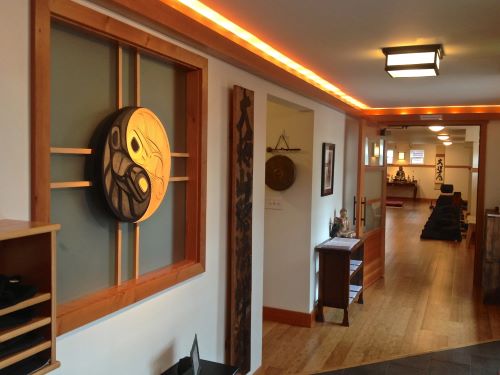
In 2015, I had the good fortune to spend a few days at Chobo-ji, the Rinzai Temple in Seattle. Each morning I was there, I joined the community for zazen at 5:30. There were usually about a dozen people in attendance, with perhaps twice as many zabutons. First a ritual cup of tea was shared (salted plum, which must be an acquired taste; I wasn’t there long enough to acquire it), then chants in Japanese, followed by two rounds of 25-minute sitting with a brief stretch break in between. Afterwards the abbot, Genjo Marinello Roshi, still wearing his elegant robes and a snap-brim cap, led the group outside and half-a-block down an alleyway to a local coffee shop. A table was already set up and waiting. Two of the residents from the temple were also in robes, and none of the patrons raised an eyebrow. Clearly Chobo-ji was well integrated into the neighborhood. Because it was Seattle, everyone ordered coffee. “Some people do order tea,” Genjo confided to me, “but we feel sorry for them.”
Genjo Roshi is the second abbot at Chobo-ji. The first – and founding – abbot was Genki Takabayashi, a Japanese-born Rinzai teacher recruited to Seattle by Dr. Glenn Webb in 1978.
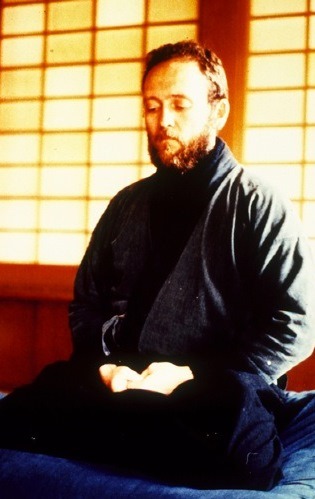
“I came to Seattle as a VISTA volunteer and a community organizer, trained, I understand, by the same Jesuit priest who trained Obama,” Genjo tells me. “Anyway, when I came here I looked for a Zen group.” Genjo had studied briefly with Daizen Victoria while a student at UCLA. “And there was only one Zen group in Seattle, and it was the Seattle Zen Center run by Dr. Glenn Webb who had spent a dozen years in Japan studying Japanese woodblock paintings and pictures and had become quite a scholar in that form and had been introduced to Zen because some of the Roshis where he went to go look at the prints said he wouldn’t be able to see them properly unless he meditated. So that’s how Dr. Glenn Webb got into Zen.”
“Did he accept that that was the case later in life? That meditation was necessary in order to appreciate the artwork?
“Actually, I think he did. So, he came back and started the Seattle Zen Center in the early ’70s. I came in 1976, and I did my first sesshin with Hirano Osho-san, the Soto Zen priest who came directly from Eiheiji. That was in the summer of 1977.”
Genjo points out, “It is my understanding that Glenn did receive transmission, but I never saw him dressed in the robes, and he wasn’t really playing the role of a priest or a Roshi; he was more an art history professor who had a Zen group. He was also a tea master. He had more than enough to do as a tea master and an art history professor and a part-time leader of a Zen group, so he was looking for someone to come from Japan that he might recruit to lead the group.”
While studying at Daishu-in in Kyoto, Webb met Takabayashi who had been expelled from his original temple and was at Daishu-in at the sufferance of the abbot, Soko Morinaga. Takabayashi had been an orphan placed in a temple to be raised as a priest. It was not a way of life he would probably have chosen otherwise, and – in a letter to Kobutsu Malone – Webb suggested that Takabayashi may have grown up “somewhat resentful at his fate. Apparently, when he was around 18 his teacher (his adopted father, Gempo Roshi) sent him to the grand priest-training-hall (sodo) of Daitoku-ji.
“As Morinaga put it to me,” Webb wrote, “on those occasions when he could go out on the town, Genki was a womanizer and pub-crawler. He got one woman from the neighborhood pregnant, she refused to abort the child, and Genki refused to marry her, thereby bringing shame to her family and to the temple. So he was kicked out of Daitoku-ji. As a favor to a friend, Morinaga Roshi took him in. But he made Genki’s life hell: when I met him at Daishu-in he was low man on the totem pole, relegated to menial tasks and never allowed to engage in anything important. He showed no remorse for his sexual misconduct, but he seemed determined to go as far in his training as he could. He was a kind of Zen fundamentalist regarding his sitting and his adherence to the tiniest detail of Rinzai Daitoku-ji liturgy.”
As unlikely a candidate as Takabayashi was, Webb invited him to Seattle even though Morinaga was not in favor of the move.
“I was at the airport when Genki Takabayashi arrived in 1978,” Genjo tells me, “and ended up doing sort of a twenty-year apprenticeship with him as his senior student.”
I ask what Genki Roshi was like, and Genjo speaks of him fondly, although he begins by noting that although Takabayashi was a modest man when he first arrived, he quickly came to relish the reverence with which he was treated as a Japanese Zen Master in America.
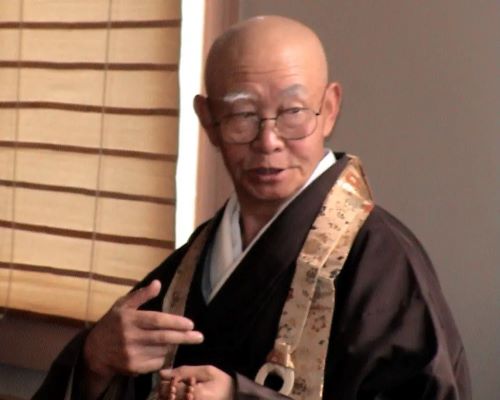
Elsewhere, Genjo wrote that Takabayashi “taught students how to make every moment a learning, and how to never give up despite inner and outer conditions.”
“How did you personally come be ordained?” I asked.
“The Dalai Lama came and gave a talk at the University of Washington on the Four Noble Truths, and I was sort of blown over by the Dalai Lama and how he handled hecklers who were critical of his association with Tibet and thought that he was somehow a traitor to China. They were protesting on the UW campus, and I just saw him with great aplomb deal with the detractors, and I thought, ‘This guy’s really got something. And I already have a Zen priest here in Seattle.’ So after that talk, I went to Genki Roshi, and I said, ‘All right. Whatever it takes. This is now my path.’ I was at a breaking point with VISTA. I could either go back to school to study public health with my psycho-biology degree, or I was going to take the path of Buddhism. After the Dalai Lama came, I was bowled over enough that I said, ‘All right, I’ll go to Japan. I’ll do whatever’s necessary. I want to become a Zen priest.’”
Genjo was 25 at the time, and Genki insisted that he spend a year demonstrating his sincerity before ordaining him in October of 1980.
As part of Genjo’s training, Genki arranged for him to spend time in Japan.
“So, I went to Japan, at Genki Roshi’s instruction, to Ryutakuji, which is a little temple outside Mishima and was Torei Zenji’s temple, direct Dharma descendent of Hakuin. Hakuin and Torei founded this temple, a little teeny temple where Eido Shimano Roshi trained and where Genki Takabayashi’s Dharma brother, Sochu Suzuki, was the current abbot. So that’s where I got sent, which was in September of 1981. And I stayed there until February of 1982. A very brief period. But a winter in a Zen temple in Japan was to be remembered.”
“Did it differ at all from your expectations?”
“Well, I thought people would want to be training there, and in general people were training there because that was their lot in life. And they couldn’t at all understand that I came there voluntarily to train because no one would do that. That was incomprehensible, truly incomprehensible. So I settled on saying that I had been sent there, and they could understand that. But if I tried to say I wanted to train in Zen, they would just shake their head. ‘No. That can’t be the reason.’ So that was interesting. And then, of course, it was a very martial style. I remember one time sweeping a gravel path outdoors with a whisk – a bamboo broom – and whistling a little, just a little bit, and being told, ‘No! No, you can’t whistle! This is a Zen temple!’ And you couldn’t do anything right. There was a rule that for six months it didn’t matter who told you what to do, when you did it, it was wrong. And if you did it to someone’s satisfaction, someone else would come by and un-do it and say, ‘No. That was wrong. It has to be done this way.’ And whoever was closest to you – because everyone was more senior to you – was correct. So you just had to learn – through sort of an ego-annihilation – that you could not do anything right. So I thought all that was terribly unnecessary and unkind, but I put up with it.”
Genjo smiles easily and often as he speaks. “I came back from Japan very arrogant and thinking that I must be some kind of top shit because I got through this boot camp of Zen and I must know something special. And I had actually had a few breakthroughs there that made Sochu Roshi happy. That’s all. It had gone to my head. I must’ve been a pill when I came back, and people didn’t like me. I was much too, ‘This is the way it has to be done, and there’s no other way to do it. And this is country-bumpkin Zen, and I’m going to straighten this out.’ That didn’t go over very well. Eventually I calmed down.”
Not long after Genjo’s return to Seattle, Genki and Glenn Webb had a falling out.
“It’s hard to say exactly over what. It was sort of like too many cooks in the kitchen. And so they just went their separate ways. There were some hard feelings about that in the group, and the group split. It was sort of a schism. Anyway, it split, and I went with Genki Roshi. But I never lost my association with Dr. Glenn Webb, and I still have it.”
Webb’s group was still called the Seattle Zen Center, while the members who went with Takabayashi formed Dai Bai Zan Cho Bo Zen Ji which translates as “Listening to the Dharma Zen Temple on Great Plum Mountain.”
Takabayashi wanted to complete Genjo’s training, but he himself didn’t have the necessary experience to oversee it.
“Genki Roshi suggested I go train with Sochu Roshi, his ordination brother in Japan. And he wanted me to go back to Japan for the Osho ceremony, and that was being arranged when Sochu Roshi died.” Takabayashi conducted the Osho ceremony instead but then advised Genjo to work with Joshu Sasaki Roshi of Rinzai-ji in Los Angeles.
“I think I did about twelve sesshins at Bodhi Manda, their retreat center in New Mexico. Something like that. And Sasaki Roshi came to Seattle once and did a sesshin with us, and that was a big deal. We were all thrilled. I had already gone down to Bodhi Manda. Genki Roshi had been going down to Bodhi Manda; he has also been going down to Mount Baldy, another retreat center in the San Gabriel Mountains. And Sasaki Roshi wanted Genki Roshi to become the abbot of Rinzai-ji in East Los Angeles, wanted Genki Roshi to move down to LA, and Genki Roshi wanted to bring me as his attendant. So we were all going to be inside the Joshu Sasaki Roshi camp there for a while. And Sasaki Roshi had heard me translate Genki Roshi’s teishos.”
“You’d learned Japanese by now?”
He raises his hand, counselling me to be patient.
“No. I’d learned much more pidgin Japanese. We had what was called Temple Language which was a mix of pidgin English and Japanese. If you were sitting in the audience, you would just think this was gibberish, but Joshu Sasaki understood it perfectly because he had a pretty good command of English and also of course a clear command of Japanese. So he thought, ‘Well, Genjo must know Japanese because of these beautiful translations he’s doing for Genki Roshi.’ Then he said, ‘This is your temple, while I’m here please be the translator for me.’ And I said, ‘But I don’t speak Japanese!’ And he said, ‘What are you talking about?’”
Takabayashi was tempted by Sasaki’s invitation to move to Los Angeles, but then the reality of East LA became daunting.
“Genki Roshi was looking over the center at Rinzai-ji in East LA, and he was hearing gunshots just about all the time. And he was thinking, ‘This is not for me. I’ve got a beautiful family and sangha in Seattle. I’m not moving down to East LA.’ And that’s when the relationship between Joshu Sasaki and Genki Roshi began to crumble because Joshu Sasaki was very insistent that Genki Roshi move and that I move with him, and we were taking too long to make that decision.”
When the relationship with Sasaki dissolved, Genki turned to Eido Shimano Roshi at Dai Bosatsu in the Catskills.
“Genki Roshi went there first after things fell apart with Sasaki Roshi. This was around 1995 or ’94, I think. Genki Roshi knew that his English was not sufficient to take me through the koan studies at the level he wanted me to go through, so he was shopping around for me. That’s why he was going down to Joshu Sasaki Roshi and then he was going to Eido Shimano Roshi because these were two Japanese men he knew of and respected, and he wanted me to do sort of a Zen finishing school. So he was trying to sell me to them, saying, ‘I’ve really got somebody I’m developing here in Seattle, but I can’t take him all the way. I don’t have the authority, nor do I have the English skills. Would you please take my chief disciple and finish him up?’ He was still trying to keep a connection to Japan through the sanctioned teachers here in the United States, so I ended up working with Eido Shimano Roshi for about fifteen years, 1995 to 2010.”
“Did you move to Dai Bosatsu?”
“No. But I spent about ten days twice a year there. Just for sesshin.”
“At the same time continuing in Seattle?”
“Yes. I became an osho in 1990. And then I got installed as the second abbot.”
“And when did you assume full responsibilities as abbot?”
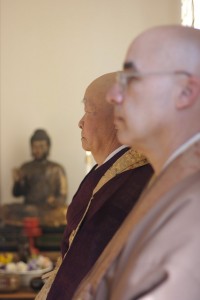
“One day Genki Roshi just announced to the community, ‘Go see Genjo in dokusan.’” He chuckles. “That was as much of a ceremony as I got.” In fact, Genjo was formally installed as abbot on January 10, 1999. And in 2008, he was named a Dharma heir by Eido Roshi in New York.
After his retirement, Genki Takabayashi moved with his wife back to her home state of Montana. He started a small Zen community there, but it didn’t last, and he spent his time – as his biography on the Chobo Ji web site states – doing “the activities he loved best, gardening, pottery, calligraphy, writing and cooking.”
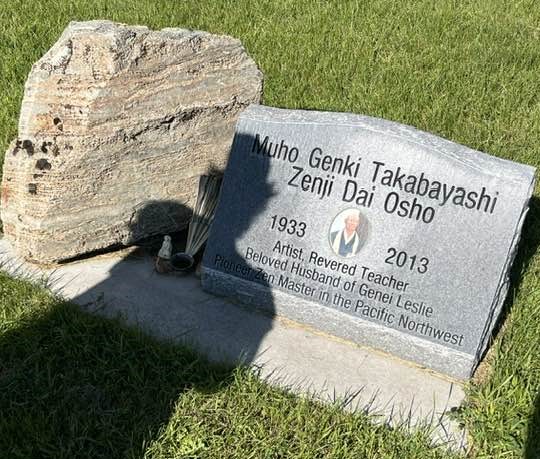
Genki Takabayashi died on February 24th, 2013.
In a memorial posted by the Northwest Dharma Association, Genjo Roshi wrote of him:
Over the course of my long association with him, I learned three profound lessons.
The first thing Genki showed me about the human condition is that it is possible to transcend our likes and dislikes, preferences and opinions.
During the 1980 summer sesshin with him, which was held at Dry Falls State Park outside Coulee City, Washington, the temperatures were in the 90s and the meditation hall was full of mosquitoes and flies. In addition, Mount St. Helens had a secondary eruption, flooding the air with gritty ash.
To say that our meditation periods were hellish was not an understatement. During this retreat, students would twice daily visit Genki Roshi in the dokusan room, where dharma interviews were conducted. It was a small room with little ventilation, and we all concluded some animal had died and was rotting somewhere under the floorboards.
Despite all this, in the meditation hall and dokusan room Genki sat serenely and unmoving in the full lotus position, with a beneficent countenance, seemingly impervious to adversity.
The next year the autumn sesshin was held on the Seattle Zen Center’s newly acquired property at about 5,000 feet, on the crest of a ridge between the small cities of Cle Elum and Ellensburg, Washington.
Snow started falling during the retreat and our newly built meditation hall was still without windows. During one interview period I was waiting in line to visit Genki Roshi, and snow was coming through the vacant window and piling up on the frame of my eyeglasses. When I opened the flap of the outdoor camping tent that was serving as the dokusan room, I could hear the crackle of ice snapping.
In front of me Genki was once again sitting serenely in full lotus, surrounded by icicles hanging from the walls of the tent. When I left the next month to train at Ryutaku-Ji, an affiliate monastery in Japan, these images of Genki Roshi sitting untroubled by conditions and circumstances allowed me to face the uncertainty and trials of such a journey with a measure of equanimity, and I am forever grateful.
The second gift I received from Genki Roshi was the opportunity to soak up his actualization that an “enlightened” life is an “ordinary” life. In everything he approached, he demonstrated that living life fully with “everyday openhearted activity” was paramount.
No matter if it was sitting zazen, cooking, calligraphy, gardening, landscaping, cleaning, pottery, giving teisho, making a bowl of whisked green tea, or writing fiction, Genki was fully present to the activity at hand, operating with joy, unending enthusiasm and energy. He taught us that samu (work meditation) was more important to our training than zazen, sutra recitation or koan study.
The third lesson learned, the hardest to accept and perhaps the most important, is that all of us are fully human. That is to say that though Genki amply demonstrated that we can be and are all vessels of the Dharma, we are also limited, and from time to time stubbornly primitive. There will always be tension between our base instincts and true insight.
When Genki left Japan he abandoned a relationship and a child. He never understood credit or money well, and often found himself in debt. Early on during his time in Seattle we had to warn female participants that there was a good chance he would make a pass at them.
We are all a blend of Buddha and bumpkin; with all the training in the world we will never arrive. In other words, from wherever we are we are always just beginning. I often tell the story of how at least once a year Genki would give a teisho where he would exclaim, “I now just beginning to understand, just now beginning to see.”
Everyone has limitations and shortcomings that arise from wounds in our history. There are three options for dealing with them. One is to do the very difficult work of combusting, digesting, and integrating these wounds. Second is to contain them so that they don’t cause harm to others. Third is to skip over them with spiritual bypassing, which can be easily done, but usually comes back to haunt us. Like most of us, Genki made use of all three.
Genki Roshi proved time and again that he could be an inspirational catalyst for those training with him. He probed and prompted us to investigate and experience the depth of our true nature, a bottomless vastness without form that gives rise to everything. He taught mainly by example how to live fully and passionately, with an attentive caring attitude, beyond any attachment to rank, position, preference, or opinion. He became a surrogate father to me, and I will be forever grateful for his continued presence in my life. May the flower of his inspiration continue to bloom for generations to come.
Cypress Trees in the Garden: 83-97, 111-12, 113, 115, 247-49
The Story of Zen: 5-9, 337, 407-08
Zen Conversations: 102-03; 143
 Richard Bryan McDaniel
Interesting Rick. I believe this is the place we all stayed in Seattle. I remember we all went to the coffee shop although Joan, Richard and I sat separately from the Zen group. Xxx
>
LikeLike