
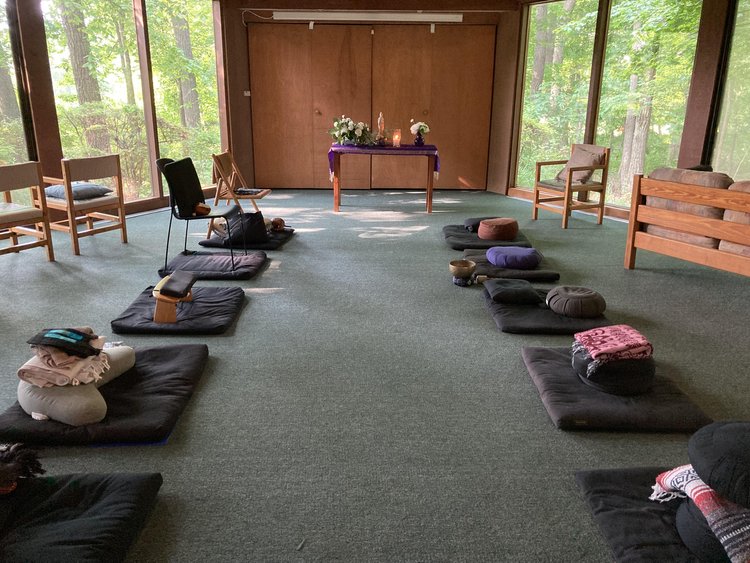
Joyful Mind Zendo, Rockville, Maryland
For Martine Palmiter there is a natural connection between the contemporary concept of being “woke” to racial or gender injustices inherent in societal structures and the concept of awakening found in Buddhism.
“I was raised American Baptist, and I loved going to church with my mother. And it was one of the first integrated churches in our county in the 1960s. Our pastor railed against the Vietnam War and held out Martin Luther King as a beacon. So I was raised in that faith tradition of rebellion against injustice and also love, and I was very impacted by that. And in high school I joined a Bible-study group, led by a now well-known protestant pastor, Brian McLaren, who is a former evangelical who preaches contemplative practices with Richard Rohr.”
I knew about Rohr, a Franciscan contemplative whose study of various spiritual traditions included spending time at a Japanese Zen monastery, but not McLaren.
“In our Bible study, we were instructed to pray and have faith, to let Jesus in our hearts, and to experience God personally. I tried, but nothing happened, and I was disillusioned. I wanted to find something that would touch my deep yearning to experience God. So at age 17, I made a decision to leave Christianity behind because as a way it did not work. For me.
“When I went to college, something happened that did touch my heart. A real turning point for me was taking a course in Feminism 101 which just turned my life around. Opened my eyes. In this class we studied feminist theory from different perspectives: economics, art, history, childbirth, aging, spirituality, sociology. I learned about the possibility of God as a female. I learned about historic violence and oppression against women from foot binding in China, to rape in all cultures, to all manners of control of women. So that touched my heart. I learned to look more critically. This was kind of the first time I’d heard about all these things in the world; I would leave that class shaking for an hour or two. The class made me feel awake and alive for the first time in my life. “
She tells me that the course motivated her to explore women’s spirituality, and I express some surprise that it hadn’t, rather, drawn her to political action.
“Politics didn’t interest me, but spirituality did. I began to see how changing the heart and mind could change the world. As the feminist slogan went, ‘the personal is political.’ I went to my first convention for the National Organization for Women in Washington DC, and it was there that I found out about women-affirming spirituality groups, body practice, and Wicca, where male and female gods were equal and the earth honored. I was impacted by Starhawk, whose book, Spiral Dance, emphasized engaged actions that are in harmony with one’s thoughts and words, and I went to an outdoor pagan camp she hosted in West Virginia.”
Starhawk – Miriam Simos – was associated with the San Francisco neo-pagan and wiccan movements, and her book, Spiral Dance, focused on Goddess spiritualities.
“I also started reading Matthew Fox’s work, Original Blessing; he was a radical Christian theologian who did contemplative earth-based Christianity and mystical contemplative traditions, and also Rosemary Radford Reuther’s books on feminist theology. She was a Catholic nun who was radically transformed by seeking a more woman-centered spirituality and a more earth-based spirituality. “
I ask in what way she had viewed male and female spiritualities differing at that time.
“Well, at the time I was shocked that there could even be something as a female godhead. I had never thought about that. I ended up studying the anthropologist Marija Gimbutas’ work on the ancient matrilineal cultures. And I think what Marija Gimbutas’s work did for me was reveal that there were periods of time in our human history where there was an equality or multiplicity of gender/sexes where people were equally revered for who they were.”
“And what did you derive from all these studies?” I ask.
“That’s a really good question. They made me know what I didn’t know. I kept learning. I’m a life-long learner. I just kept opening up and exploring, saying, ‘Well, this isn’t it. This isn’t it.’”
In the course of time she married, had children, and she and her husband moved to Miami, Florida, and lived in a plant nursery where they tried to establish a business renting plants to conventions and parties. She also studied massage therapy, and it was there she found a flyer about “what I thought was a women’s retreat in Tampa. I didn’t know it was a Buddhist retreat. I just thought it was a women’s circle. It ended up being led by Tsultrim Allione, who is a Lama now in the Tibetan tradition. It was attended by all women, and we practiced in a yurt. We fasted, meditated, and we did dakini goddess practice, and we chanted. I felt something very deeply in that. It was the first time I had meditated deeply; we practiced from morning till evening for five days and there was lots of chanting. And we learned the Tibetan chod practice. I still do those chants forty years later.
“And then I tried Christianity again. I went to a few Congregational and Unitarian churches to see what they had to offer. It still didn’t satisfy my yearning for an authentic experience of spirit. But it was very soon after that I found Zen. And I remember hearing one of my teachers – Roshi Robert Kennedy – say, ‘When you get to the end of seeking, that’s where you find Zen.’ That’s exactly how I felt.”
The Florida business wasn’t successful, and she and her husband moved back to the community where she had grown up, and there she met a woman in a bowling alley.
“Our kids were both in leagues. We connected and she and I became fast friends, best friends to this day. She had studied at Dai Bosatsu with Eido Shimano Roshi, but now practiced alone with her husband. She encouraged me to try a local Korean Seung Sahn Zen group, and it was my first Zen experience. And I did fall in love with the practice of silence and sitting, walking, and chanting. But the group was majority men and had a masculine feel to it with discussions on martial arts. So after a year I found a phone number for Rose Mary Dougherty, who was starting a Zen sangha nearby.”
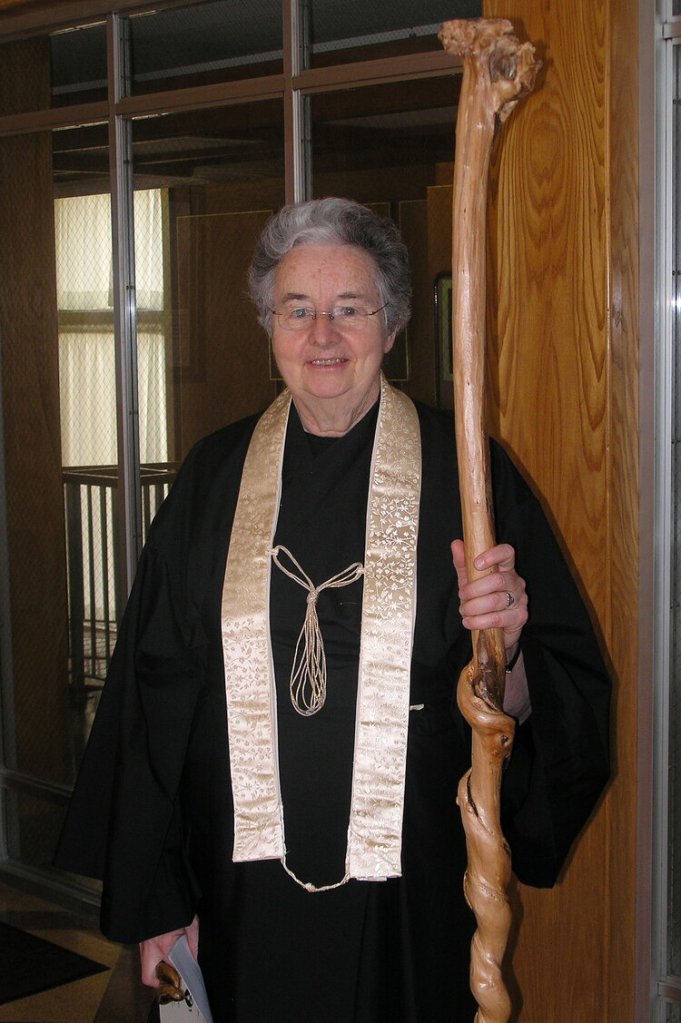
Rose Mary Dougherty had studied Zen with Robert Kennedy, a Jesuit, and Janet Richardson, a Catholic nun and Kennedy’s heir. “She invited me to her home, where she had set up a room as a zendo. And right there I knew she was my teacher. Her presence alone told me this was right. She had a presence about her.” For a long while, however, Martine did not realize that Rose Mary was a Catholic nun, a member of School Sisters of Notre Dame
“What did she introduce you to that you hadn’t found with the Korean Zen group?” I ask.
“Presence. There was a lot of busy activity at the Korean group sitting. And when I went to Rose Mary’s house, it was still and silent and beautiful and peaceful and calm. And it stayed that way every time I went.”
“So you find this woman who’s a nun – but you don’t know that she’s a nun – and you start going to her house because she has ‘presence.’ Where does this lead?”
“Well, it leads to seventeen years of devotion to Zen practice and to her.” Martine became the One Heart Sangha’s first President when Rose Mary’s group incorporated, and, as it grew, they moved from her home to a nearby church were they still meet, twenty years on.
“And probably somewhere along the way, she suggested you do a sesshin,” I say.
“She did. It was a five-day retreat. And I told her I was terrified. The sesshin took place at a convent in Pennsylvania and was led by Sister Janet Richardson.
“Part of practicing with Catholic sisters, for me, was that I saw sincere practice with authenticity and with a sense of compassion and openness. These sisters also did a lot of work in social justice. Many in our sangha came to Zen trying to integrate their lives as former Catholics or recovering Catholics, but for me all I saw was their faith in Zen. As a matter of fact, it might have been helpful to me that I came as a non-Catholic. I didn’t have any baggage with that. I never called Rose Mary ‘Sister’ although others did. I called her Sensei.”
Although the tradition of Zen within which Robert Kennedy and Janet Richardson practiced made use of koan work, Rose Mary did not. “She taught shikan taza. She taught, ‘Just this.’ She wasn’t known for her dharma talks; she was known for her strong sitting and her strong presence. Roshi Charles Birx told me that when he met Rose Mary, he felt he was in the presence of a saint. I always felt her strong presence that way also. And I think that’s what I really got from her. She didn’t even talk about Buddhism; she emphasized interfaith Zen that could be practiced by anyone of any faith. She read poetry, and she said, ‘Just this.’ And all she encouraged was strong zazen. That was her entire teaching. And it was not enough for some people. A lot of the members left looking for more. But for me it was just right.”
In 2014 Rose Mary was diagnosed with Parkinson’s.
“We noticed it first with her hands shaking. Then she felt she had to come out and tell people about the diagnosis, and she stepped back from teaching. She asked three of us who had been practicing with her if teaching would be something we wanted to do. The two other men said yes, but I said I wasn’t ready. It wasn’t until four years later, after a crisis of faith, that I was called to be a Zen teacher.”
When Rose Mary was moved into a nursing home in Baltimore, Martine wondered, “Who’s going to be my teacher? How am I going to go on? I had only known one teacher. She was it, and she was everything for me. Luckily, another Roshi – Charles Birx – talked to me at the time, saying, ‘You have all her teachings. You are like two arrows meeting in mid-air. She has her path, and now you have your path.’”
Charles Birx is another Robert Kennedy heir.
“And what he said threw me back on myself, where I needed to go, and I never sat more strongly in my life. For the next months I practiced zazen twenty-four hours a day. I just practiced. I sat with this question, ‘What now? Who am I?’ I went right back to the beginning of Zen. Then, I experienced dropping everything. Everything I ever believed in, everything I had ever done. I said, ‘Okay, your life is now just this. This is your path, teacher or no teacher. You are just going to sit zazen, live zazen. This zazen is it. That’s it. Zen is just practicing with your life, fully aware.’
“I started to sit with a new intensity, practicing zazen 24/7. Everything just broke through for me, and I started experiencing what they describe. Crying and laughing and all of that. And I called my teacher, crying. And I told her I finally understood ‘just this,’ and I felt ready to be a teacher. I thanked her for giving me my life back through Zen. She asked to meet with me a few times in Baltimore before confirming me as a Zen teacher and asked me, ‘Can you really claim it? I want you to sit and if you find peace with this, let me know. I will pray for you.’ She did a lot of praying for me. And asked me to pray for her, which I did.
After a few weeks, Rose Mary confirmed Martine as a Dharma holder, and they sought a way to study together to complete her transmission. “She told me, ‘Well, I have bad times with my Parkinson’s, but early mornings are best for me.’ So 6:30 in the morning on Sunday, I would go up, and we would study together, and we would sit together in the hospital room, the nurses coming in and interrupting. And her presence was right there, in the midst of it all. I was just blown away, the bright light from her being as the nurses came in and poked and prodded her, her generosity and kindness never left, even with loud noise. A loud football game would be playing while we were sitting, and she’d say, ‘Oh, in that room, that person doesn’t have good hearing. Just let it go.’ Everything was ‘just this.’
“I asked her, ‘What will I teach? How will I teach? I don’t know how to be a teacher.’ And Rose Mary didn’t say anything, except, ‘You’ll figure it out.’ And what happened to me, as I was driving back on a highway, I heard a podcast – a Zen podcast – mentioning the Zen women ancestors. ‘What!’ I thought. So I pulled over to the side of the road. I had never heard of such a thing. I had never heard of any woman ancestors in all the years practicing Zen. The podcast mentioned a book of koans with women’s awakening experienced called The Hidden Lamp. This was the first time I could actually see myself being a teacher. I felt awake and alive again and confident. So I found other books, and I just read everything I could on women in Zen. And here I had left feminism pretty much for seventeen years practicing Zen, and here it was right back at me. And I knew then that’s what I wanted to teach. I wanted to delve into the koans, I wanted to learn and teach about women ancestors. And I told Rose Mary, ‘I want to teach women Hidden Lamp.’ She said, ‘Okay, as long as you get them to sit zazen.’ She and I studied for one year together in her cramped hospital room, her voice getting dimmer, her shaking increasing. But she was still very present. I learned more that year about Zen than I had in the years prior.”
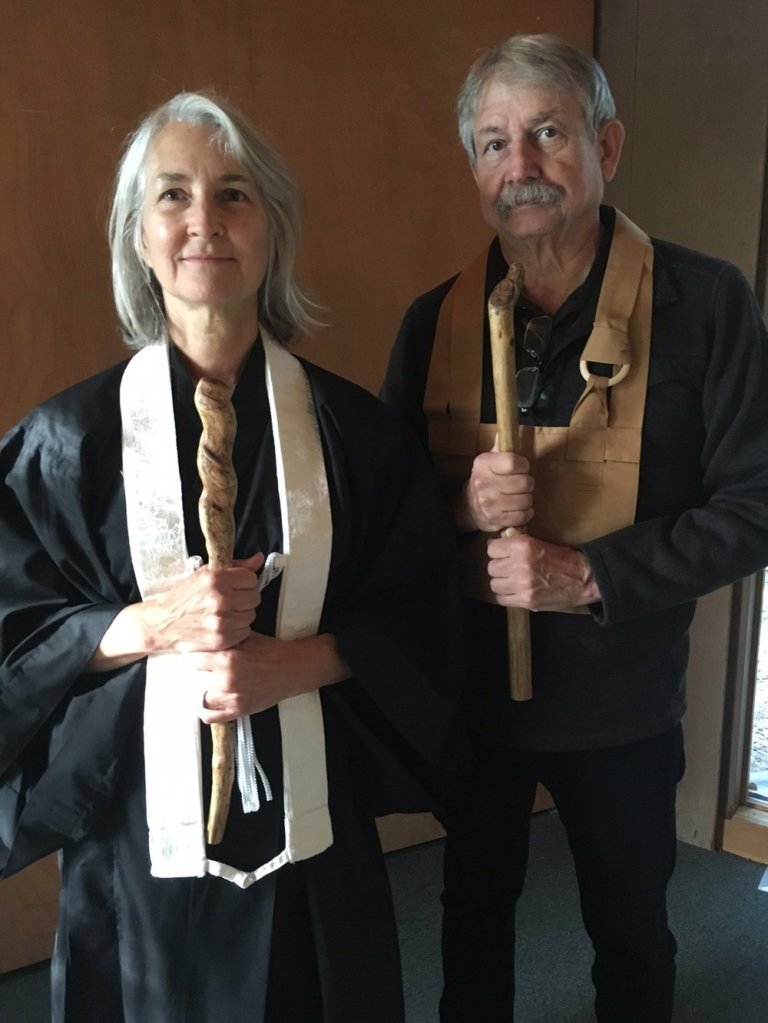
Rose Mary asked another teacher, Robert Ertman, to install Martine as an official teacher in the Soto tradition because she was physically unable to do so.
“And then one day I got a call that she was actively dying. We had just met three days ago, and this was a surprise. I felt very awake to life and death in this moment. And I went in there, and they’d cleared her room out, and they had her in a hospital bed. It was a Catholic hospital room, so they cleared everything out of her Zen life. But there she was, breathing but unconscious. And I did the one thing I knew how to do. I knew that hearing was the last thing to go; I told her, ‘Rose Mary, I love you.’ I felt like her daughter and companion on the Way.”
Then she chanted the mantra from the Heart Sutra: “‘Gate, gate, paragate, parasamgate, bodhi, sva-ha!’” [“Go, go, go beyond, go totally beyond, go beyond together with all beings”] “I chanted that several times in her ear. Just for her. And then I left, and then she did die. And I knew my path then. Yeah. I loved her.”
As a recently authorized teacher during the pandemic, Martine forged new ways of helping students. She initiated a Precepts Practice Group which used the text Waking Up to What you Do by Diane Rizzetto, one of the founders of the Ordinary Mind Zen School.
“This group met during the pandemic on Zoom and worked together with ‘practice partners.’ It maintained our community while we were on Zoom.”
“We started a women’s sangha on Zoom, and called ourselves the Tea Ladies, after the unknown awakened sages on the side of the road serving tea to travelers on the path. We use The Hidden Lamp and Householder Koans and do a Koan Café approach of reading and sharing how the ancestor stories impact our lives today. Five years later, we are still meeting, and women open their hearts. And then I started a women’s sesshin once a year, which was very needed. Right now, I do have a strong women-students following, I have to admit. I have male students too because I love them too,” she adds with a laugh.
“Then George Floyd happened and the pain of that was going right in – I allowed it right in – because I had already done the women’s opening work. So one of the first things I did as a teacher besides Tea Ladies, I developed a workshop called, ‘Waking Up to Whiteness.’ And I offered it through Zen Peacemakers. I had full confidence I needed to wake up; we all needed to wake up. And this year I’m waking up to queerness and LGBTQI. All the pain surrounding legislation and violence against non-conforming people. You know, I’m waking up to straightness, whiteness. There is a teacher, Oshin, who is deaf and teaches at No Barriers Zen, and we invited him to teach once, and he woke me up to blindness and deafness. So you caught me in this interview at a time of great openness. Flowering. I am opening again to all of that . . . So I was talking to somebody the other day about this interview, and they said, ‘What are you going to say your teaching’s about?’ And I said, ‘Courage. Confidence. Curiosity. Love.’ I think that’s it. I think that’s it.”
“And if I asked you what a Zen teacher teaches?”
She laughs. “Courage. Confidence. Curiosity. Love. Right?”
 Richard Bryan McDaniel
Martine this is booby.. text me202 317 9967
LikeLike