
Stone Willow Zendo, Spokane, WA
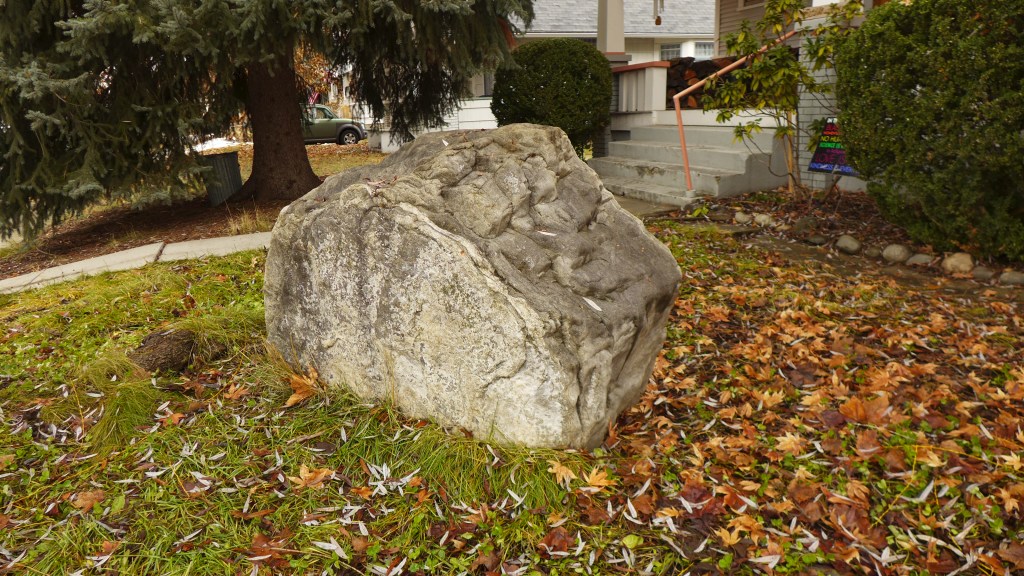
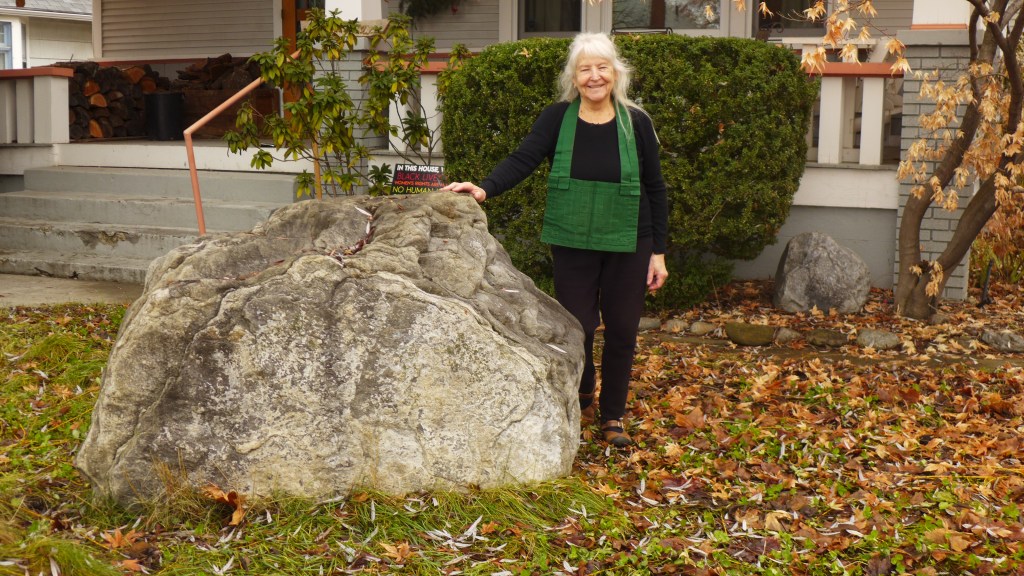
Daya (Dianne) Goldschlag explains how the Stone Willow Zendo in Spokane, Washington, got its name. “In front of my house in Spokane is a big rock named Shunryu.” She has a soft-spoken – at times, almost shy – voice. “And there’s a wonderful story behind the rock coming here. It’s quite large. It’s over 5000 pounds. And then there was a big willow tree that is now on its way out, I’m afraid. Willows don’t live that long. It was here long before I moved here. So it just was easy. Stone under willow tree. Stone Willow.”
I ask about the wonderful story.
She smiles at the memory. “Well, at the time I had two dogs, and I took them walking every day in various forested areas. And one place I would go to was through the driveway area of a Catholic convent to get down to the river. And along the driveway were all these big rocks. I think they dug them up when they were making the driveway. And there was one rock which was then on its side kind of flat. I would go and sit on it with my dogs – for some reason, I was just very attracted to this rock – and then we’d continue our walk. And one day it just popped into my mind, ‘Why don’t I go ask if they really want this rock or could I have it?’ So, I went into the convent and ended up talking with the Mother Superior, explaining that I was interested in this rock. So at first she just thought I was kind of crazy. Which is understandable. It’s an odd thing to do. And then she had to go talk to someone, and she kind of dismissed me. And usually I’m not very assertive – you know? – I’m kind of shy, but I just stayed there. And when she was finished with this other person, I said, ‘I know this sounds crazy. But I have a Zen Buddhist teacher I worked with who loved rocks, and this rock for some reason . . . You know, I just thought if you-all aren’t using it, could I have it?’ And she was about to dismiss me again, and I gave her my card. And as well as being a Zen teacher, I also do therapeutic body work. So that was on my card. And she kind of stopped and said, ‘Do you think at my age you could help my neck?’ I think she was in her early 80s. And I said, ‘I think there’s always a chance for change no matter how old we are.’ And she said, ‘Okay. How many sessions would you give me in exchange for the rock?’ I said, ‘Oh! I don’t know. Three?’ She said, ‘Five.’ I said, ‘Okay. Five.’ She said, ‘I have to check this out first with our groundskeeper, and I’ll get back to you.’ So I left. And then I kinda forgot about it. Weeks went by. And one day I came home, and there was a message from the Mother Superior saying, ‘Okay. You can have the rock. But we don’t deliver.’”
So Daya had to arrange for a backhoe to dig the rock up and transport it to her house. She found a person who said he could do it and would let her know when it was convenient for him to do so. She didn’t hear from him again for some months.
Then she was hosting two friends – Darlene Cohen and Elizabeth Sawyer – when the man called back and said he would meet her at the convent to fetch the rock. “So the three of us went. And Darlene and Elizabeth are both students of Suzuki Roshi, so they understood how I felt about this rock. And this man came with his son who was about eight, and they worked beautifully together. And they brought blankets so they could wrap the rock and put a chain around it. They didn’t want to mar it – he completely understood how I felt about this rock – and they worked together for some hours and got it loaded on the back of a trailer on the back of a truck. And we followed them, and they brought it to my house. So it must have been about three miles or five miles to my house from where it was. And I had thought I’d have it a certain way, and he said, ‘Let’s try a different way. You might feel you want it this other way.’ And he worked with me, moving this giant rock until we both agreed this seemed the most energetic stance for it. Which was standing up rather than being flat. And meanwhile all the neighbors came out. One of them videoed it. And then he didn’t want me to pay him. I said, ‘I have to pay you.’ So we came up with a very inconsequential amount, and I also gave him some homemade jams and bread that I’d made. Just different things like that to give him along with a hug. I mean he was a wonderful man who I had never met before. And when he left, Elizabeth and Darlene helped me bring out water and a willow branch, and we washed and blessed the rock and named it Shunryu. And kids in the neighborhood always climb on it.”
“So you took a Catholic rock and Buddhaized it.”
She laughs – which she does easily – and nodded. “Uh-huh.”
She tells me she grew up in a Jewish household in the Bronx, although they weren’t “really” practicing.
“My grandmother – my mother’s mother – lived with us till I was about, I think, eleven, and she was practicing and deeply religious. But she moved out, and one day I said to my mom, ‘What’s that in the refrigerator, mom?’ And she said, ‘It’s called bacon.’” We both laugh. “So we were not a religious family, but I was just telling somebody that when I was little – so maybe five? – I asked my dad what ‘God’ meant. I had heard the word somewhere. And because I was little, he tried to make it simple, and he said, ‘There’s two different beliefs. There are some people who believe there’s a being up in the sky who kind of looks over and takes care of us. And other people believe God is in all the trees and rocks and animals and people.’ And I said, ‘Oh! That’s what I believe.’ And my father said, ‘That’s just fine.’ And basically that’s what I still believe.”
“And how did a non-practicing Jewish girl from the Bronx end up with a bunch of practicing Buddhists in California?”
“Well, let’s see. So first, I left home when I was 19 and took a plane to England. Originally I was going to go to Israel and work on a kibbutz but got talked into going to Europe first by a friend.”
It was a different era, and 19-year-old girls were still able to hitchhike throughout Europe and into Iran, Iraq, and Kuwait. “Then eventually I ended up in Israel where I spent some months on a kibbutz and then finally hitchhiked back through Greece and Europe and then came home. So my world had been blown apart. You know, I had never been on a plane ’til I flew to Europe, and I lived mostly in the Bronx. So my parents expected me either to go back to college or get a job. And I just couldn’t quite do either of those. So one morning, I got my backpack and hitchhiked to upstate New York to a – whaddya call it? – a horse ranch, a dude ranch, and ended up working there for a summer. And then came back and lived in the lower east side of Manhattan – you know – and took acid and all of that.”
For a while, she found work at the Fellowship of Reconciliation in Nyack, New York, where she met Jim Forest, the head of the Catholic Peace Fellowship, and, through him, the Vietnamese Zen monk, Thich Nhat Hanh. But it was the ’60s, and California was where it was at, so she went back on the road and arrived in San Francisco. “I think it was 1967. You know, still flower-child time. So I went back and forth a few times. Ended up in California. And I was living in LA working at a Catholic college antique toy museum.”
“A Catholic college antique toy museum?”
“Yep. Yep. Sister Mary Corita. Did you ever hear of her? She was an artist who taught at that college. So one morning I was supposed to hitchhike to Mexico with a friend. And I went for a walk that night. And at that time, I was having some difficulty speaking and understanding English though it was my language. And what I think was happening is, people don’t always mean what they say. And I would kind of get what they felt or meant underneath, but then these other words would come, and I just became socially confused. Now I would probably call it some kind of spiritual crisis. So as I was on my walk that night, there was a phone booth. I went in and I called my friend Jim Forest. I don’t know why I called him, but I did. And I told him I was going to hitchhike to Mexico in the morning, but this other thing was going on, and I was really having a hard time. And he said, ‘Don’t go to Mexico tomorrow. Call this place, Tassajara, and tell them that you know me and Thich Nhat Hanh – we were just there – and tell them that we said that you need to just stay there for a little while.’”
Tassajara is the San Francisco Zen Center’s practice center in the Ventana Wilderness Area.
“So, that night when I went back to where I was staying, I called Tassajara. They still had a wind-up phone; you had to go through the operator. And Peter Schneider happened to be in the office, and he was – I think – the director right then at Tassajara. And he said, ‘Well, have you sat zazen? Do you know anything about Zen?’ I said, ‘No. I’m just having this difficulty, and Jim Forest and Thich Nhat Hanh thought it would be helpful for me to spend some time at Tassajara.’ And Peter said, ‘Well, we have one student bed available. You’ll have to find your way here, but you can come.’ So the next morning, instead of hitchhiking to Mexico, I hitchhiked from LA to Carmel Valley. Spent the night in a field in Carmel Valley. And the next morning got up and continued hitchhiking. Got part way to Tassajara, hiked part way, and ended up at the front gate. Somehow. Walked in, and the first person I ran into was David Chadwick.”
David Chadwick would later become Shunryu Suzuki’s biographer.
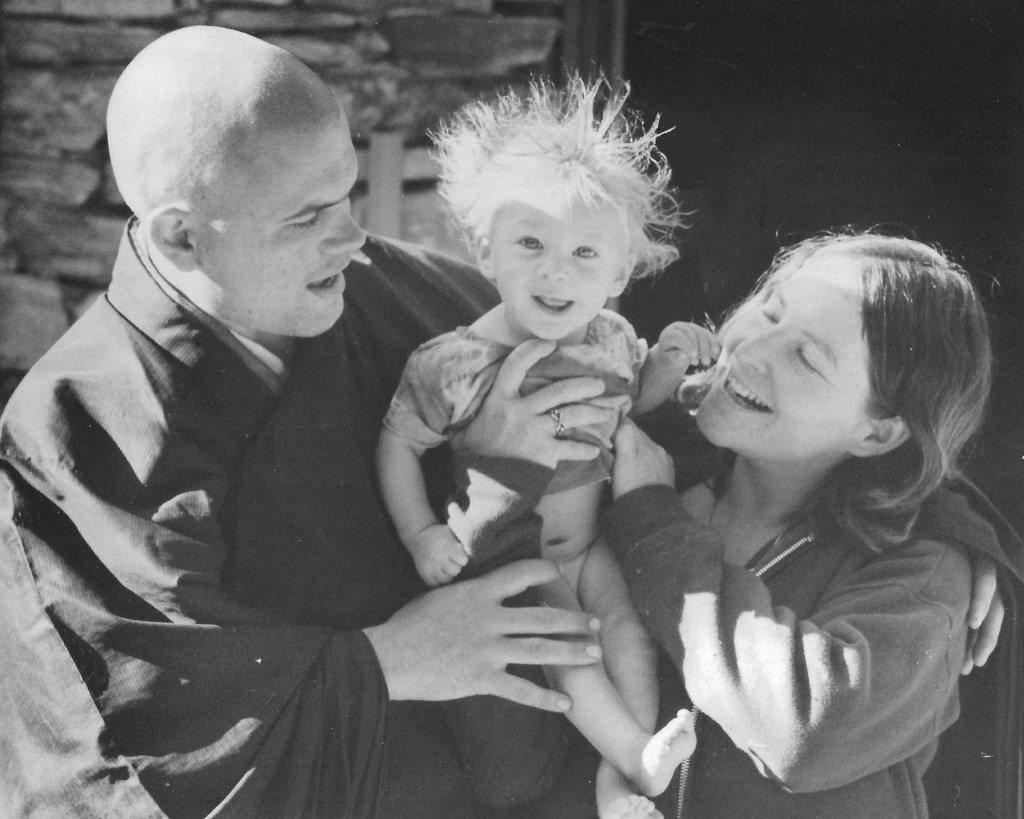
“So he was the first person I ran into. He eventually, I should say, became my husband, and we have a son together although we’re not together anymore. We haven’t been for a long time, but we’re still good friends. So he suggested I go take a bath – you know – at the hot springs there and then come have lunch. And I had no idea where I was or what went on there. I just took a bath. I came and had lunch. Someone gave me zazen instructions. And I stayed a week at Tassajara doing the whole schedule, sitting and working. And by the end of the week – or maybe it was two weeks – I was okay. And I think the reason I was okay is because one didn’t have to speak. So you’d pass somebody on the trail; you’d stop; you’d gassho; and then you’d go on your way. Or you’d have your meals served and when you had enough in your bowl you raised your hand and they stopped putting any more in your bowl, and you’d bow to each other, and then you silently ate your meal. And the silence, and yet the respect and the appreciation that each person gave in their bows, I think that healed me. And when I left, I went to Berkeley – I don’t remember why – and ended up sitting at the Berkeley Zendo and got a job on the University of Berkeley campus, and then started going to San Francisco on Sundays to hear Suzuki Roshi. And in six months’ time, I was accepted back at Tassajara and went and lived there for some years. So, that’s how that all happened.”
Because I am not very familiar with the protocols of the San Francisco Zen Center, I ask if students enter into what are elsewhere called shoken relationships with a teacher. “Kind of a contractual relationship with a teacher?” She tells me they do. “And you had that kind of relationship with a specific teacher?”
“Suzuki Roshi,” she tells me.
“And after his death?”
“Well, Dick Baker – Richard Baker – was his successor, but Dick Baker and I never got along very well. And eventually we agreed that he was not my teacher, and I was not his student. Suzuki Roshi had asked all the students to follow Dick, and I tried at first. But I never really trusted Dick. I didn’t feel comfortable with him.”
She reluctantly left Zen Center and set out on her own. “Before I left, I had learned body-work massage. So I just did that for friends. But I took classes and trained with various people. When I stopped working for Zen Center, I got a job in an old Finnish sauna in massage, and I did that for – I don’t know; I can’t remember – a year or something. And also went to a school to get certified as a masseuse. Then I moved to Muir Beach near Green Gulch and opened an office in Mill Valley, California, and did that professionally.”
The organic farm Green Gulch is another SFZC practice center where Daya had resided for a period at the same time as Darlene and Elizabeth. “Elizabeth and Darlene and I were all pregnant at Green Gulch at the same time. Elizabeth’s son and my son were born eight days apart. Then Darlene’s son was born six months later. So these three boys were all raised together.”
“And you stayed connected with the Zen people after moving to Muir Beach?”
“Well, they were all my friends, my family. Though some people were upset that I had left. They thought I was wrong. Which, when everything came out about Dick, that turned around again.”
In 1983, the Board of Directors of the San Francisco Zen Center took the unprecedented step of pressuring Baker to resign his post as abbot as much because of the lavish lifestyle he maintained – at Zen Center expense – as for the sexual liaisons he had engaged in with students. Baker was not, of course, alone. Around the same, other Zen teachers were revealed to be engaged in inappropriate relationships with students and other abuses of authority.
“How do you reconcile this?” I ask. “That we’re in this tradition where we almost daily chant the Four Vows to save all beings, to ‘uproot blind passions’ and the rest of it, and yet there are people who get into positions of authority whose lifestyles don’t appear to reflect those vows?”
“I think that happens all the time amongst human beings in all different kinds of traditions. It’s something I’m very aware of now being in the role of teacher. I’m really, really careful that I interact with my sangha as peers and am very respectful of each one of those people. I’m actually afraid of misusing power. And so I probably err in the other direction. But that’s okay. I’m willing to err in the other direction. You know, I guess it’s just humans. And the humans who get into power are often people who somehow get lost in it, who want it and head toward that position. Dick Baker was quite a young man himself. I think he was only in his 30s when he was appointed.” He had been 35. “He really wasn’t ready for such a position in some ways. But someone had to take over. And I think Suzuki Roshi had really wanted Zen Center to financially make it and be a center that could be there for many, many years for people to come and sit zazen at. He saw Dick Baker, I guess, as someone who was capable of creating that and keeping that going. But in other ways, Dick got lost.”
I ask how she came to leave Muir Beach for Spokane. She explains that for a while she studied with a teacher who worked in the Gurdjieff tradition. “It’s a long complicated story how I happened to go study with her, which I don’t want to go into now. And she had been born in Spokane, and they really liked Spokane and decided they were all going to move to Spokane and said, ‘Why don’t you move here too?’ And I decided to do it. So I talked to David. We were not divorced yet; we’d been separated for years but were co-raising our son, Kelly. So I had to talk to him first, how he felt about Kelly and I moving to Spokane. But he agreed to it. So one day Kelly and I got in our VW bus and went on a car-camping trip for a month and ended up in Spokane.”
“A Volkswagen bus?”
“Uh-huh.”
“Did you have a Grateful Dead decal on the window?”
“I did not, but I could’ve.” And we both laugh.
“And once you got settled in Spokane, one day you opened up a zendo.”
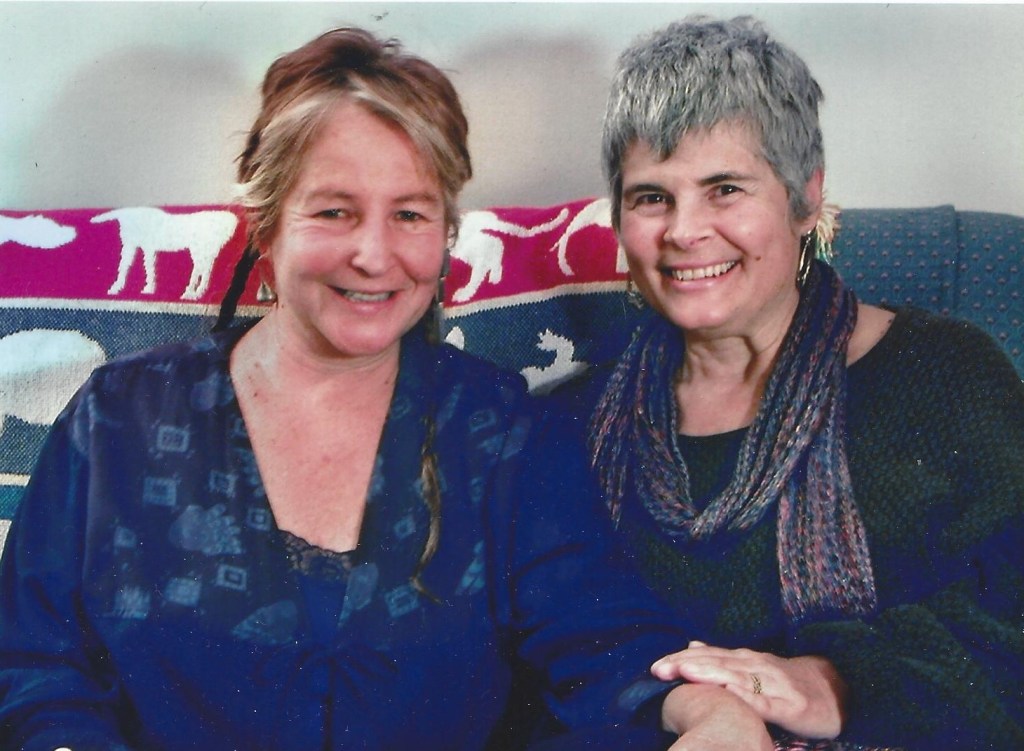
“So, I’d fly down and visit Darlene. Darlene would come up and visit me, and when she was teaching in Tassajara I would go down and assist her. And she really wanted me to become a teacher, and I kind of preferred walking behind holding incense for whoever the teacher was. Anyway, we started having day or half-day sesshins or retreats here in Spokane. Darlene would lead them, and I would assist.”
“This was in your house?”
“No. There were different places that we’d find. Sometimes they’d be outside if it was summer, out in somebody’s backyard. Or there were some centers at the time you could rent, and we’d do them there. And one of the people who came to these, we were talking one day, and he was a very well-read Buddhist, but he wasn’t sitting. And I said, ‘Do you want to sit zazen? If you do, I’ll sit with you one morning or one evening a week.’ Because I knew Suzuki Roshi would want me to offer that. And he said, yes, he would. So we started sitting together one morning a week. And then another woman heard about it somehow, and she said, ‘Can I join you?’ And I said yes, of course, and so then there were three of us. And then I don’t know how it happened, but it grew! So now it’s in my home.”
“How large a community?”
“It goes between six and twelve people. And we sit for 35 minutes every Friday morning, then we have tea and study afterwards. Right now we’re studying Dogen’s Genjokoan.”
Most of the people in the Shunryu Suzuki tradition were ordained before they were authorized to teach. Daya, on the other hand, is lay transmitted. I ask her how the concept of lay transmission came about.
“It still hasn’t for some people in the lineage,” she admits. “But Darlene wanted it to be lay transmitted. I don’t remember exactly why, but she had wanted to be lay transmitted herself and realized that that was not going to happen. The only way that she could get the kind of authority, position, opportunity to teach would be from being priest-ordained and then transmitted. So she did that, but she told me she would rather not have done that. But once she did that, she could then lay transmit me, which she wanted me to do.”
Unfortunately Darlene died before she was able to give Daya transmission, and, after that, Daya’s interest in transmission lapsed until another SFZC priest – Teah Strozer – urged her to resume the effort.
“Teah Strozer is a wonderful person and teacher. She and Darlene and I were all friends. We would go out for a meal when I came to the Bay area, and so on. So Teah was very aware of what Darlene wanted for me and was requesting for me. And so it was Teah who, after Darlene died, kept calling. She’d come here to see if I was ready to take that step yet. She really wanted to honor that. She gave me my Dharma transmission.”
“Was there a reason why you didn’t want to be ordained as a priest?”
“I lead a lay life. I have a family, husband, kids, grandkids, friends. I feel the main responsibility for a priest is her or his temple or sangha, and then family comes after that. For me, my family comes first. And the sangha is right up there, but the temple is not my main responsibility. That’s why I’m a lay person. Family-oriented. It’s called being a householder. So I didn’t see any reason to be a priest. That just wasn’t what my life was like.”
“It’s not, of course, unique. There are lay transmitted people in other lineages.”
“There are. Other lineages do have a lay transmitted path. But Suzuki Roshi’s lineage did not.”
“You said not everyone in the lineage accepts the idea.”
“Mm-hmm,” she murmurs, smiling.
“Do you want to elaborate on that?”
“There are some people, mostly priests, who feel only people should be Dharma transmitted who are ordained priests.”
“What does ‘transmission’ mean in your lineage?”
“It means you are now in the ancestral lineage; you’re a new ancestor. And you’re recognized as being able to and committed to transmit the Dharma.”
“So someone who already holds transmission has ascertained that you have a grasp of the Dharma and that you have the capacity to help other people grasp the Dharma as well?”
“Mm-hmm. And want to.”
“So insight and capacity. In which case, why is priesthood a necessary component?”
“I have no answer for you on that. I don’t see why it is relevant myself.”

“What’s the role of a priest? If you lived in Japan, it’s pretty clear. A priest has charge of a temple and carrying out the ritual obligations attendant upon that. A lot of Japanese priests today would really rather be stockbrokers or race car drivers or male strippers or something, but they’ve inherited their positions from their fathers. It’s the family business to look after a particular temple. But that’s not the case here. First of all, there aren’t enough temples for all the priests to look after. So, what’s their responsibility in North America? What do they do?”
“Well, I think in the early years of Zen Center, Suzuki Roshi was coming from his tradition, and that’s what he knew.”
“I understand that, but I don’t understand what he thought all these ordained priests were going to do. Did he think they’d go out and set up temples in Spokane or Kansas City or wherever?”
Again she says it’s a not question she can answer.
“And now that you have transmission, are you authorized to pass that transmission onto someone else?”
“Yeah. But I can’t priest-ordain anybody.”
“And what do you see your responsibility is to the people who come to you?” She takes a moment to consider her answer. “You’ve opened up your house,” I prompt. “You’ve put a stone out front.”
She chuckles gently. “Well, one is just to offer a space for anyone who wants to come and sit zazen. I’d say that’s the base. And then I think part of my job is to pull the rug out from any set-answers or absolutes.”
“Pretentions?”
“Pretentions. Graspings. And I have to do it for myself as well. But that is a role. And I know they turn to me in discussions for responses, for answers, for my sense of the discussion or to widen that discussion. And I’m there to support people in their practice and encourage them. And some encouragement has to come with words. And, I mean, I think that’s what words are for mostly. And also just to sit and have a place where they can sit with me.”
“And what do you hope for them?”
“That they become really comfortable being their own selves.”


Such a lovely life story…inspiring! Thank you for sharing it.
LikeLike