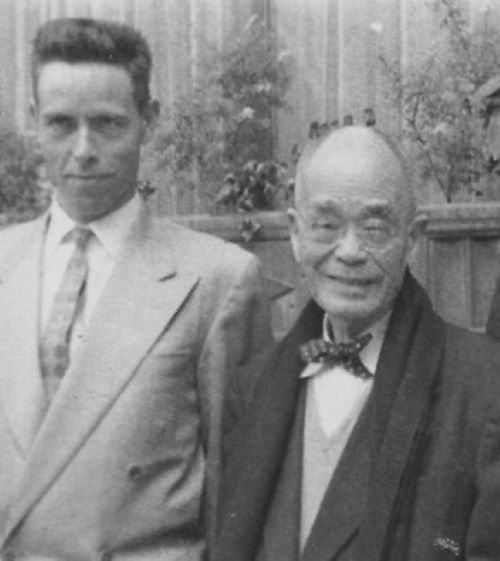
D. T. Suzuki and Alan Watts

Adapted from The Third Step East

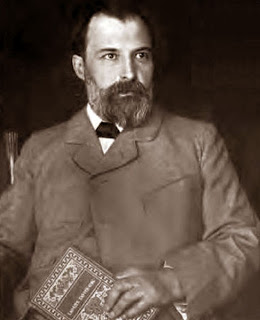
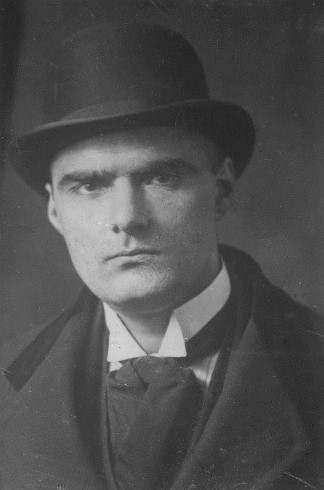
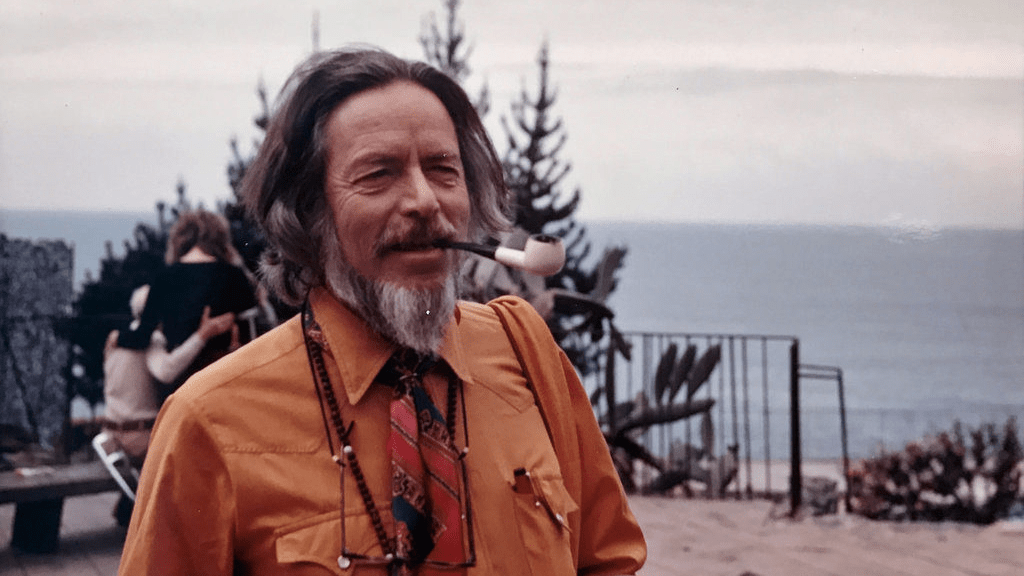
When telling me about Shunryu Suzuki’s arrival in the United States, David Chadwick pointed out that Suzuki “landed in the middle of the Alan Watts Zen boom.” Two men, in particular, can be credited with preparing the way for the extraordinary success of early Zen teachers like Suzuki and Philip Kapleau. The first was another Suzuki – Daisetsu Teitaro Suzuki – and the other was his popularizer, Alan Watts.

Teitaro Suzuki was born in 1870 in what is now the Ishikawa Prefecture. His family was of the Samurai class, which—prior to the Meiji Era—had held a privileged position in feudal Japan. After the Meiji reforms, however, most of those privileges were lost.

His father died when Teitaro was only six years old, leaving the family in poverty. A year later, his older brother also passed away. At an early age, he wondered why he had had to face so many difficulties and challenges in his life—the loss of family status, the deaths of his father and brother, the family’s straitened financial circumstances.

Fiscal constraint prevented him from completing secondary school, but he was able to find work teaching English at a primary school in a nearby fishing village. The Suzuki family recognized Teitaro’s academic talents, and, after their mother died in 1890, his older brother provided him funds to attend Waseda University in Tokyo. This put him close to Kamakura where Engakuji – one of the primary Zen temples in Japan – was located. Still preoccupied by the concerns that had haunted him as a child, he determined to visit Engakuji, where the abbot, Imakita Kosen, accepted him as a lay student.

Kosen assigned him Hakuin’s koan, “What is the sound of one hand clapping?”  Suzuki found it entirely opaque. When he went to sanzen with Kosen, the teacher would put his left hand forward without saying anything, and Suzuki had no idea how to respond. Whenever he attempted to express his thoughts about the koan, Kosen dismissed these as nothing more than ideas.

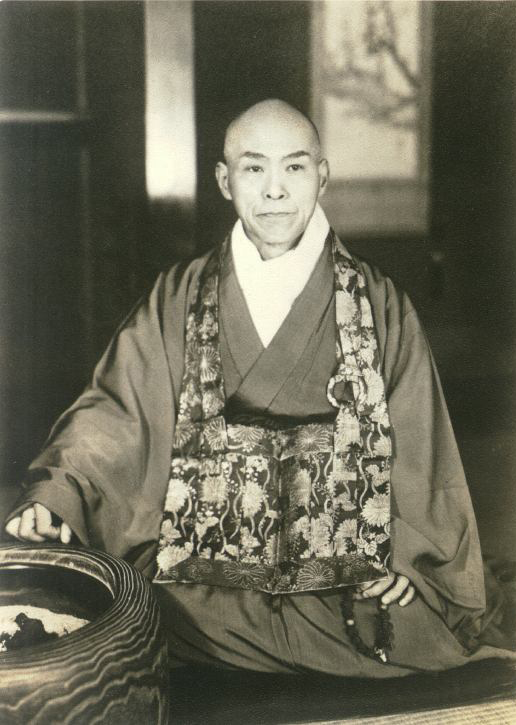
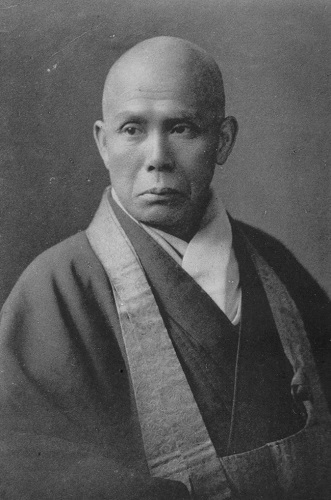
Soyen Shaku

Within a year, Kosen died. His heir, Soyen Shaku, changed Suzuki’s koan to Mu. Suzuki applied himself to the new koan with all his energy, feeling as if his life would be meaningless if he were unable to resolve it.

When Shaku learned that his student was able to read and write English, he assigned him a number of translation tasks, including his correspondence with the organizing committee of the World Parliament of Religions. He also had Suzuki translate Paul Carus’s The Gospel of Buddhism, for which Shaku had provided an introduction. Throughout all of this work, Mu remained at the back of Suzuki’s mind, but he came no closer to understanding it. Because he had nothing to say, he stopped attending sanzen with Shaku, except those mandated during the formal retreats, and, on those occasions, Shaku often dismissed him with a blow.

This continued for four years. Suzuki wondered if his difficulty was due to a lack of familiarity with Zen literature; perhaps, he thought, he could find the answer to Mu in one of the books in the Temple library. He immersed himself in these, which would be a great help to him when he later began writing, but nothing he read helped him understand Mu any better.

When, after the 1893 World Parliament of Religions, Paul Carus asked Soyen Shaku to consider remaining in the United States to assist him in preparing translations of Eastern texts, Shaku suggested that Teitaro Suzuki would be better suited for the position. In a letter to Carus, Shaku described the future scholar as an “honest and diligent Buddhist” but also noted that he was “not thoroughly versed with Buddhist literature.”

It was a great opportunity, but Suzuki was aware that going to the United States also meant that he might not be able to partake in sesshin for many years. If he did not resolve the koan during the upcoming sesshin, he would not have another opportunity until he returned to Japan, and he had no idea when that would be.

The next sesshin was the December Rohatsu Sesshin which marks the anniversary of the Buddha’s awakening. Traditionally, it is the most demanding retreat of the year. Suzuki concentrated on Mu, synchronizing it with his breath. By the final days of the seven-day retreat, the koan was no longer something separate from him. There was not the koan on the one hand, and the person repeating it on the other; there was only Mu.

Then, after a round of meditation, he was roused from his concentration by the sound of a bell being rung, and Mu was resolved. This was the “satori” – or awakening to one’s true nature – about which Suzuki would write so tantalizingly in the future. Suzuki rushed to sanzen and was able to answer all but one of the testing questions Shaku put to him; the next morning, he was able to answer that question as well. Shaku acknowledged the validity of his awakening and gave him the Buddhist name “Daisetz” which means “Great Simplicity.”  Suzuki retained the name for the rest of his life, joking that it actually meant “Great Stupidity.”

He arrived in San Francisco in 1897 and was welcomed to the United States by being placed in quarantine on the suspicion that he had tuberculosis. After a period of observation, as well as interventions on his behalf by Carus, he was allowed to proceed to Carus’s home in Illinois.

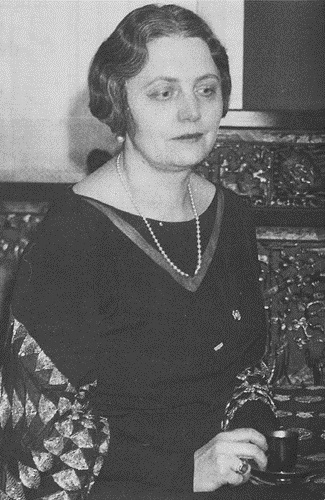
Paul Carus

Carus was one of a number of thinkers at the turn of the 19th and 20th centuries who were trying to reconcile the growing conflict between religion and science. He sought to identify what he called a “Religion of Science,” a religious perspective shorn of mythology and superstition, in harmony with current scientific understanding, which could be globally accepted. He believed that Buddhism had the potential to fill this role. To that end, his Open Court Publishing made Eastern texts available to the West. Suzuki would work with Carus on this project for eleven years.

His first assignment was to assist with a translation of the Tao Te Ching. Suzuki was not happy with the rendition, believing that Carus distorted the work by his use of abstract Western terminology which didn’t adequately reflect the intention of the text. Suzuki also took it upon himself to translate Ashvaghosha’s Awakening of Faith in the Mahayana, which would be the first of many books in English that he would release under his own name. This was published in 1900, after which Suzuki began work on Outlines of Mahayana Buddhism, in which he sought to counter the perception of western scholars who viewed the Mahayana – with its esoteric teachings and plethora of Bodhisattvas – as a degenerate form of Buddhism when compared with the older Theravada School.

There was growing academic and popular interest in Buddhism after the World Parliament of Religions, although the number of Westerners who gave serious thought to adopting the Buddhist faith was miniscule. There were a few, however, some of whom even found their way to Engakuji and undertook Zen training under Shaku’s tutelage. In 1905, one of these, Ida Russell – a resident of San Francisco – and her husband invited Shaku to make a second visit to the United States as their guest.

Shaku accepted the invitation and arranged for Suzuki to meet him in California. Arrangements were made for Shaku to give a number of talks to the immigrant Japanese communities in San Francisco, Los Angeles, Sacramento and Oakland. Then in 1906, attended by Suzuki, he proceeded across the country by train. During his tour, Shaku met a range of political and academic figures, including President Theodore Roosevelt, and he gave public lectures on Zen. Like Suzuki in his Outline of Mahayana Buddhism, Shaku sought to correct popular misconceptions. Christian critics had been vociferous in condemning Buddhism as a negative and life-denying doctrine the goal of which was the total extinction of the person in Nirvana. Shaku argued instead that Buddhism was life-affirming, and that through meditation practice the individual came into direct contact with “the most concrete and withal the most universal fact of life.”

Shaku’s tour lasted nine months, and, while they were in New York, Suzuki met Beatrice Erskine, whom he would later marry. When Soyen Shaku returned to Japan, Suzuki resumed his work with Carus and remained in Illinois for another two years.

In 1908, he left Open House Publishing, went to New York, and renewed his acquaintance with Beatrice. Then he did a tour of Europe before returning to Japan, where Beatrice would eventually follow him.

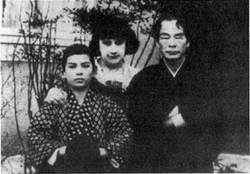
They were married in Yokohama in 1911 and adopted a son, Paul, who was of mixed European and Japanese descent. Both their marriage and the adoption flouted the ethnocentric attitudes common throughout Japan. The family lived in a small cottage in the Engakuji compound until 1919, when they moved to Kyoto, where Suzuki taught at Otani University.

They founded the Eastern Buddhist Society and published an English language journal, The Eastern Buddhist, to which they both frequently contributed articles. A number of D. T. Suzuki’s pieces were collected and published by the British company, Rider, in 1927 under the title, Essays in Zen Buddhism. The book related Tang dynasty koans and tales never before heard in the west and was surprisingly successful. More than any other work to that date, it would be responsible for promoting a popular interest in Zen both in North America and Europe.

Suzuki was 57 when Essays in Zen Buddhism was released; his output after its publication was prodigious. A second and third volume of Essays were brought out by Rider. He released a translation of the Lankavatara Sutra in 1932; The Training of the Zen Buddhist Monk was published in 1934; and Zen Buddhism and Its Influence on Japanese Culture came out in 1938, the same year that Beatrice published Mahayana Buddhism.

The appeal of Suzuki’s books was the portrait he gave of a religion which stood in stark contrast to the Judaeo-Christian heritage of the West—a religion without a deity, a religion which held that the practitioner could attain the same insight and awareness its founder had had. In response to those critics who viewed the Mahayana as a distortion of the Buddha’s original teaching, Suzuki insisted that a vital religion must not be limited to its earliest expression but must demonstrate the ability to evolve. Zen, he argued, was Buddhism “shorn of its Indian garb,” the cultural and historical trappings of the original teaching. What was central to Zen, after all, was not a “dependence on words and letters” but the transmission of the original awakening experience by which Siddhartha Gautama became the Buddha and which he passed onto his disciple, Mahakasyapa.

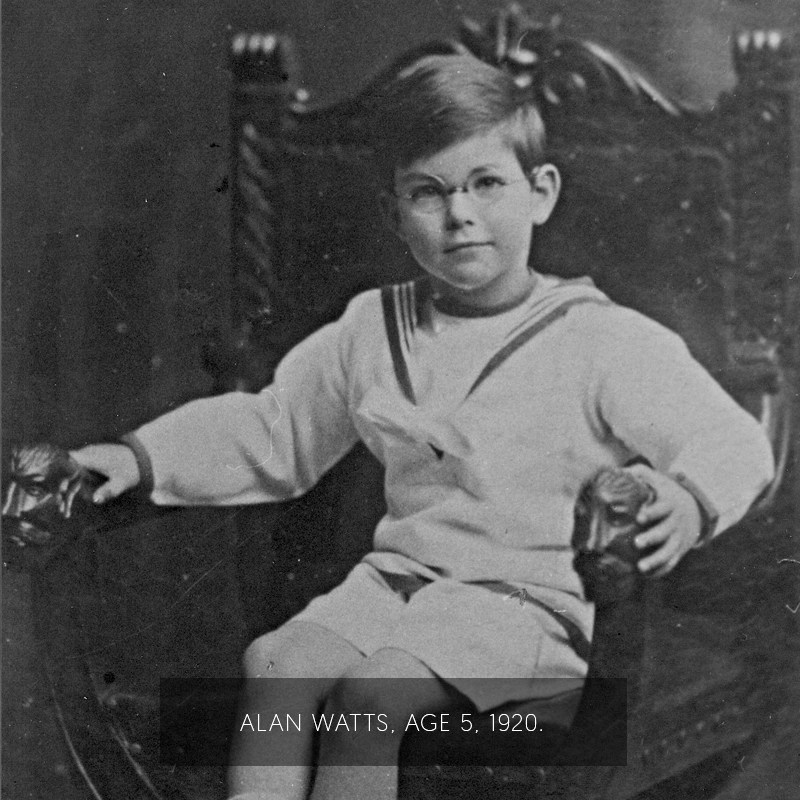
Alan Wilson Watts was born during the First World War in the English village of Chislehurst in Kent. His mother, Emily, came from a staunch Evangelical Protestant family. She was loving but strict and was the family disciplinarian. Watts’ father, Lawrence, on the other hand, was more gentle and tolerant. Emily had been raised to believe that human life was a testing ground during which it was determined whether one was worthy of salvation or was to be condemned to eternal damnation, and she was as concerned about her only child’s spiritual well-being as she was his physical. Religious instruction took place in a gloomy, unheated second-floor bathroom. In this bleak environment Watts’ nanny read him Bible stories, and his mother taught him his first prayers and spanked him when she deemed it necessary. It was also the room where he was quizzed every morning about the state of his bowel movements. He hated the room.

In contrast to the disagreeable bathroom was the first floor Sitting Room, reserved for use on special occasions only. Before she was married, Emily had taught at a school for the daughters of missionaries to foreign lands, and, in the Sitting Room, she kept exotic presents given her by the families of those girls: Chinese and Korean vases, a Japanese tapestry and cushions, and a brass coffee table from India. Here Watts first acquired his love for the mystique of the Orient.

Watts suffered through the brutalities of the British boarding school system, where he received what he later described as a “Brahmin’s education.” The preparatory school to which he was sent was expensive, and his parents had to struggle to make the fees, but they were willing to do so in order to ensure their son received the type of education they believed would serve him well in the future. The all-male boarding school, however, was not the type of environment for which Watts was suited; among other things, even as a young boy he preferred the company of girls and women. The curriculum focused on the history of the British Empire, militarism, and low church theology. Watts sought escape from the dreariness of this course of study by reading the novels of Sax Rohmer, in which he identified more with the Asian villains, like Dr. Fu Manchu, than with the square-jawed British heroes, such as Nayland Smith.

He decorated his room at home with the type of inexpensive Asian ornaments a schoolboy could afford, including a small reproduction of the Kamakura Daibutsu. Eventually his mother—who had good taste in such matters—supplemented these with better pieces, as well as presenting him with a copy of the New Testament written in Chinese, which roused a lifelong interest in Chinese calligraphy. Once more—as in the contrast between the awful bathroom where Bible stories were told and the Sitting Room—the brightly colored exotica of the Orient provided an alternative to the drabness of all things British and Protestant.

He was intellectually gifted and earned a scholarship to King’s College in Canterbury, a public (that is to say, private) school to which otherwise his parents would not have been able to send him. The rich history of Canterbury, its elaborate Gothic architecture, and the pageantry of High Church Anglicanism provided a more stimulating environment for Watts than his preparatory school had. On the other hand, he was well aware that he was not of the same class as the majority of his fellow students. In order to counter a bourgeoning sense of social inferiority, he developed a persona which allowed him to feel intellectually superior to his classmates.

He may not have belonged to the gentility, but his tastes ran in that direction. He was precocious enough, while still a teen, to be able to cultivate adult friendships which permitted him to share in a lifestyle beyond his family’s reach. His appreciation of Asian art and aesthetics led him to search for books on Japan and China. One of his adult friends loaned him a number of these, including a pamphlet by Christmas Humphreys, then President of the Buddhist Lodge in London. In the overview of Buddhism provided by Humphreys, Watts found a view of life which struck him as more reasonable than Christianity, so, at the age of 15, he boldly announced to his classmates that he was a Buddhist. He also initiated a correspondence with Humphreys in which he expressed himself so maturely that Humphreys assumed the writer from King’s College was a member of staff and was surprised to discover, when Watts attended his first Lodge meeting during the holidays, that his correspondent was in fact a sixth form student.

Christmas Humphreys

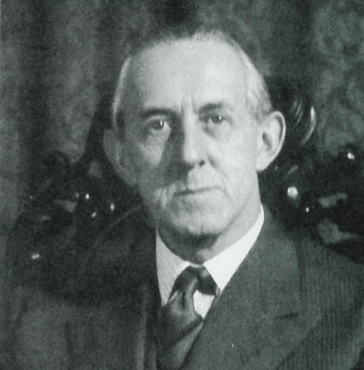
Humphreys was the type of adult Watts admired and sought to befriend, wealthy and sophisticated, a barrister who was to become a well-respected judge. Humphreys and his wife, who were childless, admired the young Watts and came to look upon him almost as a son. Watts’ actual parents, perhaps hoping his interest in Buddhism was a youthful enthusiasm he would outgrow, supported his inquiries and even attended Lodge meetings with him. Lawrence eventually became a Buddhist. Emily remained reserved, noting that Humphreys ran Lodge meetings much like a Sunday School class. It was Humphreys who introduced Watts to the books of D. T. Suzuki.

As head boy of his house at King’s College, Watts had the freedom to use an Elizabethan room after hours where he experimented with meditation guided by his reading, although he was not clear about what the writers meant by satori, moksha, samadhi, or enlightenment. He was considering this problem in the fall of 1932. In his autobiography, he wrote, “The different ideas of it which I had in mind seemed to be approaching me like little dogs wanting to be petted, and suddenly I shouted at all of them to go away. I annihilated and bawled out every theory and concept of what should be my properly spiritual state of mind, or of what should be meant by ME. And instantly my weight vanished. I owned nothing. All hang-ups disappeared.”

Watts’ masters at King’s College—and his relatives—felt that he should easily be able to earn a scholarship to Oxford, but he did poorly on the entrance examination, and the scholarship did not materialize. Once he completed public school, his formal education came to an end. His prospects were not good, and he was fortunate to have the friendship of Humphreys at a time when his mother’s family, in particular, let him know how disappointed they were with him. Without a university degree, the professions were closed to him, and it was not clear how he was going to support himself financially.

Dmitrije Mitrinovic

With Humphreys’ guidance, he continued his independent studies. He met a number of people who shared his interest in esoteric religions and the occult, among whom was Dmitrije Mitrinovic, who was rumored to practice black magic. Mitrinovic introduced him to the study of psychology, which would remain one of his abiding interests. He also read the Upanishads, the Diamond Sutra, and the Daodejing. Humphreys—whose Buddhism was liberally laced with Theosophy—introduced him to Blavatsky, but their greatest shared interest remained Suzuki whose works they continued to study and discuss.

Lawrence was able to help his son get employment at the foundation where he worked raising funds for London hospitals. The job was not difficult, and it gave Watts – still only 19 – time in the evening to work on an attempt to clarify Suzuki’s writings. At the end of a month of effort in 1935, he had a manuscript entitled The Spirit of Zen. Humphreys contributed a foreword, and the book was released by John Murray the following year.

It was a small work, less than 40,000 words, which was essentially a reader’s guide to Suzuki, but it already demonstrated a skill which Watts would hone throughout his life of being able to describe spiritual issues in a clear and intriguing manner.

The year after The Spirit of Zen came out, Watts met Suzuki, who was in London to attend the World Congress of Faith and, as the guest of the Buddhist Lodge, greatly impressed his hosts. In Suzuki, they found someone who not only understood Zen but embodied it.

In 1937, a wealthy American woman, Ruth Everett, showed up at a Buddhist Lodge meeting accompanied by her daughter, Eleanor. Watts was overwhelmed by the mother—who, having spent time in a Japanese monastery, knew more about Zen than he—and was smitten with the daughter. Eleanor had an American vivaciousness and freedom of behaviour unlike anything he had encountered in the few girls he had been with prior. When Ruth returned to America, Eleanor stayed behind.

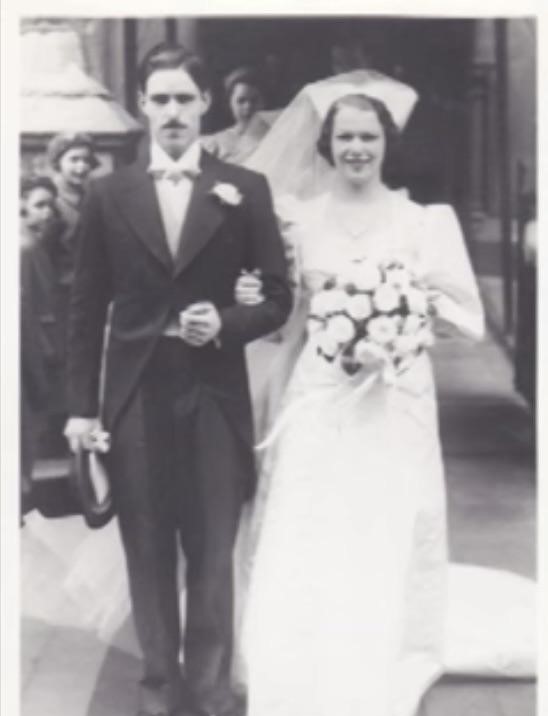
Alan and Eleanor were married in April 1938. Although they both professed to be Buddhists, it was a traditional Anglican ceremony. Watts was 23. Eleanor was 18 and pregnant. The young couple moved to New York where Ruth had arranged an apartment for them next door to hers.

Through Ruth, Watts met the Japanese Zen Master, Sokei-an Sasaki. Watts made an effort to work with Sasaki but discovered—as he would realize throughout his life—that he preferred being the teacher to being the student. After their brief formal relationship ended, Watts continued to observe Sokei-an in order to learn how a Zen master lived his life, something which became easier to do when Sokei-an began his courtship of Ruth after her husband’s death.

Possibly because she was having difficulties as a young mother, possibly because she still lived closer to her own mother and her mother’s influence than she would have liked, Eleanor did not fare as well in New York as her husband. She became increasingly unhappy and depressed. Then one day she stopped in at Saint Patrick’s Cathedral, looking for a place to rest during a trying day, and there she had a vision of Jesus so vivid that she could describe in detail everything he was wearing.

This vision came to her around the same time that Watts had become interested in Christian mysticism and was wondering whether—as long as it shed its claim to be the only true religion—Christianity might also be an effective means to achieve that sense of union with God/Dao/Ultimate Reality which in his most recent book, The Meaning of Happiness, Watts had asserted was the purpose of religion and the route to happiness.

Ruth was not surprised when Eleanor and Watts suddenly dropped their purported Buddhism and began attending services at St. Mary the Virgin Episcopalian Church. Not long after this, Watts approached the curate to inquire how he could become a priest. In his autobiography, he struggles to rationalize this decision, explaining that if he were to help Western people understand the “perennial philosophy” underlying all genuine religious traditions, he could best do so within the prevailing tradition of the West.

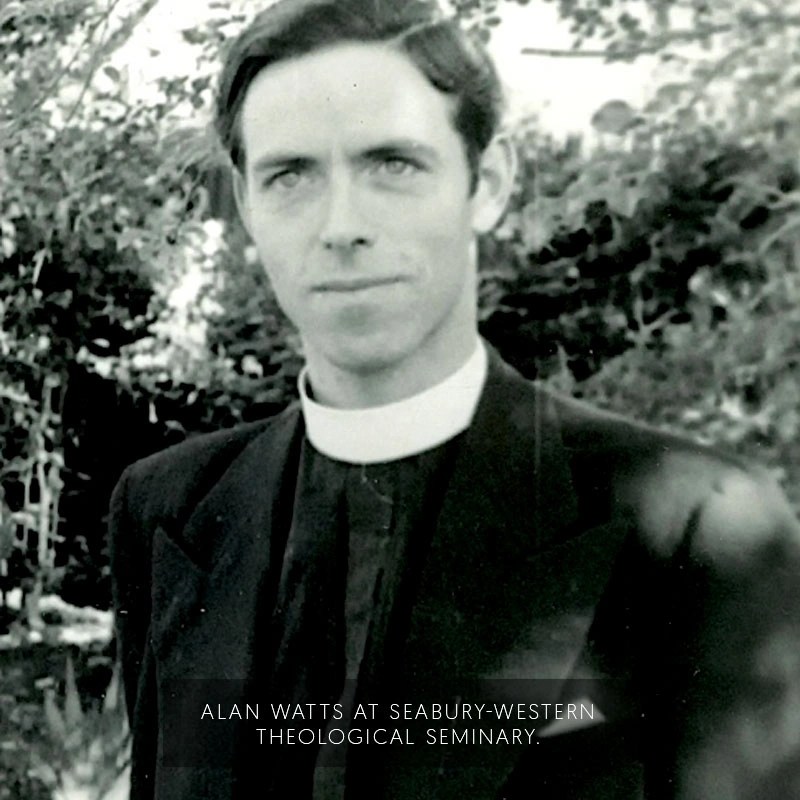
Whatever his motives, Watts and his family moved to Evanston, Illinois, where he entered Seabury-Western Theological Seminary; after which, for six years, the now Reverend Alan Watts served as a chaplain on the campus of Northwestern University. He published another book, Behold the Spirit, in which he compared Christian mysticism with Zen and other Asian traditions. It was well received in church circles.

His clerical career came to an end in 1950, when Eleanor informed his bishop that she and her husband had become estranged in part because of his affairs with women who satisfied desires she was unwilling to fulfill. Nor was Eleanor entirely innocent, having taken a lover ten years younger than she, who—with Watts’ complicity—lived in their house. When Eleanor, already the mother of two daughters, became pregnant with her lover’s child, the situation could no longer be concealed.

Watts resigned his priesthood and affiliation with the Episcopal Church before he could be dismissed, writing a long and self-justifying letter to the bishop in which he asserted that church doctrine had become so out of touch with the realities of contemporary culture that he could no longer, in conscience, continue as its spokesman. It was, at best, a disingenuous argument.

Eleanor procured an annulment, and Watts—behaving almost like a caricature of an adulterous husband—married Dorothy DeWitt, one of his students and his daughters’ sometime babysitter. He retained custody of his children—Eleanor was content with her new son—but no longer had the financial security his former wife’s wealth had provided him. His income from writing was inadequate to support his new family, so he accepted an invitation to move to San Francisco in order to help Frederic Spiegelberg establish the American Academy of Asian Studies. He shed his nominal Christianity and returned to nominal Buddhism without compunction.

Watts loved California and immersed himself in the burgeoning cultural scene although he still came across as a little square. Kerouac portrays him as Arthur Whane in The Dharma Bums. He still had a restrained British manner and dressed formally, and he had what sounded to Americans like a very cultured accent. He came across with authority, and it was natural for him to assume the position of Director of the Academy when Spiegelberg stepped down in order to teach at Stanford.

Watts arranged for a number of interesting guest lecturers to visit the Academy including both Suzuki and his former mother-in-law with whom he appeared to have been able to retain a civil relationship. At any rate, she loved her granddaughters, and they lived with their father.

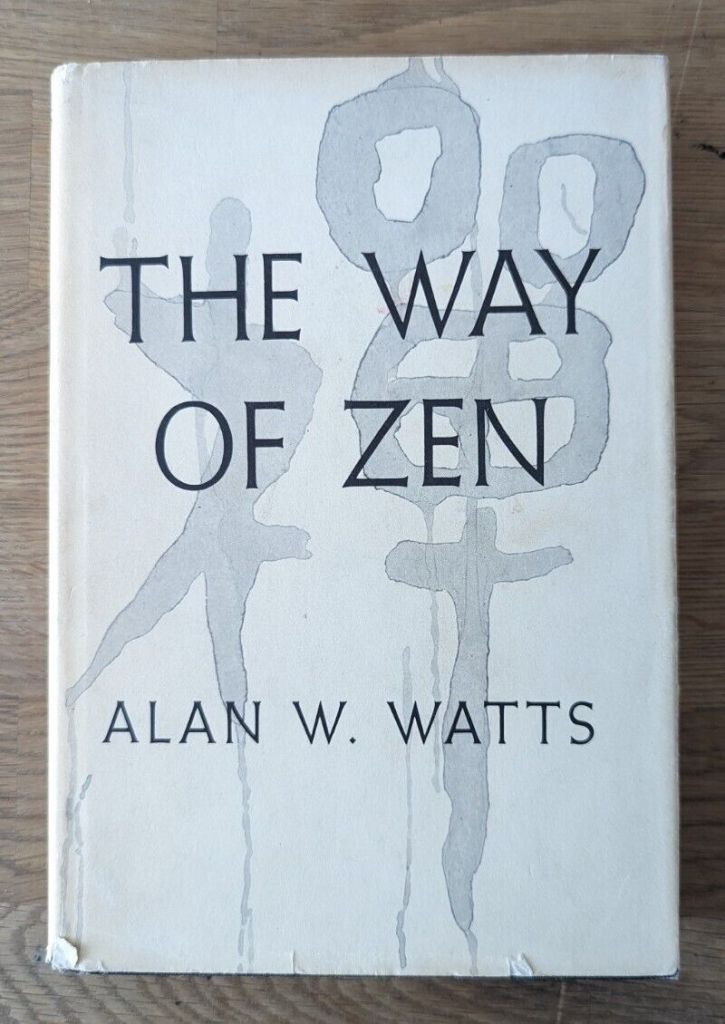
California had long attracted people with an interest in Asian philosophies. Krishnamurti, the Vedandist, Swami Prabhavananda, and other credible spiritual teachers were well established in the state. Watts fit in easily. In addition to his work at the Academy, he became a frequent guest on educational radio and television. Then in 1956, he published the book for which he would become best known, The Way of Zen.

D. T. Suzuki’s books had appealed to a broad but relatively small and well-educated readership. Watts was a much clearer writer and easier to read than Suzuki, and his book introduced Zen to an even wider audience. To some extent it was a matter of timing; the book came out when interest in Zen, in part because of the Beats, was on the rise.

In the book, however, Watts warns that he is not in favour of importing Zen wholesale from Japan: “—for it has become deeply involved with cultural institutions which are quite foreign to us. But there is no doubt there are things which we can learn, or unlearn, from it and apply in our own way.”

He begins his analysis of Zen with a point to which he frequently returns in his work: that what one perceives as one’s Self is an arbitrary social convention. It is not only that one tends to see oneself in light of the way in which others perceive and define one (one’s social role, personality, even physical appearance); one also tends to view the Self as what he described elsewhere as “an ego encapsulated in a bag of skin”—a soul separate from and animating a physical body, both of which (soul and body) are cut off and distinct from the environment about one.

Zen is a “way of liberation” through which the individual can realize the restrictions and limitations of social conventions and come to identify the “self” as part of a larger ecological whole which is all of Being. This is not a matter of rejecting or rebelling against other perspectives. It is rather a matter of seeing through the illusion of separation or dualism. For Watts, this is something which must occur spontaneously; it cannot be achieved by effort.

He presents Zen as a matter of cultivating a particular attitude towards life rather than being a training method which brings about a change in one’s manner of experiencing. Seated meditation – zazen – is just a natural way to sit and be; it had not been intended, he suggests, to become the strained and sustained practice it had evolved into in Japanese monasteries. To support this contention, he quotes a conversation between the Tang dynasty Zen figure Baso and his teacher, Nangaku. Nangaku came upon Baso sitting in zazen and asked, “What is it that you’re trying to accomplish by sitting like this?” Baso replied that he wanted to attain Buddhahood. Nangaku sat down beside him, picked up a piece of broken tile, and began to rub it vigorously. When Baso asked what he was doing, Nangaku said that he was polishing the tile to make it into a mirror.

“But no amount of polishing will turn a tile into a mirror!” Baso complained.

“Neither will any amount of meditation, as you practice it, make you into a Buddha,” Nangaku shot back.

Watts ends the passage at this point. D. T. Suzuki, Philip Kapleau and later Zen practitioners would complain that by doing so he distorted the intent of the story. To present it as a condemnation of zazen, Kapleau wrote, “—is to do violence to the whole spirit of the koan. Nangaku, far from implying that sitting in zazen is as useless as trying to polish a roof tile into a mirror—though it is easy for one who has never practiced Zen to come to such a conclusion—is in fact trying to teach Baso that Buddhahood does not exist outside himself as an object to strive for, since we are all Buddhas from the very first.”

The criticism was just, but, in fairness to Watts, he had specifically denied being a spokesperson for traditional Zen in his book and did not intend it to be an instruction manual. What it did do was present the Zen perspective as an appealing orientation towards life from which Western readers could learn to develop a more healthy relationship with their fellows and their environment than currently found in contemporary North American society.

The book became, as Watts put it, a “minor bestseller,” and its publication allowed him to resign his position as Director of the Academy and earn his way as a writer and lecturer. His reputation was on the rise. Tens of thousands of people attended his seminars and read his books. Ironically, his personal life was a mess. He became a heavy drinker and proved to be no more capable of fidelity to Dorothy than he had been to Eleanor.

As his fame grew, so did the number of his detractors. Academics dismissed him as a popularizer, and some members of the emerging American Zen community dismissed him because of his lack of formal training. Shunryu Suzuki, however, when overhearing his students criticize Watts, told them that they should respect what he had accomplished and consider him a great Bodhisattva.

Young people flocked to him and sought to become his disciples; the fact that he did not accept any of them only increased his allure. At the Human Be-In of January 1967, Watts was present with the Beat poets Allen Ginsberg and Gary Snyder; Shunryu Suzuki was there as well. In the counterculture, Watts had become mainstream.

The “Summer of Love,” however, was short lived, and, as the original innocence of the first hippies dissipated, a few began serious spiritual quests. Zen centers, located in places as unlikely as Minneapolis, were filling up. The total number of practitioners – many inspired by reading Watts and Suzuki – was not large compared to the general population, but it was large enough to have been unthinkable in 1958 when Kerouac, in The Dharma Bums, had predicted a generation of Zen practitioners across the land.

The Third Step East: 9, 10, 17, 21-39 43, 56, 59, 66-68, 70, 78, 79-80, 82-83 88, 93-107, 112, 113, 121, 127, 134-35, 137, 144, 147, 148, 158, 168, 172, 181, 203, 204, 237-38

The Story of Zen: 5-6, 13-14, 108, 115, 121, 160, 224, 216-25, 231, 233, 234, 237, 244-70, 280-81, 296, 302, 306, 320, 337, 345, 370, 399, 424

Joriki Baker

Blue Mountain Zendo, Bethlehem, PA –

When he was 25 years old, Joriki Baker dropped a set of keys and, when bending over to pick them up, fell to the ground and was unable to get up.

“I’d damaged my back in my teens body surfing,” he tells me. The injury had been considered healed, but, although he didn’t realize it, it had left his spine severely damaged. “At 24, I was a heavyweight competitive bodybuilder, owned my own training company and was director of the east coast operations of a subsidiary of Solgar Nutrition called Optibal. I’d just gotten married. I had a wife I loved, money, a house, and a baby girl; I was at the pinnacle of my life. I was done with school and was working as a social worker, personal trainer, and a competitive bodybuilder.”

Then he dropped the keys. “An ambulance was called, and I found out that I had severe degeneration of the facet joints in my lumbar, the joints that allow the vertebrae to pivot forward and backward and side to side. I also had severe spinal stenosis in my whole lumbar spine. I was scheduled to undergo a spinal fusion with rods and screws from L4 to S1. But I had to wait a year for the surgery. So I lost the house, our cars, my job. and the ability to provide for my family.”

He had to go on welfare, and his family moved into a one-room efficiency apartment while he waited for the operation.

“That was the darkest period of my life ever. Not being able to provide for your family, for your newborn, not knowing if you’ll be able to work again or walk again was crushing. One day I went out onto the back porch; it was really the stairs of the fire escape. This apartment complex sat on a hill that overlooked a park, and in this park was a small river called the Jordan Creek. It was the middle of summer, and it was pitch black and pouring rain, and I’m just sitting on the back edge of the fire escape looking out over this park, wondering, ‘What am I going to do?’ Everything was taken away from me just as I just got started. I’m thinking, ‘Should I just leave my wife? Is it better for me to just leave my wife so she can find somebody who can provide for her and my child? Is it selfish of me to drag her through this?’ You know, really deep and painful questions. There was water pouring on me from the storm, but I couldn’t feel it. All I could taste was the salt from my tears. And I looked out over the river and at that exact moment, there was a bolt of lightning that struck the far side of the river. Everyone has seen that, in the middle of the dark night, a lightning bolt strikes, and everything just lights up like it’s day for a moment, and then it turns black immediately again. It was just a lightning strike on the far side of the river, but there was also something else that happened. This was the catalyst for what I consider the beginning of my Zen training.”

He’d had some experience with spiritual practices earlier in his life, although he tells me they were more a “hobby” than a genuine practice. His interest began when he was 14 and a Native American school friend invited him to take part in a traditional sweat.

“It was the first time I actually felt something stir deep within. I felt a connection that I hadn’t felt before with the world around me. I remember, for a brief moment, an experience as if all of us we were one within this lodge, within this sweat. And it kind of woke me up to maybe there’s something more to spirituality than the Lutheran religion. And it got me interested in not just religion and theology but also in psychology. Like how does all this stuff work?”

Later, at university he became friends with a Vietnamese student and his family. “The father had been monk in Vietnam. And when he came to the United States, he married and put his robes down, had a family and was running a convenience market at the time. He was kind of my first exposure to Buddhism. He had a family altar, and he would explain a little bit to me, and we would do some chanting. And Tim – or Thien, we’d call him Tim – would explain a little bit to me.

Nishida Kitaro

“Shortly after that, I read a book by a philosopher named Nishida Kitaro. He created the Kyoto School of Philosophy that was the first Eastern philosophy that was accepted by Western academia. One of his contemporaries was D. T. Suzuki; they were actually in a monastery for a period of time together. His  books kind of bridged the Western and Eastern philosophical gap. So I was reading his stuff and it really started to make sense, and it really, really began to irritate my philosophy professors at school because they had never heard of it, and a lot of them were Christian-based and this is now Zen Buddhist-based, so they didn’t understand it. I was writing these papers and still getting decent grades on them, but the professor was just like, ‘I don’t like this.’

“So after I started reading Nishida Kitaro I decided, ‘Okay, I’ve got to check this out for myself.’ So I started going to different centers. In the beginning because of the Vietnamese connection with Thien, there was Thich Nhat Hanh groups that I sat with. And I sat with a Nichiren Daishonin group, a SGI [Soka Gakkai International] group. We chanted the Lotus Sutra an awful lot. And then I got married and that kind of put a halt to that.”

“Your wife didn’t join you in the chanting?”

“No,” he says laughing. “She wants nothing to do with it. I’ve been married to her for 31 years, and I love her to death. She’s been so patient and loving with through all of this, but she didn’t marry a monk. But she’s stood with me through all this change. She is my Bodhisattva.”

And then, not long after the birth of their daughter, he dropped the keys.

His post-surgery recovery was slow and difficult. “I was depressed and hid from my friends who knew me as a 320-pound Mack Truck. Now I am 200 pounds, and I can’t walk without canes.  I would go into the park at night and would practice walking with and without canes so nobody would see me.”

He also came upon a book by the former Catholic monk, Thomas Moore. “It was Care of the Soul. And it re-framed depression and illness. Instead of being negative things, they became positive or at least neutral. Moore taught that there was wisdom within depression, pain, and disability. These experiences became something to be learned from versus something in need of immediate eradication. So what is back surgery and depression teaching me? For example, depression was not negative but a period of deep introspection or being in Saturn. A period to grow. In the west depression and disease are bad things, things that need immediate cures. So you’re depressed, Prozac! Your back hurts, surgery! So, it was re-framing what I saw as, ‘Oh, my God! My life is over! My body is broken; I’m never going to be the same again’ to, ‘You know, this doesn’t define me, and I can learn and actually become stronger from it.’”

He once again looked for groups with which to practice.

“I found a gentleman by the name of John Sellars who was a student of Philip Kapleau. He was a large animal vet, and he ran a zendo in a town called Reading, Pennsylvania, which at the time was about two and half hours from me. He was my first exposure to Japanese Zen. He would usually do readings from one of Kapleau Roshi’s books, and then we would sit for 20/25 minutes, and I remember that after I would sit for those 20/25 minutes, on my way home I felt like I had summited Mount Everest.”

“Did he insist upon formal sitting postures?”

“He was very open, because it was meant to be kind of a conduit to Rochester. So at that time I was sitting on a zafu, sitting Burmese-style, facing the wall. But I remember that every time I left there, I cannot say there was one time I did not feel better than when I came. You know, we’re talking about feeling, and we’re talking about direct connection and experience. And it connected with me in a way that was similar to the sweat but even deeper. So I sat with John for quite a long period of time, and he wanted me to go up to Rochester, and I was going to, but then decided not to for some reason, probably the distance and having young children. But I wanted more, and I ended up finding a place called Mount Equity Zendo. This is Dai-En Bennage. She was a professional dancer from France who ended up in Japan living under a soy vat because she couldn’t find a temple at the time that would take a female nun in. I mean, she was the real deal. And not only that, she was not only ordained in Soto Zen, she was also ordained in Vietnamese Thien Zen. These were two things I was familiar with already.”

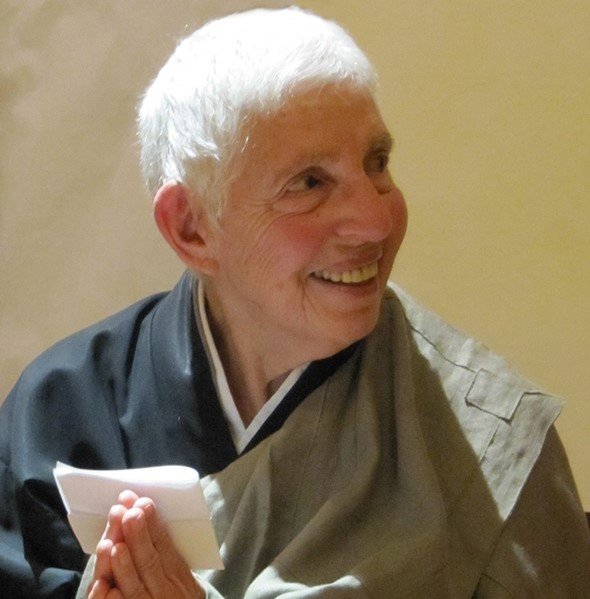
Dai-En Bennage

“Back up a bit. Did you say she was living under a soy vat?”

“She was living under soy vats. You have to read her book. She is one of the most legitimate teachers that I’ve ever met. So she ran this nunnery. It was almost all nuns. I was one of the only males. Sitting with her was kind of a mix between Thich Nhat Hanh and Soto. So we would do hardcore sitting, but she had this loving open heart. She really opened up Zen practice to me. I always say that if there’s one regret I have from back then, it would be not staying with her for longer. Because now in my head I’m thinking I have to go and practice real, legitimate, hardcore Zen. Mount Equity Zendo was beautiful. It was an old Quaker farmhouse that she had converted into a temple. There were active nuns living there; she had committed students. She’d have regular sesshin and retreat and everything like that, but – I don’t know – being young and immature, I somehow thought I had to go somewhere that was more legitimate. You know, the Asian architecture and the Japanese teacher.”

So he headed for Eido Shimano’s Dai Bosatsu Monastery in the Catskill Mountains

“Shimano was a controversial figure,” I remark.

Jiro Afable

“I wasn’t sure if I wanted to talk about this with you, to be honest, because I loved Eido Roshi, and I had the greatest respect for him, but also I knew that he hurt an awful lot of people. With that being said, I had a heads up on that even before I went to Dai Bosatsu, so I never really formally took Eido Roshi as a teacher although he was always around. But when I first went to  Dai Bosatsu, I first studied with Jiro Afable Osho who was Vice Abbot. Dai Bosatsu, at the time, was probably one of the most severe monasteries in the United States. Japanese monks would complain of the rules and schedule. But for some reason, I loved it! I didn’t sit like everybody else because now my spine is fused, so I’m flip-flopping between a seiza bench and a zafu and maybe a couple of rounds during a week-long in a chair. And at that time there weren’t any other people who had physical limitations at Dai Bosatsu that I ever saw. If you sat on more than one zafu, it was the ‘tower of shame.’”

He visited Dai Bosatsu regularly from 1999 to 2007, until the situation there finally prompted him to leave. At the same time, he was hosting a sitting group at what he called the Blue Mountain Zendo.

“I started Blue Mountain Zendo in 1998, and we’ve had the temple in a different area, but, for the most part, we have lived within them with our two children. My daughter memorized the Heart Sutra in Japanese by the time she was 7.”

He had permission to operate a sitting group because it was a long distance to any of the authorized centers where he could participate. By 2001 Blue Mountain had grown sufficiently that it was incorporated. Visiting teachers conducted sesshin there.  “Dai-En Bennage ran sesshins. Denko chipped in. Kobutsu Malone visited us.” Denko was Denko John Mortensen, a Danish Zen student and former Vice Abbot at Dai Bosatsu who has gone by several names – Egmund Sommer / Denko Møller – and is currently known as Choan Bertelsen. He is the founder of the first Zen temple to be established in Denmark. Kobutsu Malone had been the gatekeeper at Dai Bosatsu and then the archivist who collected documents recording the sexual and other improprieties of both Eido Shimano and Joshu Sasaki. Malone was instrumental in connecting Joriki with the man he now recognizes as his primary teacher, Genjo Marinello.

Genjo Marinello and Joriki

“I heard of Genjo actually through Kobutsu and through the Shimano Archives. We were talking to each other online. And I didn’t have a teacher for I guess it would be about three years. It was just substitutes stepping in and out, and I knew my training was not complete. So I was like, ‘What’s your place like up in Seattle?’ So I ended up travelling to Seattle and doing a sesshin with Genjo at Chobo-ji. And you know that they always say that you have many teachers, and each teacher gives you something special. And you hear me talk about Dae-En Bennage as a core teacher, and she is. Even though I didn’t spend a lot of time with her, she is one of my core teachers. But Genjo is my teacher. It was recognizable immediately, that he was a balance of everything that I was looking for.”

Then his back issues reemerged. “Over the last two years, I’ve had some struggles. I required radical back surgery. My whole lumbar, SI joints, and pelvis are all fused. I almost died the first time. My kidneys shut down; I had toxic shock; suffered effects from hypoxia and was on a ventilator in ICU for two weeks. And then they had to redo the surgery a year later because the first one failed, and I have severe scoliosis.”

Throughout this, he continued his practice with Genjo and eventually received Osho – or priest – status. I ask what being an osho authorizes him to do.

“It authorizes us to do various ceremonies, Dharma talks; and it authorizes us to do koan work with students.”

“It authorizes you to be a teacher.”

“To be a teacher, yes, not an heir. That’s another step.” He points out that, to date, Genjo’s only full Dharma heir is Rinzan Pechovnik.

“So you’re now authorized as a teacher. What does a Zen teacher teach?”

“The thing I would say that is most important is love. And I don’t necessarily mean that just in an emotional way although that is part of it too. Being open – being completely open – to something else, somebody else, the world around you as you. That was definitely a lesson I learned from Genjo. It was something that I had never – other than Dae-En Bennage’s loving presence – I had never really considered before because at Dai Bosatsu it was a such hard-core Rinzai training. It was always so disciplined and militant, and that the form was everything. The ritual. Memorizing the sutras. Not making mistakes. And then all of a sudden to hear, ‘There’s no right way to do it, and there’s no wrong way to do it.’ And what is most important is that you love yourself, and that you love the people around you. And that, to me, was like, ‘Wow!’” He laughs. “And it seems so simple, and it seems like something I would have heard a really long time ago, but I didn’t.”

“How do you – how does one – teach people to love?”

“You don’t. You demonstrate it. And that was the thing. Genjo showed me through accepting me as I was. That had always been a point of contention at DBZ, not being able to sit like all the other monks were. But Genjo accepted that I would sometimes have to sit in a chair, and he would always say, ‘Well, you’re the captain of your own ship when it comes to practice. Only you know when you have to change something.’ I was like, ‘Wow! I am?’ And just his presence and the way he acts, and how open he is to people and not expecting them to move from where they are until they’re ready to. So it was the first time that I felt from a Zen teacher pure acceptance of who I was.”

“Okay,” I say, “but when someone comes to the Blue Mountain Zendo, they don’t come because they want to find love. They come because they’re drawn by something. I’m older than you, and I remember the days when what drew people to Zen was the desire for enlightenment, for awakening. Everybody read Kapleau, and they wanted kensho.”

“That’s what they wanted?” I’m surprised that he sounds surprised.

“Even guys who ended up someplace – like San Francisco – which downplayed the centrality of enlightenment, it was the desire for enlightenment that drew many of them there. What are people seeking for when they come to you?”

“I always address that right off the bat. I call it the proverbial carrot in front of the horse. The issue is we are already enlightened; we are just blind to it. Don’t get me wrong. To get to that point of realizing and feeling that you already are awake and that things already are clear, that takes an awful lot of training.”

“If it isn’t enlightenment people are searching for, what is it that initially draws them to the practice?”

“Suffering. It’s the same thing that people came to Buddha for and everyone since. People come – you and I – our stories, we all come to Buddhism because of some form of suffering, or we think something needs to be changed. We feel something is missing or out of place.”

“And the students who come to you, what specifically are they looking for from you?”

“They have no idea, most of them. The students who stick around, I’ll ask them, ‘Well, was it what you’d expected?’ And they’ll say, ‘I had no expectations. I had no idea about what it would be.’ And the majority of students who stick around are the students who don’t come in with a head full of, ‘I know what Zen practice is.’ But the ones that come in with that ‘I don’t know’ – or beginner’s mind – those are the ones that stick around. They’re the ones that really begin to practice. So if I would hear somebody asking for enlightenment . . .” He chuckles.

“You know,” I point out, “that language isn’t used much anymore, but one person who defended it was Rinzan.”

“Rinzan?”

“Yeah. He said he suspects that people probably still had the desire for enlightenment – although almost everyone says “awakening” now – but they don’t use the language because of a self-consciousness about sounding pretentious.”

Joriki admits that there are different ways of looking at the issue but insists that he still shies away from using terms like “enlightenment.” Just, he adds, as he shies away from the term “meditation.” “It’s really not what we do. We don’t meditate. We do zazen.”

The distinction he is making is between popular understandings of meditation promoted through YouTube videos and Rinzai koan practice.

“And there’s nothing wrong with YouTube videos. I think we all kind of went through that as a gateway. But I’ll tell people, ‘We really don’t do any guided meditation here. The only guides we use in Rinzai is koan practice.’ If it’s a Soto student I will say we don’t exclude doing shikan taza. Sometimes we do ‘just sit and digest,’ especially on the last day of sesshin. But our primary focus is on koan work. And then for those with internet experience only, we will go into what koan work is. And then we’ll move into the initial breath work for their first few weeks of zazen. But I really don’t do a lot of explanation. And that was something I absolutely hated when I first started practicing Rinzai Zen, ’cause nothing was ever explained, and I didn’t understand why. And eventually I realized that it is a disservice to explain something to somebody in great detail about Zen because what you’re doing is you’re giving them your experiences – your insight into it – and not allowing them to develop their own.”

“What do koans do?” I ask.

“I see them as expedients. You know, I told you about when I first hurt myself that flash of lightning and everything was present all at once. I still can’t explain what happened, but that night I saw everything all at once. Form, emptiness, intermingling, everything in a flash. Right? I don’t see that experience as being something that’s special really. I think that’s an experience that a lot of people have. But I perceive the thing that differentiates a Zen student is that a Zen student is not satisfied or doesn’t just settle for just that flash. She wants  to understand it more, wants to go deeper with it and explore it until there is combustion. Koans are an expedient to look at the ‘all at once’ picture, that satori picture – you know, if we’re talking about enlightenment – that all at once flash and break it down even more to pure experience. And I always tell people, each koan is like a piece of a puzzle. The puzzle, of course, is satori, the big picture, and the little pieces are the kenshos from the koans that we work on. We get this brief flash of the complete picture which is gone as quickly as it was revealed. The more puzzle pieces we fit together, the deeper the understanding and connection to our essential nature we experience. So, they’re expedients to me. Nothing more. They’re not magical or anything like that. Just expedients.”

John Tarrant told me they were a designed learning system.”

“An ancient technology. John Tarrant is a wise man. I would agree with that.”

“What do you think he meant by that?”

“I mean, there’s always debate on it when it comes to the koan curriculum and how it’s laid out, whether it was put together in a certain order for certain reasons. There is a symbiotic parallel process that manifests aspects of the ego simultaneously. Koans will bring to light what lurks in the darkness of your mind and bind it with the koan practice. I think the curriculum was put together with a specific reason. And I think it naturally and organically guides you through – the system guides you through – going back and looking at that big picture. So, I think there’s a reason for the order they’re presented. But Jiro Osho – who was my first teacher at Dai Bosatsu – he didn’t necessarily do them in order. He did, ‘Who is he?’ first.”

Albert Low started with ‘Who are you?’”

“Exactly! Because that really is the starting point. Because until you know, you’re going to be meandering around with out a foundation. That’s an important starting point. So I guess in a way you could mix them up a little bit, although Genjo has always done them in order.”

Joriki tells me that one of the things he particularly admires about Genjo’s teaching is the emphasis placed on the Precepts. So I ask him how he understands the first of the frequently chanted Bodhisattva Vows. “You’ve made this vow, over and over again, that goes something like, ‘All beings without number, I vow to liberate.’ What does that mean?”

“Well, there really isn’t anybody to liberate,” he says with a laugh. “In truth. And in a way, nobody needs to be liberated either. That’s the thing. And we go back to Thomas Moore full circle here – remember? – where people feel that things need to be changed; they think things are not as they should be, that things should be different. And then suddenly we realize that maybe things are as they are for a reason, and that maybe they’re perfect as they are. And everybody’s journey, whatever it is, is exactly the way that it should have been.”

Al Fusho Rapaport

Open Mind Zen, Melbourne, Florida –

There are more than a dozen teachers identified on the Open Mind International website. Fusho Al Rapaport is the founder and director of the general organization and remains a teacher at the Melbourne, Florida, zendo although he tells me he no longer works much with beginners. His students are often people who have had years of prior Dharma experience. “A lot of the people who come to me are people who have studied in other traditions and in some cases gotten Dharma transmission from them but just feel they’re not entirely clear about what Zen, their life – whatever – is about, and so they want to clarify that.”

“So what is Zen about?” I ask. “What does it do for people?”

“What does it do for people? Generalizing is really tough. Sometimes people ask me, ‘What has it done for you?’ But since I’ve been doing it most of my life, it’s hard for me to know what it would be like for me without it. But I think – at least the way we work with it in our organization – that it’s basically a way of getting in touch with what’s really going on in one’s mind, in life, in relationships, and getting rooted in what’s real rather than what the mind is creating. And that’s a lifelong process; I don’t think it ever ends. As Dogen said, it’s practice/enlightenment. Meaning that it’s rolling along, and we’re practicing being awake and practicing awakening, and awakening is practicing us. So the awakening is resident in the practice; it’s not separate from it.”

When I ask how he first encountered Zen, he tells me that he first taught himself to meditate by following the instructions in a book he’d got from the Los Altos branch of the Long Beach Public Library when he was 17 years old. “There were things going on it my life that I couldn’t deal with psychologically. It was 1970, and, in the climate that I grew up in, it wasn’t like there was assistance if you were having psychological issues. It just wasn’t a thing. So I was in the library and checked out some books on yoga, and there was instruction in some of those books on meditation.”

“What was the psychological difficulty?”

“Originally? Falling in love for the first time.” We both laugh. “It was a woman. A woman who was beyond my ability to handle emotionally at the time for a number of reasons. And it started a kind of a cascade within me, a kind of an emotional cascade I wasn’t equipped fully, at the time, to deal with psychologically. And the meditation really helped me work with what I was feeling. Probably also helped me by-pass some emotional content,” he adds, smiling. “But it did help. I started doing yoga regularly and meditating from the books. I didn’t have a teacher. I don’t think there was a yoga teacher in all of Long Beach at the time. If there was, I didn’t know of them. So other than the books, I didn’t have any other resources. And I gradually I began connecting with people who were into alternative things like that, but I didn’t meet my first Zen teacher until 1975.”

Shinzen Young

One of Fusho’s friends at the time was Steve Young – later Shinzen Young – who would also become a meditation teacher. “He was a Buddhist monk, and we became friends before I met my first Zen teacher. He had studied in Japan and was living at a Center in LA called the International Buddhist Meditation Center which was pretty close to the Zen Center of LA. And he was the one who introduced me to Kozan Kimura who was my first teacher.”

I am not familiar with Kimura.

“Well, that’s because he was only in the US about a year. I didn’t meet him until about halfway through his trip. He was Japanese, didn’t speak English. He did travel with a woman who was a translator slash girlfriend I believe. I was living in Colorado for a while and while I was back in LA visiting family, I called Shinzen up, and we met for lunch. He said, ‘I’m studying with this Zen teacher.’ He was also translating for Joshu Sasaki Roshi at that time ’cause he’s fluent in Japanese and several other Asian languages. So I met a number of Zen teachers in LA about that time, but Kozan Kimura was the first one, and I had an immediate connection with him. It’s like the minute I met him, I knew he was my teacher. I’d never had that feeling before at all. And I’d been looking I think, even though I didn’t realize I was looking.

Kozan Kimura and translator

“Once I realized he was my teacher and that I wanted to study with him, I went back to Colorado, got rid of all my stuff there and came back to Southern California. But I didn’t have a car at first, so I had to take buses from where my mom’s house was in LA, and then walk in south-central LA – which was a pretty dangerous place at that time – to get to this little house he had in South Central LA.”

“I’m wondering why you did this.”

“Why I was meditating?”

“Well, maybe why did you think you needed a teacher so badly that you were willing to brave the streets of south-central LA to work with one?”

“As I said, I didn’t realize I was looking for a teacher before that. It’s kind of like if you’ve ever fallen in  love at first sight?  I just realized intuitively that he was my teacher. We could say that it was karma, that we had past karma. That’s possible. Who knows? That’s certainly a possibility. I don’t opine on those ideas much because I can’t prove them one way or the other, but it’s how it felt. When I met him, I felt like I knew him and that I needed to study with him.”

During the next six months, Fusho spent as much time as could with Kimura, but eventually the teacher returned to Japan. “So I essentially started looking at different communities in LA, and since my friend Shinzen was translating for Sasaki Roshi, I spent a fair amount of time listening to Sasaki Roshi’s Sunday talks. I did a retreat with him at Mount Baldy Zen Center, but due to something that happened during the retreat, I decided not to stay with that organization. Then I ended up at the LA Zen Center.”

“Are you willing to tell me what happened at Mount Baldy?”

“Well, Sasaki basically – as he was known to do – accosted my girlfriend in the interview room during the first interview. That was the kind of stuff that guy did. And I just couldn’t get over that he’d done that in the interview room so I started looking around more.”

The Zen Center of Los Angels, he tells me, “Had a huge residential community. And that really appealed to me. I did a retreat there in ’77, and I think I moved there in the winter of ’78. So a little over ten years after they started. I was in the training program for three months, then I ran out of money, and they put me on staff. And I was on staff there for about a year or two. And I decided not to stay on staff, but I lived on the same block. I had a job outside of the Zen Center and rented an apartment.”

But there were problems at ZCLA as well. Among other things, the Roshi, Taizan Maezumi, was an alcoholic.

“Towards the end of my residence in LA there, the community had reached the size that the zendo was nowhere near large enough for everyone to sit in. I think we could sit maybe sixty or so in the big zendo, and then we had a smaller one which fit maybe twenty-five or thirty in. And during retreats there were sometimes more than that sitting, so they were trying to raise money. They did this big fund-raiser to try and raise money for this building, a Japanese-style zendo that they were going to build. They had a well-known LA architect who had come up with architectural renderings of what it would look like. And they did this fund-raising dinner which was supposed to court donors in the LA area, a lot of whom were members of the center. There were a lot of members who had money. Certainly those of us practicing there didn’t, but people who didn’t live there, some of them were professionals in the entertainment industry and other businesses. So the big highlight of the night was supposed to be Maezumi Roshi giving this talk at this dinner. And he walked up to the mike when it was his turn to speak – and we were all drinking a lot, don’t get me wrong; it was kind of a party scene at that point – and he was laughing, and, if I remember correctly, he said something like, ‘I wonder why you’re all here tonight?’ Something like that. And he just laughed and turned around and left the lectern. There was this murmur that went out in the crowd, and then somebody else came up and jumped in ’cause it was obvious that that was all that he was going to say. He wasn’t going to give this big inspiring speech about how we needed to raise money for the zendo. So you could say either that he was being an enigmatic Zen master or he was so drunk he didn’t feel he could speak, or both, and I don’t know which is true. But the effect of it was that some of the donors were really pissed off afterwards, including the architect who had been donating his time. And the whole thing fell apart. I never heard about that project much again. Which is sad. It would have been a really amazing thing if they’d been able to pull it off.”

Fusho didn’t work with Maezumi directly.

Bernie Glassman and Genpo Merzel

“When I first arrived at Zen Center of LA, both Maezumi and Bernie Glassman were in Japan. Bernie was Maezumi’s first successor, and at that time he was taking successors to Eihei-ji in Japan to do this really traditional week-long thing at Eihei-ji. So they were gone for a few months, and during that time Maezumi had left Genpo in charge, Genpo Sensei at the time. So my first introduction, I walked into the interview room in the retreat I did in ’77, bowed and looked up. I expected to see a Japanese man sitting there but instead it was Genpo.”

Genpo is Genpo Dennis Merzel a Maezumi heir who would later be censured for his sexual affairs.  

“And we started talking. Turned out we went to the same high school, grew up in the same town, knew some of the same people, used to go to some of the same beaches. He’d been a lifeguard back then. So, I ended up feeling a connection with him. As you can tell from the way I described meeting my first teacher, my connection with teachers has always been a highly intuitive process where when I met someone who was my teacher, I just immediately knew it. So when people say, ‘I don’t know how to find a teacher,’ I don’t know what to tell them.”

When Genpo left Los Angeles to establish the Kanzeon Zen Center in Salt Lake City, Fusho moved there for a time to continue studying with him. I ask how he supported himself through all of this, and he explains that he organized conferences.

“Originally they were holistic health conferences, then I moved into yoga conferences. I was working with Yoga Journal for a few years. And then I started doing Buddhism conferences. They were called ‘Buddhism in America.’ I did one in ’96 in Boston; I did one in San Diego; I did one in Estes Park with the Naropa Institute, and then I did one in New York with Tricycle magazine a few months before 9/11, right down there where it happened, the World Trade Center’s Marriott. So I produced conferences, and that gave me the money and the freedom to do the kind of meditation practice and retreats that I wanted to do. My guess is I’ve done a lot more retreat time than most lay people because I had a schedule that allowed for long retreats.”

“What drove you to keep it up?”

“It felt like I was going into something more deeply all the time. Reality or whatever you want to call it. Buddha Mind. I was also practicing koans. I think that I had a desire early on to be a teacher. Not everyone does. But I was working through the White Plum koan system, so I worked with Genpo.”

“When you say you thought you’d like to be a teacher, what did you think that meant?”

“Well, at the time I had no idea of what it would amount to,” he says, laughing. “That’s been an on-going discovery over the years that I have been officially – and before that, unofficially – teaching. Just that I felt I was in contact with something that I could share, that I could somehow make a contribution to helping people free themselves from suffering or whatever, which I felt I had done to a large degree. I think that because I started so early, that Buddha Mind was something I really connected with from virtually the first time I meditated when I was 17. So that’s what I felt I was able to communicate to people. It felt like the right thing to do, and I did it. When I moved to Western Massachusetts in 1983, there was no Zen group in the town I was living in, so I set one up.”

“And how did you get to Massachusetts?”

“Well, I met woman in LA at a conference who I ended up getting involved with. And for a few months we were doing a back and forth. She lived in Boston, and I lived in LA. So around ’82 I decided to move to the Boston area to be with her, and then about a year later we moved to Western Massachusetts because we wanted to get out of the city. And there wasn’t a group there, so I knew Daido Loori had his group in New York – it was only about a three-hour drive from where I was living – and I called him up, and I said, ‘Would you be willing to come out and do a talk? ’Cause I’d like to start a sitting group.’ And he said, ‘Sure.’ So he came out and gave a talk. I think about twenty-five people showed up most of whom I didn’t know; one or two I did. And at the end I said, ‘Does anyone want to continue as a sitting group?’ And about twelve or thirteen people said yes, so we started a sitting group.”

Meanwhile, he continued his own training first with Maureen Stuart – also known as Ma Roshi, who had been authorized to teach Zen by the Japanese teacher, Soen Nakagawa – and later with the late Jules Shuzen Harris, an heir of Enkyo O’Hara.

Shuzen Harris

“I got Dharma transmission in 2008 from Shuzen Roshi. He had a center in Philadelphia and was a friend of mine from Kanzeon in Utah. We had both left Genpo at different times. I actually started teaching unofficially when I moved to Florida in 2001. I wasn’t certain at that time that I wanted to get Dharma transmission and go that route. I’d been authorized as an assistant teacher by Genpo before I left Utah, but I didn’t get full Dharma transmission until Shuzen.”

“Did it make any difference to the people you were working with whether you had full transmission or not? Did they care?”

“No. Basically they knew I knew what I was talking about at that point. So we’re talking around 2001, and I started Zen practice in ’75. I already had twenty-six years of Zen practice and thirty-plus years of meditation practice at that time. So, you know. I do believe the whole Dharma transmission thing is valuable – and I do it myself – but it doesn’t guarantee that anyone’s a good teacher. And these days there are a lot of people with Dharma transmission who don’t have a tremendous amount of experience in my opinion. Each teacher has different metrics about how they determine that. Actually going through the process of getting Dharma transmission alienated some people,” he says chuckling. “Because I think things were looser before. Once I had Dharma transmission, I tightened things up a bit.”

He called his Florida community Open Mind Zen. There are now affiliate groups in Indiana, California, Kentucky, and Germany. The focus of Fusho’s teaching is on koan work.

“Koan study is a unique form of spiritual practice unlike anything else that I know that exists in any other religion. At least in a formal way. There’s some of it in some religious practices, say in Sufism and few other places here and there, Tibetan Buddhism. But koans aid us in getting in contact with the non-logical, intuitive part of the self, which – I believe – Zen training is oriented in getting us in touch with. And it does so in a systematic way, approaching it from many different angles over years of practice. It helps us to drop self-consciousness because when working with koans you have to present things in a very unselfconscious manner. Dropping the sense that we ‘know.’ Because people who are highly intellectual don’t like not knowing what the answer to a koan is.” He smiles. “I know this because I had that experience when I was working with them. So there’s a lot of value to working with koans. Hearing the stories of ancient teachers and how they related to students and each other. Learning to drop self-consciousness, helping to get in touch with – again – Buddha Mind, True Nature, whatever you want to call it.”

We discuss some of the technicalities of koan practice, especially expectations around the first koan students are given. In many instances it is “Mu,” the classic story of Zhaozhou’s response to a monk who asked if a dog had Buddha Nature. In the tradition in which I trained, Mu was considered a breakthrough koan, one of a handful of koans to which the only acceptable response was some degree awakening.

Fusho nods his head. “Yeah, I understand that. I don’t treat it that way, and it’s a really involved discussion. I will say this about the initial breakthrough koan and that whole issue: First of all, when I did training at the Zen Center of LA, my teacher treated Mu as a breakthrough koan, and it took me about a year and a half to pass Mu. It was really an intense experience when I did. I went through the classic stages of it, getting into a state of Great Doubt and all that beforehand, being with me day and night, the hot iron ball that I couldn’t swallow, and all that. It all happened to me. So you have to understand that the position I have now is based on experiencing that. So I did a quote/unquote ‘traditional training,’ and to me tradition is just someone started something, a lot of other people started with the same thing, and then it becomes a tradition for a certain amount of time. But someone had to start the method. So over the years, having had numerous opening experiences, and now practicing meditation for over fifty years, I have come to the conclusion that when you build up in your mind that something’s a breakthrough koan, then that’s what it becomes. And the pressure – psychological and physical pressure – that is developed over working on a koan in that kind of environment works for some people, but it’s actually psychologically harmful for others. Especially anyone who comes from a trauma-based background. And so I approach koans in a very different way now where people do have to come to the correct answer but perhaps in a different way. And I break Mu up into a few different parts. And some people have a real breakthrough, and others just slide into it. And I think part of it is that I’m dealing with people who are coming to Zen with a much more mature perspective than I did when I started. I was quite a mess when I started Zen practice is probably the best way to put it. So I needed that psychological pressure at that time, but I don’t put that kind of pressure on people I work with. I do a process with new students called ‘Zen Dialogue.’ It’s a system of dialogue, and one of the things we do in that technique is we work with people in getting in touch in a direct conscious manner with Buddha Mind or whatever they call it in their particular way of viewing it. So I use different kinds of techniques to get people to see that, and sometimes it’s a big bang, but most of the time it’s not. And I find that if you don’t set up in your mind that there’s this big barrier that you have to break through, then guess what? It’s not a big barrier which you have to break through.”

As our conversation winds down, I return to something he had said earlier.

“You suggested that Sasaki didn’t live up to your concept of how a Zen Master should behave. You’ve actually encountered a number of authorized, often deeply respected, Zen teachers whose personal behaviour has been problematic. Sasaki, Maezumi, Genpo. So, people with teaching authorization and transmission can still have messy lives?”

“Oh, yeah. Absolutely. That’s one of the reasons why in our school I like to have people do other psychological work rather than just straight sitting practice and koan practice. Because you can sit for a long time and do koans for many, many years and still not work with psychological and trauma-based issues going on within you. There’s a number of ways to get at those other issues, but I think they have to be addressed. One of the things that’s happening in the Americanization of Zen, there’s a lot more women practicing. There’s probably an equal number of women and men teachers now. And there’s a lot of psychotherapists and social workers and people in counseling professions doing it. And so there’s been an element of that brought into Zen where these days if you try to away with the stuff that the teachers back in the day that I started out did, you couldn’t. You’d be excoriated immediately on the internet and called out for it. Whereas back then, people could do things, and it could be hidden quite easily for many years sometimes by other people that knew what was going on but then regarded these teachers as the ultimate guru-like authority. So I don’t think that exists much anymore. There’s an openness now – hopefully an openness – in Western Zen which has developed as a result of women being equal and also Western psychology being incorporated as an element.”

“Are you saying that the concept of a Zen teacher as an exalted figure with guru-like authority has diminished to some extent in North American Zen?”

“Definitely. Yeah, definitely. There’s a sense, I think, that the original teachers because there were very few of them and they were Asian and exotic, wore exotic clothing . . . This wasn’t just in Zen. This is something that occurred in all different disciplines that came over from Asia, the yoga tradition, other meditative traditions, the original teachers were like godlike almost – and in some cases they encouraged this – they were viewed as ultimate authorities who in many instances could essentially do anything they wanted, and people would accept it as stuff they needed to work on if they didn’t like it. That doesn’t exist much these days. Someone who’s abusive of women or whatever is not going to last two hours as a teacher. They’re just not. Whereas that could happen for decades previously.”

I mention someone who told had recently told me that her only meeting with Joshu Sasaki had taken place when he was over 100 years old, and he still tried to pull her to him.

“That just confirms what I said earlier. When someone has an addiction like that, you can sit for 100 years and not necessarily work on those kinds of issues. It wasn’t part of Asian teachers’ tradition to do psychological work. Although evidently Maezumi tried.”

“He went into therapy,” I point out. “He entered a rehab program.”

“True, but he still ended up dying essentially from drinking too much from what I understand.  It takes work to get over that kind of addiction that I think many teachers wouldn’t do because there were enough people still treating them as gurus. And this reflection on the psychological underpinnings and the trauma-based underpinnings of peoples’ addictive behaviours didn’t exist in Asia, as far as I know. There’s a discussion that could be had about why things happened the way they did – and I have ideas based on my experience – but all I know is that it doesn’t work now.”

Seung Sahn

Kwan Um School of Zen –

The Kwan Um School of Zen (or Seon in Korean) began in Providence Rhode Island in 1983 and is now a global phenomenon. Its founder was the Korean monk, Seung Sahn, originally a member of the Chogye Order in Korea. He came to the United States in the 1970s while in his mid-40s, arriving with only a smattering of English, and supporting himself by working as a handyman in a laundromat. His story is one of the most remarkable in the history of North American Zen.

Dae Bong Sunim is one of Seung Sahn’s Dharma heirs and the Kwan Um Regional Zen Master for Asia, Africa, and Australia.

Master Seung Sahn and Dae Bong Sunim, 1999

“Zen Master Seung Sahn was born in 1927,” he tells me, “outside the city of Pyongyang. At the time Korea wasn’t separated, but it’s in what is now North Korea. He grew up during the Japanese occupation, which was probably one of the most significant issues of his childhood. His family were Protestant Christians, although I don’t know how active he was.”

His birth name was Duk-In Lee, and, as a teenager during the Second World War, he and a group of friends made a radio with which they could listen to what Dae Bong supposes was “The Voice of America.”

“Of course, they were strongly opposed to the Japanese presence. He said that when he was young, he only felt one thing, ‘Free my country.’ Amazingly, perhaps his best friend in America was Maezumi Roshi who was Japanese. It was a great teaching to us to see their friendship given their countries’ history.”

Almost all of the people I spoke to about Seung Sahn imitate his accent when describing him. Dae Bong suggests it was because the accent was cute and charismatic. Judy Roitman, however, thinks “forceful” is a more appropriate term. “Soen Sa Nim’s English was never fluent, but it was direct and expressive, and the accent was part of it. His speech was more powerful than if he’d enunciated everything correctly. It felt as if his limited English forced him to go directly to the heart of things.”

“He was arrested because of the radio,” Dae Bong continues, “and then he was let out of jail when his high school teacher spoke up for him. Then he and his two friends stole some money from their parents and went up to Manchuria to join the Korean Free Army to fight for the liberation of Korea. There they met up with one of his friend’s older brothers who was in the KFA. They intended to join as well but were told, ‘Go back and finish high school.’ So he finished high school, and when the war ended – as you know – America and Russia supported the division of the country. Seung Sahn Sunim’s parents sent him and his younger sister to the south while they stayed in the north to take care of their parents. He and his sister never saw them again.”

Eventually he entered university where he studied Western philosophy.

“He really liked Socrates. He always talked about Socrates walking around Athens saying, ‘Know thyself! Know thyself!’ One of Socrates’ students said, ‘Teacher, do you know yourself?’ He said, ‘I don’t know, but I understand this “don’t know.”’ Soen Sa Nim really liked that.”

It takes a while for me to catch that sometimes people refer to Seung Shan as “Soen Sa Nim,” which sounds – to me at least – very similar, and I have trouble distinguishing when which is being used. “Soen Sa Nim,” Judy explains, is both a title and an expression of affection. “Soen Sa means Zen Master, and Nim is an honorific that has a tinge of ‘beloved,’ so it’s not just that you’re looking up to someone, but you’re looking up to someone with affection and love.”

Then during the General Strike of 1946, Seung Sahn observed rival factions in South Korea fighting in front of the rail station.

“This really hurt his mind,” Dae Bong says. “Growing up all he wanted was ‘my country be free’ and now that the Japanese were gone, the Korean people were fighting each other. He became disgusted with society and went into the mountains saying he wasn’t coming back until he understood the truth of human life.”

Judy tells me that he stayed in one of the small cabins attached to a Buddhist monastery, where he continued to read Western philosophy until one of the monks asked him why – as an Asian – he wasn’t reading Asian philosophy. The monk gave him a volume that included, among other things, the Diamond Sutra.

“One day,” Dae Bong explains, “he came to the line in the Diamond Sutra that says, ‘If you view all appearance as non-appearance, this view is your true nature.’ At that moment, his mind became clear. He realized the truth, but also realized that understanding it is not enough. It must become your lived experience. So he decided to become a monk. Soon after becoming a monk, he asked an older monk, ‘What is most difficult kind of practice?’ The older monk told him to do a 100-day retreat chanting the Great Dharani for 20 hours every day, get up for two hours in the middle of the night, pour cold water on yourself outside in the winter and then chant for two more hours. And only eat crushed pine needles. He asked the monk, ‘What is the result?’ The monk replied, ‘Three possibilities: get enlightenment, go crazy, or die.’ Soen Sa Nim thought, ‘Get enlightenment or die is okay, but going crazy not so good.’”

Kobong Sunim

The story continues that Seung Sahn achieved enlightenment during this regimen, after which he went to see Zen Master Kobong who was considered the toughest master in Korea. “He showed Zen Master Kobong a moktak[1] and asked, ‘What is this?’” Dae Bong tells me. “Kobong Sunim hit the moktak with a stick. Seon Sa Nim thought, ‘Ah my mind is the same as his,’ and turned to leave. Then Kobong Sunim said, ‘What did you see? A bird, a building, an airplane?’ Seon Sa Nim turned around and asked Kobong, ‘How can I practice Zen?’ Kobong Sunim asked him a traditional kong-an[2] which he didn’t know how to answer, and he said, ‘Don’t know.’ Then Kobong Sunim told him, ‘Only go straight “don’t know.”’”

After sitting the traditional three-month retreat the following winter, Seung Sahn visited Zen Master Kobong again. After Kobong tested his comprehension of several koans, he acknowledged the younger man’s enlightenment. Seung Sahn received transmission from him in January 1949. He was 22 years old.

The following year, the Korean War broke out, and Seung Sahn was drafted into the Korean army. “He told us that while he was in the army, he experienced something which touched deeply him. He was in an area where some American troops were having a meeting. They had chairs set out and a raised platform. There was a big map, and a lieutenant on the platform. There was going to a be a briefing about the day or plans for the next days. Even though he didn’t know the language, Seung Sahn could tell that the enlisted men sitting in the chairs and the officer were joking back and forth. He said you never would see this in the Korean army. In the Korean army due to Confucian sensibilities officers and enlisted men were very separated in terms of their behavior with one another. But the American soldiers were joking back and forth with the officer like equals, and it wasn’t a problem. Then a colonel came in. The lieutenant said, ‘Ten-hut!’ and everyone stood up and saluted. Then everyone smoothly separated into their jobs, no longer ‘equal’. That really touched him, that insight: when it’s not job time, everybody’s equal. When it’s time to do our job, you separate because of your job. In the Korean Confucian approach that had developed for centuries, people were strictly separated by social positions or jobs. This moment of equality between the soldiers and the officers affected Soen Sa Nim very much, and he developed an interest in the United States.”

Conditions in the Chogye Order were messy in the 1950s, and Seung Sahn felt that if the order didn’t modernize its approach, particularly its attitude to lay people, it wouldn’t – as Dae Bong put it – “be able to connect with modern Korean society in the future. So he got the idea of going to teach in America. In 1966 he was invited to Japan by the Japanese government to help the Koreans living in Japan. And then in 1972, he flew to America.”

America was a common destination for Zen teachers at the time. Taizan Maezumi went to Los Angeles in 1956; Shunryu Suzuki came to San Francisco three years later; Joshu Sasaki arrived in 1962. The question is why Seung Sahn chose to set up shop in Providence, Rhode Island.

“That’s a good question,” Dae Bong admits. “He landed in LA, and soon Korean Buddhists knew a Korean Zen Master was in town. They gathered around him and asked him to make a Buddhist Temple. He did. But after a few months, he realized, ‘If I stay in LA or go to Chicago or New York I will be surrounded by Koreans and not be able to meet westerners.’ So he told the Koreans in LA, ‘I’m going to the East Coast; I’ll be back in a few months.’ On the plane he met a Korean man who had been living in America a long time, and Soen Sa Nim told him, ‘I want to meet American people.’ This man told him that on the East Coast there is a small town, Providence, probably about 200,000 at that time. It has a very good university, so you can meet young American people there. And there’s almost no Koreans there. He went there and got a job taking care of a laundromat and rented a small apartment. That’s how he ended up in Providence.”

“Then what?” I ask. “Put up on posters on phone poles saying ‘Zen meditation this way’?”

“Almost. The Korean word is ‘Seon’ and the Japanese word ‘Zen.’ He knew Americans knew the word ‘Zen’ so he went around the town, probably to the university, and put up signs that said ‘Zen’ and gave his apartment’s address. And students started to show up. In 1972, many young people were interested in Zen. Zen Master Seung Sahn has a great face and bearing. When people met him, they became interested immediately. He said he made noodles or soup for anyone who came ‘because students are always hungry.’ Then he’d take them into the other room and point at sitting cushions he had; he’d sit down himself in meditation position. People would look at him, and they’d just copy it. He couldn’t talk to anyone because he knew almost no English. Then one of the students realized that Soen Sa Nim spoke Japanese because he grew up during the occupation of Korea and had to speak Japanese in school and outside the home. One of the professors at the university spoke Japanese. The student introduced the two of them. Then the professor – Leo Pruden – would come over to the Zen Center on certain days and translate Soen Sa Nim’s Dharma talks from Japanese to English. At some point about eight young people had moved in with him. It was just a little house; the students shared a bedroom. Soen Sa Nim had a bedroom, and the living room was the meditation room. They got up early every day, did 108 bows, chanting, and sitting. After breakfast the students would go to school and one of the students – Bobby Rhodes – she would go to work. She was a nurse. Soen Sa Nim would go to work in the laundromat.”

Bobby Rhodes

Bobby Rhodes – Zen Master Soeng Hyang – is the current Kwan Um School Zen Master. She was also the first member of the Kwan Um School I interviewed back in 2013.  When I asked her how she had first found out about Master Seung Sahn, she told me, “I didn’t find out about him, ’cause nobody knew him. But I was looking for an apartment, and the apartment that I looked at was above his temple. I didn’t take the apartment, but I came back a couple of weeks later and knocked on the door and met him.”

“What was that meeting like?

“I had been scared to go back, because I’d read all these Japanese books about getting hit. So I was afraid he’d be too severe. But it was great. He was down on the floor doing calligraphy, and he was very sweet and friendly. And there was an American Brown University student there who walked me around the apartment, showed me things, and introduced me to Master Seung Shan. And then, when I was leaving, he spoke hardly any English, but he said, ‘Come back! Come back! We have a Dharma talk on Sunday.’”

Bobby did come back the following Sunday, and, shortly after, she moved into the “temple.” “It was just an apartment,” she explains. “There were three of us. We had a big living room that we turned into a zendo and put up an altar, and it had a kitchen and two bedrooms. So I just slept out in the Dharma room. I was a hippie. So I was fine. I was used to sleeping on the floor. We were young. Very young. I was twenty-four. I could sleep on a dime. It was simple.”

When Dae Bong first came to the temple, Seung Sahn’s status had changed. “By the time I appeared, there were six Zen centers under his direction. Four on the east coast; two on the west coast, and groups in Toronto, Chicago, Kansas, and – I think – Colorado. What attracted me? First, it was Zen Buddhism. Second, I liked the chanting, chanting the Heart Sutra. The people were quite natural. Bobby gave a talk, and it was basically about how at work that day, she was going to open up a banana for one of the older patients she took care of, and the guy said, ‘No! You open it from the other end.’ She said, ‘No. We always open it from this end.’ And he said, ‘No, I saw some chimpanzees on TV, and they open it from the other end,’ and he opened it from the other end, and it worked quite well. I thought, ‘Well, that’s a stupid talk but simple and clear. There’s not only one way to do things.’”

Seung Sahn had not been at the first gathering Dae Bong attended. They didn’t meet until Dae Bong signed up to attend a three-day retreat.

“The first night when I went down there, as soon as I saw Soen Sa Nim, I had a very a comfortable feeling. What really struck me though was when during the Dharma talk and Q&A someone asked him, ‘What is sanity? What is insanity?’ He didn’t understand those two words and turned to his student and said, ‘This man. What say?’ The student understood Soen Sa Nim’s English and said, ‘This man asked, “What is crazy; what is not crazy”’ I was curious right away because I had studied psychology in university and worked in a mental hospital and on the psychiatric ward of a prison. Zen Master Seung Sahn said, ‘If you are very attached to something, you are very crazy. If you are a little attached to something, you are a little crazy. If you are not attached to anything, that’s not crazy.’ I thought, ‘That’s better than the eight years that I studied and worked in psychology.’ Because it covers everything: religious people, successful people. Everyone. And he kept talking. ‘So, in this world everybody’s crazy because everybody’s attached to “I.” But this “I” is only made by our thinking. Originally it doesn’t exist. If you don’t want to attach to your thinking “I,” and realize your true “I,” you must practice Zen.’

“We started the retreat next morning; a lot of people were there only for the talk. Zen Master Seung Sahn gave private interviews to each student every day. At my first interview, he asked me if I had any questions, and I said, ‘No.’ Then he gave me his basic Zen teaching ending with: ‘your before-thinking substance, my before-thinking substance, this stick’s substance, the substance of the sun, moon and stars, all universal substance is the same substance.’ At that moment I thought, ‘I’ve been waiting my whole life to hear that.’”

By the mid-80s, Seung Sahn had a well-established network of centers and was generally admired by Zen practitioners in other traditions as well. But the 80’s was a stressful time within North American Zen. In 1982, a number of Eido Shimano’s students left his sangha because of his sexual misconduct. In 1983, Richard Baker was pressured into resigning as abbot of the San Francisco Zen Center in part because it was known he engaged in affairs with students and with the wife of a major financial donor. In 1984, Taizan Maezumi in Los Angeles – who also admitted to having affairs –  entered a rehabilitation clinic for alcoholism. 1988, one of Joshu Sasaki’s students published a poem in which she accused her teacher of sexual abuse.  And that same year, Seung Sahn also acknowledged that he had been engaged in relationships with students.

Judy Roitman

Judy Roitman insists, however, that Seung Sahn’s situation was different from those other teachers. “He was not a predator. So in Korean culture there is this kind of accepted — not considered a good thing, but tolerated — situation of a student, who is female, having a sexual relationship with a monk. It’s tolerated but it stays in the shadows. And so Zen Master Seung Sahn had relationships. But they were relationships. He was not a predator. I know people he had relationships with. And if you talk to them about it – which I have – they will tell you that this was not a damaging relationship. It was not something that was destructive. They just had this monk boyfriend who was also their teacher, which is breaking all kinds of bounds, but this was back when people didn’t understand things like that. I have been with predators. These were people who destroyed peoples’ psyches. These were people who were like crocodiles waiting on the bank waiting for a nice young hippo to go into the water and slithering to attack them. Master Seung Sahn was not like that.”

I ask if the revelations of those relationships had the same impact on the Kwan Um community that it had in other communities.

“The revelation did have a very strong impact. There were people who left. However, he did something those other guys didn’t. He apologized.”

Judy also points out that the Kwan Um school was “one of the first Buddhist organization in America to come out with an ethics policy. I still think it puts too much emphasis on sex because I see sex generally as a symptom rather than the disease. The underlying disease tends to be issues of arrogance, pride, and feelings of being special: ‘I can do anything I want.’ But we’re very clear about the process of a teacher and a student wanting to have a relationship, what this means and how they can go about it in an ethical way. Basically they have to be open about it, and they can’t have a teacher-student relationship if they’re going to have an intimate relationship.”

Towards the end of his life, Seung Sahn’s health deteriorated. He had a pacemaker inserted in 2000 and died four years later. The Chogye order honored him with the title “Dae Jong Sa” – Great Lineage Master – but the Kwan Um School continues to retain its independence.

I ask Dae Bong if the words “Kwan Um” mean anything, if they can be translated into English.

Kwan means ‘perceived,’ and um means ‘sound,’ and it’s the name of the Bodhisattva of Compassion . . .”

“Oh, shoot,” I say interrupting him. “Kannon.”

“Yes, it means ‘perceive the suffering of the world and help. Be a Bodhisattva.’”

“I should have figured that out on my own.”

“Well, that was Soen Sa Nim’s teaching. Zen doesn’t always have compassion at its core. It has compassion but not always at the core. But that was the core for Soen Sa Nim, ‘Realize your true nature and help others. Your compassion will naturally come out.’ That is the Kwan Um School of Zen.”

[1] A wooden instrument that is hit during chanting to regulate speed

[2] The Korean term for koan.

Sallie Jiko Tisdale

Dharma Rain, Portland, Oregon –

When I was in high school, I became involved with the Mormons for a bit. It had nothing to do with religion and everything to do with a girl, but I acquired a basic knowledge of their belief system. It’s hard to believe someone attracted to it would also be attracted to Buddhism, but, I guess, it happens.

Jiko Tisdale is the godo at Dharma Rain in Portland, Oregon. The godo, Jiko, explains, “is essentially the head of teaching. Traditionally you divide it into the teaching side and the operations or administrative side. The abbot – Kakumyo Lowe-Charde – oversees all of it,, and I oversee the teaching. We also have a kanin who oversees the operations side. So I facilitate our Dharma council which is a group of about eight seniors whose job is to make sure that we don’t deviate too much from the teaching that we offer, and that we keep our mission clear and don’t get too diluted. So we look at work practice, Dharma talks, classes, as well as what’s the temperature and tone of the sangha’s character right now. Are workshops going okay? It’s all kinds of little stuff like that. I give Dharma talks; I lead classes; I teach seminary classes, and I have formal students of my own. We have six or seven active teachers right now, and I keep an eye on what everybody’s doing to make sure that we’re not duplicating, we’re not missing things.”

Godo and kanin are traditional terms for positions within the Soto monastic system. They are usually reserved for people who are ordained. Jiko, however, is not. “I have lay Dharma transmission which enables me to give the Precepts, take formal students, and transmit other lay teachers. And it allows me to continue a lineage within my own traditional Soto Zen lineage.”

I ask how she first became involved with Zen.

“I was very young,” she tells me with a laugh. “I was in my very early 20s. I was in nursing school and really stressed and depressed, and I knew something was missing. And I didn’t know how to figure out what was missing, but some deep, wise voice told me that I needed religion. I had been raised kind of a milquetoast Lutheran by parents who had left their churches to compromise on the Lutheran Church, but it was very much an Easter and Christmas kind of thing. No passion. And when I was twelve, I converted to the Mormon Church, which was quite a shock to my parents. And then by the time I was in college, I became active politically in radical and progressive causes. So I kind of went from the Mormon Church to the Church of Politics, but it was always about a passionate belief in something greater than myself. And I was seeking a community, a community of fellow travelers. And by the time I was in my last year of nursing school, there was still something missing, and I decided that I wanted a religion. I didn’t know what it would be; I was open to any possibilities. So I opened the yellow pages, and I started with the A’s, which was the Adventists. And then when we got to the B’s, there was Buddhism. So I knocked on the door of this unprepossessing little rental house here in Portland, in a neighborhood I’d never been in before. And there was a Swiss guy with curly hair who said he was the priest, and he gave me a cup of tea. I had no idea what he was talking about, but now I say that it was like I’d heard the language when I was a baby. It felt like I knew this language even though I didn’t speak it. It felt like going home just immediately, and I had no idea why. But I kept coming back. And I started sitting zazen because they told me to do that.”

The unprepossessing rental house was the Oregon Zen Priory, a satellite of Jiyu Kennett’s Shasta Abbey. After the Swiss monk returned to Europe, Kyogen and Gyokuko Carlson  were appointed the guiding teachers, and Kyogen became Jiko’s formal teacher.

“I plunged in with both feet and became just a passionate practitioner from the beginning with no idea what I was doing. Going down to the abbey for a ten-day winter Jukai with no idea of what a retreat meant, what a sesshin included. And I just kept plugging away. And then after a couple of years, the Carlsons separated from the Abbey and became independent, and we started our own temple, and eventually I knew what we were talking about. And I’ve been here ever since. I’ve been to other places, dropping in as a friend or just seeing what was up, but I never felt any need to explore any further. Soto Zen was the right fit for me from the beginning.”

“You said you were ‘stressed and depressed.’ What were you depressed about?”

“You know, I would say now that I was at a transformational point in my life where I had to make some decisions about who I was going to be. But at the time I didn’t understand that. I was agoraphobic, but I was in my senior year of nursing school and had to get up early in the morning to do hospital clinicals, and I had a kid. And so there was this collision. My need to slow down and be quiet and listen to my interior life bashed against a time in my life when I had to be very outward and very ‘on.’ By the time I graduated nursing school I had pneumonia, and I was just kind of a wreck. But I grabbed hold of Soto Zen, and – you know – Soto Zen is so interesting because it doesn’t give you anything to grab onto. There are no mantras. There are no mandalas to look at. There are no exercises to do. All I was given was, ‘Go stare at the wall for half an hour.’ If I had encountered Rinzai Zen first, I might have become a very competitive koan student. If I’d encountered Vajrayana, I’m sure I would have been seduced by the music and the color and all that other stuff. But I got lucky in finding Soto Zen because there’s nothing, no crutches, nothing to grab onto at all. I don’t know why I stayed. I mean, I was bored; I was confused. But I kept going back. For some reason it was what I needed.

“And I loved the monastery. I was immediately entranced by the very plain, pure form of Soto Zen. I was drawn to the plainness of it, I think, because I have a very complex brain going on up there all the time so there was something about the ascetic nature of it. It was a good balance. A lot of people I know in Soto Zen are Type A personalities, lawyers, psychotherapists, physicians, people who are pretty powerful and intense in lay life but are somehow drawn to this place where there’s nothing to be competitive about, where there’s nothing to grab onto and make concrete. You’re just stuck with yourself, and we somehow seem to recognize that we need that balance.”

“What is the function of Zen? What’s it for?”

“What is it for? It doesn’t have a function. It isn’t for anything. I’m in it; it’s not in me. We have this saying: ‘Zazen doesn’t care.’ And I’ve always really liked that because the idea is that it’s just there. It’s available for me if I partake in it. But zazen doesn’t care if I sit or not; zazen doesn’t care if I like it or not, or if I’m bored or tired or whatever. Zazen doesn’t care. Zazen is a space that exists, and it’s a place where there’s enough room for me to have whatever I have.” She pauses a moment, then says, “I’m very suspicious of too many words here.”

“You said that the godo is the head of teaching. What does a Zen teacher teach?”

“Nothing much,” she says chuckling. I’m used to getting that kind of answer to the question, but then Jiko actually goes on to list specific things involved in teaching. “That’s the pat answer. But I do teach Dharma. I’ve studied for decades to understand the basics of Dogen’s Zen, and Dogen is something I’m very passionate about. I’m facilitating a sutra study group in the spring where every week we’ll study a different sutra in overview. There’s plenty of history. The next Dharma talk that I’m going to give is about Keido Chisan Koho Zenji, who was Jiyu Kennett’s teacher and is considered one of the founders of our temple. I studied the Japanese language for a few years. I can’t speak Japanese, but I’m not entirely at sea. I’ve travelled to Japan. So there is a whole academic or intellectual side to what we teach. That’s about half of what our seminary program is, which is advanced studies for senior students.

“But the other half is practice and personal integration, and that you can’t teach. All you can do is make a space for it. Invite and welcome people and offer them a little bit of guidance. I think it was Jack Kornfield had this image I really like of it’s like you’re standing on the ground and you’re watching somebody climb a cliff. And you can see where the handholds are, and you’re saying, ‘Go right! Go right!’” She laughs gently throughout this description. “And they’re going left, and you just keep yelling, ‘Go right!’ There’s a certain bit of that involved. But I think one of the most important functions you have – especially with the students you work with intimately – is you get to know them over time and you function as a mirror. Because it’s often easier for another person to see your patterns than for you to see them from inside. So the teacher-student intimacy allows a teacher to see patterns and call them out. To say, ‘We’ve been here before’ or ‘I’ve seen you have this reaction before, this response pattern.’ And working really hard to make it safe to be yourself, to be authentic and whole. It’s not about suppressing parts of ourselves that we don’t like or ignoring things or trying to be a different person. It’s really about integrating oneself into a whole. You need a big space for that to happen, and you need time for that to happen.”

“So studying Dogen,” I say, “studying sutras, looking at patterns in one’s life. It brings me back to the question I asked earlier. To what end? What’s the purpose – the function of all this activity? What’s it gonna do for me?”

“Well, I’ll tell you one thing it’s done for me. I started out depressed and thinking about driving off a bridge, and I felt anxious all the time, there was just this sort of free-floating dread. I haven’t been afraid in a long time, and I haven’t been depressed in a long time.

I ask how, then, it differs from psychotherapy.

“Oh, it’s quite different. I said this in a talk recently: Zen has plenty of room for psychology. Psychotherapy is great. Counselling is great. I think almost everybody can benefit from therapy. But therapy isn’t big enough to contain Zen. We have to not get confused. Psychology is part of the self, and Zen has room for every part of the self. But Zen is bigger than that. Zen is an inter-being with all things. And it is a kind of freedom and liberation from the patterns of the self which we may heal and strengthen through therapy. But there’s a space that’s much bigger than that. And I’m not going to say a whole lot about this, Rick. But we touch that space sometimes. You can’t chase it, and you can’t make it happen, but once you touch that space, people are conditioned forever by that moment of freedom. And I knew the moment I touched it my life was never going to be the same. And that sense of freedom, that sense of fearlessness has never left.

I ask if she’s willing to talk about that moment, and she shakes her head. “No. I don’t know if it was Shunryu Suzuki, maybe it was Maezumi, but one of them said, ‘Once or twice in a lifetime there is the big liberation, but there are a million moments that make you dance.’ And I think those million moments are as important as one or two iris-openings. You know? A million moments that make you dance! What else could we want? Marvelous! And I do feel that even in a down time or a hard time or irritation or frustration or sadness . . . I mean, the world is burning; of course I’m sad. But I can close my eyes and feel a root that goes all the way down into the ground of being, and it stabilizes me. And I think one of the most important things we get from this practice is stability of self. An equanimity, an undisturbedness beneath superficial disturbances. The ocean has lots of waves. Our everyday awareness and consciousness can be very roiled. But the deep ocean is very still. And if you can put an anchor down into that ocean, you’re going be very stable.”

In addition to being a Zen teacher, Jiko is also a nurse and a writer, but everything in which she’s engaged is connected, inevitably, to her Zen practice.

“Nothing is not connected. It’s like a gestalt. Zen is a way of being in the world; it is a way of seeing the world and being in the world. It’s a way of interpreting things. I notice right now with what’s happening globally and politically that I’m conscious of having an equilibrium that many people do not have. That doesn’t mean I don’t feel enraged at times. It doesn’t mean I don’t feel a little anxiety about what my grandchildren will have to cope with. It doesn’t mean I don’t have emotional reactions. But I don’t feel knocked off my feet. I don’t feel unstable. And I do feel grateful. I’m very aware of the kind of privileges I have and the safety I have as a white, educated American citizen in a fairly peaceful part of the world. I’m aware of the tremendous good luck and privilege of that. So Zen is never not talking to me, reminding me – as my teacher would say – to look up.”

“What is zazen?”

“It is a matter of simply being as present and aware of what’s happening in this moment as possible. So it’s what’s happening in your body and what’s happening in your mind and what’s happening in the room, and not chasing any of it or judging any of it or grasping on to any of it or pushing any of it away. It’s a matter of cultivating this deep presence and attention without valuing parts of it. We do a lot of pushing away and grabbing onto, and they’re both clinging. They’re both attachment. This is fundamental Buddhism, the Four Noble Truths. So zazen is a way of cultivating a space in which everything can arise and fall, including myself, without entanglement.”

As the time we have available begins to draw to an end, we talk about changes which have taken place at Dharma Rain since she first found the Oregon Priory in the yellow pages of the phonebook.

“When I first came there was one teacher, and three people would come to sit, and we would listen to a recording of a Dharma talk by somebody else. Last Sunday there were sixty-five people in the zendo. We have a flourishing children’s program. We have a pre-school – a Montessori pre-school – on campus and a pretty strong family practice. So it’s a thriving community, and post-pandemic – to our surprise – we’re seeing a lot of younger people. People just like me in their early 20’s, lots of questions, really wondering what to do and seeking a way forward. So I feel a lot of gratitude for the yellow pages.”

After having a chance to see this profile online, Jiko sent me an email in which she wrote:

“So what is really missing for me is enlightenment. For you, too, I think! I really avoided that! When you ask, what is the function of Zen? My answer is about zazen, which is avoiding the question. Like any good Zen teacher would! Let me just say this: There are not enough words, no adequate words, to explain awakening. We don’t wake up to language, we wake up to reality. It happens in an indefinable moment, the iris opens, we can see the whole of it. Then the iris closes, and we are forever changed. Zazen is an opportunity to visit a space without judgment or separation. A space where dualism can disappear. Most of the time, we are just cultivating the ability to be present and aware. Plowing the ground and planting the seeds. Good Zen requires this effort, as well as character development – moral development – and then we open our hands and let go. Awakening is our birthright and sooner or later, each of us will find the way. I deeply believe in this promise.”

Dharma Rain teachers Jyoshin Clay, Jiko Tisdale, Genko Rainwater, Kengan Treiman, and Kakumyo Lowe-Charde

Sr. Madeleine Tacy

Day Star Zendo – Wrentham, Massachusetts

I met Sister Madeleine Tacy in 2016 when I visited the Day Star Zendo in Wrentham, Massachusetts. That visit is described in the final chapter of my book, Catholicism and Zen. Seven years later, she is now the guiding teacher of Day Star. The group had been started by Father Kevin Hunt, a Trappist monk as well as a transmitted Zen Master, now retired. He was succeeded by Cindy Taberner who withdrew from teaching for health reasons.

“I know this is still new for you,” I say, “but what do you think the community is looking for from you?”

She considers the question a moment.

“Well, I think they want things to continue. And nobody seemed to say they were leaving because, ‘I don’t want her as teacher.’ Some of them I’ve only met on Zoom, to be honest. The pandemic did that. And there’s a group that have known each other for longer than I’ve been around. Which is fine. So I think it’s a responsibility to carry on what was started with the group. And do the best I can do; that’s all I can do.”

“That doesn’t really tell me what they’re expecting from you. What is it they look for from a teacher?”

“Well, I hope it’s not the answers, because they have the answers. I don’t. I think maybe it’s somebody that’s going to point the way, but they have to find out for themselves. You know the old koan about don’t confuse the moon with the finger that points at it. I think the people that are there are serious about their practice. Maybe they’re looking for encouragement. Maybe also a little prodding to go beyond. Whatever that means.”

Cindy Taberner, Kevin Hunt, and Madeleine Tacy

Madeleine is a sister in the Dominican order, and she tells me she entered the convent after high school. Her mother was supportive from the start, but her father was less so. “He tried to bribe me. If I didn’t go, he would buy me a car. And at that time – that was ’57 – so that would have been a real status symbol, but – no – I went.”

1957 was still well before Vatican II, and the Catholic church was very traditional, especially in rural areas like the one where Madeleine grew up. She remembers her father, for example, kneeling by his bed at night with his prayer book before turning in. After the council, she became curious about other forms of spirituality and did a master’s degree in history “on the historical development of the hesychast tradition and Chan Buddhism in China which happened – time wise – about the same era.”

Hesychasm was a form of monastic life in the Orthodox Church which sought divine quietness (“hesychia” in Greek) through which one can attain experiential – as opposed to theoretical – knowledge of God. The hesychast “Jesus prayer” – in which the phrase “Lord Jesus Christ, have mercy on me” is repeated silently in sync with one’s breath – became popular in the early 1960s in part because of a 19th century volume called The Way of the Pilgrim which was described in a couple of New Yorker stories by J. D. Salinger and later brought together in a book entitled Franny and Zooey.

“How did you become interested in hesychasm?” I ask.

It began, she admits, through reading, although I suspect it wasn’t reading Salinger. And then there was the impact of the Second Vatican Council.

The council was convened in 1962 by Pope John XXIII, who declared that it should “Throw open the windows of the church and let the fresh air of the spirit blow through.” It was a broad renewal of every aspect of church life. John died before the council was completed, and his successor tried to moderate some of the enthusiasms that first arose, but it still brought about enormous changes and led to new experiments in spirituality.

“After Vatican II there were a lot of Houses of Prayer that sprang up all over,” Madeleine tells me, “and I went to one of them in Round Lake, New York, about half an hour north of Albany. It was a small community made up of various and sundry women religious. There was a core group. I think there were five of us who were part of the core group. And the person in charge was trying to make a synthesis of or a hybrid of Integral Yoga and Catholicism. She had studied in New York with I think it was Swami Satchidananda. And so we used that, and we also used the Jesus Prayer. And so I lived there for three years, and then decided it was time for me to leave. So I came back to our community in Dartmouth, Massachusetts, and have lived here since ’76 . And there was an opening for a campus ministry over at the local university – the university of Massachusetts at Dartmouth – and I was hired there, so I stayed there for 37 years.

“Of course, I went back to school – you had to go back to school – and got a master’s in counseling. And then I was part of a couple of counseling centers for a while. It was an inter-faith counseling center. I think I was the only Catholic on the staff. Anyway, there is a small college, Andover Newton, near Boston, and I went there and did a master’s in religious studies, and then I continued and did a D. Min. afterwards. It was a good experience. But it was not a place to learn to nurture your spiritual life. It was a lot of intellectual input.”

I ask why she left the community at Round Lake. She tells me she’d probably got what she needed from it and felt it was time to move on. Then, a little reluctantly, she admits she did have one reservation about the community.

“The person in charge, the woman who started it, she was also a Dominican sister, but she was from Cuba, and she had grown up in a well-off family. My brother and I at one time realized we had grown up poor. We didn’t know it at the time, but we were poor. So I understood the difference between living a life of poverty – basically Zen people would say ‘not attached to your stuff’ – and talking about it. I don’t know exactly how to explain it, but there’s a difference. I knew what it meant because I had lived it, and she knew what it meant intellectually. She really tried to live out of it but then would do things you couldn’t do if you were poor. So I didn’t go too well with that.”

The difference between theoretical and experiential knowledge or understanding is a recurring theme in our conversation.

“But the thing I learned up there was we used to have a morning sit and an evening one when we came back from work. We cleaned houses for a living. And I kept that meditation practice when I left there.”

In addition to sitting with the Jesus Prayer she took advantage of other opportunities as they arose, including a Zen sesshin which the Jesuit, William Johnston, held at Fairfield University. “That was my first long-term sitting.” And when on sabbatical in 1999, she spent two months at Daido Loori’s Zen Mountain Monastery. “It wasn’t any kind of culture shock because the lifestyle they had was what we lived in the novitiate. So that was a no-brainer.”

But essentially she practiced by herself – or with one other sister – for around twenty-five years. Then she did a Zen retreat with another Jesuit – Father Robert Kennedy – on Long Island. “And I spoke to him afterwards and said I was looking for a teacher, and he gave me Father Kevin’s name. And then I became a part of the Day Star Sangha, and now there was a group to sit with.”

I wonder if the formalities of Zen practice were ever problematic for her. She assures me they weren’t. “You know, people get all bent out of shape because somebody’s bowing to the Buddha, and yet their house is filled with their ancestral pictures. So, you know, go figure. Right? I had no desire – still don’t – to convert to Buddhism. It’s not what I’m looking for. Somewhere in your book” – Catholicism and Zen – “I think it was Yamada –who said there are two kinds of Zen. There’s the Zen Buddhist who is a strict Buddhist, and then there’s Zen. And I agree with that. It doesn’t have to be an either/or. I mean Catholicism has picked up all kinds of stuff in its history. This is a technique. And there are some things that are similar to Christianity, and there are some things that are not. Why try and reinvent the wheel if somebody’s already invented it? Outside of the Jesus Prayer, Catholicism does not have a structured tradition that goes from one century to another. They have a lot of traditions that have gone from one century to another like Benedictine spirituality and Carmelite spirituality, but they don’t have that continuity. They have the continuity of wanting to have a relationship with God – that’s there – but there are different ways that gets worked out. So that was one of the attractive things about Zen.”

I tell her about Elaine MacInnes,  another Catholic nun, who was the first Canadian – indeed one of the very first Westerners – to be officially authorized to teach Zen. “She told me that she had been drawn to the mystics while doing her novitiate, but there had always been the question of how, nobody could tell her how to develop that kind of prayer life. And when she was sent to Japan and met Yamada Roshi, and what he gave her was the technique. He gave her the how.”

“I would agree with that,” Madeleine says, nodding her head. “I would agree with that.”

“What does the technique do?”

“For me what the technique has done and continues to do is being a way of practicing being in the present right now. I think that’s the most important thing because we don’t live our lives in the present. We live them in the past or we live them in the future. We don’t live in the present, and the present is all we have. If we’re not living in the present, when we come in contact with people and things and situations, we always have our agenda about how it should be, and we miss seeing how it really is. And Zen provides a technique to deal with that. The more I’ve practice, the more simple things have become. Shugen Arnold one time gave a talk at Zen Mountain Monastery on the difference between training and practice. And he said, training is what you do in the zendo. Practice is what you do in the kitchen. And there has to be a transfer of learning, as the educators would say. If there’s no transfer, it’s like learning the multiplication tables and then never using them for anything. And so for me, it’s not just being in the zendo that’s important or sitting every day. That’s not the thing that’s important. If it doesn’t change how I relate to the world and how I relate to people, it’s pretty useless. You need to put into practice what you say is important, otherwise – I think – you’re wasting your time sitting on a pillow because that’s all you’re doing. You’re not living in the present. You’ve got all kinds of opinions about how things should be, and you haven’t let go of those things.”

“You say it impacts the way in which you relate to other people and to the world. Does it impact the way in which you relate to God?”

“It does. I was just looking for something on the computer, and I found an article about Meister Eckhart and his teaching on the fact that we have to let go of God in order to be in relationship. And what he’s talking about is that we have to let go of the God that we’ve created. That’s the piece that’s important because we all create our own God or our version of who we want God to be. You know, this is the only quote I know from Greek philosophy, so don’t be impressed. But Heraclitus said that if an ox had a God, God would look like an ox. And that’s what we’ve done. We’ve turned God into something that we can manage. And so the old cover of Time Magazine that said, ‘Is God dead?’ Well, that’s a real question, because our image – in my experience – has to die. Our image of God has to die, which is not a denial of God. It just simply means that – and this is what Eckhart was saying – God is beyond our ability to know who God is. You know, he says that the Godhead is unknowable. It’s because we don’t have the capacity. Which is different from saying God doesn’t exist. So to go back to how does it have an effect, you can tell by looking at the things that irritate you in life and the judgment that you make on them. For example, before icemakers there was always one cube in the ice try because the last person who used it didn’t fill it up. There was always two sheets of paper on the toilet roll because no one changed the toilet paper. There are always dishes in the sink because someone didn’t do them. And if you look at that in your life, people usually have some very strong thoughts about how they’re always the one that has to pick up after someone else. And that’s a marvelous example of not living in the present. The present is ‘this needs to be done,’ and so you do it. You do it without any judgment about why it’s there and who did it and what I’m going to say to them when I see them.” She smiles. “I can tend to want things to be reasonable and orderly in my life, but life is not reasonable nor is it orderly.”

As we come to the end of our conversation, I mention, that we’d talked about what the community she now leads might expect of her, but what – I ask – is that she hopes for them.

“I hope that they develop their practice to a point where it becomes not just a practice but a way of life. I don’t know how to explain that any further, but it’s not just something that I do, but it is something that I am. It’s part of a person’s being.”

The community remains a group of people who largely self-identify as Catholic but who have also found Zen helpful in the practice of their faith.

“There’s somebody in your book, I looked for it, but I couldn’t find it, but somebody” – Yamada Koun – “says it takes two hands. And I thought that was a wonderful analogy, that you work much better with two hands than you do with one, and the one is not jealous of the other. It gives you stability. I’m aware of that because I broke my arm in December and did a really good job at it. So it was a reminder, one hand is good, but you really need the other one to function. The way I would say it is that there’s one Truth with a capital T. All the other little truths, they’re true, but they’re not the whole thing. I don’t think we can ever understand the whole thing. We might be able to experience it, but I don’t think we can ever really understand it in the traditional meaning of what it means to understand something because I think it’s beyond – well, I know it’s beyond – our ability to express it. And so I think it’s the journey that’s important and not in a Western sense of I read the book, and I take the test, and I pass so I know it. It’s like making bread. Someone asks you how to make bread, so you tell them. And they say, ‘Well, how do you know when the dough’s ready?’ And I tell them, ‘Well, it feels right.’ You can’t get that in the book. And that’s what our practice is like. We can’t get it out of a book.”

Catholicism and Zen: 15-16, 168-80

Nyogen Senzaki

Adapted from The Third Step East

The story is told that in 1876, a Japanese fisherman—or possibly an itinerant Kegon monk— named Senzaki came upon the body of a recently deceased woman on the Russian Kamchatka peninsula which extends southward towards the archipelago of Japan. At the woman’s breast, there was a newborn child which the fisherman rescued and brought back to his homeland. The dead woman had clearly been Japanese, but the baby grew up with Chinese features as a result of which Nyogen Senzaki came to assume that his natural father had been from either Siberia or China.

The child was officially adopted by the fisherman and registered as the first-born son of the Senzaki family. His given name was Aizo. His adoptive mother died when he was five after which he was sent to the house of his grandfather, who was the abbot of a Buddhist temple in the Pure Land Tradition. There he was educated in classical Chinese and Buddhist literature.         

The grandfather was a devout man who instilled a strong moral sense in his grandson, but he was also a man who lamented the degraded condition to which Buddhism and, in particular, the clergy had fallen. When he sensed that his grandson was drawn to religious life, he encouraged the boy to live by the Buddhist Precepts but discouraged him from becoming ordained. When Aizo was sixteen, the grandfather became ill and his last words to the boy were: “Corruption among Buddhist priests keeps getting worse. Although you have always wished to leave secular life and seek the great Dharma, entering monkhood may, ironically, hinder your goal. Beware of joining that pack of tigers and wolves called monks.”

Aizo returned to his adoptive father’s house, where he began a course of study intended to prepare him for a medical degree. He remained drawn to Buddhist studies, however, and, by the age of eighteen, had read the entire traditional collection of Buddhist scriptures called the Tripitaka. Around this time, he also read the autobiography of Benjamin Franklin and took up Franklin’s habit of maintaining a journal in which he daily recorded his deeds, both good and bad, marking the bad deeds with a black dot. The young Aizo was saddened by the frequency of black dots in his diary. Attracted to the highly disciplined lifestyle of foreign missionaries then proselytizing in Japan, he briefly considered becoming a Christian.

He felt a strong sense of obligation to the members of his grandfather’s temple; their donations had provided the old man with an income and, thus, helped pay for Senzaki’s education. He wondered how he could repay the debt he owed them and, despite his grandfather’s warning, kept coming back to the idea that he might best do so by entering religious life.

He first learned of Zen through a friend who composed haiku and introduced him to the poetry of Matsuo Basho. This led him to investigate other works on Zen. In his reading, he happened upon the story of Tokusan, a student of the Diamond Sutra. Tokusan realized that his academic study was not furthering his spiritual development so one day burned all the notes he had gathered on the Diamond Sutra and began his formation anew under the direction of Zen Master Ryutan. Inspired by this example, Senzaki gave up his medical studies and sought ordination as a monk. His head was shaved, and he was given the Buddhist name Nyo Gen, “Like a Phantasm.”  The name came from a passage in the Diamond Sutra which states that all “composite things” are like phantasms, like figures in a dream.

Soyen Shaku

After his ordination, he began a correspondence with Soyen Shaku who had recently been elevated to the post of abbot of Engakuji Temple, and, in 1896, Senzaki traveled to Kamakura to study with Shaku.

At their first meeting, Shaku was concerned by the physical appearance of the young man who presented himself at the temple. A physician was consulted, and it was discovered that Senzaki had tuberculosis and needed to be kept in isolation. His first year at Engakuji was spent quarantined in a small hut on the temple grounds. From time to time, Shaku would visit Senzaki, whose condition continued to worsen. On one occasion, he asked Shaku, “What will happen if I die?”

“If you die, just die,” Shaku told him.

Once Senzaki’s health improved, he did koan study with Shaku for five years but, at some point, became disturbed by the disparity he saw between the Buddhist vow to “liberate” all creatures and the secluded and comfortable life monks led far from the daily cares of lay life. He was also disillusioned with many of the Buddhist priests he met who, in contrast to the austere lives exhibited by Christian missionaries, paid slack attention to the precepts. He never questioned Shaku’s commitment to the Dharma nor the sincerity of his teacher’s vows, but Senzaki saw little of that same zeal among the majority of priests in the Zen establishment. He recalled his grandfather’s last words and found himself in sympathy with the criticisms common during the Meiji Restoration about the Buddhist clergy. In a commentary on a koan he wrote many years later, Senzaki derided those who proclaimed “themselves Zen masters, just because they passed several hundred koans in the secret rooms of their teachers. They teach their students in their own secret rooms and produce similar Zen teachers. It is a sort of school for magic and tricks. It has nothing to do with the understanding of Buddha Shakyamuni and Bodhidharma. The whole matter is nothing but a joke. No wonder most Zen teachers in Japan now have wives and children. They drink and smoke and accumulate money for the comfort of themselves and their families.”

Senzaki aspired to live the life not of a married priest but of a celibate monk in the manner of the earliest followers of the Buddha. But even as a monk, he did not feel it was his calling to remain sequestered from the world at large. In a letter to Shaku, Senzaki explaind his reasons for wishing to leave Engakuji: “Though it was my original vow to attain Buddha’s Dharma for the benefit of all beings, the present flood of corruption does not permit me to focus on the eternal. I believe I must sacrifice my own practice to work in the here and now.” 

Soyen Shaku supported his disciple’s decision to return to his village in order to set up a primary school, which he termed a “Mentorgarten.” His intention was to create an environment in which both students and teachers were mentors to one another. Although he remained a monk, he did not operate the Mentorgarten as a religious institution but rather as a secular school where he hoped students would have an opportunity to develop both their intellectual and spiritual capacities.

It was a struggle to find the funds necessary to operate the school, and Senzaki was disappointed by the lack of support he received from the community he sought to serve. The Buddhist establishment, in spite of interventions on his behalf by Shaku, was equally unsupportive and considered the school heterodox. Senzaki was also disturbed by the increasingly militaristic atmosphere in Japan which was then engaged in the Russo-Japanese war. Unlike Shaku, Senzaki was openly critical of the Zen establishment’s support of the war effort.

Despite their political differences, Shaku invited Senzaki to accompany him as attendant when he accepted an invitation to visit San Francisco, and Senzaki gratefully agreed to do so. Their hosts in California, apparently not understanding the relationship between the Zen master and his attendant, took Senzaki on as a houseboy. His duties included doing laundry and general cleaning. The housekeeper, however, decided the new houseboy’s English was not adequate for his duties and soon dismissed him.

Senzaki gathered his few possessions into a suitcase and set out on foot to find one of the local hotels which catered to Japanese clients. Shaku, who had not intervened on his behalf, accompanied him, carrying the suitcase. When they came to Golden Gate Park, Shaku handed over the suitcase and told Senzaki: “This may be better for you than being hampered by being my attendant. Just face the great city and see what happens—whether it conquers you or you it.”  He instructed Senzaki to find work in the city which would help him learn as much as he could about the country and its people. “Do not utter even a syllable, don’t even pronounce the ‘B’ of Buddhism for seventeen years. You must come to understand these Americans before you will be able to teach them. Find work, no matter how modest; work in anonymity for at least seventeen years. Then you will be ready.”  After these final words, the two separated, and, although they maintained a correspondence until Shaku’s death in 1919, they never again met in person.

Following his teacher’s instruction, Senzaki worked for a while as a household servant. When conditions in San Francisco forced him to leave the city during the 1920 Anti-Japanese Crusade and Congressional Hearings on Immigration, he worked on a farm near Oakland. After the hysteria in the city abated, Senzaki returned and found employment in a hotel. He held a number of positions there: porter, elevator operator, telephone operator, and bookkeeper. He eventually became the manager and even, for a while, was a part-owner of a hotel. But he was not a natural businessman, and it didn’t flourish. When it failed, Senzaki became a cook. He was also a language tutor, teaching English to Japanese students, and Japanese to American students. In his spare time, he meditated in the Japanese Gardens in Golden Gate Park and spent long hours at the public library, reading American and European philosophy and improving his understanding of the written language. He later confided to Robert Aitken, “I enjoyed reading Immanuel Kant. All he really needed, you know, was a good kick in the pants.”  All the while, he continued to write articles on Zen which he sent back to Japanese periodicals, but he did not make any effort yet to teach Americans.

In 1919—the year Soyen Shaku died—Senzaki found a publisher in Japan for 101 Zen Stories. He included two stories about his teacher in the collection. 101 Zen Stories would eventually be translated into English with the help of Paul Reps and then be included in a small volume entitled Zen Flesh, Zen Bones, which also contained their translation of the koan collection known as the Mumonkan or Gateless Gate. Zen Flesh, Zen Bones would become one of the most influential books on Zen in America in the 1950s. The stories in it became some of the best-known Zen tales in the Western world.

Senzaki had not completed his Zen training in Japan, and he never received inka, or formal sanction to teach, but he took Soyen’s words to him in Golden Gate Park as authorization to do so after the specified time had passed. So when the seventeen year period of silence came to an end in 1922, Senzaki rented a hall and gave a public lecture on Zen. The subject was meditation although no meditation instruction was provided. He based it upon an earlier talk given by Soyen Shaku on the subject. From time to time after this initial lecture, Senzaki would present another. He had no permanent temple to work from and called this series of talks a “Floating Zendo.” 

His first audiences were primarily Japanese, but eventually a number of Western students also began to attend. As the number of American participants increased, Senzaki started holding separate sessions for them during which he spoke in highly accented English often having to clarify the word he was trying to say by writing it on a blackboard. His command of the written language would always be better than his spoken English. When he felt some of the members of his audience were ready, he began to instruct them in meditation.

In 1931, he moved to Los Angeles where he continued the practice of holding separate lectures for Japanese and non-Japanese audiences. He called the Los Angeles zendo the Mentorgarten Meditation Hall. By now, periods of zazen were a regular part of the evening’s activity.

Senzaki informed his students that the purpose of both Buddhism and zazen was to come to the realization that from “the very beginning we are all buddhas, for our minds as well as our bodies are nothing but Dharmakaya, the Buddha’s true body, with infinite light and eternal life. It is our delusion to see ourselves in the small cells of individual egos.”

This, however, was something each student had to discover on his own; it was not something one could acquire from another. He told them: “I am a senior student to you all, but I have nothing to impart to you. Whatever I have is mine, and never will be yours. You may consider me stingy and unkind, but I do not wish you to produce something that will dissolve and perish. I want each of you to discover your own inner treasure.”

During meditation, Senzaki’s students sat in chairs rather than on cushions. He assigned them koans and held sanzen interviews after the meditation periods. He used the koans of the Mumonkan but also at times assigned a passage from the Christian mystic, Meister Eckhart. Eckhart, Senzaki explained, “said, ‘The eye with which I see God is the very eye with which God sees me.’  We use these words as a koan to cut off all attempts at conceptualizing. When you work on this koan, you will see that there is no God, no ‘me,’ but just one eye, glaring eternally. You are at the gate of Zen at that moment. Don’t be afraid, just keep on meditating, repeating the koan in silence: ‘The eye with which I see God is the very eye with which God sees me.’  There is no reality other than this one eye.”

He insisted that their practice needed to continue beyond the periods set aside for formal meditation. One also practiced by being mindful of the everyday tasks with which one was involved: “—no matter what your everyday task may be, it will turn into Zen if you quit looking at it with a dualistic attitude. Just do one thing at a time, and do it sincerely and faithfully, as if it were your last deed in this world.”

Hazrat Inayat Khan

Senzaki recognized that Zen did not have a monopoly on spiritual insight. He respected Eckhart and other Christian mystics, and he told the following story about his visit with the Sufi master, Hazrat Inayat Khan. The meeting took place at the home of a western Sufi instructor, a woman identified as Mrs. Martin. A psychologist, Dr. Hayes, was also present. The meeting began with pleasantries, Dr. Hayes asking the visiting Sufi master his opinion about America.

Then the Sufi asked, “Mr. Senzaki, what, please, is the significance of Zen?”

Senzaki smiled at the master; the master smiled back. Their dialogue, as Senzaki expressed it, was over.

Dr. Hayes, however, thought Senzaki was having difficulty finding the appropriate English words to use, and he explained, “Zen is the Japanese expression for the Sanskrit term dhyana, which means meditation.”

The Sufi raised his hand and shook his head, silencing the psychologist. Mrs. Martin got up, saying, “I have a copy of a book written in English which I believe gives a very good introduction to Zen.”  But the Sufi told her it was not necessary.

Senzaki and Hazrat Inayat Khan smiled at one another once more.

Senzaki’s lifestyle was almost ascetic; he tried to live as much like a mendicant monk as was possible in America, although he avoided the outward trappings. He did not shave his head and came to have a distinctive and distinguished head of white hair in later life. He did not wear special garb and was critical of the Japanese Zen priests who came to California and made a show of their robes. He viewed with suspicion and kept separate from both the official Zen hierarchy in Japan and the one being established in North America.

He seldom had any money even when he was working, and, whenever students tried to give him some, he tended to pass it on to others. If students left money in the meditation hall, it was Senzaki’s habit to discover who the donor was and invite them to dinner at a café he enjoyed patronizing.

On one occasion, Senzaki took his dirty clothes to a laundry in his neighborhood but did not have the money to reclaim them. Shubin Tanahashi—the woman who operated the laundry with her husband—saw him walking by their establishment one day and ran out to ask him why he had not picked up his clothing. When Senzaki explained that he could not afford to do so, she made an arrangement with him. Her son, Jimmy, had Down’s Syndrome and was confined to a wheelchair. He was non-verbal and needed extensive personal care. Mrs. Tanahashi offered to do Senzaki’s laundry without charge if he would occasionally assist them with the care of their son.

The boy was thought to be incapable of speech but with gentle patience Senzaki taught him to repeat, in Japanese, “Shujo muhen seigando.”  This is the first of the four Bodhisattva vows: “All beings, without number, I vow to liberate.”

The Tanahashis were so grateful for the care Senzaki provided their son that they offered him accommodation in their home, and Mrs. Tanahashi became his first disciple in Los Angeles.

Paul Reps

Although Senzaki often struggled with the spoken English language, he was a skillful translator, and a number of artists, poets, and members of the “bohemian” community were drawn to his Zen meetings. Among these was the poet and artist, Paul Reps, who had spent fourteen years in Japan studying Zen and haiku writing. Reps worked with Senzaki to translate 101 Stories into English, after which the two collaborated on a translation of the Mumonkan and the verses accompanying the series of paintings known as the Ten Bulls which illustrate the stages of growth in Zen practice.

In 1934, Mrs. Tanahashi showed Senzaki a magazine from Japan with some poems and prose passages written by a young Japanese Zen monk named Soen Nakagawa. The poet was reported to be living as a hermit on Dai Bosatsu Mountain near Mount Fuji. Like Senzaki, Nakagawa was openly critical of the lax moral lives and careerism of Zen clerics as well the vain ritualism that preoccupied temple life. Recognizing a fellow soul, Senzaki and Reps wrote to Nakagawa, sending him a copy of the translation work in which they were engaged. As a result of this initial correspondence, Senzaki and Nakagawa began an enduring long-distance friendship. In 1940, the younger monk made preparations to visit Senzaki in Los Angeles, but the outbreak of war between the United States and Japan prevented those plans from being carried out.

After the 1941 attack on Pearl Harbor, public attitude towards Japanese residents in America, particularly those living on the west coast, was highly charged. Anti-Japanese sentiment had been common in California for many years. There had been legislation segregating schools, banning inter-racial marriages, and preventing people of Asian descent from acquiring US citizenship. Senzaki had been so fearful for his own safety in San Francisco during his first years there that he had carried a pistol.

With the outbreak of war, all persons of Japanese descent were excluded from California as well as parts of other west coast states. Families were relocated to internment camps set up inland. Senzaki was sent to Heart Mountain in the Wyoming desert where he shared quarters with a family. He continued to host a meditation group in the small hut in which they lived, sometimes crowding in as many as twenty attendees.

When, after the war, the displaced Japanese returned to what had been their homes in the “exclusion area,” they often found their properties had been confiscated or foreclosed; former neighborhoods where they had dwelt were now occupied by people of other ethnic backgrounds. Many found themselves homeless. In 1945, forty years after he had parted from Soyen Shaku in Golden Gate Park, Senzaki had as little as he had had when he first arrived in North America.

Immediately after release, Senzaki spent two months in Pasadena at the home of one of his disciples, Ruth Strout McCandless, to whom he had given the Buddhist name, Kangetsu. He had entrusted her with his books when he learned he was being sent to Wyoming. Ruth McCandless had taken over from Paul Reps the responsibility of acting as Senzaki’s editor, and she and Senzaki would collaborate on two books published after the war, Buddhism and Zen in 1953 and The Iron Flute in 1961.

After spending two months with the McCandless family, Senzaki returned to Los Angles. He rented a small apartment in Little Tokyo over a hotel which was a popular rendezvous point for prostitutes and their clients. His rooms consisted of a bed-sitting room and a small kitchen. Here he continued meeting with his Japanese and American students seated on wooden folding chairs he had purchased from a funeral home. The formal part of the sessions consisted of an hour’s meditation, a short talk, and the recitation of the four vows. Following this, the members of the group shared a cup of tea, then departed. There was little socializing, and, if members tarried too long, Senzaki would gently encourage them to leave.

Senzaki had remained in America in large part because he thought the American psyche was suited to Zen; he considered it “more inclined to practical activity than philosophical speculation. Because Buddhism is not a revealed religion, its wisdom is not derived from any Supreme Being, nor from any agents of His. The Buddhist believes that we must attain wisdom through our own striving, just as we obtain scientific and philosophical knowledge only by independent effort. To attain prajna [wisdom], we strive in meditation and avoid conceptual speculation.”

He felt that the American mind, “with its scientific cast,” was naturally drawn to Zen. “The alert adaptability of the American mind finds in Zen a quite congenial form of spiritual practice.”

After years of correspondence, Senzaki finally met Soen Nakagawa in 1949 when the younger man visited him in Los Angeles. Nakagawa stayed almost six months. Senzaki had hoped to entice him to remain in America and become his heir, but Nakagawa felt obligated to return to Japan.

In 1955, accompanied by Ruth, Senzaki made his only return visit to Japan after fifty years in America. He visited Soyen Shaku’s grave and Soen Nakagawa, who was then the abbot of Ryutakuji Temple. Because it had been so long since Senzaki had been in Japan, Nakagawa was concerned that he might be uncomfortable with—among other things—the traditional Japanese latrines over which one squatted. So he drew a diagram of a western-style toilet and had the monastery carpenters build one. They were not able to connect the toilet to running water, but it did provide a seat for the visitor.

Nakagawa recognized that his friend was becoming more feeble with the passing years, and he kept apprised of his condition after Senzaki returned to America. In 1958, Nakagawa asked one of his younger monks who spoke English, Tai Shimano, to go to America to act as Senzaki’s attendant, but before Shimano was able to leave, they received word that Senzaki had died on May 7.

At his funeral, Japanese priests chanted the traditional funeral rites. Before the ceremony ended, a recording was played. On it a woman, Seiko-an, read a document which Senzaki had entitled his “Last Words.” Senzaki himself could also be heard laughing in the background and cheerfully correcting Seiko-an’s pronunciation from time to time.

I imagined that I was going away from this world, leaving all you behind and I wrote my last words in English. Friends in the Dharma, be satisfied with your own heads. Do not put on any false heads above your own. Then, minute after minute, watch your step closely. These are my last words to you . . . Each head of yours is the noblest thing in the whole universe. No God, no Buddha, no Sage, no Master can reign over it. Rinzai said, “If you master your own situation, wherever you stand is the land of Truth. How many of our fellow beings can prove the truthfulness of these words by actions?”

Keep your head cool but your feet warm. Do not let sentiments sweep your feet. Well trained Zen students should breathe with their feet, not with their lungs. This means that you should forget your lungs and only be conscious with your feet while breathing. The head is the sacred part of your body. Let it do its own work but do not make any “monkey business” with it.

Remember me as a monk, nothing else. I do not belong to any sect or any cathedral. None of them should send me a promoted priest’s rank or anything of the sort. I like to be free from such trash and die happily.

Nyogen Senzaki’s ashes were divided in two. Half were buried in Los Angeles. The other half was reserved and would eventually be mixed with a portion of Soen Nakagawa’s ashes and buried at the Dai Bosatsu Zendo established by Tai Shimano in the Catskill Mountains of New York.

Nyogen Senzaki compared himself to a mushroom—without a deep root, no branches, no flowers, and probably no seeds. He underestimated the legacy he was to leave behind. He never acquired the celebrity which D. T. Suzuki attained, but through his students—several of whom went to Japan to study with Soen Nakagawa—the practice of Rinzai Zen obtained a foothold in North America.

Soen Nakagawa, Nyogen Senzaki, and Ruth McCandless

The Third Step East: 41-56; 9, 59, 61, 67, 69, 102, 111, 113, 114, 115, 116, 122, 127, 138, 148, 149, 150-52, 156, 161, 163, 168, 172

The Story of Zen: 5-6, 229-43, 266, 269, 280-82, 305, 320

Dae Bong Sunim

Mu Sang Sa Temple, Korea

When I was gathering background material on the Korean Zen Master, Seung Sahn – founder of the Kwan Um School – I was advised to interview Dae Bong Sunim, the former abbot and current guiding teacher of Mu Sang Sa Temple in Korea. I only had his Dharma name, so I wasn’t expecting the person who appeared on screen for the videochat to be a 73-year-old white guy from the United States with a strong East Coast accent. “It’s good to have surprises,” he tells me.

Before discussing Seung Sahn, I ask Dae Bong how they first met.

“I was interested in Buddhism when I was quite young, and when I was teenager I became interested in Zen because of a story I’d heard.”

“Maybe we better establish where and when this was,” I suggest.

Dae Bong turns out to be one of those people who need little prompting.

“Okay. I was born in 1950, and in 1976, in America, I was working in a shipyard as a welder. I had thrown away my career – which was just beginning – in psychology a year or so before that. And I really began to be very interested in finding a spiritual group that I could practice with. I was on the east coast of the United States in Connecticut, and I saw the New York Times Sunday magazine section. On the cover there was a picture of an American Japanese Buddhist monk. He was American but – you know – it was a Japanese tradition, and I realized, ‘Oh, there’s Zen in America.’ ’Cause I wanted to find a teacher who could teach in a way that was not dependent on culture. And when I read the article, it was about the opening of Dai Bosatsu, Eido Roshi’s place in the Catskills in New York. And I don’t know; I wasn’t attracted to it. It struck me as a little cold. And so at some point around the end of the year, with one of the guys that I worked with, I drove up to central Massachusetts and just drove around on a Sunday, asking people and looking for signs for a Buddhist Center, and there were some Tibetan groups up there – Buddhist groups based on Tibetan Buddhism – but I was particularly interested in Zen. And then I remembered that I’d heard that there was a Zen Center in Providence, Rhode Island. So on a Sunday in January, I drove up there and managed to find it.”

By then, I was hooked. I steered the conversation back to Seung Sahn but made a note to do a follow-up interview with Dae Bong on his own story.

He was born Larry Sichel in Philadelphia and grew up in in a largely Reform Jewish neighborhood.

“I went to synagogue. Not all the time but a lot. My family had belonged to the synagogue for a few generations. And I was bar mitzvahed and have a big family. One side of the family would gather on the big holidays. Forty people or so at my grandmother’s for the Seder and for breaking the Yom Kippur fast. What I liked the most . . . I think I have a religious mind. I wasn’t into the theology at all, but my favorite holiday, just recently passed” – we are speaking in October – “is Yom Kippur because it’s purely spiritual. You know, many of the Jewish holidays relate to some historical event, and then there’s all of this theological-spiritual meaning that comes out of it. But I just liked this, ‘How have I turned away from God? And turn back.’ That’s it. I’d stay in the synagogue in the evening, all day long, and my family would come and go. Even when I was like 8/9/10, I’d stay there all day. And around 10, I started to understand what was happening. Basically you’re just saying the same two things over and over in different ways. I turned away from whatever . . . Buddhism. Your True Nature. You know? I’ve indulged in ‘I/my/me.’ And . . . now turn back. And that holiday is all between you and God. It’s not like, ‘What did I do bad to other people?’ And then you turn back, and you’re back on track for a year. I didn’t think about things this way then, but it’s called the Day of Atonement. So if you break it down in English, ‘at-one-ment.’ Becoming one again. This is Zen Buddhism! But they add on all this other stuff.

“So, yeah, grew up American Jewish. What happened to me one time . . . And I know this is before 1988 because we were in front of my parents’ house, and I’d been living in the Zen Center about eleven years – I’d been a monk about four years – and two of my father’s old Jewish friends who knew me since I was a baby sort of confront me.” He speaks in an exaggerated accent. “‘Are you still Jewish?’ And I said, ‘Come on, it’s, like, in the DNA, it’s in culture, it’s in character.’ And they’re like, ‘Are you Jewish? You never come to the synagogue. Are you Jewish?’ And finally what I did, I had stretchy pants on. I went like this.” He acts as if he going to pull his pants down to show them that he’s circumcised. “And they got it. The oddest answer to them; it just took away all their thinking. I learned that style from doing koan interviews with Soen Sa Nim. So then, of course, they’re old Jewish guys; they don’t give up. They dropped that question, and they started sayin’ to me, ‘Well, when’re you comin’ back to the synagogue?’ And I said, ‘I like the Zen Center.’ They kept going on, and then I had this thought – I remember – like a boxer. Sometimes a boxer will go down low, get in really close, and hit them in the belly. So I said to them, ‘Actually, I wanna be a rabbi.’ And then their reaction was perfect. One of them said, ‘Don’t do that! Don’t do that! People only tell you their problems. It’s a real headache.’ The other guy says, ‘And they don’t make much money.’ They never questioned me like that again. Whenever I’d run into them, they’d say, ‘You still doin’ that Buddhist thing?’ ‘Yeah.’ ‘Ya like it? They give you enough money?’”

He tells me he first became interested in Buddhism when he was eleven and took part in a cultural exchange to Japan.

“I grew up in Philadelphia; went to public school. A very good public school. I was very aware of the American history of slavery and the relationships between African Americans and White people. I couldn’t digest how people could do that kind of thing to others. And now people are still doing it in various ways. Also I was struck that although the street I lived on was nice – 1960, everybody had a car – I knew there was lots of suffering in the houses. It hit me that economics is important – people should have shelter, clothing, food, medical care, and education – but it didn’t take away all suffering. This was on my mind a lot in primary school. I didn’t know anything about Buddha. Then in Japan we visited Kamakura; there’s a big outdoor Buddha. I saw it and immediately felt deeply inside, ‘This person understands suffering and what to do about it.’

“And then I think I told you how my brother told me that story about these two monks.” The story relates how two monks come upon an attractive girl stranded on one side of a stream, unable to cross over without ruining her kimono. So one of the monks picks her up and carries her across. Later that night, at an inn, the other monk complained “Monks are not supposed to touch women, especially young and attractive women.” The first monk responded, “I put her down by the stream. Are you still carrying her?” “I was 16/17 when my brother told me that story, and I thought, ‘Zen has wisdom.’”

In college, he first studied physics. “I wanted to know what is the true nature of the universe, so I wanted to study theoretical physics. I remember in elementary school reading the simple explanations of relativity. I remember sitting in class and thinking, ‘If the universe is infinite, what does that mean?’ And about time, ‘Where’s the line between Tuesday and Wednesday? We know on the clock there’s a line. And on the calendar there’s a line. But in nature, where is the line?’ Actually there’s no line between day and night. That’s something we make up. There’s light and then a little less light, less light, then dark, darker, darker, less dark, less dark, and a little light, more light. There’s no divisions. It’s all continuous. So I got this sense that there’s no division in anything. We make it up. This is true about our body. I talk about this in Dharma talks with people. I’ll say, ‘So, yesterday you ate some rice, and you called it rice. Today it’s part of your skin, it’s the energy of your emotions. It’s your hair. It’s you. And tomorrow you go to the bathroom, and – boom! – something comes out. It’s shit. So rice is you, and you are shit. And then in the old days, the shit goes on the field, and it becomes rice.’ Thich Nhat Hanh talks somewhat like that as well. What are you? I started to realize the whole universe is just one living being.”

I suggest we’d probably skipped ahead a few steps. “So let’s back up. You’re in college. You’re studying physics. How’d you end up becoming a welder?”

“So I switched in my second year from physics to psychology.”

“No wonder you became a welder.

“Yeah. I started university ’68; I finished ’72. I became a welder in ’75.”

“Did you actually practice as a psychologist?”

“I worked as a student on the psychiatric ward of a city hospital as a nurse’s aide to begin with. I had to work in college, and my last two years I got a job working three evenings a week and sometimes nightshift on the weekends, and it was excellent because when you study psychology, you study psychopathology and personality theory, and then I’d think, ‘Yeah. Human beings are like this.’ And then I’d go to work, and my understanding would get blown apart. And then I’d get another idea, some other theory, and I’m like, ‘Oh, they’re like that.’

“After I graduated, I traveled around a little bit, and then I came back to the East Coast, and I got a job in the Whiting Forensic Institute which was a psychiatric hospital on the grounds of the state psychiatric hospital, but it was part of the prison system. I worked there only four months. A friend of mine had a full-time job at the University of Connecticut Hospital on the psychiatric ward as a counselor, and, when he quit, he recommended me, and I switched over there. I did that for two years. Then I realized I’m not psychologically clear enough or strong enough to really do this as a profession, and I don’t think I can get the wisdom I’m looking for going to graduate school. So, that was 1974, and when the hippie movement had somewhat passed, gotten discouraged, but there was still a lot of that sensibility around, and people were getting into ‘back to the land’ and crafts. I decided I wanted to learn pottery.”

“Of course you did,” I sigh, and we both laugh.

“Yeah! Yeah! And my hair was down to here then. So I learned pottery, and I loved it, but I realized, ‘I’m not a potter, and it’s not really addressing the great concerns I have about life’ which I couldn’t quite put in words. Then I needed to work and make money, and I saw a sign that the government would support a four-months program in learning to weld. And my pottery teacher, who was a woman, knew how to weld, and I thought, ‘Well, I’ll learn how to weld, and then I’ll make some money.’ But in terms of life-direction, I was lost. And so I learned how to weld, and all those guys were like from my wrestling team in high school. None of them went to university; many of them were ex-soldiers from Vietnam. Young guys. I knew how to get along with them. The only job I got hired for was at Electric Boat which builds submarines for the Navy. So I worked there for a little more than a year. And socially I learned a lot. My close friends from childhood were all getting Ph. D.s in psychology or finishing law school, and they were going to do poverty law, legal aid, and everybody’s like, ‘What are you doing?’ I just said, ‘I don’t know.’ During that time – I was about 25 – I finally got serious about looking for a Buddhist meditation group. I wanted to practice Zen.

“So one Sunday, I’m talkin’ with one of the guys I worked with. He was a welder also. I don’t know how we connected, but he had been reading Dharma Bums and On the Road by Jack Kerouac. I said to him, ‘I’m going to drive up to Massachusetts and look around for a Buddhist place. You want to come?’” So we drove up there, we drove around all the college campuses, and I asked people if they knew of any Buddhist centers in the area. We spent the day and then we went back home.”

In the days prior to the internet, that’s what you had to do.

“A couple of weeks later, I remembered I had heard there’s a Zen Center in Providence, Rhode Island. I didn’t know anything about the tradition, the master or anything. So on another Sunday in early January, I took my friend and we drove up there. The Zen Master wasn’t there, but his students were having Sunday evening practice, and they always have a Dharma talk Sunday afternoon. One gave a short talk, and another answered questions. We hung around afterwards eating popcorn, and it seemed . . . I liked it. It wasn’t intellectually deep. It was very kind of ordinary. Afterwards, when we were eating popcorn, nobody was talking about Buddhism or anything. Just normal stuff. Then, as I was leaving, somebody said to me, ‘Are you comin’ back?’ And I said, ‘Yes!’ I was surprised that I said it kind of strongly. I meant it. My friend was not all that interested. A month and a half later, I thought, ‘I’m going to go again.’ But there was a branch center closer to where I lived in New Haven, Connecticut. I drove over there on Sunday and after the talk – which was similar, just everyday life – but the point was, ‘Don’t hold your idea’ and ‘What am I? Do you know? What are you?’ Buddha’s ‘Don’t know,’ Bodhidharma’s ‘Don’t know.’ So it was pretty down to Earth. And I asked the guy who gave the talk to teach me how to sit. He said Zen Master Seung Sahn was coming in two weeks to lead a three-day retreat. I decided to sign up for it. I met Zen Master Seung Sahn the night before the retreat when he and a student gave a public dharma talk. He’d been in America about five years, and he could speak English, but it was . . .”

“I notice how all you guys make fun of the way he spoke,” I tell him. “Last time you said it was because it was cute.”

“Well perhaps because he was quite strong, humorous, clear and charismatic, so people were drawn to . . . Sort of like Dylan. People start playin’ and sounding like his voice. In any case, I think I told you somebody asked him, ‘What’s crazy, what’s not crazy?’ He gave an answer that I felt cut across everything. It was just beyond any kind of academic explanation. ‘If you’re very attached, you’re very crazy. If you’re a little attached, you’re a little crazy. If you’re not attached at all, that’s not crazy.’ I thought that is better than my eight years of studying and working in psychology. Then he continued, ‘So everyone in the world is crazy. Because everyone is attached to “I.” But this “I” doesn’t exist; it’s just made by thinking. If you want to not attach to your thinking “I” and realize your true “I,” you must practice Zen.’

“The next day during my first private interview, the Zen Master said, ‘Your before-thinking substance, my before-thinking substance, somebody’s before-thinking substance, the substance of this stick, the sun, moon and stars, all universal substance is the same substance.’ At that moment I thought, ‘I have been waiting my whole life to hear that.’ And I felt he got that 100%. It wasn’t thinking. And I can learn from him how to realize that myself.

“But I didn’t know what to do if you realized your true nature. Later I asked the Zen Master about it. ‘If you attain your true nature and it’s empty, what happens? Do you just disappear? Do you kill yourself?’ Soen Sa Nim would often say, ‘That is only halfway to correct enlightenment. No longer attachment to name and form but if you attach to that, then you’ll make many problems for yourself and others. That’s where you cut your thinking. You just become one with the situation.’ He said, ‘Then you must enter “just do it.” When you’re eating, eat. When you’re talking, talk. When you’re with your family, family mind. When you’re driving, driving mind. Moment-to-moment only help others.’”

I drag the conversation back to his biography. “Somewhere along the line you decided to move into the Zen Center. You said you lived there before becoming a monk.”

“Yeah. I had three retreats with Soen Sa Nim while I was working, and the day after the third one, I quit my job, I went home, and I tried to figure out what to do. I called up the Zen Center in Providence and said, ‘I want to move in.’ They said, ‘Well, come up.’ They knew me because some of them had been at the retreats I did. And they said, ‘Stay for two weeks, and then we’ll see.’ So I moved up there, and I moved in. Then I had to work to support my life there. There was a four-story old building, and there was an American monk there, and he was going to paint the outside of the building during the summer. I remember I moved in on May 6th, 1977. It was also my grandfather’s birthday. But it is really important to me because I was beginning to find my direction. They asked me if I would stay for the summer and help the monk paint the building. I did not have to pay to live there during that time. So I did.

“The Zen center had a pretty strong daily practice. Two hours every night or something like that, and, of course, we got up at – I think 4:30 – 108 bows and sitting forty-five minutes, and chanting for about forty-five minutes. Then breakfast and then most people would go off to work or school. A couple of people stayed in the center. Evening practice was chanting for thirty minutes – or later it became an hour – and then an hour or two of sitting, and extra practice on the weekends and group work periods. So you couldn’t have much social life. But it was okay to me because I’d been through some relationships, and I wanted to understand the practice.”

Dae Bong and Seung Sahn

“So you move in, they put you to work as a painter, you have to get up at 4:30 to do 108 prostrations, and then somewhere along the line you decide that’s not enough, and you want to become a monk.”

“After about a year, becoming a monk kept coming up in my mind. Again it was like I don’t know why I became a welder. I don’t know. I think – for me – this was the way to really attain the truth of the universe, which, of course, was what I was always interested in. What is the truth of our life and how can I help others? I wanted to devote myself to this way. Also I had made a very strong connection with Soen Sa Nim. He had given me good advice about two very difficult things in my life at that time.”

The two things were that he had a son by a woman he had broken up with, and he had recurring thoughts of suicide.

“I signed the paternity papers; I signed an agreement to send a certain amount a month, money every month through the Connecticut Child and Family Services. But that really hit me. I want to be a good person, but I am not raising my own child. When I left this woman, I started having thoughts of suicide.  Somehow I struggled my way through the next few years. Then I met a Zen group and a Zen Master.

“When Seung Sahn returned to the Zen center after traveling for two months, I’d been living there and practicing two and a half months. I asked to talk to him, and I told him two things. First I told him, ‘I think about killing myself a lot.’ His response was very interesting. He said,” (Dae Bong speaks softly and once again imitates Seung Sahn’s accent) “‘You did that last life. But that wasn’t your idea. Somebody put that idea in your head. You practice, practice, practice. Then one day you can take that idea out. Then no problem.’ That’s interesting. Then I told him, ‘I have a son who’s about three-and-a-half years old, and I am not raising him. I’ve seen him once since he was born.’ Soen Sa Nim said, ‘Oh, then this karma already cut.’ And he looked at me, and he said, ‘Oh. Not cut.’ Then he said, ‘Any child when they’re nine or ten, they think about, “Who’s my father?” When they’re 15/16 and have some energy, they will look for father. You practice hard. Then when he comes looking for you, you can help him that time.’ So I don’t know if other people talked to him about things like that, but he gave me very helpful advice. I don’t know anything about past lives or not, but I had the motivation to try, not because of finding our true self, but because I did something that was a big, a very big problem. I left a woman with a child. And I left this child.”

“And did your son seek you out as Master Seung Sahn predicted?”

“Yes, kind of at first. When he was around 9, his mother was almost in a car accident. Her father was dead; her mother was an alcoholic. Her sister was far away, and she had broken up with a nine-year relationship, and she suddenly thought, ‘What happens to him if I die?’ And she found me through the Zen Center. I was living in a Korean temple in LA then – 1983 or something – and she called me up. And I thought, ‘Okay, here it is. It’s not him. It’s her, but he’s only 9.’ She told me this, and I said, ‘I’ll raise him if anything happens to you, don’t worry. He can live with me, and I will raise him.’ Then I told Soen Sa Nim about it, and he said, ‘You bring him to see you. Don’t you go visit them.’ But they wouldn’t come, even though I pay for it, so I went to see them. I realized the Zen Master really understood my karma. If I go back into that situation, I’m gonna get fucked up again and that won’t help them or anyone. Anyway I went to visit them, and we met a few times.

“A year later I became a monk and soon after became Abbot of our Zen center in Paris, France. My son’s mother got married, changed her name, and moved. Then I couldn’t find my son and he couldn’t find me. He was 12 at that time. When he was 32, he found me through the internet – he was already married – and we had a great talk for hours, and we’ve been in touch ever since. He has come to see me, and I have him. And we have a good relationship. The first time I visited, I stayed with him and his wife for a week. Before I left, his wife said to me, ‘You guys never lived together? DNA’s incredible. You guys never lived together, but you’re so similar!’” He chuckles. “It’s interesting.”

I ask how he came to be the abbot of the French Center.

Dae Bong’s Transmission Ceremony 1999

“We had just built a monastery behind the Providence Zen Center, past the pond and up a hill. The idea was that the monks and nuns would live there, and we would start to hold our three month retreats there rather than in the middle of the busy Zen Center where people were often coming and going. I went to England in the Spring to visit my brother. There is a French nun who had recently come from Korea to France to start a Zen Center. I went to Paris to visit her for three days. They had just signed a lease for a building; they asked me to stay for a while. I stayed for a week, and everything broke in the new place while I was there. The biggest problem was the toilet on the third floor. The vent pipe for the toilet was underneath the kitchen sink on the first floor. All the shit backed up and came out under the sink. The nun and her friend ran out. I cleaned it all up. Then they called Soen Sa Nim and asked if I could stay in Paris. He said, ‘Tell him to decide.’ They talked to me, and I said, ‘How can I decide? I’m supposed to go back to the monastery. Another monk and I are going to sit a three-month retreat there soon. Nobody else is coming to the retreat.’ So I called Soen Sa Nim. I said, ‘Sir, I’m supposed to go back to the monastery soon where this other monk and I are gonna start . . .’ He said, ‘That monk likes to be alone. One monk’s enough.’ So I said, ‘Okay. I’ll stay for the next two months to prepare for your visit.’ There was a Korean woman who Zen Master Seung Sahn had invited to Paris to be a Guest teacher. She attracted a lot of people. She came and . . . It’s a little complicated. She got along fine. She trusted me. So when Soen Sa Nim was about to leave Europe, and he asked me, ‘What’s your plan?’ I said, ‘I’m going to go back to America. I owe my brother $1000, and I know at the monastery you don’t want me to work. If I stay in the Zen Center, I can work for a couple of months, do house-painting or something to pay him off, then I’m free.’ Then Soen Sa Nim called in a monk who had some money and said, ‘Write a cheque to his brother for $1000.’ My friend gave me the cheque, I said, ‘Thank you.’ Then Soen Sa Nim said to me, ‘So go back to America, go to Korea, stay in Europe. You decide.’ There were no monks in our school in Europe, and I understood what the Zen Master wanted to do there. So I said, ‘Okay, I’ll stay in Paris. How long should I stay?’ Soen Sa Nim said, ‘One year.’ So I stayed, no job, just living and practicing in the Zen center. One month later, the French nun who was abbot ran away. So we called up Soen Sa Nim who said, ‘Okay. You are abbot.’ So I became abbot and stayed three years.”

And in 1993, he took up residency in the Mu Sang Sa Temple Korea, which means he’s been there now for thirty years, although he admits he also “ran off” twice over that time. “I think a mixture of cultural shock, and cultural shock from the Western monks too.”

I tell him that I used to prepare young people to do short-term work assignments in developing countries and that I would explain to them that they probably wouldn’t experience culture shock when they arrived at their placement because they will be expecting things to be challenging. Rather, they would experience culture shock when they returned home.

He nods his head. “That’s true. It wasn’t the Korean culture. It was the Western sunims who shocked me. They had a kind of arrogance. It kind of fit in with the traditional – now changing – Korean Confucian hierarchy. A kind of arrogance towards lay people and towards women. The younger Western sunims at our temple now don’t have that arrogance.”

He did, of course, return to the temple, eventually served as Abbot and continues as the Guiding Teacher.

Megan Rundel

Crimson Gate Meditation Community, Oakland, CA –

Megan Rundel is a Dharma heir of Joan Sutherland and the guiding teacher of the Crimson Gate Meditation Community in Oakland, California. She grew up in Houston, where her father was a member of the Physics Department at Rice University. The family religion, she tells me, was science.

“Both of my parents were kind of actively anti-religious and anti-spiritual. They believed that everything in life could be explained by science, and that logic and reason and scientific reasoning were the highest ways to use one’s mind and the best way to know truth.”

“And did you share that point of view?” I ask.

She pauses for a moment. “I always had . . . I knew that that wasn’t the whole truth, but, of course, as a child I couldn’t articulate why. Actually, I was a wall-gazing kid. I would sit in my bedroom as a ten-year-old – I think I was feeling over-stimulated probably – but I would stare at the wall and kind of just let things settle, and I knew there was something bigger that I wanted to make space for. But it took me until I was in college to start to be able to articulate to myself what this other way of knowing could be.”

It began with a course in world religions she took at Wesleyan University. I ask why – given her family background – she had enrolled in the class.

“I was fascinated. I had an identity already as not a scientist and a bit of a rebel in the family. You know, I was an English major.”

“God forbid!” I had also been an English major.

“So I was trying to find my footing in a – I guess – low grade rebellion. And in this world religions class, we used Houston Smith’s textbook, The World’s Religions, and the section on Buddhism really lit me up and excited me. I thought, ‘This is what I’ve been looking for.’”

“Okay. Life sucks; it sucks because you want things; the only way to stop it sucking is not to want things; and then you won’t be reborn again. What was the allure in that?”

“Yeah. I don’t think it was that exactly. It was more the kind of expansiveness. The feeling that the world . . . that the universe is so much larger and stranger than what’s in front of us, and that there are ways to explore that facet of reality.”

“How is that different from the way in which a physicist approaches understanding the world? Might they not describe what they’re doing in much the same way?”

“I think that’s very astute, and I think I did absorb something from my father, a fascination with theories of everything. Wanting to understand the big picture. So I do think I had that quality of mind certainly from my family, but I inclined it in a different way. I think I leaned into the mystery rather than trying to figure out the mystery.”

For students who were interested, the professor for the World Religions course hosted a zazen group before class.

“That required getting up at the ungodly hour of 8:00 a.m.” Megan tells me.

I ask what drew her to it – especially given the ungodly hour – and she considers a moment before answering.

“Here’s the true story about why. I sometimes hesitate to tell it, but it’s the truth. Just a few weeks before I began this religion class, I had taken psychedelic mushrooms.”

“I’m shocked.”

Megan laughs. “I know. But I had what I now recognize was a very deep mystical experience which I didn’t have much way to make sense of. And I knew that I needed to keep working with it. I needed to find a way to lead it into my life in some way, and I had no idea of how to do that. And so when I got to this religion class and had the opportunity to sit zazen, they synced up beautifully. The zazen really gave me that chance, and the teachings worked so well with the experience that I had had that it all felt of a piece to me.”

“It isn’t a unique story,” I mention.

“Yeah. I know.”

“So what you were looking for was a way to understand the experience that you’d had with the mushrooms. And perhaps integrate it?

“Integrate it? Yeah. That’s the language we would use now, for sure. I just knew that I wanted to live a life that was informed by that experience. And I knew I couldn’t take mushrooms all the time. I also had a work-study job in the university library. So I could go into the stacks, and I read every book – I think – by D. T. Suzuki. There wasn’t a lot out there at that point, but I read everything I could get my hands on and just felt really inspired. It opened up a world to me that felt important. So when I graduated from college and moved to San Francisco in 1988, I started to attend sittings at the San Francisco Zen Center. But it was kind of sporadic. I was also young and enjoying life in the city. Then a few years later I moved to Madison, Wisconsin, because my husband was in graduate school there. And I found myself kind of lonely and depressed, and I found – not too far from where we were living – the Madison Zen Center, which was an affiliate of the Rochester Zen Center.”

There was no resident teacher in Madison, but Bodhin Kjolhede from Rochester visited regularly. “People who had a teacher were working with Bodhin. So it was just a small, local basically sitting group affiliated with Rochester, and I really dove headlong into training, doing every sit that they offered and before too long starting to do sesshin in Madison and in Chicago and in Rochester. And that’s where I started koan practice, and my first teacher was Bodhin. And as you know, it’s a style of Zen – at least back then, maybe it’s changed – which was pretty vigorous and Japanese in style. And that kind of worked with my temperament at the time. It was the early ’90s, and I was in my 20s. I had so much energy and angst and stuff at that point in my life that it was good for me to have that discipline. The intensity kind of met my intensity.”

After her husband finished his degree, they moved back to California.

“For a while, I went back to Rochester for retreats, but I realized that that was a long way. And I asked Bodhin who I should study with in the Bay area. I wanted to continue my koan work. I had been working on Mu for a few years at that point and was very deeply involved and wanted to continue that, and Bodhin suggested John Tarrant. So I looked him up. John’s group was in Santa Rosa, but there’s an affiliate group here in Oakland, and I just took to it. And it was so different from Rochester, the culture of Rochester. It totally blew my mind. It was so much more California,” she says with a laugh. “Creative and free and expansive and sometimes psychological and really with an emphasis on the creativity that’s inherent in the koans. And, again, I think the timing was perfect. I had benefited from the intense discipline in Rochester, and then it was so wonderful to feel this freedom that John’s teachings offered. And I just kind of exploded out from that.

“John is charismatic and a koan genius in a certain way, and his vision of Zen and the koans and the practice is incredibly beautiful and inspiring. And that was very important and meaningful to me, personally, and to a lot of other people as well. I don’t think it’s a secret that he can be problematic personally, but those initial years of just feeling the possibilities, just the joy of the koans with him was an incredibly valuable teaching.”

John had not yet established the Pacific Zen Institute, and his group at the time was known as the California Diamond Sangha. Joan Sutherland was a senior student when Megan began practice there.

“I adored her. I thought she was wonderful. I loved having a woman teacher, and I loved that she combined some of the beauty and the creative energy that John brought without the drama. And I really just kind of fell in love with her. She started to teach maybe a year later, and I was one of the first people in line to be her student. And after I started working with Joan, she very quickly became my primary teacher.”

“You said you ‘loved’ having a woman teacher. Does it make a difference?”

“It sure did to me. Probably a man could be similar in some ways, but Joan brought a way of teaching to groups and in one-on-one dokusan that was just so warm and engaged. It was something I hadn’t experienced before, and it felt – I don’t like the word ‘feminine’ exactly – but it felt . . . It had the qualities that I would feel in other female relationships. A certain warmth; embodiment; kindness. Combined with her incredibly keen intellect and prajna. You know? That combination was so profound. It really met me exactly where I wanted to be.”

Megan was in graduate school at the time studying clinical psychology.

“So I had a period of time in the ’90s when I was in grad school – I was getting a doctorate, so it was a long time – and I had the flexibility to do a lot with Zen, go to all the retreats and so forth. And I was studying psychology, and those two endeavours really informed each other.”

“Did you formally give Joan the box of incense and all that?” Presenting a box of incense is a traditional way of asking a teacher to accept one as a student.

“Uh-huh. I think that was probably ’96.”

“Her approach to koans – as you pointed out – very different from the Rochester style.”

“Oh, yes! Oh, my gosh! I felt like it was the first time that my subjectivity was part of it in an authentic way where I felt there was interest in me as an individual human. And that really felt important to me. I felt like I needed to be met on a human-to-human level.”

Joan Sutherland and Megan Rundel

“Okay. So you formally become her student in 1996, and then somewhere along the line she identifies you as a person whom she could entrust with carrying on this tradition.”

“I have no idea how that happened. I mean, I worked with Joan for a long time, and I just felt so fortunate. I did not at all think of myself as anybody who could carry on the tradition or teach. I really didn’t. I didn’t have interest in that or confidence that I could. I sort of actively didn’t want to. For lots of reasons it didn’t feel at all like a natural fit.”

“What changed your mind?”

“I guess a couple of things. Joan seemed to think that I had the qualities needed for the role, and I trust her. So part of it was just trusting Joan. And the other thing is that I’m the last person that she named as a teacher before she retired. And I knew that she was about to retire, so I really knew that I had two choices. I already had my little group here in Oakland and was kind of operating, I guess, as a meditation instructor. So I could try to struggle on in that role, which didn’t seem likely. I could just find another group, which around here is just dominated by the San Francisco Zen Center, and I knew that’s just . . . Or I could take her up on the offer.”

“What was your reservation about Zen Center?”

“It’s very formal. And I really loved koans which they don’t do. I felt engaged with that and I really liked the more expansive and free feeling that it brought out in me. As somebody who can be kind of shy and interior, I liked the expansive quality of Joan’s lineage.”

She tells me that her group in Oakland – Crimson Gate – is largely made up of fellow psychologists. “Not all. But everybody kind of knows – you know – it’s a psychologically-minded group.”

“So tell me what the difference is between what a psychologist/psychotherapist does and what a Zen teacher does.”

“Traditionally a psychologist helps a person look at their story, question aspects of it, and heal past wounds. And a Zen teacher helps a person get beyond their personal story and expand into what I guess we might call ‘big mind.’ So I guess psychologists specialize in helping us with our ‘small minds,’ which does relieve a lot of suffering, and Zen teachers help show us the realms of ‘big mind.’”

“What draws people to Zen practice? What makes somebody wake up one morning and search out Crimson Gate on Google?

“Well, as I said, most of the people who come to our group are psychologists or therapists.”

“Okay then, so what is it that psychology doesn’t offer them that they hope to find in Zen?”

“It depends on the person, but I guess I could say a few things. One is just a break from the hecticness of modern life. And especially maybe in the Bay Area where things move really fast. Everybody’s really busy. It’s an intense place. So I think a lot of people just want a break. Want the quiet, a way to be quiet and to just drop all of the speed and the burdens and the complications. And then I think a lot of therapists have the intuition that there’s something beyond the personal story. And I think we regularly get glimpses of that and intimations of that as therapists, but our training doesn’t really offer us any way to work with that or explore it in ourselves or our patients. So I think the Zen practice offers a way to . . . You know, Freud has this great note – Freud was always best in his footnotes – and he had this one in The Interpretation of Dreams about the dream navel which he said was the place where any dream opens out into the unknown, the unknowable. So I like to imagine it as a sort of corridor where on one side you can see into the dream world, and the other side is just this mystery. So sometimes I think of Crimson Gate as sort of a way of being in that dream navel with one eye on the world of dream and play and the other eye on the vastness. And I really think people have a craving for finding a way to get to know that place and to do it together. Joan’s tagline for her group used to be, ‘We all wake up together, a conspiracy of friends.’”

“On the webpage for Crimson Gate you say that the practice helps us ‘heal dualities.’ What do you mean by that?”

“Modern life and language encourages divisions in the mind. Like good and bad, right and wrong, success and failure. And it’s so easy to get trapped in those dualities and have your entire life run by trying to get from one to the other or feeling polarized. And Zen practice is a way to see into the ‘no-self-ness’ of those qualities – the non-existence of those qualities – and that is a healing experience.”

“And yet you chose to work with a female teacher in order to avoid the drama associated with a male teacher. Is this not duality?”

“‘Emptiness is form,’” she says, quoting the Heart Sutra, and we both chuckle.

“Well, let’s consider that,” I suggest. “We chant these things: ‘Form here is only emptiness, emptiness only form / Form is no other than emptiness / Emptiness no other than form / Feeling, thought and choice, consciousness itself are the same as this.’ We chant it, but that doesn’t necessarily mean it makes any sense to us. How is ‘form emptiness and emptiness form’?”

“I love that there’s really no paradox there. That’s truly my experience. I always think of it as having binocular vision. With one eye we can see emptiness or the vastness – as Joan would call it – and with the other eye we have a firm grip on reality and how the world works. So it’s a ‘both and.’ It’s both true that there is no gender, there is no practice, there is no duality, and, at the same time, having a woman teacher was profoundly important to me as a woman. I grew up at a really interesting point in history. My mother was having her consciousness raised when I was a little girl. And I think she was in the League of Women Voters and kind of in that wave of feminism, and I think I really learned from her early on that it’s important for women to speak up, to not just absorb the patriarchy but to own our differences but also our strengths. Joan, I think, was an amazing role model for that.”

“Let me make sure I’m following you here: You seem to be suggesting that one first has to recognize the dualities? So in my case, as a white, cis-gendered male there may be a whole bunch of things I might take for granted, and the first step is to be aware of those assumptions, and the real differences that exist?”

“Absolutely.”

“Okay. And, at the same time, what? If it’s important for me to be aware of the dualities, especially being this highly-privileged individual . . . And I’m out-numbered in my family. Most of the people in my family are female; one is trans-sexual; I have three Filipino grandchildren; I have a First Nations great-grandchild. So . . . ‘Form here is only emptiness, emptiness only form?’”

“So in your family there’s differences, there’s markers, there’s gender, there’s ethnicity, there’s sexuality, and you’re in the same family, and they’re both true.”

“Okay, then the website goes on to say: ‘More than ever our Way helps us heal dualities, cultivate a kind and open heart, and make way for inquiry into our true natures.’ What is our false nature?”

“Well, our false nature is ‘I’m right and you’re wrong.’” We both laugh.“That’s the world of ignorance. And our true nature is, ‘It’s really nice to meet you, Rick.’”

“That doesn’t really clarify anything, does it? Say I come across this on your website, and I’m curious enough to come by the center. If you start talking about ‘true nature,’ in order to make any sense out of what you’re saying, don’t I have to have some idea of what my false nature is?”

“I would probably say, ‘The stories that you have about yourself are false, and there’s more to you in your life than that. And you have to find out about that for yourself. I can’t tell you that. But if you come and sit in meditation with us, you’ll discover something for yourself.’”

“So, again, how is that different from if I came to you as a psychotherapist?”

“In psychotherapy we move into your story and try to help understand the story and to make sense of it, and to help you have – maybe – better stories. More effective stories that work better in the world. And in Zen, it’s about dropping the story and seeing what’s bigger than that.”

“And what is the value of doing that?”

“It helps us be wiser and kinder and more aware of our place in the world.”

 One really can’t ask for more than that.