Brother Fulfillment

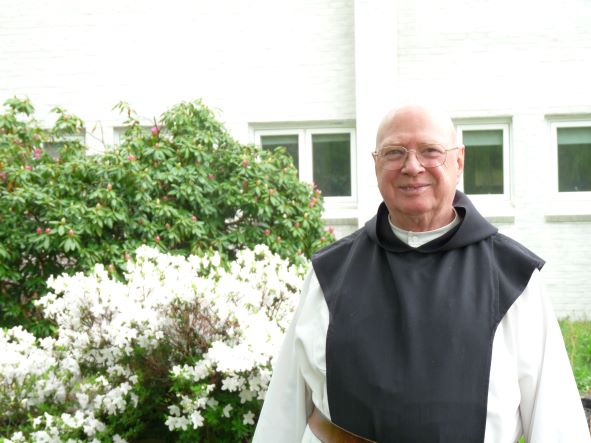
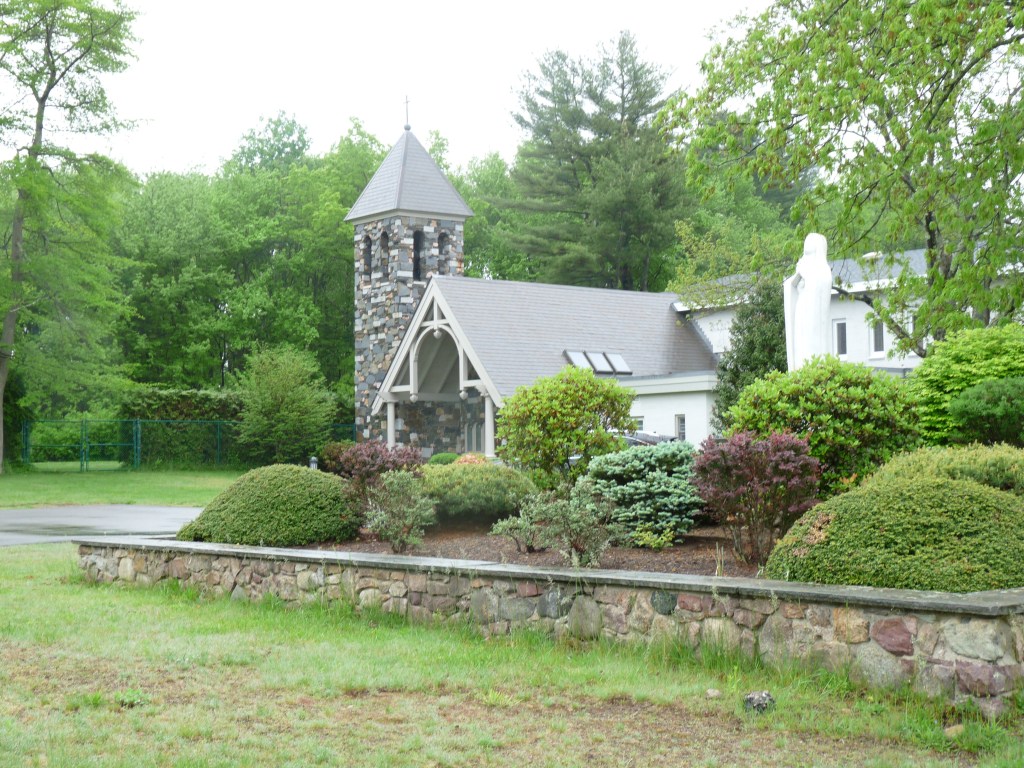
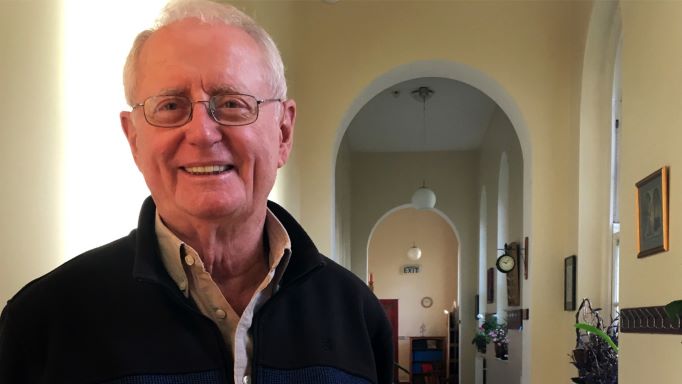
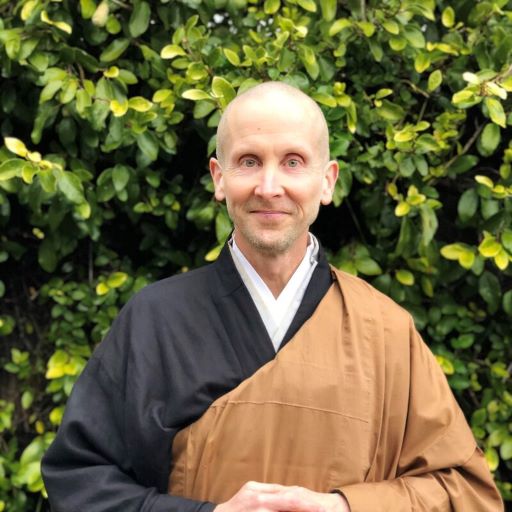
The work coordinator at Blue Cliff monastery at the time of my visit in 2014 was introduced to me both as Brother Phap Man and as Brother Fulfillment, the English translation of his name.I ask how he is normally addressed, and he tells me he is trying to retrain people to call him Brother Fulfillment. His birth name is Aaron Solomon. His father was Jewish, and his mother was Methodist, which was the primary religious influence in the household. “My Mom’s father was a preacher.”

When I ask what led him to the monastery, he says, “That question is always a question of looking back in time to see what the elements were. You know? But it’s nice. It’s good. I like looking back.” He has a tendency to speak in brief, staccato phrases. “One thing was I went to a pre-school run by Catholic nuns. So that might have had something to do with it.” He also laughs easily and often. “You never know. In fact, I was seriously considering becoming a Catholic monk until I found out how hard it was to enter the Catholic order.”

He had been a monastic for seven years when I met him. I asked if he still felt it was what he should be doing. He doesn’t answer immediately.

“It’s still very much what I want to do in my heart, but I gotta temper that with the fact that it’s quite difficult at times. Which is probably why I like it. I really want to continue. That’s my aspiration. I love so many things about this life. But it’s very challenging. It’s not that I’m questioning my aspiration. It’s still very strong. What’s different between now and when I was first in the monastery is that I’m not as naïve about what it means. I know that it’s not like you become a monk and then everything’s roses. That’s not how it works. It’s a path of transformation and practice. And, to be honest, you can do that as a monk or as a lay person. It’s about taking the time in your life to do that. What it takes is the self commitment to do that. So, I’m very much still there. And I’d love to say, ‘They’re going bury me in this tradition.’ That’s really what I want.”

He tells me that Blue Cliff is a happy place to be.

“But it’s a happy place not in a totally naïve sense. Which means it also has its suffering. But we recognize that. We try to practice in such a way that we can see there’s no happiness without suffering. And we have the tools transmitted to us to know what to do with suffering so that we can create peace. That sounds like advertising, but that’s our aspiration. That’s what we’re working with. For me, it’s embodying that in my daily life so it’s transmittable. If it’s not embodied, if it’s not alive in me, if it’s just a bunch of ideas, it’s useless. What really counts is that people come here, and they get in touch with it as I did when I showed up and said, ‘Wow! This is it. Okay. There’s something alive here.’

“But I have a more worldly view now because you gotta run a practice center. You’ve gotta deal with differences of opinion, conflict. You become an adult. You gotta grow up. You have responsibilities and stuff. So for me, the edge now is balancing the responsibility with the freedom of monastic life and the vows and the Zen tradition of nowhere to go, nothing to do. So, yeah, running this practice center, there’s challenges and difficulties. But I’ve found it to be extremely rewarding. And having the time and the people to learn about things with, things that are not every day things. I think that’s what I was always looking for in my life. Didn’t want to learn about math, although I love the idea of how things are put together. I wanted to know the ‘whys?’ So where do you go to school to learn about how to just live? How to deal with your emotions or relationships with people? Then I discovered, ‘Oh! There’s a career for that!’ And in the big sense too, like really waking up. Really getting to the bottom of it all. It’s a long path, and that’s plenty for a lifetime. Many lifetimes.

“So I think that my conviction was very strong when I entered the order. And I hold onto that as a vow. So it doesn’t really matter what happens between here and someday I have to pass away. There’s a thread here, or a rope, that I hold onto, and it can guide me through. This is just a journey. I don’t really consider changing course, but I made a commitment to myself that if I have clear insight and peace and calm, then I can make a decision. I learned that partly from our teacher [Thich Nhat Hanh], because he said at one point he had to leave the monastery because of the war. He had to do something to help. He couldn’t just stay hiding in the monastery, meditating. He had to go out and reach out and that brought him here, to the United States. But he said he didn’t think about it. It wasn’t an analytical decision. It was insight. And it was so clear. No question. So I’m not limiting myself. I just promised to do the decision making from clarity and insight. So I don’t know what will happen in the future.”

When I speak with Brother Phap Vu six years later, he tells me that Brother Fulfillment is still a monastic. Not all the people I met during that visit, however, remained there.

Cypress Trees in the Garden: 439-63                                                                                          

Other Links:

https://rickmdaniel.blogspot.com/2014/05/523-blue-cliff-monastery.html          

Blue Cliff Monastery

Robert Kennedy

When I was working in International Development with the YMCA, I used to subscribe to the National Catholic Reporter, in part because it had a leftist slant on the Catholic Church—my birth heritage—with which I was comfortable, but largely because it was one of the best sources I could find for hard news coverage of events in Latin America. It covered other stories of general interest to Catholics as well, of course.

I first learned of Father Robert Kennedy—a Dharma heir of Bernie Glassman—in an NCR article in which it was announced that Kennedy, a Jesuit priest as well as an authorized Zen teacher, had recently given transmission to a Trappist monk, Kevin Hunt [see photo]. If I remember the article correctly, Father Hunt, when asked what a Trappist Zen Master did, replied that he wasn’t sure but suspected he was going to find out.

Robert Kennedy maintains the Morning Star Zendo in Jersey City. At the time that I spoke with him, the Zendo was actually a one bedroom apartment in which a room had been set up as a meditation hall.

Kennedy had spent several years in Japan in the ’60s – was ordained a Catholic priest there – without having any interest in Zen at all. After he returned to complete his graduate studies in America in the early ’70s; however, while driving one day, he heard Alan Watts on the radio pointing out that “nothing in nature is symmetrical.” “I don’t know why that statement hit me with the strength that it did, but I had to stop the car and think. It was an extraordinary moment.”

He went back to his rooms, took a blanket off the bed, folded it to make a cushion, and began sitting. His Zen practice had begun. “Something in my spirit said I had to stop doing theology and turn to experience. Turn away from theory and learn from my own doing.”

Eventually he realized he needed to work with a formal teacher. He had a sabbatical in 1976 and went back to Japan—“not as a teacher this time, but as a pilgrim.” The Jesuit order, which was committed to understanding other cultures and faith systems, supported his desire to undertake Zen training and arranged for him to meet Yamada Koun Roshi, the teacher with whom Sister Elaine MacInnes had studied.

Father Kennedy remembers the first time he saw Yamada Roshi walk into the zendo. “I was sitting in the back, up against the back wall, and I remember he walked in to light the incense and to begin the day of sitting. I remember it vividly. Again, I cannot explain it. The very sight of him walking into the zendo was life changing.”

When the sabbatical year was up, Kennedy continued training in the United States – at Yamada Roshi’s suggestion – with Taizan Maezumi in Los Angeles. It was there that he met Glassman, and when Glassman received inka from Maezumi and returned to New York, Kennedy became his student. Glassman’s approach to Zen training was very different from that of Kennedy’s first two teachers. He had a strong sense of social responsibility. Kennedy described participating in Glassman’s street retreats among the homeless. “Glassman Roshi said that a lot of people like Zen because they like to sit in a zendo and be quiet and there’s a certain artistic flavor. The last time I saw him, a few weeks ago, he said to me, ‘Some people like Zen clubs were they can sit together with like-minded people.’ But he brought us out onto the street.”

After Glassman acknowledged Kennedy as a Dharma heir, Kennedy’s first inclination “was just to sit quietly by myself—you know—which is a good idea after you become a teacher if you sit quietly for about ten years.” He smiles. “Ripen a bit.” But Glassman immediately assigned him a student, a Catholic nun – Janet Richardson – whose training he was put in charge of. Then other students began to appear. At first they were Catholics, but eventually people from other—or no—traditions came as well.

He has now acknowledged several Dharma heirs of his own, including the Trappist Father Hunt. In the course of our correspondence I refer to the two of them as “Catholic Zen teachers,” and Kennedy corrects me. Rather, he says, he is a Zen Teacher who happens to be Catholic. “The phrase ‘Catholic Zen’ can imply we are mixing Zen and Catholicism into something new. Kevin and I strive to practice Zen as it is taught by our Zen teachers, but Catholics can pay attention too.”

Cypress Trees in the Garden: 134, 303-10, 318-19, 468, 469

Catholicism and Zen: 66, 148-55, 158, 162-64,172, 195

Zen Conversations: 12; 31-33; 107-08

Other links:

Morning Star Zendo

https://en.wikipedia.org/wiki/Robert_Kennedy_(Jesuit)

Kokyo Henkel

When I spoke with Kokyo Henkel in early April 2020, he was just retiring as the resident priest of the Santa Cruz Zen Center and preparing to undertake what was intended to be a three month retreat in the Crestone Mountains. With the covid crisis, it became longer.

Early Buddhism was less a faith tradition for the general population than it was a specialized way of life for people who chose to separate themselves from the world. Similar to the monastic tradition within Christianity, it was a life dedicated to meditation and study. Monasticism has never been a common way of life – and is, if anything, less so now – but it is a form of Buddhism in which Kokyo feels at home. 

He first encountered Buddhism while a student at Brown University in Providence, Rhode Island, where representatives from Seung Sahn’s Korean Zen temple led weekly meditation sessions on campus.

“College was kind of a busy and sometimes stressful life. And I remember the first times of sitting in meditation and feeling that access to that vast sense of peace and presence and simplicity. And walking home after the meditation and seeing the grounds of the campus so fresh and clear. I came onto it quite quickly.”

After graduation, he headed to California

“I’d heard of the San Francisco Zen Center. I didn’t know anybody who practiced there, but I had their magazine, The Wind Bell, which was floating around my dorm in college. And it was winter when I graduated, so that was a good excuse to go to California. I took the bus across, and when I got out to California, I started looking for practice places. I didn’t have any savings. I just had a backpack. So I was looking for places which would take me and I could work some for my stay.” He discovered that such places were rare.

“But one that said, ‘Yes. You can come right now’ was the City of Ten Thousand Buddhas, the Chinese Chan Temple in Ukiah. I had no idea what I was getting into. It’s a very traditional Chinese Buddhist monastery with maybe a couple hundred monks and nuns living there. And they were in the middle of their annual retreat, which is basically a Zen sesshin but for three weeks. They sat from 3:00 in the morning until midnight. I had never done any retreats or anything longer than a couple of periods, but they said I could come and do some work around the place and join the retreat. It was mid-way through, and I did the last ten days of this retreat with this wonderful kind of beginner’s mind. If I had known what it involved, I might not have gone. But it was wonderful.”

He tells me it “hooked” him “at a level deeper. But at the end of the retreat, they stopped all silent meditation. They went into their daily schedule, mostly ritual chanting, and, at that time, that was all a little bit foreign to me. I wanted to find a place to do a lot of silent sitting. So by the spring I found my way to Tassajara.”

Tassajara is the monastic training area in the Los Padres National Forest associated with the San Francisco Zen Center. “When I got there, that’s really where I felt like I had come home, and basically I just stayed there. And then there’s Green Gulch Farm, which is kind of a semi-monastic farm community up in the mountains. And so between those two temples, I basically spent the next twenty years.”

He had become head of practice at Tassajara by the time he was asked to move to Santa Cruz and work with the community there. “In some ways, I think, I never really fully stepped into that transition in a way that everybody could relate to. I have such a love for sesshins and retreats and deep Dharma study and so on. I definitely played that role, and that worked for many people. But others, I think, wanted someone more like the village priest and counsellor. Someone to hang out with like that. I could play that role a little bit, but it didn’t come quite as naturally to me.”

We talk a little about Zen practice during situations like the current pandemic.

“Being present I think is really key these days,” he tells me, “because we spin out about, ‘How long is this going on for?’ So to be present, and, of course, zazen is such a gift many people feel these days to keep that practice going. And I would even encourage people to use the opportunity of sheltering in place to do more retreat. Maybe people have more time than they usually do. They’re working less hours. I suppose some have a hard time finding a quiet place to sit if they’re home, if there’s others around working at home. But that’s part of my own thinking of going onto Crestone and to retreat at this time is like, ‘Well, nothing else is really happening.’ And it’s beneficial to others to not go out and interact, so it’s a natural retreat time. And of course all the teachings that apply to suffering in daily life are the same teachings that apply now in these days.”

Further Zen Conversations: 20-23; 73-74; 123.

Other links:

San Francisco Zen Center

Santa Cruz Zen Center

Diane Fitzgerald

Fifty years ago, Diane Fitzgerald marched in the “very first Earth Day parade in New York City. It was kind of a random occurrence that I happened to be there and joined in as a fourteen year old. That was the start.”

Diane is the founder and resident teacher of Zen DownEast in Pembroke, Maine. That makes it less than two hours from where I live in Island View, New Brunswick, but currently the border between Canada and the US is closed, and, while I would have liked to have been able to visit her, we had to make do with Skype instead. It had been suggested that I should speak to her about the EcoSattva program associated with community.

“The term is the combination of the words ‘ecology’ and ‘bodhisattva,’” she explains, “and it refers to a person who takes compassionate care of the Earth. Part of the practice is an acknowledgement of the importance of environmental ethics. Just like the Buddhist precepts guide our lives because we’re not perfectly realized human beings, so we also have a set of environmental ethics to guide our lives in this particular practice.”

Our conversation naturally turns to the significance of core Buddhist teachings in the current pandemic. It was a topic she had recently discussed with her community.

“The standard teachings in Eco-Dharma is first our practice is to meet reality as it is arising, not turning away. Another is studying the self so that we can learn what our engrained habit patterns are – our blind spots – and seeing the ways we construct the self, which helps us identify the many cognitive biases that we have and the psychological defences we develop individually and communally when we’re faced with a crisis of this magnitude. Another is the teaching of interdependence and non-separation. So at this time we’re very much aware of our bodies and how this tiny virus can invade and rearrange us to produce more of itself. So this teaching on interdependence and non-separation is very apparent from our experience of the virus. And the truth of impermanence. So our whole world seems upside down. We have this great sense of groundlessness, and we keep grasping and trying to find something of the old routines and the old normality. But there is a possibility that this provides an opportunity to recognize that the true reality of our existence is groundless. After all, at some point we will die. We often lead our lives without need to confront that, and this situation brings it front and center to us. So how can we find some freedom in that groundlessness that allow us to be more compassionate, more open, less afraid of uncertainty, less afraid of paradox.

“Something else I think is particular to Eco-Dharma is the practice of what Joanna Macy calls ‘Active Hope,’ where we don’t need to be optimists, but we do envision a goal or values that we adhere to. And our work is to commit ourselves to what we believe to be right and not be attached to what the outcomes may be. So it is in the practicing of what we believe to be right and true that we find our commitment flowering. In times like this, when everything is so unknown and unpredictable, how can we continue to practice Active Hope which is not Pollyannaish? It does not require optimism, it just requires a commitment to these values that we hold dear because of our practice. And it does reference the refuge that we take in sangha [community]. That is one of our vows, right? And how community, even though we’re practicing social distancing – as some people have said, it doesn’t have to be social-isolation – that we really do need each other, and we do need to be aware of the most vulnerable members of our community and the world. How does that taking refuge in sangha allow us to bring forward our natural compassion and empathy for the community that’s ours, the whole of Earth as our community?

“So we meet the reality of what is arising. We see how the conditions of the environment can contribute to viruses, to respiratory problems, to the transfer of disease from animals to human beings. How the work on forests is creating all kinds of ecological complications for us as our world continually expands and expands endlessly. And for us to be able to see the reality of that as well as being able to see the reality – without turning away – of what we, as humans, are doing in response.”

She adds that it is not only meditation centers whose programs have been on hold recently. Ecology conferences and seminars have also been suspended, and she wonders about the impact that will have.

“Right now none of the conferences are going on, none of the research is going on. And is that all going to come to a halt? It’s clearly going to impact the immediate future. So how do we turn what is a response to an immediate problem into how we respond to this longer term problem of the eco-crisis. So that’s what I mean about meeting reality as it is without turning away. The practice of doing that can be so beneficial to individuals and communities. And making clear the truth of interdependence. When we start to see that we are not in control, not totally independent, maybe that’s something too that we can encourage a greater reflection on in our Buddhist  communities. Not that we don’t already – but in this kind of ecological sense – and perhaps we can develop new ways of being in the economy, being in the market, that are more communal and less the case where I feel free to take what I want and exclude you whether you are here or somewhere else around the world.”

Zen Conversations: Pp. 123; 164-68.

Other Links:

Zen Downeast

Greater Boston Zen Center

Ken Tetsuzan Morgareidge

Ken Morgareidge is one of three teachers at the Zen Center of Denver. “There’s myself. There’s Karin Kempe and Peggy Sheean. We were all sanctioned on the same day by our teacher, Danan Henry Roshi, in 2010, as the co-directors of the Zen Center of Denver. So there’s no primary person. The three of us are sort of the Unholy Three.”

Our conversation took place during the social turmoil of the rancorous 2020 US election campaign, when Americans were dealing with both the corona virus and the exposure of blatant systemic racism in the country. Ken reflected on the value of Zen training in such circumstances.

“One of the paramitas” – virtues cultivated in Buddhism – “is Ksanti Paramita. The perfection of patience and forbearance. That’s one of the things that I think we can all work on in a very deep way. Nothing is ever going to happen as we would like it to happen. So one of the aspects of our practice is to deal with all the craziness that comes up, whether it’s something like this corona virus or political outcomes we’re not happy with or changes in the economy. All those kinds of things. So it’s not like this is a totally unique situation. It’s unique in that it’s happening to everybody all at once. That we all have stuff coming up in our lives that is sad, tragic, or irritating or infuriating. And our practice helps us to look at these things in a way where we’re not dragged around by them, where we don’t have to respond in a wildly emotional way. We can look at it and say, ‘Okay. That’s what it is. This is my karma in this moment. What do I do now?’ without going into recriminations or ‘If only this had happened; if only I’d done that’ – which is useless.”

Like everything else in Zen, however, the development of patience and forbearance is not something anyone else can do for one. The role of the teacher, Ken tells me, is that of a guide. “I tell my students, ‘You’re hiring a guide – that’s me – but the guide’s not going to carry you. You have to walk the trail yourself.’”

He also compares himself to a coach.

“I was in competitive fencing for many years, and I trained like a fiend for quite a period of time. And so when I went to my first sesshin in Rochester with Kapleau Roshi, it was very familiar – the type of intensity you have to put in in sesshin practice – and Kapleau was the coach. So I think of myself as a coach. When people come to me, they’re coming for coaching, for me to warn them about the pitfalls, help them out if they fall into one, to keep them on track, to encourage them as much as I can, and to admonish them when I need to. Just as a coach with his players, I can’t get out onto the field and play the game with them. And that’s tough. So many times you want to help them in ways you know you can’t. But I provide as much guidance as I can. And if they’re struggling with a koan, I’ll encourage them, but, of course, they have to solve the koan on their own. There’s only so much I can say. And that’s tough. But I tell them, ‘You have to do this yourself.’”

“What are you guiding them to?” I ask. “Where is the trail taking them? To what end”

“It’s taking them deeper into their practice. That’s all I can say.”

“Well, again – to what end is the practice?”

“To what end is the practice? The end of the practice is practice. If you look for an end – like enlightenment or some state of mind – you’re not going to get there. Because you’re already there. Your job as a practitioner is to be here in this moment. But you’re already here. The Buddha said all beings are enlightened from the very beginning. We just have to strip away the stuff – the accretions of many lifetimes – and see the truth of that and trust in it and then live out of it. That’s our job as a Bodhisattva practice. We’re not practicing for ourselves. At least not exclusively. We’re practicing for the world, and that’s one of the great challenges we’re faced with right now. How do we help each other and how do we help the world in a time of crisis. And everyone has to come up with their own answer. So if there’s any kind of a goal, it’s just to go deeper. Go deeper into myself. As a teacher, help the student go deeper into their own true nature – their own Buddha-nature – and find out what that is and then live from that.”

Tetsuzan left the Denver Center of Denver in 2020 and retired to the Iron Mountain Hermitage in Florence, Colorado, where he still meets with students.

Other Links:

Zen Center of Denver

https://en.wikipedia.org/wiki/Danan_Henry

Jay Rinsen Weik

Rinsen Weik – jazz guitarist, Aikido instructor, and abbot of the Buddhist Temple of Toledo – is  in what he calls his library. There is a stick of incense burning on the altar to the left of his desk. There is a figure of Manjushri (the Bodhisattva of Prajna/Wisdom) and another of Guanyin or Kannon (the Bodhisattva of Karuna/Compassion).

“No seated Buddha figure,” I note.

“No. I take care of that part,” he says, laughing. He is fun to talk with. He laughs frequently and has an irreverent sense of humor. “Words are great. I love them. I’m surrounded by them,” gesturing at the shelves, “but they won’t ever scratch the itch. So what has to happen is people have to first be able to see into the true nature of themselves – which means letting go of the linguistic processing of that and actually just experience it – and then we have to be able to communicate that to each other. It’s learning a language, like jazz; it’s learning how to speak and express this ineffable, unspeakable, what-the-fuck-it-is thing.”

I ask him what qualities of character long term Zen practitioners develop.

“Gumption, grit, determination to take their lives seriously and to take their suffering seriously. That’s a quality that starts to increase. And it can look differently for different people, but there’s a kind of steel in the spine that absolutely has to show up to be able to engage. So I notice a lot of that. People start to become much more self-aware. They’re much more aware of what their mind is doing and how they’re thinking, and they notice what they’re noticing. And they notice the effects of what they’re doing with their awareness and start to catch things that used to be on autopilot pretty much all the time.”

Later in the conversation, it becomes apparent that he see these as useful qualities in the current social-political climate. He tells me, for example, that he is concerned about “the abhorrent nature of our politics today. I find the lack of ability to have reasoned conversation really disconcerting. It’s not about an exchange of ideas and working something out, but it’s just pure demonization of the other. Now, interestingly, not everybody in the sangha here is of the same political view. I’m not in California or Boston where I would assume everyone in the room is a pretty liberal leaning person. Most are. Not all. And so that is something that’s interesting for us to navigate. How do we make our community a place that feels welcoming to everybody, like, for real. ’Cause, you know, I’m in Ohio. It’s a swing-state.” And, as it happens, a state that voted for Trump.

We’ve both been conversations where people have wondered whether one can hold conservative social values and still be a Buddhist.

“My response,” Rinsen says, “is that there’s a healthy and an unhealthy version of the baseline intelligence of both poles of our political system. So there’s a healthy version of liberal, and there’s actually an unhealthy version of liberal. That’s possible. That can be. In the same way, there’s definitely an unhealthy version of the conservative. There is also a healthy version of it. I think that’s possible too. How those might interface with each other is a complicated conversation. But if I made it really, really simple – which is always kind of a mistake – basically the liberal tends to look at systems, and the conservative tends to look at individual responsibility. The conservative folk that I serve, they’re very attuned to people taking responsibility for themselves. The unhealthy version of that, of course, is, ‘I’ve got mine. Screw you.’ The healthy version of it, though, is true. You have to sit your own period of zazen. No one can do that for you. That’s technically a conservative point of view. Now the healthy version of the liberal view is that, look, the system has to be set up in a way that everybody gets a fair chance. If the system is designed to suppress people, we need to fix the system. And that’s completely the case. Redlining – you know – is a thing. In fact, where the temple now is is on the other side of what used to be the redline where black people couldn’t get a mortgage over there but over here they could. So systems being unhealthy can definitely be the case. But you can get so enmeshed in the idea that it’s always the system and it’s never the person’s responsibility. That can get a little pathological too. So what I do when I’m in those kinds of situations or conversations, I always try to say what’s the healthy and unhealthy version of both poles, because what everybody will do is take the healthy version of theirs against the unhealthy version of the opposite. And they make it even worse and make themselves even better. And then, even if you have a healthy side, what’s the shadow side of your healthy version? ’Cause there always is one. If somebody can’t acknowledge that, they’re gonna demonize the other. So I think Zen is very good at getting the mind unhooked from those locked places.”

The Story of Zen: 377-82, 427, 430, 435

Zen Conversations: 51-52; 80-83; 111-15; 132-34

Other Links:

https://jayrinsenweik.com/

Buddhist Temple of Toledo

Albert Low

Albert Low, the Director of the Montreal Zen Center, died in 2016 at the age of 87. In 2013, I had arranged to interview him and four of his students for Cypress Trees in the Garden; however, three of the chapters, including the one on Albert, were omitted to keep the book under 500 pages. It was a decision I regret. Albert’s life was worth commemorating, and I owe him a debt of gratitude. Although I was introduced to sitting practice by a Jesuit with whom I worked in the Dominican Republic, Albert was my first formal Zen teacher, and he wrote the foreword to my first book, Zen Masters of China.

In 1975, Philip Kapleau’s Rochester Zen Center established a practice center in Montreal. Half a duplex was rented in the anglophone neighborhood of Notre-Dame-de-Grace on the city’s north side. It was a turbulent time in Quebec politics. The separatist Parti Quebecois had a majority government and were preparing a referendum on independence from Canada. The head of practice at the Zen Center was anxious about the looming vote and moved out of the province. So it was perhaps counter-intuitive that Kapleau sent an English immigrant with a very British accent to Montreal to replace him.

When I arranged the interviews in 2013, one of Albert’s senior students, Monique, wrote to make sure I realized just how remarkable his achievements at the predominantly francophone center had been:

“He has to deal in French and/or English in his daily encounters with people and in his dokusans. I would think it is certainly a feat in itself that he has been able to establish an harmonious bilingual sangha and succeeded in maintaining it without conflict throughout the years, given the strong nationalist tendency in Québec. I do think it is a proof of the power of his dedication and compassion. It acts as a magnet on people. It also demonstrates his capacity to meet challenges, for it certainly must not have been always easy for him.”

My interview with Albert took place in the ground floor parlor of the Center. Over the fire place, there was a reproduction of The Solitary Angler by the 13th century Chinese painter, Ma Yuan. Albert had a warm, welcoming manner and an elfin twinkle in his eye when he smiled. He did not claim the title “roshi.” Most of his students referred to him by his given name; those who wanted something more formal called him Mr. Low.

He had been born to a working class family and grew up in a low-income London neighborhood. “I was ten years of age when the war broke out. I was sixteen and a half when it ended. And I went through the blitz and the doodle-bugs and V-2.”

I was unfamiliar with the term “doodle-bug.”

“They were the pilotless planes, or pilotless flying bombs. They sounded something like a two-stroke motorbike as they went over, and, when they cut out, you made a dive for it. I was in the dockland area of London, and that took a particularly heavy hit. There was very little of it left by the time the war came to an end. And I remember asking, ‘Why do they want to kill me?’ It gets very personal when you’re that young and that intense. And that’s what stuck with me. There was this question, ‘What’s going on here? What’s it about?’

“Then after the war, I think it was Churchill decided we must know why we engaged in the war. And the films of the concentration camps, when the allies liberated the concentration camps, were shown at local cinemas. You can imagine. You’d just seen some Hollywood razzmatazz, and then, without any warning, these things are projected on the screen. It was absolutely horrific. I can’t tell you how I felt when I left the cinema. I was absolutely stunned.”

“How old were you?”

“I was about 18; it was just before I joined up. And it took me years, really, to even be able to ask the question. But I think that started me off on questioning. In any case, after the war—I’d been in the navy—I started becoming very, very anxious about everything.”

He had also had a number of experiences which suggested there was another dimension to life. While lying on the grass in a park as a 17 year old, for example, he had the passing sense that he was more than just his physical body. Elsewhere he described that it felt as though “I were the space and that everything was made of space. The trees, the grass, the sky were all of one substance, and that substance was, in some way, me.”

“After the war, I was fortunate enough to have a GP, Dr. Nothman—he was a Polish fellow—and he was quite a philosopher,” he said chuckling. “And he ran a small group of young people. And we used to get together quite regularly, and he introduced us to all kinds of philosophy. I didn’t even know the word ‘philosophy’ existed then; ‘psychology’ was a new word. And gradually he introduced various things. And then his wife got hold of a book by Ouspensky, In Search of the Miraculous, and she recommended it very highly. And by luck—I don’t know how it was ever possible—I found it in the local library. And that transformed my life. That was a real eye-opener, that there were such possibilities in the world. Ouspensky was a student of Gurdjieff, and Gurdjieff was a man, I think, who opened me up more than anybody else.

“Gurdjieff’s main theme was ‘intentional suffering and conscious labor.’ He also pointed out that we’re asleep; that we have potentials that we don’t realize. And it was really the duty of a true human being to open ourselves to these possibilities. He was a very remarkable man, and he travelled a great deal, India and Egypt and so on. And he was looking for various ways that we can open ourselves to our true potential. And he managed to condense that into a very intense kind of understanding. And, of course, practice as well; he had various practices, although I couldn’t do these. But he also emphasized the necessity of what he called ‘remembering yourself.’ And it is interesting because Dogen says we must forget ourselves, and both are saying the same thing. And that became something like, you might say, an aim in my life—to be present, to remember myself—and it all developed from there.”

The group examined another system of thought popular at the time which led to what Albert calls a “rather a dismal part of my life. But anyway, what the group was about, really, wasn’t simply philosophy—Dr. Nothman was looking for some way by which he could help people at a psychological level. He wasn’t satisfied with Freudian theory. And he did take up hypnosis, and we were engaged in hypnosis for a while.” Then they came upon a book about human development popular at the time. “And I must say it was very plausible. It was plausible for him as well. There was a number of people that were interested in it. And we started doing something, really, similar to Carl Rogers’ non-directive therapy.”

Albert was recently married, and he and his bride, Jean, forsook their honeymoon to take part in a nine month evening course on the program. “And then after the nine months, I thought, ‘Right. This seems to be something I should get interested in.’ So I gave up my job and became one of its teachers and went to South Africa on that basis. I built up a center in South Africa.”

But as he became more familiar with the program, he found many of its claims questionable which put him in an ethical dilemma. Although the teaching was lucrative, he could not continue to present it to people who sought and needed real solutions for the problems they faced in life.

So Albert, Jean, and a couple of friends began a new quest for an effective spiritual path. They experimented with forms of yoga, dervish whirling, and automatic writing. He returned to his study of Gurdjieff and what that teacher called “The Work”—the effort needed to see reality as it is, independent of the distortions of one’s subjective perspective.

Another writer Albert came upon during this period was the French psychotherapist, Hubert Benoit, whose The Supreme Doctrine: Psychological Studies in Zen Thought dealt with themes similar to those found in Gurdjieff. Benoit’s book introduced the Lows to Zen, and echoes of both Benoit and Gurdjieff are found in Albert’s later writing and teaching.

They remained in South Africa, although he needed to find other employment.    

“I had a difficult time to start with. I started to sell tiles and roofing, and that’s the last job I should ever have had. I made an absolute balls-up of it. Then I went to the country; I went to a ranch, and stayed there for a year. And then I came back. I had a degree by then—because I was studying for a Bachelor’s Degree extramurally—and I got a job as a personnel officer in a very large company, the biggest book, paper distributing company in South Africa and rose fairly rapidly.”

The political situation in South Africa at the time, however, was deteriorating. “In 1961 there was the Sharpeville Incident in which authorities shot about 70 black people—they were demonstrating perfectly peacefully—and wounded hundreds of others. That was when Jean and I started thinking, ‘Can we stay here?’ We were always uncomfortable with the way it was there. And then there were the treason trials with Nelson Mandela.

“Anyway, by that time I was the senior personnel manager in this company, and they were going to send me either to Harvard or to the Glacier Institute of Management for extra training. And I realized if I took that, I couldn’t very well leave. I mean, I was fixed. So Jean and I sweated that one out. And I said, ‘I know. We’ll go to Canada.’ And that was it.”

They chose Canada because a friend had moved there before them. “Hilda was very close, sort of a grandmother to the children. She was a bit older than us, and we related well.”

He found work with the Union Gas Company in Chatham, a town a little less than 200 miles southwest of Toronto where Hilda operated a shop. He and Jean had continued their reading, and they came upon Philip Kapleau’s The Three Pillars of Zen. “And then, I don’t know whether you call them accidents, coincidences, whatever occurred. Hilda came to see us one day and said, ‘You know, there’s a fellow came into the shop the other day, and he was talking about a guy called Yasutani, apparently he’s from Japan . . .’ You know, yackety-yak. And Jean said, ‘Well, look, we just read a book about that man.’ So I said to Hildo—because I was in a job already, and I couldn’t leave it very well—I said to her, ‘Why don’t you go to New York and see if you can get on one of these courses that he’s giving?’ Sesshins, really. So she phoned and tried to get on, but they told her it was full. Then later they said, ‘We’ve got a cancellation.’  So she phoned me and said, ‘Look, I’m going there.’ So I said, ‘Okay, when you meet him, ask him if he’ll come up to Canada, and I’ll set up a group for him.’ I didn’t know who the hell it was going to be, but there it was. So anyway, she did, and Yasutani agreed. So between us we managed to conjure up eleven people, and we hired a hunting-shooting lodge about fifty miles north of Toronto, and that’s where we met Yasutani.”

Albert found Yasutani dynamic and felt an immediate connection with what he recognized as an authentic spiritual tradition. The gathering in Ontario was essentially an extended workshop, but, when it was over, Yasutani announced “that he was going to give a course, a sesshin, a five day sesshin, at a place called Painted Post. It was a country club, actually, in Rochester, New York. So we tried to get on. I phoned Kapleau, and he said, ‘It’s full. We can’t provide a bed and food for you.’ Well, we said, ‘Don’t mind about the bed and food. We’ll provide the food and sleep on the floor. He said, ‘Well, with enthusiasm like that, I can’t very well refuse, can I?’ So we did the five-day sesshin.”

This began Albert’s twenty-year relationship with Philip Kapleau and the Rochester Zen Center. He was driven in his practice by personal distress and an anxiety about death which had remained with him since his youth. He describes his condition in an article first published in the Rochester newsletter and then reprinted (pseudonymously attributed to “Roger”) among the enlightenment accounts included in Kapleau’s second book, Zen: Merging of East and West.

“I was saturated by terrible anxiety and psychological numbness. I was terrified of being alone. On one occasion I was so sure that I was going to die that I stopped the car and got out so that I would not die unattended. As it happened, the shock of the cold air when getting out of the car braced me and brought me back to my senses.”

Kapleau encouraged Albert to view these anxieties for what they were, illusions, and to use the energy they generated to bolster his practice. Simultaneously, the exigencies of work prodded his effort as well. “The very mundaneness, the inconsequential problems, the battles and disagreements were spurs to continue my practice. The constant humiliations that were suffered through my trying to introduce new ideas were very powerful ego abrasives.”

His struggles were rewarded during the 1974 Rohatsu sesshin when he achieved a kensho experience that redirected his life. “After this, I was really gung-ho. And again Jean and I sat down, and I said, ‘I think I really ought to get more involved in this. I’d like to get other people, help other people along the line.’ So we decided to move to Rochester.”

In 1976, he resigned his position at Union Gas, and for the next three years he and Jean took part in the residential program at Rochester. It was not an easy transition. To begin with, they were generally fifteen to twenty years older than the other residents. “It was difficult, you know. We didn’t fit in. We were neither fish nor fowl.”

Perhaps because they were more mature, the Lows were uncomfortable with the competitiveness that many students brought to practice. They also recognized that some of the structures established at Rochester—which younger members accepted without question—were unnecessary, and they were suspect of the severity of the forms Kapleau retained from his training in Japan. By 1979, Rochester had lost some of its appeal. Albert spoke to Kapleau about his feelings, and that was when Kapleau asked if he’d like to go to Montreal. “I had been to Montreal on business several times, and I’d also been here, with him, when he ran a workshop. And I really liked it—I was a bit of a Francophile—and I said, ‘Yeah, I’d like to go there.’ So, anyway, that’s how I came.”

He was originally posted there not as a teacher but as head of practice, although there was not much of a practice save for evening zazen. If the members were not particularly active, they were slavishly loyal to the models established in Rochester. Even the color of the walls was the same. Albert made changes slowly and—because he was still under supervision—had to seek approval from Kapleau for each suggestion he brought forth. It wasn’t until Kapleau authorized him to teach in 1986 that he had a free hand in organizing things as he saw fit.

He scheduled monthly sesshin and held introductory workshops not only in Montreal but elsewhere in Quebec and Eastern Ontario. Membership grew, and it became clear that that the duplex in NDG was too small to meet the needs of the expanding community.

Albert and Jean spent days walking about the city looking for prospective sites to relocate the center. One day, they went for a picnic lunch in a long, narrow park running alongside the Rivière des Prairies in the Ahuntsic-Cartierville neighbourhood. Across the street from the park, there was a large three-storey turreted house with extensive grounds for sale. It seemed unrealistic to believe they could afford it, but they made inquiries and, on the off-chance that the vendor might be eager to sell, made a low offer. Eventually they negotiated a sale price of $155,000 (roughly the equivalent of $556,000 today) which was still more than the sangha could afford. But $55,000 was raised from various sources—the Lows themselves contributed $15,000—and they assumed a mortgage of $100,000 at 12% interest.

Extensive remodelling was required; Albert described the interior of the main house as more suitable to a brothel than a Zen Center. Further renovations were needed to transform a separate structure on the property—a small building which had previously been a schoolhouse and then an auto mechanic’s garage—into a meditation hall. The zendo proper was established on the second floor with raised tans and seating for twenty-eight.

The rooms of the main house were rented to center members. “We had to do that because there was no way we could pay the mortgage,” Albert explained.

The Lows lived on the third floor and eight residents rented spaces on the first two floors. Although it was a residence, rather than a monastery, there were a few stipulations prospective tenants had to agree to before being accepted.

“If they were residents here, they had to practice in the morning, they had to practice in the evening, they had to attend as many sesshins as I could let them on. That was the condition. And we had to eat together, because that was the only way it would work. We couldn’t have everyone cooking separately, so we had communal cooking. That sort of thing. So there was a degree of community.”

One of the senior students I interviewed, Roch, had been one of those early residents. Like Monique and the other two students I spoke to, his mother tongue is French, and, from time to time, he had to discuss with others the best way to express something in English. The five of us met in what is called the Lower Zendo, a large open room on the ground floor of the former school and garage. There was an altar to Kannon at one end with a bowl of three Granny Smith apples as an offering and a vase of freshly cut flowers. In the stairwell leading up to the zendo proper, there was a large circular sawmill blade suspended by a rope. It served as the zendo’s gong and had a surprisingly sonorous tone.

“I was living in the bush, on my own, because I was in really deep pain. So, I locked myself in an old farm house, and I couldn’t tolerate people anymore, so I just isolated myself.” He was 23 years old at the time. “My brother was travelling on the west coast, on his bike, and when he came back, at Christmas time, he had a book, The Three Pillars of Zen, and he handed it to me. He said, ‘That’s for you. You need that.’ And I had never read something so sharp. Straight to the point!”

When, after ten months, Roch came back to the city, he saw a poster at a bookstore.

“It said: ‘Zen workshop in Montreal. Albert Low.’ And I called, and I came to that workshop, September ’81. And I felt, ‘Well, I’m gonna come back here.’ And then I left, went back home in Gatineau, and, a few days after, I said, ‘Well, I’m going to write to him.’ But I didn’t know what to say. I just wanted a contact. I was writing poetry at that time, and I said, ‘Well, I’m going to send him a few poems. Just to have contact.’ And he wrote to me, ‘Dear Roch. Don’t try to fill up the hole that can’t be filled.’ And I cried. That’s it. Like I say, I was in deep pain. Deep pain. But you don’t know why. It’s just . . . You stop breathing.”

The other three nodded their heads in assent.

“So I left Gatineau, and I spent two months in a small apartment in Montreal, and I was taking my bike every morning to come to the morning sitting at the Zen Center. And Albert told me one day, ‘Why don’t you live here? You won’t have to make that ride every day.’ He said, ‘There’s a room free. Would you like to come in?’ I said, ‘Yes.’ And I think it was like that for most of the people who came.”

He lived in residence for 1982 and ’83. “ We shared evening meals and breakfast. There was sitting every morning, weekdays. Sunday mornings, we had a longer period. There were no official rules, just being quiet and behave properly. If I had to try to sit on my own at home, I don’t think I would have done it. But when the bell rang in the morning, well you just put your robe on and get in the zendo. And, of course, living here you meet other people. And what was interesting was meeting people that you lived with at a Zen Center and going to a restaurant with them, going for a bike ride. I used to go to the pool with Albert. That was important, too. I knew Albert as a man before a teacher, and that was really important. Albert, for me, is an ordinary man. Then he became a teacher when we would go to dokusan. But I met him drinking tea, swimming in the pool, mowing the lawn. That was very important for my practice.”

The residential program eventually came to an end, allowing the Lows to move into more spacious quarters on the second floor.

Monique first heard Albert on the radio. “One afternoon I turned on the radio, and I heard him in the middle of a sentence. I did not know who was speaking but I heard him say: ‘You cannot have what you are.’ And I realized that he was speaking about happiness. That struck me. ‘You cannot have happiness; you are happiness.’ I was instantly attracted. Not only by what he said but also by the quality of his voice. This was not the kind of voice we hear in the media in general. It was the voice of someone who does not try to sell something to you. The voice of someone who does not force anything. 

“So listening more, I learned there was a Zen Center in Montreal, and that he was the master of that Center. At that time, I knew about Zen having read a few books, but somehow it had stayed at an intellectual level.” She paused, then corrected herself. “No. It was more than that. I had been deeply interested by the way of Zen for years, but until that afternoon, I had never been able to muster my determination to actually start the practice. I was waiting for something to happen that would push me, make me plunge into the water so to speak. So hearing Albert on the radio that afternoon was decisive for me. I phoned the Zen Center, and it was Jean who answered, and I didn’t even know what kind of question to ask. I said, ‘Well, so you’re practising Zen there?’ She said, ‘Yes.’ ‘So, I would like to come.’ So she said, ‘Okay, there’s a workshop.’ And I went. And that’s it. At the very moment I entered into the zendo for the workshop I knew in my guts that I had found the place. And when Albert came into the room and started to speak, it was clear for me, without any doubt, that he was someone I could trust.  This trust has gone deeper and deeper over the years.  I feel very grateful for that.”

Since the four of them are francophone, I raised the issue of language.

“We have a bi-lingual community here,” Monique told me. “But some people come from Ontario or other parts of Canada or from USA and don’t speak French. A few, from Montreal or Quebec don’t speak English. So the remarkable thing is that it does not prevent us to work together. But that does not mean that it is not a challenge. It is. For some, given the history of Quebec and the nationalist movement here, it can become a problem. Albert is very aware. He has a keen understanding of the situation here. So if someone begins to resent the fact of ‘too much English speaking,’ he can help this person to work with this problem, to see that this particular problem is also part of his practice. It is not something outside of the practice. Everything is ‘grist for the mill’ as he says often.”

The board president, Roger, adds: “You’re not a definition of a Quebecois or an Ontario person or whatever. This is what makes you suffer. This is what makes you say, ‘I’m this instead of that. And, unfortunately, everybody is looking at that, and I’m this. How come I don’t get that?’ This is the source, very fundamental, of how human beings massacre each other. It is the same with language and religion. Because religion is how we define ourself. Language is also how we define ourself. But that’s not who we truly are.”

The language difference between us, however, did give me the sense, at times, that they struggled to feel confident I understood what they are trying to express about Albert:

“There’s something to say about the teaching of Albert,” Monique insisted. She has a forceful way of putting things. “He is teaching an authentic Zen.  I would say he is teaching a radical Zen. I mean the Zen of the ancient Chinese Zen masters. And Zen is not a psychotherapy. The Zen he teaches is not a psychology and, also, is not a morality. Which, of course, does not mean that he shrugs off morality. Far from it. But when I say he teaches an authentic and radical Zen, I mean he teaches the Zen of Rinzai and Hakuin. ‘You have to penetrate completely the Great Affair,’ like Hakuin said. ‘It is a matter of life and death.’ Many people come to a Zen Center thinking or wishing that meditation will enhance their personality, make it better, more lovable; they want to be a good person and be loved as a good person. Albert repeatedly tells us: ‘There is nothing here for the personality.’  And he says also, ‘Don’t come here to practice Zen.’ It means, among many meanings, don’t come here to make or to gain some personal benefit from your practice. You are not here to gain a medal because you have, you know, passed your first koan. You’re here because you suffer and you want to go to the root of suffering. And that’s the Zen that he teaches here. We have to go to the root of our suffering. In that way, our whole life is our practice.” 

“Well, yeah,” Roger added, “From the beginning you’re a Buddha. So, what more do you want?”

“So this is a demanding Zen,” Monique continued. “It does not give comfort. It’s not a Zen that makes you feel that you . . . you’re . . .” She returned to French and looked to the others for assistance.

“That you’re succeeding,” Louis, the most soft-spoken of the four, said. The other agreed, laughing gently.

“Some people look for something that’s entertaining,” Roger said. “The way things are done, using Japanese and Chinese and so on and all the big words and all the big chants and so on, and you wear beautiful clothing and so on. A lot of people are looking in that direction. They’re totally lost as to who they really are, but that’s what they’re looking for. The exotic.”

“Yes,” Louis agreed. “At the Center here, it is really focused and oriented on the practice. It exists for practice.”

In the parlor with the reproduction of the solitary fisherman floating in an empty sea, I asked, “What is the function of Zen?”

Albert replied without hesitation. “Oh, there’s no function of Zen.”

“So why do people come here?”

“Because they think there is a function of Zen.”

“And they discover?”

“There is no function of Zen. If they work long enough.”

The Story of Zen: 372

Zen Conversations: 49; 70; 87; 123

Zenshin Michael Haederle

Zen communities – sanghas – come in many forms. There are residential monastic communities such as Shugen Arnold’s Zen Mountain Monastery. There are groups who work with resident teachers in cities and towns, like Paul Cooper’s community in Honesdale, or in isolated areas like Mitra Bishop’s Mountain Gate. And then there are groups of individuals who come together regularly without a resident teacher as such, usually hosted by a long-term practitioner who functions more as a facilitator than a instructor. I host such a group in my town, and Zenshin Michael Haederle hosts a similar group in Albuquerque. We both struggle with what our role is. In Zenshin’s case there’s also the fact that he’s a “lay monk.”

“Yeah, it’s weird terminology,” he admits. “Some people have pointed out that none of the Zen clergy in Japan really qualify as Buddhist monks, because they can be married, and they don’t take most of the monastic precepts that are embedded in classical Buddhism. A better term in English might be ‘priests’ or ‘ministers.’”

“Is that how you see yourself? As a minister?”

“Maybe. In the sense that, yes, I’m leading a Zen sitting group and provide some guidance there, although I certainly don’t consider myself a teacher. To me it’s just a commitment to make the Dharma available for people.”

“How is ‘making the Dharma available for people’ not teaching?”

“I suppose it’s the personal connotation I attach to it, but a ‘teacher‘ implies sort of a hierarchical relationship. I relate to the Sanskrit term kalyanamitra, which means ‘spiritual friend.’ I like the image. It’s more horizontal.”

The current social environment in the United States – the pandemic, increased racial tensions, the looming election – is challenging. I ask if he sees evidence that Zen practitioners are in any way better equipped to deal with these circumstances than non-practitioners.

“One of the things that I really appreciate about Zen practice is it’s all-encompassing.  It’s kind of a tool, if you want to think about it that way, that’s applicable to anything we encounter in life: aging, sickness, death – all the traditional things. It also applies to what’s going on in our society. It’s obviously not about nihilism or zoning out or shrugging your shoulders and saying, ‘Whatever,’ but it is about meeting whatever’s going on with clarity and equanimity so that your response is going to be appropriate to the circumstances. So not leading with an opinion or a mental freaking-out session, but having a fuller appreciation of the context of the situation you’re actually in – this moment and not all the other moments in your imagination. Obviously that’s a challenge, but that’s the aspiration. It’s not that anybody can do that freely all the time or anything, but it’s a great place to start, because it’s so easy for our emotions to take front and center, our emotional response to bullying and injustice, the crazy disregard for objective truth and facts and things like that. I mean, it’s all really disheartening. But then just working with that, working with our own anger or despair or all the other related emotions. Those are real, in their way. It’s a matter of meeting these circumstances in a way where we don’t go out to the gun stores and get our own arsenal to match the arsenal on the other side or something like that. We want to get outside of that mindset, that paranoic conflict, I think that’s really important.”

One of the benefits of long term practice is that one can become “more alert to our mood states — to whatever is coming up in the moment. You realize you can do something about that. You can take a look at this whole personality complex that seems to be having this problem — this whole neurotic story-telling thing — and more or less see through that pretty quickly. Not wanting to sound boastful or anything, but where years ago I might have been hung-up for days, weeks or months on some kind of conflict or afflictive emotion – because I was pretty neurotic – now it’s hours or its minutes. Literally, the drama really loses its attraction.” He chuckles. “I can see that going through the ruminative or obsessional thought thing is just a waste of time. ”

One ceases to identify with the feelings as they arise, I suggest.

“Absolutely. Because fundamentally there’s no one there to identify. Identity becomes a highly suspect concept. Yeah, the emotions come up; it’s not like suppressing or repressing anything. It’s just allowing it all to be there and allowing it to go away and not fighting with it.”

The practice helps people “get into this place of openness that is waiting for us, that is always here.”

“What prevents people from sensing it if it’s ‘always here’?” I ask.

“Conditioning. Socialization. The way that we’re all conditioned to think about the world. I think evolution obviously equipped us with this ability to construct an imaginary self that seems to function in the future that has enabled us to do very complicated things. There’s an adaptive side to that, obviously. We wouldn’t be this way if there wasn’t a good reason for it — that’s what evolution more or less says. But it comes with a price. Because it’s an illusion. It’s a construct. It’s like an avatar on your computer screen. There’s not really a little version of you on the computer screen, although you can use it that way for useful purposes. There’s no separate self that actually time travels to the past or future. Coming back to this primary experience in this moment, it’s always right here. It’s only ever now when you’re thinking about the past or the future. That’s happening now. The brain is now. Of course ‘now’ is an idea too. It’s ineffable when you really let go of all the ideas of these things, but the experience remains. Right? But is there an experiencer?” he adds with a laugh.

Further Zen Conversations: 95-98.

Other links:

Michael Haederle

David Loy

David Loy is a Dharma heir of Yamada Koun in the Sanbo Zen tradition. “According to Zen,” he tells me, “we are not fully awake. There is something we need to realize about ourselves and about the world, and the path is to help us wake up.”

I ask what that “something” is.

“There’s a lot of ways to answer that, but for me what stands out is non-duality or non-separation: overcoming the delusion that there’s a me inside that is somehow separate from you and the rest of the world outside, and that therefore my well-being is separate from yours and others’ well-being. The delusion of self. Kensho – ‘opening’ as some people prefer now – is a letting go of that and realizing or experiencing the world at least momentarily in a non-dual way. So that is what I’d say we need to wake up to. And then to integrate the implications of that into how we live.”

David is a co-founder of the Rocky Mountain Ecodharma Retreat Center where he and Johann Robbins – of the Insight Meditation tradition – offer ten day “ecodharma retreats.”

“Which is mostly meditation – we’re usually outside, somewhere on our 185 acres, or nearby – but it’s partly workshop as well. To some degree we model ourselves upon Joanna Macy’s ‘Work That Reconnects,’ helping people get in touch with their gratitude but also their grief about the global ecological situation, since many of us are closed down emotionally because we can’t cope with our grief. We’re afraid of it, because we don’t know what we can do personally to make a difference. Our approach is we’ve got to get in touch with our grief, to start to face it and work it through together, in which case it can empower us to respond more directly to what’s going on.”

It’s not, he stresses, a Zen retreat as such. “There’s a different kind of meditation we encourage that is more sensory-based, in the sense of not going into your head and reciting Mu or working on a koan, but opening up to the natural world. That’s number one. Number two we encourage gratitude practice. Feeling gratitude, with the realization that gratitude isn’t just something we feel or don’t feel, it’s a practice we cultivate. As Brother Steindl-Rast said, we’re not grateful because we’re happy; we’re happy because we’re grateful.”

For part of the retreat, participants go off by themselves. “Everyone goes off on a solo, with their tent and sleeping bag. People pick their location, and they’re there by themselves for two days and two nights. During that time, we encourage them not to have an agenda but to continue to be open to what’s happening. To notice, what does the land, what do the trees and the meadows and the large and small animals have to offer?”

It reminds me of Bernie Glassman’s Bearing Witness retreats, in which he had said it was not he but the street or Auschwitz which was the teacher.

“That’s our sense too, that the beautiful, unspoiled land where we practice is the real teacher. The whole point of our schedule and program is to enable and maximize that process. But let me make a couple of distinctions here. Bernie was wonderful in the ways he focused on social justice. And that’s a huge question, all the more so today. What’s the relation between ecodharma – which focuses on the ecological crisis – and social oppression such as racism? But whereas Bernie focused on how humans relate with and often oppress other humans, our focus has been on how humans relate to and exploit the rest of the natural world. I’m very concerned to integrate social justice issues into ecological issues, but not to the extent that we ignore the problem of what might be called species-ism. Trees don’t vote, don’t march or protest. Right? The whole point of ecodharma, as I understand it, is realizing that we need to expand the moral sphere of responsibility beyond human beings to the rest of the natural world, not only animals but forests and lakes and ecosystems. That’s a little different from what Bernie was focusing on although I think it fits in quite well.”

I ask about similar work in Asia, and he mentions a group called the “International Network of Engaged Buddhists” based in Bangkok. “It is a pan-Asian organization that works with a lot of different engaged Buddhists, but it’s a minority development, not part of the main institutions.”

“Engaged Buddhism,” I note, “is a phrase that Thich Nhat Hanh coined, and one of the things that he advises his followers to contemplate is that the human species isn’t immune to extinction. We aren’t, as a species, going to last forever.”

“Today I think a growing number of us have that sense. There is an interesting parallel with awareness of own individual mortality. Buddhist practice helps us get in touch with our own impermanence, our own insubstantiality. That’s an important part of it. And part of the challenge of ecodharma, I believe, is that it raises similar questions about the fate of the human species and certainly modern civilization as we know it today.”

I ask what he hopes for people participating in the retreats.

“First, to come to feel a deeper connection with the natural world. And gratitude will normally follow naturally from that. I would also hope that they are able to get in touch with their own grief about what’s happening to the natural world.  It’s not that we work through that grief once and for all, but it’s something that shouldn’t be denied when it arises. Painful though it is, opening to our grief is necessary for the transformation – the kind of enlightenment – that we need today. But my most important hope would be that those who undertake this process be empowered and motivated to become ecologically and socially engaged.”

Zen Conversations: 34-36; 50-51; 118-19; 124-26; 155-58

Other links:

www.davidloy.org

rockymountainecodharmaretreatcenter.org