The first time I met Koun Franz, a friend and I had arranged to visit his center in Halifax. We arrived early and found the door locked. Then we saw a young man with a shaved head, wearing Japanese samugi, approaching with a wide smile. “Wouldn’t it be great if I wasn’t the guy?” he asked us.
I’ve come to know Koun slightly over the years since; he has been a guest in my house a couple of times. I like him; I admire him. I have no doubt that he’s the genuine article, and yet his concept of Zen is so different from mine that at times is seems they have little in common except the word.
Or perhaps it’s just a matter of vocabulary.
Kensho – awakening – has been fundamental to my understanding of Zen, my personal experience in Zen, and to the teaching of Albert Low, with whom I practised from 2003 until his death in 2016. Albert was blunt: “ . . . the word Buddha means awakened. To be awakened is to be awakened in, and therefore to, true nature. Zen teachers who teach anything less than this are cheating their students.” Just to be clear, what Albert meant when he said “awakening to true nature” is the attainment of “enlightenment.”
“At this point in my life,” Koun tells me without apology, “I really don’t have any interest in enlightenment. That was such a driving force for so long, but to me, now, it doesn’t hold up. The people I’ve met, by and large, who claim to have had some sort of enlightenment experience are no more mature – by any measure – than anyone else that I know.”
That’s something I recognize from personal experience as well. Over the years, I have met several people whose “enlightenment experiences” have been acknowledged as genuine and yet who remain miserably unhappy – and frequently not very nice – people. The fact is that kensho is not necessarily transformative.
So if Zen practice isn’t about kensho – awakening – what is it about?
“What I’m really interested in,” Koun tells me, “is maturity. I think Zen offers a vehicle by which people can grow up in a profound way. I tell this story a lot: When I was in my senior year in high school, I was about to graduate, I went to a Hallmark store in my town, and they had the graduation gifts – you know they always had the shelf for the season – and one was this little framed thing, and it said something to the effect of, ‘Being an adult means taking responsibility for your actions.’ And for me – I was 17 or something – that was a tiny ‘falling away of body and mind.’ I looked at it, and it was absolutely true. And I knew it, and I didn’t want to hear it. I wished I hadn’t seen the sign. But I knew that it was right. And I think what the Zen path does is it offers – through the model of the Bodhisattva – a way to take responsibility for your actions that goes beyond what we usually think that is into a much, much broader vision of adulthood. That’s inspiring to me.”
“What, then,” I ask, “is kensho?”
“It’s an experience. It’s like . . . The first thing I wanted to say is that it’s like a burp of the mind. I mean, it’s a good experience. No one would say it’s not. I think it’s positive when people have those experiences. It’s not a negative. It’s not like, ‘Go put it back.’ But it is as temporary as anything. It doesn’t mean anything. It means you had a good experience. It’s like a drug experience. If someone takes mushrooms, and it inspires them to look more deeply into their mind, to think in a more universal way about something, great. If they take mushrooms and the first thing they do is want to go back and take more mushrooms, they blew it as far as I’m concerned. They missed the opportunity. For me, Zen practice is about a kind of honesty and about a kind of maturity. And that doesn’t require some kind of mind-blowing episode.”
I agree that “mind-blowing episodes” aren’t necessary. In fact, I often find myself agreeing with Koun.
“There’s an important model in my mind of some person who lives in the woods and has no exposure to any of this and discovers all of it. It has to be possible for that person to do that in order for Buddhism to be true, as far as I’m concerned. And if there’s any element of it that that person couldn’t discover, then that is not central to Buddhism. That’s an invention of Buddhism that somehow holds Buddhism up in some way, becomes scaffolding for certain teachings. Right? But to me, that’s a critical part of getting to what’s at the center.”
“Which is?” I ask.
“The basics. Can that person in the woods arrive at impermanence, not-self, and dukkha as kind of unassailable fundamental principles of experience? If they can, that’s a verification, to me, of those things and a verification – to me – of what Buddhism is.”
And that, too, is my personal experience, that one can come to a recognition of these principles without having been led to them by someone else or by the tradition we call Buddhism. But then, I might also have called the attainment of that recognition “kensho.”
Mike Fieleke is the resident teacher at the Morning Star Zen Sangha in Newton, Massachusetts.
“I was raised Protestant,” he tells me, “and that actually planted the seeds of practice, because I felt as a child – I bet many children do – a kind of sacred presence that was a mystery to me that I gave the name ‘God.’ I felt a sense of connectedness and vastness at a very young age. And when I was an adolescent, my parents were divorced, and I became very lonely and lost in my own religious practice. I think in rejecting my parents – out of anger – I also rejected their religious teachings and traditions and felt quite lost. So that’s part of how Zen made its way into my life. I was looking for something different.”
“And your students at Morning Star, what brings them to your door? What are they looking for?”
“I would say often what they’re looking for is stress reduction. That’s probably one of the most common things that brings people through the door. They just want to feel better, because they’re suffering, and, often, they feel quite alone.”
The question then is, why Zen rather than – for example – yoga or a course in mindfulness?
“I guess it’s what do we do different,” Mike suggests. “The best way for me to put it is the lack of agenda. The idea that we aren’t there primarily as a self-improvement project, and the goal is not to be different from what we are, but to see what we are. And there is a faith that that – in and of itself – is liberating. I took a Mindfulness-Based Stressed Reduction course many years ago, and I think there’s good in these practices. You can really bring people into the moment through a kind of connectedness to their body and their breath and an awareness of what’s unfolding. And I think the notion that it makes you feel better in some way, that it will relieve your stress, is sometimes true and great marketing, and it gets a lot of people in the door. In Zen, while there is a grain of truth that stress can fall away, still I worry that there’s a little bit of a disservice in that goal too. I think that for me what has been most liberating about Zen and what I think it offers is that, of course, we can make changes in our lives and in our thoughts and behaviors, but that we don’t necessarily have to. We can simply see, and everything unfolds, everything goes its own way, and we have the capacity to have faith in this unfolding. And that whatever is alive in the given moment is the Dharma, is exactly what we’re seeking. So I guess it’s that quality of being met in the instant that I love so much about Zen.”
“Do people still seek awakening?”
“In our tradition we do acknowledge the importance of these moments but don’t necessarily set them up as a goal. We’re very careful about acknowledging it in any personal way. Like, ‘Oh! That’s kensho!’ We’re very careful about that because it can set somebody up for years of problems, where they’re trying to aim for the same thing again and get attached to some previous experience and trapped in it. And that, obviously, becomes a problem to them. A hindrance. Or it’s no longer liberating.”
“The early teachers in America often gave the impression that kensho was essential to Zen practice,” I point out. “It was argued that the only suitable response to Mu, for example, was kensho. Anything short of kensho failed to respond to it adequately.”
“I think we have a certain level of expectation around, particularly, the source of Mu. I would say we are looking for a kensho experience in that. But I guess I would say that we allow for a different intensity of that experience, that we aren’t looking for ‘great kensho,’ per se. It might, for some, be like just a subtle release, maybe a tear in the eye, maybe some laughter. But not necessarily like” – deepening his voice – “great awakening. And I think that – to go back to what people are looking for when they come in – I think you’re right, fewer people come into practice thinking, ‘I’m going to get enlightenment.’ More people are coming in, like I said, saying, ‘I just want to feel less stressed.’ And so the way that we meet people maybe has shifted based on peoples’ hopes.
“I wonder if part of our de-emphasizing awakening – although it is the heart of the matter – aligns a bit with the Soto tradition. And I think that’s really woven into the fabric of who we are, to acknowledge that it’s already true, that there’s nothing to attain, and we just need to realize that. But I think another aspect of it might be that we are meeting people where they are when they come through the door. And if we suddenly say, ‘I know you want less stress, but what you really need is . . .’” He laughs. “Then they’ll just turn and run.
“You know, it’s interesting; teachers can have different views of kensho. I’ve known some who really de-emphasize it and talk about it as makyo [delusion]. There are others who think, ‘No, this is actually compass-setting. This actually matters. This is an important part of our practice.’ For me, it depends. Kensho can become makyo when conceptualized, but the experience in and of itself is not. It’s true waking up to the way things are.”
At Blue Cliff Monastery outside Pine Bush, NY, Sister Dang Nghiem tells me people call her Sister D. She is Vietnamese by birth The Vietnamese language is tonal, and there is an element of that tonality in the way in which she speaks English.
“My mother passed away by the time I was twelve, and my grandmother raised me. Grandma told me, ‘When you grow up, first, you should raise your brother. Have him raised well and educated. Then you get a high education yourself. Then you should become a nun, and that will be the best way you can serve society.’ My grandmother planted these seeds in me since I was seven or eight years old. I came to the US; I finished high school; I went to college in Tucson, Arizona; then I went to medical school. I finished medical school; I went to residency. I was able to realize my Grandmother’s first two requests, raising my brother into a wonderful young man and obtaining an education for myself, but becoming a nun was still a strange and haunting thought to me. I went to Thay’s retreat when I was a resident.” “Thay” is the term his disciples use to refer to Thich Nhat Hanh. “Even though I was raised as a Buddhist, I never really practiced it. My grandmother was a very deep practitioner, but I just went along with her. In the US, as a teenager, I never went to the temple because I lived with foster parents who were Christian. In college and in medical school, I had no time for a spiritual life.
“While I was doing residency, one of the doctors said to me, ‘You know, doctor, there is a Zen Master who’s Vietnamese, and he’s giving retreats all over the US. Maybe you’d like to attend one of his retreats.’”
Meditation Hall at Blue Cliff
She attended a retreat in Santa Barbara, and at it, she tells me, “I realized what we call the Four Noble Truths—the Buddha’s essential teaching—about this deep suffering in myself and in my family. I mean, I always knew I suffered, but to have suffering as a noble teaching was something enlightening to me. What also moved me was that all these years, growing up, I thought of myself as a victim, but, in the retreat, I realized that I was the one perpetuating the suffering. I had become a perpetrator. I was no longer a victim but a perpetrator. Then I also learned that there’s a way out. I saw that I could participate actively in the making of the suffering but also in the transformation of the suffering. This realization moved me so deeply. It also changed my views about religion, about Buddhism, because I had thought of religion as something like a superstition. However, in that retreat, I saw it was really a deep practice.”
Back at her residency program, she saw “even more clearly how my suffering continued because of the daily pressure and stress as well as because of my ingrained habit energies. I had so little time to care for myself. Therefore, when difficulties of the past arose, I couldn’t really take care of them. This awareness made me even more depressed than before. Then it happened that my partner died in an accident.”
He had gone swimming in the ocean and didn’t return. His body was never recovered. “His death woke me up. He lived a spiritual life, and, when he passed away, I didn’t regret it for him, because he had lived a deeply joyful and meaningful life. His death woke me up because even though I had all the conditions of happiness, I was unhappy and even desperate at times. If not by the stress and pressure of the present moment, I would be suffering from nightmares about the past. I realized that if I were to die suddenly like him, I would not have peace in my heart. I could not have said that I had lived my life peacefully. I could not have said that I had truly lived my life so that I could just die then like my partner. This realization made me want to change the direction of my life. I wanted to live in such a way that if I were to die anytime in the midst of the day, it would be okay. That was why I left medicine and went to Plum Village.” Plum Village is the community in France where Thich Nhat Hanh resides.
I ask if it met her expectations.
“To tell you the truth, I thought of Plum Village as only our teacher. I did not realize there was a whole community.” She pauses a moment before continuing. “I had so much suffering, that I didn’t have so many expectations about what it would be like. I just accepted it as it was, more or less, easily. What I needed was a teacher and a practice to help me take care of myself. It turned out that the sangha was there, and the sangha was crucial. My sisters were there, my brothers were there, our teacher was there, and they gave me that embracing environment like a cradle for me to care for my pain and suffering. So I discovered the sangha when I went to Plum Village.”
The Plum Village Tradition has more lay than monastic members, which—to Sister D’s mind—is the way it should be. The laity, she stresses, is essential. “We have to have lay people. In the past and even now in some countries, lay peoples’ main responsibility is to support the monastics. In our tradition, it is the opposite. Lay people’s main responsibility is to practice. We transmit the teaching to lay people, and we only ask that they practice in their daily life. We don’t even encourage them to convert to being Buddhists. Our teacher often says, ‘If you practice mindfulness, you will find the jewel in your own tradition, and you will be able to help revive your own tradition.’”
Driving along a county road in an agricultural region of New York State, I miss the side road to the Springwater Center on my first pass, come to a dead end, turn around, and watch more closely on the way back. Even when I pull onto the gravel road indicated, I’m not entirely sure I’m in the right place until I see a bench set up by a stream. In the reception area at the main building there is a notice that a black bear has been seen in the vicinity of the parking lot. Visitors are warned not to stare at it but to turn and go the other way.
The Springwater Center for Meditative Inquiry had been established by Toni Packer in 1981 after she left the Rochester Zen Center. Philip Kapleau had identified her as his successor, but, after a period of overseeing the Center during one of his absences, she decided she could no longer practice as a Buddhist. The question she found herself facing was whether or not the type of work that took place within the Zen tradition could be done without all the trappings—without identifying it as Buddhist or even calling it meditation.
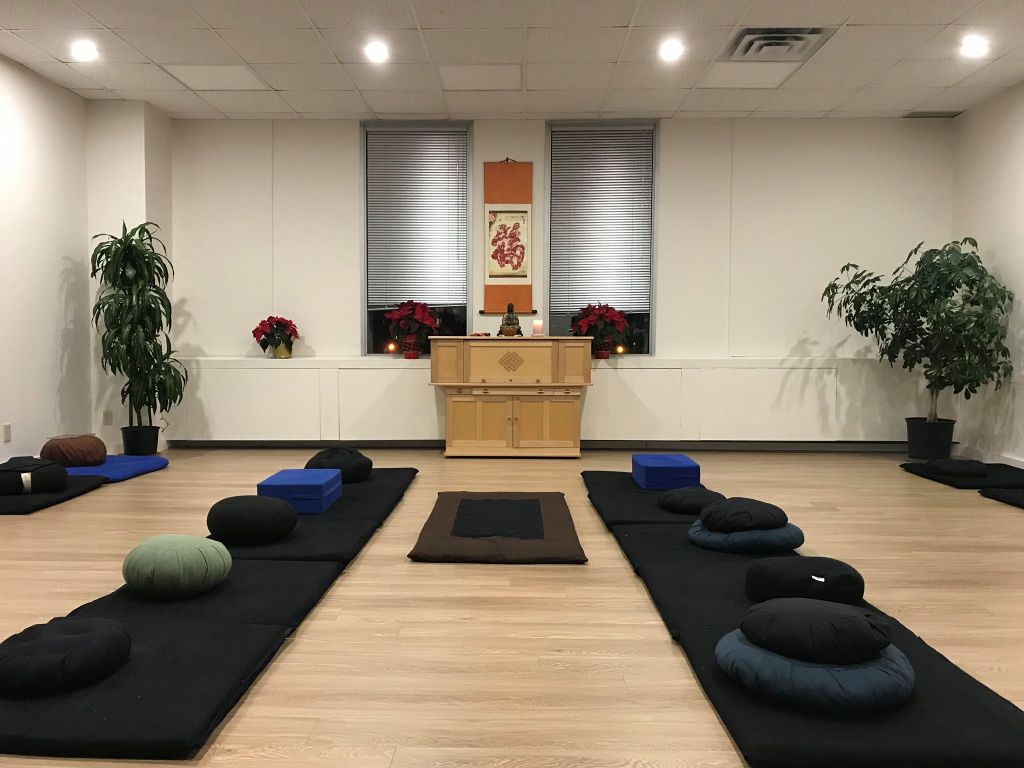
There is a very informal atmosphere here. There is no religious imagery of any type, although the “sitting room” looks pretty much like a zendo without an altar. The rules are all optional—save for two: Everyone takes on a one hour work period each day, and when silence in called for, people are silent. Other than that, even during retreats, one may choose to sit or not as one wishes. “You can go for a walk if you want,” Sandra González tells me. Then adds, “But they don’t. They follow the schedule.”
Sandra is from Nicaragua and had studied with Eido Shimano and Joshu Sasaki before learning about Toni Packer in a book and coming here in 1988.
Lunch is prepared by long-time Zen practitioner, Andy Anderson (and is probably the best vegetarian lasagna I’ve ever had). Afterwards, Sandra leads a discussion circle which reminds me of a cross between a Quaker meeting and a group therapy session. People sit in silence for a while and then someone brings up a topic which people are free to respond to in any way they wish. The topic that comes up is “authority”—the authority that teachers have or are given.
Sandra is a “retreat leader” here—she is identified as such in the print material at the Center—but she is hesitant to claim to be an authority or even a teacher. When I push her, she reluctantly agrees to the term “facilitator.”
She had gone to her first face-to-face meeting with Toni Packer with some anxiety. The format was much what she was used to in Zen, seated on a cushion before the “teacher,” and she began by explaining that her work until then had been largely with koans. Toni asked her why she had come to Springwater, and Sandra said, “I don’t know.” “Then that,” Toni told her, “is your koan.” To sit and to wonder—no other practice. That is meditative inquiry.
I try to get a sense of what exactly the term means and how it differs from traditional Zen practice. “Okay,” I say, “let’s pretend I’m someone who’s heard about this place, and I come knocking on the door. I’ve never done any kind of spiritual practice before, but I think I’d like to give it a try. So I come to the door. Who would be the first person who’d speak to me?”
“Reception.”
“Okay,” I say, laughing. “So I come to reception and say, ‘Hi! I wanna try this out. Your sign says “meditative inquiry.” I want to learn how to inquire meditatively.’ What’s the receptionist going to say?”
“‘So you’re interested in this work?’” Then in a deeper voice, gently making fun of me, “‘Yes.’ So there are some people here if you want to meet, if you are interested.’”
“And who are those people? Who would I be directed to?”
“Me or whoever is here.”
“So the receptionist directs me to you, and I tell you that I’ve read a little bit about meditation, maybe even tried it out. But basically I feel there’s something missing in my life, and I’d like to see if there’s something more I can get by coming here.”
“Okay. So, let’s look at this desire that you can get something from here. So we begin to explore. Let’s look at the intention, motivation that brought you here. And that, factually, is meditative inquiry. Let’s explore right now all these motivations that brought you here. What ideas are there? And let’s put it all open. Let’s air the whole thing out. So it’s an inviting.”
“So it comes back to what Toni Packer said to you, ‘This is your koan.’”
“That’s it,” she says, almost in a whisper. “And can be through questioning if we have motives within. You know? Kind of, ‘I came sometime with a confused mind and there is this . . .’ You felt it here during the discussion. You or anybody can ask a question that can bring some person to see that the mind is going zzzzoom! So—you know—this is a space for everything. There can be some wisdom that’s not coming from you but coming from just the seeing what is going on.”
When I first met Dosho Port, he was still living and working outside of St. Paul, Minnesota, in a place called White Bear. It was not somewhere I was going to get to when I was doing my tour of centers in 2013, but, as chance has it, he was giving a workshop at the Boundless Way Temple in Worcester on the same weekend I traveled to Montague to interview Bernie Glassman.
My wife, Joan, and I pulled up to the Temple on the morning after the workshop to find Melissa Blacker, David Rynick, and Dosho drinking coffee on the veranda. The clematis on the trellis behind the large Buddha in front of the Temple was in luxuriant bloom, and Melissa proudly showed us a Kannon statue that she’d recently rescued from a second-hand store.
The agreement I had made with Dosho was that we’d conduct the interview over breakfast and then Joan and I would drive him to Logan Airport.
After a long practice with Dainin Katagiri in the Soto tradition, Dosho went to Japan where he became involved in koan practice. He has continuing the practice with Melissa and David at Boundless Way. I remark that it’s a fair distance between Massachusetts and Minnesota, and he explains that he had done some of the work via Skype. Electronic dokusan. At the time it was a new concept, and I wasn’t sure how I felt about it.
Dosho grew up in a devout Catholic family, and, when he ordained as a Buddhist priest, his grandmother blamed his mother, “She was completely fine with me, but she was mad with my mother for about a decade. She figured it wasn’t my fault that my mother had let me go astray.”
We continue the conversation in the car. Joan is driving. It is her first time in Boston, but, with one eye on the GPS and the other on the highway signs, she manages. Meanwhile, Dosho and I are discussing the way in which the koan curriculum operates. “Shikan taza is difficult,” he points out. referring to the objectless form of meditation preferred in the Soto school.
Years later, he will elaborate on this: “I think the purpose of koan introspection and just-sitting [shikan taza] combined with dignified behavior, the way it’s taught in Soto monasticism, are the same. But if the goal is to realize the same mind as Buddha and live accordingly – or ‘to practice awakening’ as Dogen put it – koan work is more effective for most householders than just-sitting.” “Householders” is the term used for lay Zen practitioners.
“What Harada Daiun Roshi and Yasutani Roshi did in the 20th century was simplify the Rinzai koan curriculum so that it was portable, so that practicing awakening as a householder was within reach of anyone who approached the work with persistence and skilled guidance. I don’t know that making it available to householders was their intention. It could be that they were just trimming the hedge that had grown up since Hakuin’s time, but that simplification, or refocusing, made it possible for English-speaking Westerners to do post-kensho koan training without being Chinese classics scholars.
“At about the same time, Shunryu Suzuki Roshi, Katagiri Roshi, and others were here trying to figure out how to teach people how to practice in householder life in the West, and so they simplified dignified-behavior training from the Soto monastic system in a way that was similar to what Harada Roshi and Yasutani Roshi had done with the koan curriculum. But, in my experience, without the monastic container, the impact of dignified-behavior training is rarely as effective as the koan curriculum. It just isn’t as obviously portable.”
On the way to Logan Airport, we discuss the difficulties some centers were having now that the first and second generation of teachers were no longer with them. A lot of the attraction of Zen in the early days had been based on those strong personalities. “I heard Leonard Cohen say that he felt such a connection with Joshu Sasaki that he would have learned shoe-making from him if he’d been a shoe-maker rather than a Zen Master. I like to think my relationship with Katagiri Roshi was like that,” Dosho tells me.
It strikes me, however, that it’s not just a matter of personality. In the same way that the youth drawn to Zen in the ’60s and ’70s were challenging the values of the previous generation, young inquirers into Zen today question some of the structures associated with it, including the Japanese cultural characteristics. “In the old days,” Dosho remembers, “when we’d meet people from other centers, we’d all compare how tough our training was. Now it’s almost the reverse. Now centers are vying with one another about how accommodating they can be. There was this young man at a talk I gave who raised his hand and asked, ‘Please, sir, what is the minimum amount of asceticism needed to practice Zen?’”
It is also, as Bobby Rhodes had pointed out, a more electronically engaged generation. And if dokusan can be done by Skype, why not experiment with other ways of using the internet to promote Zen?
We left Dosho at the airport in time to meet his plane, and time passed. We kept in contact, and Dosho briefly moved to Maine before settling in Omaha, where he is now the principle teacher at the Nebraska Zen Center. During his stint in Maine, I was able to visit him a couple of times, and even arranged to have him give a workshop in New Brunswick, where I live.
Then the teacher I had been working with, Albert Low, died in 2016, and after giving some thought to how I was going to proceed in my practice, I decided to continue my own koan work with Dosho by Zoom.
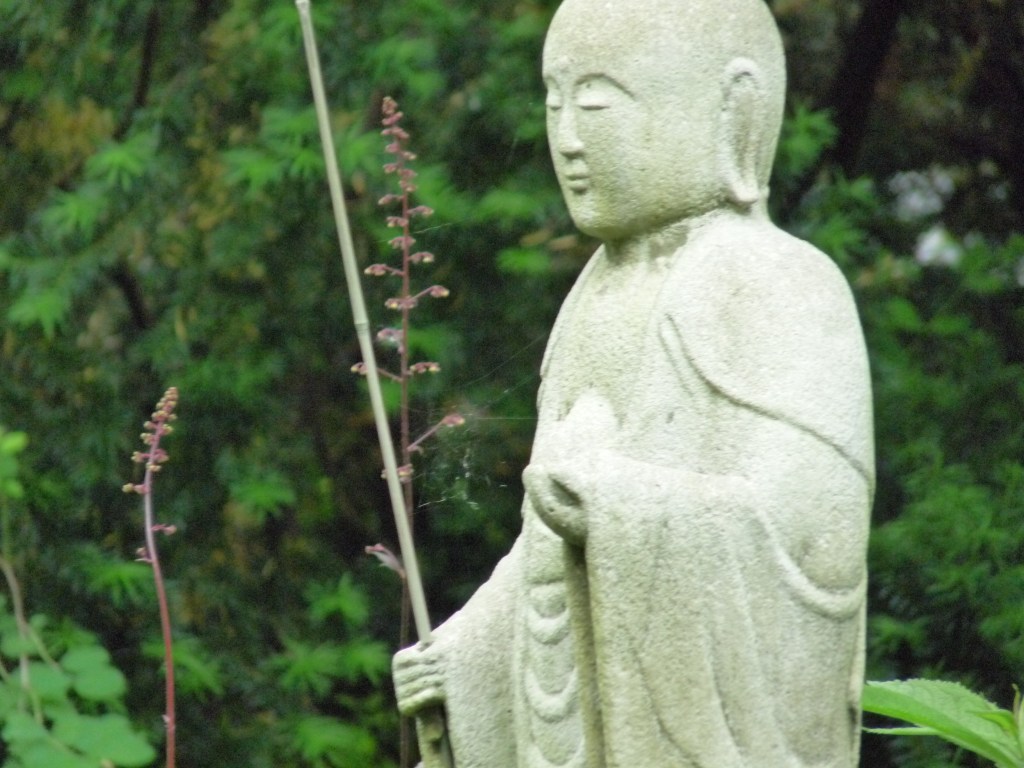
The Toronto Zen Centre is on High Park Gardens in a well-to-do neighborhood on the west side of the city. I follow a stone path around the house to the back entrance passing carefully cultivated and maintained flower beds adorned with elegant Bodhisattva statues. Downstairs there is a Zendo (with about twenty-six places) and a Buddha Hall opposite. A student takes me up to a sun-room on the second floor where I meet Taigen Henderson. “It looks like the property taxes might be a bit steep here,” I say. He nods his head.
Taigen is a Dharma heir of Sunyana Graef, who had expressed surprise that I had not included him on the original list of teachers I had intended to visit. She had been right. It was a major oversight on my part.
The Toronto Zen Centre, the first affiliate center of the Rochester Zen Center, is also the first official Zen practice center to be established in Canada, and Taigen is the first Canadian teacher to be trained in Canada. “He wouldn’t tell you that,” one of his students informs me, “because he’s so humble.” I was aware of that humility while I talked with him, but I was also aware of his self-confidence. He’s a man with a lot of life experience who is very much at ease with where he is at this moment.
When I ask the two students I met afterwards to describe him, the first thing they both noted was that he was inspiring. “You think, wow, if I could be like that.” They tell me that he embodies the teaching.
I’ve heard other students describe their teachers in similar terms. Zen training does—if one persists in it—forms people of strong character. I suspect that, at least in part, it’s because these are people who know themselves deeply and have nothing to prove to anyone else. They are the “true man of no rank.”
I remark on his sense of humor. “He has a great sense of humor,” the students tell me, and has the ability to use that humor to lighten tension when things become challenging or difficult.
He has a very expressive face and is a wonderful story-teller. And he has some pretty amazing stories to tell: The story of spending several years in Ceylon (Sri Lanka) when a young boy, at which time he got his first taste of Buddhism. “Somebody showed me a high school year book in which I said I wanted to be a Buddha when I grew up. I was just being a smart-alec at the time.” A story of spending months deep in the British Columbia interior, 200 miles from the nearest road, with two other young men. “We didn’t see one other human being in that time.” A story of working in an asbestos mine. “They were just realizing how dangerous this stuff was. In Toronto they were worried about brake-linings, and here I was sweeping asbestos dust half an inch thick up off the floor.” A story of waking up and seeing smoke pouring through a vent and realizing that the house next door was on fire. “The firemen came and broke the windows, and the house went up just like that. It made me aware just how impermanent life is, and I thought if I didn’t start doing something now, then when?” A similar sentiment is inscribed on the han outside the zendo.
He went to Rochester to do a workshop with Philip Kapleau and told Kapleau that he would like to train there for a while. Kapleau told him to stay in Canada. So he returned to Toronto and joined the affiliate branch here. He found work in the construction trades, doing house renovations. Eventually, he worked on providing low-income housing as well as training to homeless people. He also helped build some women’s shelters.
Sunyana Graef by this time had become the teacher in Toronto, while also maintaining centers in Vermont and Costa Rica. Taigen expressed an interest in living a life more fully committed to practice, and she told him that it wasn’t time yet. His work with the homeless and women’s shelters was, after all, an example of Right Livelihood—the fifth step in the Buddha’s Eightfold Path. Eventually difficulties with a sub-contractor resulted in him leaving the trade, and then the time was right for ordination.
The Centre had been at another location, in a neighborhood where prices were low because of fears that an expressway was going to be built alongside. When the expressway plans were withdrawn, house prices jumped. The Centre was able to sell its place for $400,000, and purchase its current property for $350,000. At the time, it was also considered a less desirable neighborhood because of the occasional stench drifting in from nearby stock yards. When the stock yards were closed, house values went up. “The property is now probably worth $2,000,000,” Taigen admits.
It is axiomatic that when one enters the path, opportunities arise. At times, events occur which appear to support that axiom.
There is a bumper sticker on Bodhin Kjolhede’s car that reads: “Ask me about my vow of silence.” We are driving to the Rochester Zen Center’s retreat house, located at Chapin Mill, forty minutes from the city. Bodhin’s hair is short, but not shaved off, and he is dressed in a navy blue short-sleeve shirt with a banded color and matching slacks. The Vietnamese woman in the back seat is similarly dressed. “As part of the process of adapting Zen to the west, my teacher—Roshi Kapleau—and I didn’t feel inclined to maintain the Japanese samugi,” he explains. “We chose something more western, but we also wanted a way to distinguish those who were ordained. So we came up with this.” Unlike a samugi, it is something one could wear on the street without appearing too foreign or exotic.
The conversation during the drive is largely casual, but I leave the recorder on. “There has been a recent increase in interest in our introductory workshops, our training programs, and our sesshin—all three,” he mentions.
“Interest in workshops has gone up?
“Yeah. We have to turn people away. We cut it off at fifty.”
“What age groups show up?”
“It’s all over the place, but there are definitely more people in their 20s and 30s than there were five years ago. The baby-boomers are still coming, but now there are fewer of them. And there are a lot more younger people.”
“Any idea why this current increase in interest?”
“I have hypotheses. There are those who say it’s so hard for young people to get jobs that they don’t lose much by coming. But I think it’s something more intangible, some greater interest in the spiritual.”
“Probably different factors than in the 60s, though, when drugs were a big reason people got involved.”
“They were for me.”
“Yeah,” I admit. “When people ask how I got interested in Zen, my short answer is often, ‘Mescaline.’”
He looks over at me with a grin and says, “Me too! Mescaline was my drug of choice. I was a beer-drinking fraternity guy until my first mescaline trip, and then I just saw the world in a whole different way.”
By this time, I knew I was going to like this guy.
The Rochester Zen Center is located in a fairly ritzy neighborhood. The grounds and structures are impressive and maybe a little daunting. When I arrived early for my 9:00 appointment with Bodhin in June 2013, I was told I could wait on a sofa in the foyer. Young people dressed in dark navy short-sleeve shirts and matching loose pants hurry about their business—men and women barefoot and with close-cropped, but not shaved, heads. I’m reminded of what someone had said about the San Francisco Zen Center in the days before Blanche Hartman became abbess: “Well, they’re not unfriendly.”
But if there were a certain stiffness among the students (or perhaps they are just focused on carrying out their duties), Bodhin is relaxed, humorous, and very capable of putting others at ease.
“The atmosphere here seems less formal than some of the monastic centers I’ve visited,” I say.
Philip Kaapleau’s grave at Chapin Mill
“One of the distinctions that Roshi Kapleau—as compared to his peers from Japan—was very adamant about, that we have to Americanize Zen. And Americans are much more informal than the Japanese. So we try to keep things taut, in terms of the training, but not with those elegant, elaborate, Japanese rituals. So, for example, I’ve heard that there are other Zen Centers where the teacher, to start off the morning zazen, will go through the zendo and people will all do this deep bow. That strikes me as inappropriate. Not to go off on this, but what I’m constantly aware of—maybe even a little more than Roshi Kapleau was—is how much of Zen from Asia is conditioned by the Confucian ethos of hierarchy and all. And I’m trying to find a balance between not throwing that out completely, because there’s a place for it, for hierarchy—I’m not going to apologize for hierarchy—but not over-doing it.”
It is because of his commitment to conserve the practice as he had received it that he is cautious about the degree to which he involves his students in social action.
“We have a program where our members go into soup kitchens. And there’s a whole kind of blossoming of different ways of engaging with the wider world. For example, I’m trying to give some leadership in the whole specter of global warming. In fact, recently we had a meeting where we talked about how we might have a public demonstration of the spirit of Zen the way that we did about thirty years ago when the Minnesota Zen Center organized a three day Zazen Vigil in New York City. This was on the occasion of public protests in New York regarding the proposed deployment of Cruise Missiles in Europe. And so the idea came up of inviting Zen Centers to convene across from the United Nations in a place called the Peace Park and just sit for three days. That had quite a strong effect on me. I thought it was powerful, something I could get behind more than waving protest signs and marching. So I’m trying to get something like that going regarding climate change.
“We’re really just getting into this area of social engagement. And—as you know probably—the danger of it is if you become too one-sidedly engaged—socially or politically—then you run the risk of losing the real root of Zen practice.”
I would eventually have an opportunity to spend time at Dai Bai Zan Cho Bo Zen Ji in Seattle, meeting its abbot – Genjo Marinello – and joining the regular morning sitting group not only for zazen but also for coffee at a local cafe which has a table waiting for them. No one blinks an eye at their robes when they come in. But my first contact with Genjo (the name attached to his email is “Joe Marinello”) was by Skype.
One does not get the same feel for a person via Skype (or Zoom) as one does in person, but Genjo struck me during our first conversation as having that settled self-confidence and ease which is often a characteristic of long-term Zen practitioners. His scalp is shaved, and he wears a head-set during the interview. As I get to know him, he proves to be something of a Renaissance man – pilot, amateur astronomer, software developer, mental health counselor, Zen priest. He has a killer smile.
During in a freshman English class in the ’70s, the teacher introduced the class to the idea that there “was a way to experience, or penetrate, reality beyond the scientific method; that you could have something called insight, inspiration, or intuition. You could tap into some fundamental truths heuristically by investigating your own internal condition.” The question for Genjo was “how” one did that, which ultimately led him to the practice of Zen. He was living in southern California at the time.
Later, while serving as a VISTA volunteer in Seattle, he practiced with a group established there by Glenn Webb, a professor at the University of Washington. In 1978, Dr. Webb invited a Japanese Rinzai teacher to Seattle. This was Genki Takabayahsi Roshi, who then founded Dai Bai Zen Cho Bo Zen Ji, or “The Listening to the Dharma Zen Temple on Great Plum Mountain.”
Genjo was sitting with this group when he happened to attend a lecture given by the Dalai Lama. The talk was interrupted by a group of Maoist-students who heckled the Dalai Lama for failing to support the Chinese Communist regime in Tibet. Genjo was so impressed by the way the Dalai Lama handled the situation that he announced to Genki Roshi that he was ready to commit himself to Buddhist practice.
He spent a short time in Japan, at Ryutakuji, where he met Soen Nakagawa Roshi. He was surprised to learn there that often the Japanese students were only there because “it was their lot in life. They couldn’t at all understand that I came there voluntarily to train, because no one would do that. And that was incomprehensible, truly incomprehensible. So when I settled on saying that I had been sent there, they could understand that. But if I tried to say I wanted to train in Zen, they would just shake their head. ‘No. That can’t be the reason.’”
His time at Ryutakuji was hard. His own training methods now are considered traditional and a little strict by American standards, but he makes it clear they are nothing like what he went through in Japan. “It was a very martial style. I remember one time sweeping a gravel path outdoors with a bamboo broom and whistling a little, just a little bit, and being told, ‘No! No, you can’t whistle! This is a Zen temple!’ And you couldn’t do anything right. There was a rule that for six months it didn’t matter who told you what to do, when you did it, it was wrong. And if you did it to someone’s satisfaction, someone else would come by and un-do it and say, ‘No. That was wrong. It has to be done this way.’ And whoever was closest to you—because everyone was more senior to you—was correct. So you just had to learn—through sort of an ego-annihilation—that you could not do anything right.”
For Genjo, Zen “points at our deep, true nature.” We don’t often tap into the deepest part of our nature, he explains, as a result of which we tend to have a fairly narrow and individualistic sense of ourselves “and who we are and our place in the universe.” Zen, then, provides a training that helps us to transcend “our ego identity and discover our deeper, seamless nature” with all other beings.
Genjo places as much emphasis on the attainment of karuna (compassion) as he does on the attainment of prajna (wisdom). “My initial training was dominated by—say—the wisdom component, with the idea that without deep wisdom you could never get to deep compassion, and that wisdom had to come first, and that compassion was the natural outcome of deeply penetrating the wisdom. And I still agree with that, but I also think that you can start with compassion and get to wisdom. And that you don’t have to start with wisdom to get to compassion. And that they’re different sides of the same coin. So we’re trying to strike a balance at Chobo-ji between these two legs, and both legs are important.”
[The American Zen Teachers’ Association invited me to address their Annual Conference on July 8, 2021. This is the text of that speech.]
I started writing because my leg broke.
I’d been taking a medication for osteoporosis called Fosamax. You used to see a lot of ads for Fosamax on television. A well-known actress of a certain age with a look of determination on her face told the viewer that she was going to start taking charge of own health now and that she was going to look after her bones.
You don’t see those ads anymore because it turned out that Fosamax had this side-effect. It could cause your femur – the strongest bone in the human body – to shatter.
It’s not that it was more likely your femur would break if you had a fall – although that could happen. It was quite literally that you might be walking across the room and suddenly your leg would snap in two. Then you’d fall.
That’s what happened to me in August of 2010. In my case, it took 26 months and three surgeries before the bone began to mend. It is under circumstances like these that one really appreciates Canadian socialized medicine
During those two years of convalescence, when I was no longer able to take part in the kind of activities I generally thought of as being the stuff I do – hiking, biking, kayaking, cross-country-skiing – I filled the time, instead, by writing.
My first two books were examinations of the development of Zen in China and Japan. Then to complete what I still think of as a trilogy, I wrote about the pioneers who first brought the practice to this side of the Pacific.
By the time the idea for Cypress Trees in the Garden – my fourth book – came about, I had retired from a career in International Development and was able to get around haltingly with the use of a cane. The premise for that book is the same as the premise of my most recent book, Zen Conversations. I assumed that contemporary North American Zen teachers – you – had things to say that were at are at least as worth preserving as Tang dynasty comments about mounds of flax, turtle-nosed snakes, or excrement sticks.
So in March of 2013, starting in San Francisco, I began a tour of Zen centers throughout North America. In total, I interviewed 124 American, Canadian, and Mexican teachers before the COVID outbreak put an end to travel. They represented the Soto, Rinzai, Sanbo and Kapleau schools, as well as Chinese, Vietnamese, and Korean lineages.
Those seven years were, coincidentally, a transition period in the history of North American Zen. The generation of teachers who immediately followed the pioneers – the second generation of Zen teachers in America – was starting to pass. Walter Nowick died just a month prior to my trip to San Francisco. All three of the abbots I spoke with there – Steve Stucky, Blanche Hartman, and Mel Weitsman – have since died. As have Albert Low, Bernie Glassman, and others I was fortunate to be able to meet and record before they left us.
I treated that tour much like a pilgrimage. I undertook it without expectations. I had no agenda in mind. I wasn’t seeking to defend a particular theory or to argue to a particular end. I tried not to take sides in any of the several differences of opinion I encountered. My goal was simply to record a phenomenon I found interesting and personally meaningful.
What I’d like to do now is share with you some of things I observed over the course of that process. Some of the things that you told and showed me.
I first became interested in Zen fifty years ago, at a time when it was still a pretty marginal activity. I grew up in Northern Indiana, and, when I was in high school in the 1960s, at a time when the beginnings of what would become a Zen boom were starting to take place in other parts of the country, I only remember coming across one reference to meditation. It was in one of those display cases they sometimes have in front of Protestant churches where the topic of the following Sunday’s sermon is posted – like a preview of coming attractions: “Don’t miss Pastor Pete’s breathtaking review of the seven deadly sins next week!” What this display said was: “Meditation empties the mind so that the Devil can come in and take over.” Actually, on reflection, I’m not sure why that didn’t intrigue me more than it did.
Today Zen is not only socially acceptable, it’s practically mainstream. It has even become a word in the English language – although its dictionary definition refers to neither Buddhism nor meditation. The Cambridge Dictionary defines zen as “the quality of being relaxed and not worrying about things one can’t change.” That’s the way you hear it used in sit-coms: “Don’t go all zen on me!”
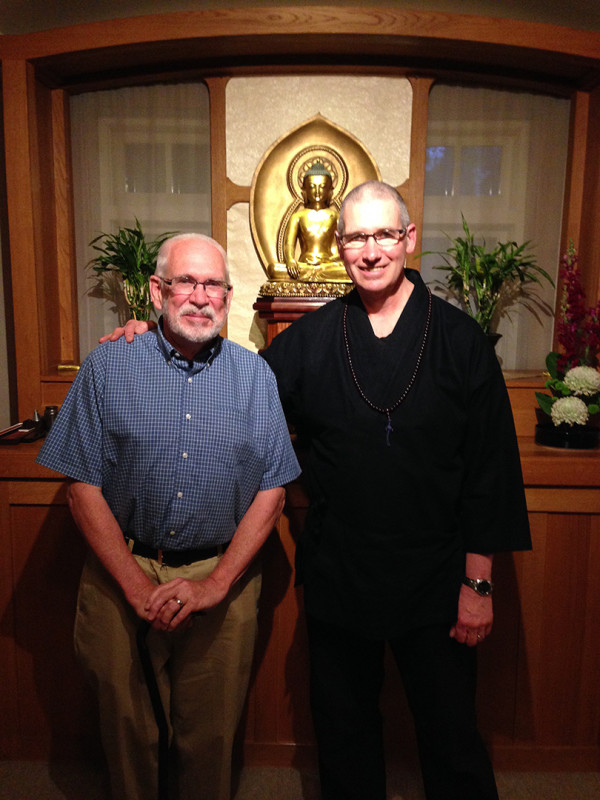
With Taigen Henderson Roshi
It has become a marketing term. When I visited Bodhin Kjolhede at the Rochester Zen Center one of the things he shared with me was his collection of products that included the word Zen in their names. There’s Zen tea, Zen breakfast cereal, Zen perfume, Zen laundry detergent. There’s the “Zen of Zin,” a California Zinfandel. There was an early electric car produced by Ford in Canada, called the Zenn (with a double N – “zero emissions, no noise”). You can purchase Zen chocolate chip cookies, Zen bath products, and even a Zen underwire bra.
I mention this because it reflects something of the current popular misunderstanding of what Zen is.
Back in the bad old days, when the citizens of LaPorte, Indiana, were being warned about the dangers of demonic possession, a handful of people elsewhere in the country were starting to make their way to San Francisco, Los Angeles, Rochester, Honolulu, and even the backwoods of Maine, seeking spiritual enlightenment. That’s the language they used; that’s the language that many of you used.
Few of them – few of you – knew at the time that there was actually more than one “type” of Zen, and they were surprised when some of the centers they went to discounted the idea of enlightenment. And while many of them – many of you – learned to accommodate that, it was still often the search for enlightenment that had brought them to the door in the first place. Even those of you for whom the enlightenment-model no longer holds up admitted to me that it was often the idea of a path to enlightenment which prompted your early investigations into Zen.
In the era of Zen respectability, however – the era of Zen wine and cookies – you tell me that the people who come to your door for the first time seldom use that language. More likely, they tell you that what they’re looking for is to reduce stress in their lives; they want to overcome anxiety or lower their blood pressure. One teacher did theorize that this could be because of a contemporary shyness about talking about spiritual aspirations, a fear of being thought pretentious if one did so.
You have also pointed out that when people first come to your centers, it isn’t usually with the intention of “joining” anything. If you become a Christian, for example, part of the deal is to start showing up on Sundays and gathering in prayer with others. But it appears that people often look at Zen less as a spiritual path than as a psychological technique. Several of you tell me that you hold regular introductory workshops – one place charges a $50 attendance fee – and that at times you even have waiting lists of people seeking to take part. But you also tell me that you don’t expect to see most of those people more than once. After all they get what they want in the workshop, which is instruction in a technique. No doubt some of them will go back to their families and back to work and tell people that they’ve taken up Zen and how much good it’s doing them. (“Really! It’s dropped my blood pressure by 9 points.”) Some of them might buy a book – more and more likely an audio-book. It’s frequently been remarked that far more people have read (or listened to) a book on Zen than have ever spent any time at all at a practice center, a phenomenon that I suppose I’ve contributed to in a small way.
The few who do stick around, even if they originally came in order to find a way of coping with stress, do, of course, acquire a more mature perspective about practice. And, of course, there were always those few people who come with more existential concerns about the purpose of existence or who are looking for a way of life that seems meaningful. Still, although these individuals can become staunch supporters of a particular sangha, they often retain a fairly narrow understanding of the scope of North American Zen. They assume that other Zen centers run pretty much the same as the one with which they’re familiar. And that’s just not the case.
It is, of course, a natural assumption. After all, as I write in Zen Conversations, a Roman Catholic attending mass in Venice, Oaxaca, or Ottawa would find the experience essentially the same. For that matter, a Rotarian attending a luncheon meeting in Italy, Mexico, or Canada would expect the format to be similar save for, perhaps, a few cultural differences.
But a Zen practitioner visiting two centers in their own community might well find them so different that they scarcely appear to have anything in common.
First, there is the wide range of visible differences – whether the guiding teacher at a center is lay or ordained, whether they have hair or not, whether they adapt a specific style of dress; the use or absence of liturgy, the regulations governing how people sit – facing walls, facing forward, facing one another. There are still a few places where the kyosaku is used, although these are becoming rarer and in most instances its use is only on request. One center gives you the option of a shoulder massage. There are centers which make use of what amounts to a talking circle. There are centers in which participants are encouraged to engage with one another socially before and after sits; there are other centers where there is almost no social interaction at all. There are degrees to which center leaders – if they are priests – understand their role as religious ministers to a community, with responsibility for visiting the sick, providing hospice care, officiating at weddings, funerals, naming ceremonies.
With Kevin Hunt Roshi
Much of this is, frankly, superficial, but it also indicates that there is no standard approach to practice in North America, there’s no central authority, no Vatican. Some members of the Soto Zen Buddhist Association have suggested they would like to be recognized as a denomination, which would necessitate some form of standardization, but I didn’t see much interest in that elsewhere. You’re generally a pretty independent – if oddly conservative – lot.
Some of you have told me – especially those of you who studied with one of the pioneers – that you felt an obligation to retain the tradition as you received it at least until your teacher’s death, only after which you then felt free to begin making adaptations that you hadn’t previously. Some of these adaptations seem pretty minor from the outside, like Kapleau’s famous fight with Yasutani over whether the “Heart Sutra” could be chanted in English or not.
The matter of what I’ve heard referred to as the “container” is something most of you consider important. There is general agreement that there needs to be some kind of container for the practice, and that the one you inherited from Asia is a strong one. The tension is always with how “foreign” or “exotic” that container appears to be. The container consists of the ambiance of the space you use – the formal decorations – the forms used (bowing, prostrating, sitting cross-legged), the language used, the nature of – or the lack of – liturgy, the type of name one uses. The title – if any – you prefer to be addressed by.
One of the biggest surprises to me during my conversations with you was how often you didn’t know what your colleagues were doing. It wasn’t unusual for me to describe something I’d seen elsewhere and for you to express surprise and then quiz me for details.
Much of this could simply be considered a matter of style. But then we get into more substantive matters, such as just how Buddhist does this all need to be?
The abbot of one of the monastic communities I visited told me that he thought of himself first and foremost as “someone who is studying and practicing Buddhadharma.” In other words, for him Buddhism is primary and Zen just happens to be the particular tradition – or perhaps upaya – that he employs in his practice. On the other hand, there were centers where, when I asked authorized teachers with impeccable teaching credentials if they considered themselves Buddhists, I was bluntly told, “No.” Just recently a teacher who saw the profile of her I had posted on my website wrote to ask me to correct it. She considered herself, she told me, a Zen Practitioner not a Buddhist.
There is even a small, but significant group of teachers – whom I find fascinating enough to have written a book about – who continue to self-identify as Roman Catholic. The first Canadian – and, in fact, one of the very first Westerners – to be authorized to teach Zen is a Roman Catholic nun from the province of New Brunswick, where I live. She is now in her 90’s and no longer actively teaching, but she still forcefully makes a distinction between Zen and “Zen Buddhism.”
The most significant difference of opinion amongst you, however, is one which cuts to the very function or purpose of Zen practice.
When I conducted the interviews for Cypress Trees, I had only two prepared questions. “How did you become involved in Zen practice?” and “What is the function of Zen?” The range of responses to that second question was impressive. It was naturally something that you had given thought to – although the teacher with whom I studied for the longest time pointedly told me that Zen has no function at all. In one location, I was told that “the function of Zen is to see beyond the constructions of the mind that blind us to reality.”
Another teacher phrased it this way, “Zen is a practice through which people dissolve the mind that separates us from everything else in this world.”
Neither of these sounded spontaneous – they are both the products of careful reflection – but they’re essentially saying something others of you put more directly and in more traditional language: the function of Zen is awakening/satori/enlightenment, whatever vocabulary you choose to use.
And when I asked what you meant by awakening, I was often told that it is a process rather than a single event, although many of you held that an initial event – let’s call that kensho – is essential to begin the process. Again, your range of expectations regarding kensho is broad. One teacher told me, “we allow for different intensities of that experience. We aren’t looking for ‘great kensho,’ per se. It might, for some, be just a subtle release, maybe a tear in the eye, maybe some laughter, but not necessarily great awakening.”
With Mitra Bishop Roshi
Other teachers had higher expectations. One told me it was the necessary initial taste of non-duality which then needs to be cultivated for full spiritual awakening. And yet a third referred to it as the “shock of discovering that all the multiplicity of phenomena are somehow one single phenomenon.” Frequently you insisted that the experience itself can be transient and of little value unless nurtured by further practice.
The transient nature of that initial insight made others of you question its value altogether. One of you good-humoredly remarked that as far as she could see kensho seemed to have had little impact on helping the people she knew be happier or overcome their sense of personal inadequacy or insecurity. She told me that she preferred to think of Zen in terms, not of achieving a particular spiritual experience, but as a means of liberating individuals from the grief and neurosis of suffering and, by doing so, helping those people turn outward and become more aware of and attentive to others. Again, not a spontaneous reflection.
The most articulate proponent of this point of view told me straight out that he had no interest in “enlightenment” whatsoever – that the people that he’d met who claimed to have had any kind enlightenment experience were no more mature – by any measure – than anyone else he knew. For him, what Zen offers is “a vehicle by which people can grow up in a profound way.” Maturity – learning how to hold oneself in the world – he argues is more important than “what it looks like inside your head.”
If I pushed you, you would usually – although at times reluctantly – agree that the various forms of Zen despite these differences share common goals; they are all about transformation in one way or another, whether that’s described as spiritual awakening or personal maturation. There are debates about things such as how effective shikan-taza can be compared to koan study, especially when working with lay people outside of monastic training situations. Or whether koan training doesn’t just create a “gaining mind” which has to eventually be shed. I suspect those debates are healthy.
All of which is to say that as a North American style of Zen continues to evolve, it will not be monolithic. Well, that was the case in China as well – with its Five Houses and Seven Schools. And there’s value in that. When you were describing your personal stories to me, you frequently talked about trying more than one form of Zen before finding the one with which you resonated.
There does seem to be general agreement that transformation should impact the way people relate to others and to the social and physical environments – that prajna in itself is of little value without karuna, without compassionate action. That seems pretty self-evident today, but that emphasis wasn’t always there in the early days of the transference of Zen to the West.
This is the one area where I found that the member of your sanghas sometimes held stronger attitudes towards a subject than you did. Occasionally – especially during the Trump debacle – I’d hear sangha members muse about whether their centers should be more politically or socially active. But as near as I can tell, most of you don’t consider that your job. Your role is more like that of a physician, and it’s not a physician’s position to tell their patient what they should do with their lives once their health has been mended. It’s possible that my surgeons held some opinions about what I should have done after they kinda-sorta fixed my leg, but they wisely kept those opinions to themselves.
You seem to recognize that you remain a work in progress. It is worth remembering that the first Soto missions established on the west coast are not yet 100 years old. That won’t happen until next year. The Los Angeles mission was established in 1922. Coincidentally, 2022 will also be the hundredth anniversary of the first public talk on Zen that Nyogen Senzaki gave in California. Although he didn’t do so in that talk, Senzaki would become the first person to give zazen instruction in North America.
And, as we approach those anniversaries, it’s salutary to keep in mind that the house still isn’t entirely in order.
When I set out to begin these interviews in 2013, the Zen community at large was reeling from two scandals that had achieved national prominence even on cable news networks. Given that, it’s disheartening that since then, two of the teachers I spoke with – both articulate men with what I believe is a sincere commitment to the Dharma – have had to resign their posts because they fell afoul of the ethical boundaries increasingly recognized as essential to all professional – let alone spiritual – relationships.
You have also admitted to me that you are aware you are still no where near as diverse as you need to be. This is a matter of practical concern to me because while my wife and I are both white heterosexuals, our children and grandchildren represent a range of cultural, ethnic, gender, and sexual identities. Zen Conversations is dedicated to my great granddaughter who is a status member of the Wolastoqiyik First Nation. It would be an enormous disappointment to me if at some time in the future any of them felt disinclined to take up Zen practice because they failed to see themselves reflected in your numbers.
Having said all this, let me end by saying that you are a thoroughly enjoyable group of people to interact with. I wrote in Cypress Trees and then repeated in Zen Conversations that as I look back over the seven years during which I was engaged in these conversations what most strikes me is how much fun they were. I was welcomed graciously and had the good fortune to meet warm and generous individuals who responded to my (at times wholly impertinent) questions frankly and with good humor. I have described you as the type of people one would enjoy spending an afternoon with drinking beer – or tea, if that’s your thing – and discussing just about anything other than Zen.
I also look back on these visits with a genuine astonishment at the trust you placed in me, at the way in which you were willing to share the most intimate details of your lives with me. I remember a conversation in which one of you spoke about your struggles with mental health issues. The emotion in that exchange became so charged that I tried to back out, saying that we didn’t need to go any further. And what I was told was, “No. When I woke up this morning, I didn’t think I’d be talking about this. But now that it’s on the table, let’s look at it.” I’m still impressed by the courage that took.
Mind you, a couple of you later reconsidered what you’d revealed to me and got back in touch to say, “You know that thing we were talking about? Maybe that shouldn’t be put into print.” But even then you trusted me to honor that request.
So it has been a genuine privilege to have been able engage in these conversations with you and to have the opportunity to help ensure that your collective wisdom will be preserved – along with those weird Tang dynasty quips – for future generations. For that, for the trust you placed in me, for your hospitality and kindness, and for your attention this afternoon, I thank you.
With David Rynick Roshi, Dosho Port Roshi, and Melissa Blacker Roshi








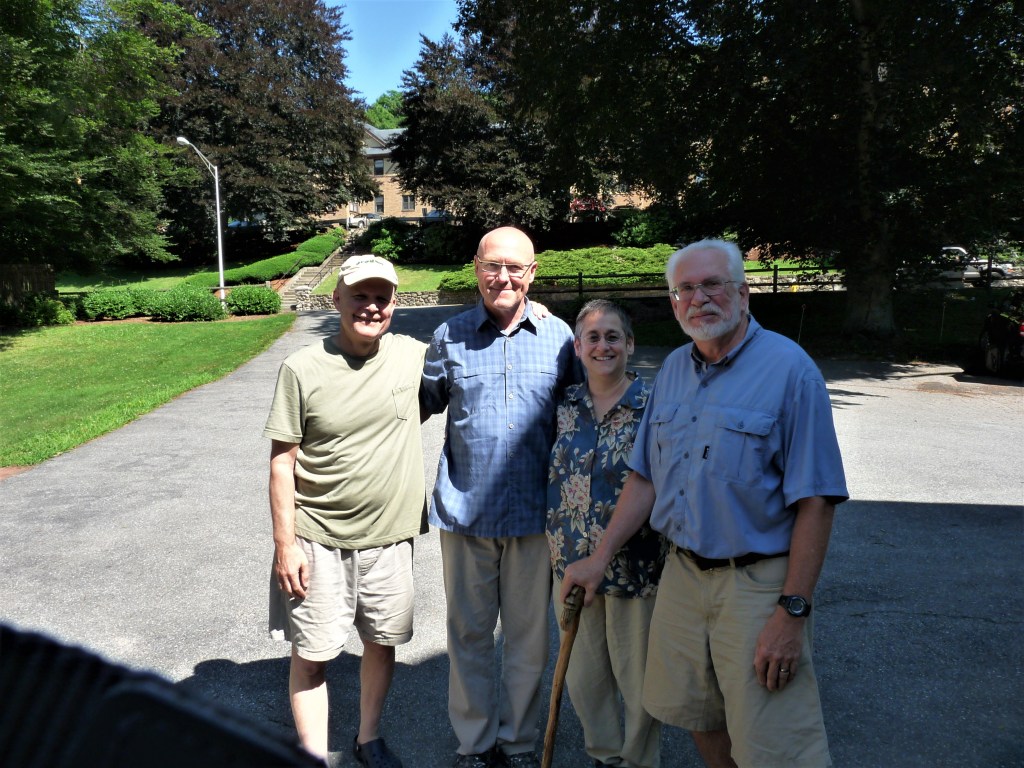
 Richard Bryan McDaniel