Valerie Forstman is the Guiding Teacher at Mountain Cloud in Santa Fe. Previously she had been a professional orchestral flutist. “Finding Zen,” she tells me, “came out of my life of music.”
She was living in Dallas and preparing for an audition, which, she says, “is rather like Olympic training. For three months, I did all the things that I knew to do to prepare. Yet as the time came nearer, I found myself waking up in the night visited by past failures. Disappointments. During the day, I was practicing and training in order to play a certain way at a future time. It was all oriented to that. In the process, what you might call the present moment became increasingly elusive. It felt like the space where the present would be was opening up like a chasm between the past and the future, and I was losing my love for playing. The week before the audition, a friend said, ‘Hey! How are you?’ I said, ‘Well, something needs to change.’ I told him briefly about this sense of a gap in time and of having lost the joy of playing. He said, ‘I’ve got just the thing. Come and sit.’”
He brought her to Ruben Habito’s Maria Kannon Zen Center in Dallas.
“The audition was on that Saturday. The next Monday I was at the Zen Center for the orientation talk, and the next Wednesday for the second orientation talk. I had done spiritual practices; had had some taste of that experience, but somehow it felt like coming home. In the beginning, I would sit for three twenty-five-minute rounds facing the wall, five minutes of kinhin – walking meditation – in between. Sometimes, turning around at the end felt almost dizzying. In three periods of sitting, there might be just a handful of moments of real stillness; otherwise, it was what we call monkey-mind. Then, chanting, bowing. Going out to the car and driving home, the street signs were more clear and distinct, and the light on the pavement was somehow more luminous. There was something happening. I didn’t even try to say, ‘Oh, this is clarifying,’ or ‘This is bringing the world to life,’ or ‘Something’s falling away.’ I didn’t have any of that language. I just knew the need to be doing this.”
That October, she attended her first sesshin. “When I arrived and saw the schedule, I thought, ‘Whoa! I can’t do that,’ but there was no turning back. It was just wonderful, potentiating naiveté. It can be so helpful not to have a clue what you’re getting into.” The venue had, as she puts it, “no particular symbols. Just a small altar with a photograph of Yamada Koun Roshi, Ruben’s teacher, and Yasutani Roshi, Yamada Koun’s teacher, and a candle, a flower. In kinhin, we walk by this altar and might glance at it. Otherwise, it was a concrete block room that had been turned into a zendo.”
On the third day of the sesshin she had an unexpected experience. “I grew up in a progressive Protestant environment. My father was a theologian, but I had not been in a church for a long time. And I’m sitting zazen and suddenly . . .” – she laughs softly as if a little reluctant to proceed – “. . . there appears a figure before me. It’s white. The sense was that this is Christ. And I heard the words, ‘This is my body.’” She pauses, then resumes speaking more slowly. “For a few moments, I was riveted, utterly transfixed. Then came the thought, ‘That’s blasphemy. This is my body?’ And, of course, it all went away. I came back to breathing, following the breath. Soon the bell rang and the clackers, and we began walking kinhin. And as I passed by that altar, my eye happened to fall on the photograph, the image, of Yamada Koun Roshi, this person I knew was my teacher’s teacher, a person obviously loved by Ruben, but for me, an inscrutable Japanese face. Right? In that moment of walking by, of the eye just chancing to glance at the face, suddenly that face was flooded with an outpouring of compassion, and I knew why. Not discursively, ‘Oh, I can explain this to you.’ It was just compassion – boundless – just pouring out, as I was walking back to the seat. Fairly soon I was tapped for dokusan. Fortunately, there were four people waiting ahead of me and one person in the dokusan room. So I sat down, sitting with the koan Mu. Just sitting there, not reflecting, but with tears coming down. By the time I got to the seat right before the door, my lap was wet. The bell rang, I went in, and Ruben said, ‘What’s happening?’ And I said, ‘Nothing.’ Then, somehow, this experience came, and I simply told him, ‘Well, I was sitting, and this appeared and . . .’ He began to ask checking questions, guiding questions. And suddenly they were just answered. It just came. Just so.
“That was just a beginning. But what a relief! For each one it’s so different, but there are clear characteristics that are common. This sense of walking and no one walking, or of creation coming up here and here, here, here! Totally new. Nothing at all and yet this! In some sense, it feels like a baby being born, and the protective film on the eyes falling away, things coming into view. Just getting used to that amount of light. In the beginning, it’s blinding. Gradually you focus, and you see this world as it is, this world in which we can practice.”
She didn’t get the position for which she had been auditioning. “I ended up as runner-up. Had that not happened, it’s likely life would have still been full of Zen, but it was a glorious failure. I’m really grateful.”
At the inauguration of the Buddhist Temple of Toledo last April, Karen Do’on Weik received “denbo,” the second stage in full authorization within the Soto tradition. Do’on is the wife of the temple’s abbot, Rinsen Weik. They met in an aikido class. “I punched him,” she tells me. She was studying to become an Episcopalian priest at the time.
Her first encounter with Buddhism occurred during a high school outing to the Rhode Island School of Design.
As she describes her childhood, it sounds like a novel written by one of the Brontë sisters. She was born in a mental hospital where her mother abandoned her two weeks after her birth. When she was about a year old, and the authorities could not locate her mother, she was placed in foster care. “I think I probably couldn’t talk or walk and probably wasn’t that responsive to much because they sent me to a foster home for handicapped children. So I grew up with mentally and physically challenged kids. You can see how this all threw me back on my own resources.”
She was eventually adopted – as a four-year-old – by a family which, as she puts it, had its own issues. Her adoptive family was Catholic, as her birth mother had been, and Do’on found solace in church services. “I loved the security of it. I loved the ritual of it. I loved being able to sit inside that ritual and have it work on me. Because I knew what was coming, I didn’t have to do a lot of extra work. I could just sit in the ritual and let it just wash over me and work on me.”
Then when she was in high school, her class visited RISD.
“They have a lovely museum there. And that’s what we were there to see. The largest wooden Buddha in the country is there. I distinctly remember walking into this room and sitting down with the Buddha, and I was like . . .” She makes a face of open-mouthed astonishment. “That level of peace, and that level of, ‘Yes,’ of fundamental okayness. I recognized that I’d been functioning with that for a long time. At the same time as the tears and the trauma. I immediately recognized that.”
“You recognized that as a state that you were personally familiar with?” I asked.
“Yes. That was what was sustaining me.”
When she was seventeen, a friend took her to a Zen gathering hosted by Richard Clarke, a controversial student of Philip Kapleau who – it is generally held – began teaching without Kapleau’s authorization to do so. But the practice appealed to her, and she found Clarke a supportive teacher. So she began sitting regularly and attending sesshin. She had also enrolled in Divinity School, leaving when she realized it wasn’t a good fit.
After meeting Rinsen, she accompanied him to retreats at Zen Mountain Monastery. They had the opportunity to work with Daido Loori and, later, Myotai Treace. But the situation became difficult after her daughter was born, and she was no longer able to attend regularly.
Eventually she and Rinsen came to study with Melissa Blacker and James Ford at the Boundless Way Temple in Worcester. They became so deeply involved in the practice that eventually Melissa told them, “‘Hey. You guys are priests. You’re doing it. So let’s just ordain you.’ We’d been studying for decades and were doing the retreats at Lourde’s College,[1] which is a nunnery basically, and we decided to do the ordination at the nunnery. So, I think I’m the only woman to get ordained as a priest in a convent.”
I ask her what her responsibilities are now that she has received denbo.
“Well, my primary responsibility,” she tells me, “is to fully inhabit Buddhahood.” She resists any efforts to get her to be more specific. It is, for her, a matter of embodying the Dharma.
“You’d considered being an Episcopal priest at one time,” I point out. “Is there a pastoral aspect to your work with students now?”
“I’m just there for them. It’s just living my life and making my life available for everybody. So my priesthood is like, ‘My hands are for you. My eyes are for you. My brain is for you. My life is for you.’”
I ask how she expects Zen practice to impact people.
“I fully expect that everyone is going to recognize they are a Buddha.”
“That’s your hope for your students?”
She nods her head. “Yeah. That everybody fully awakens to their Buddhahood. Buddhas are here to make sure all people are Buddhas. So you are constantly giving your practice away, and God knows there’s plenty of work to do.”
Sister Elaine MacInnes died on November 29, 2022. She was 98 years old. She was a member of the order of Our Lady’s Missionaries and a recipient of the Order of Canada. She was also the first Canadian to be authorized to teach Zen, in fact she was one of the very first North Americans authorized to do so.
James Ford told me this anecdote about Sister Elaine. “When she decided she should join the American Zen Teachers Association, one of our more famous Zen teachers was assigned to interview her because she was having difficulty filling out the forms. And he said he’d never been more nervous than when having to ask her if she was qualified.”
Recognized as a peer by Zen teachers in Japan and America, Sister Elaine did not always sound like them. For example, she defined Zen (“depending on the occasion,” she was careful to qualify) as “responding to God’s presence at all times, in all circumstances.”
She was closer to Buddhist orthodoxy when she stated that “Zen practice does not start and end on our cushions. Each day should be twenty-four hours of harmonious practice.” Or that “Being one with our present activity is central to Zen practice.”
“The secret in Zen,” she adds, “is not to think, not to assume, but to be.”
§
When I met her in June 2013, Sister Elaine did not introduce herself to me as a Zen teacher or even as a Catholic nun. “I’m a musician,” she told me. And I wondered if that were a factor in the sensitivity with which she responded to Zen training.
She was born in 1924 in Moncton, New Brunswick – in the Canadian Maritimes, less than 200 km from where I now live and write – on the 7th of March which is the feast day of St. Thomas Aquinas, something her devoutly Catholic family made note of.
Koun Yamada Roshi
Her mother was a musician and took care that her children were all introduced to music. Elaine was taught violin. The state of mind a performing musician needs is close to the meditative state. One cannot think while playing, Sister Elaine points out; one “is no longer conscious of the left-hand fingering and the right-hand bowing. The artist could not possibly consciously control all these as rapidly as the composition demands.” Her Zen teacher, Koun Yamada, once said, “Everyone has two hands. When we are absorbed in doing something with both hands, we are not aware of them. My two hands are in fact living my life, which is not two. From life’s point of view, there are not two hands.”
When she was ten years old, she happened upon a book in which she found a reference to Thomas Aquinas’s argument for a Prime Mover. It was one of the arguments the 16th Century Jesuits had used to explain the necessity of a Supreme Being to their non-theistic Japanese hosts. The Japanese had not been convinced, but the idea struck the young Elaine forcefully. “I remember being deeply affected and impressed. Incredibly, I seemed to understand. God the Prime Mover! I closed the volume quickly and believed it with my whole heart.”
When she was in her teens, the Second World War broke out. A number of training fields were established around Moncton for British pilots, and local residents made an effort to welcome the young men into their homes. Romances were common, and both Elaine and an older sister formed attachments to English airmen who later died in action. That was no doubt a factor in her decision to enter the convent, but it was not a step she took immediately. First, she completed a degree in music at Mount Allison University in Sackville, New Brunswick, and then did further studies at Julliard, after which she went to Alberta and performed for a while in the string section of the Calgary Symphony.
She entered religious life somewhat later than usual and was 30 before she completed her postulancy. While in the novitiate, she came to reflect upon the passage from Paul’s Epistle to the Galatians that (although she would not have known it) Thomas Merton believed expressed the spirit of Zen: “I live, now not I but Christ lives within me.” Later she wrote, “I do not know or remember how I came to be attracted by that phrase and can only say that it seemed to be given as gift. Of course I desired earnestly to know it experientially, and at the same time I was equally determined to discover how I was going to practice it.”
Then she happened upon the book One with Jesus by a Belgian Jesuit, Paul de Jaegher, in which he writes about the significance of that passage in his own life. He also said that he experienced the Divine Indwelling not as intimacy but as identification. “Identification!” Sister Elaine wrote, “When I read that, my head-world and heart-world exploded from two to one, or – as Zen masters say – ‘not even one.’ The joy of the raindrop is to enter the ocean. Total identification. Now how to practice that?”
Although attracted by what she read, she was unclear what to do about it. De Jaegher did not provide directions on how to proceed, although the book was, as she put it, full of encouragement. She attempted a few experiments on her own, “but they all went through the thinking process, which I soon discovered was creating an objective twosome. I did, however, have my own inspired insight, that the secret or core of that teaching lay in the two words ‘not I.’”
§
After taking final vows in 1961, she was assigned to Japan where she taught music to school children. She felt an immediate respect for the culture and immersed herself in it. During her time in Japan, she studied several traditional arts including flower arrangement, calligraphy, and the tea ceremony. She first encountered Buddhist spiritual practice when a friend introduced her to the Tendai monk, Somon Horisawa. He served tea to Sister Elaine and her companion, then turned to her and inquired, “How do you pray?” When she asked what he meant, he said, “For example, what about your body position?”
“I hastily assured him that body position is not important in prayer, and he heartily disagreed. ‘Body position is very important in prayer.’”
Father Hugo Enomiya-Lassalle
Her introduction to Zen came a little later. She was studying Japanese music terminology at the Jesuit University in Hiroshima where she met a Jesuit practitioner of Zen, Father Hugo Enomiya-Lassalle. “As far as I can remember,” she tells me, “that’s the first time I heard anything about Zen. And I’m so glad I heard about it from him. The rest of my time in Japan, I met so many people who admired Lassalle. I was reading everything on spirituality then because that was my first mission abroad. And I liked what I read about Zen, but it was when I got all of this from Father Lassalle that I had a deep inner conviction that this is okay, that this is the legitimate stuff.”
But when she asked him to teach her, he demurred, telling her he wasn’t qualified. “And I thought, ‘Well, gracious! What’s this? Here he is, a Jesuit priest, and he says he’s not qualified!’ And he said, ‘I’ll find somebody to teach you.’ And I said – and I’m not sure why I said this – I said, ‘I think I’d rather go to a Buddhist nun than a Buddhist priest to learn my Zen.’”
Lassalle arranged for her to attend a Zen temple in Kyoto for women, Enkoji. “So on my own, I went there and met the old roshi.” This was Fukagai Gichu. “And at first she wasn’t too keen on me. She looked at me. She had almost no English. Well, my Japanese wasn’t too bad, but it was pretty primary.” The roshi quoted the opening words of the Lord’s Prayer in Japanese, then she said, “‘If you think your father’s in heaven, if you think that’s God’ – she said – ‘there’s no place for you in Zen.’ And I said, ‘Whoa!’ I thought she had made quite a jump. So I said, ‘There are some things you’re going to have to trust me for.’ And I don’t know whether she liked that or not.
Enkoji
“They were an ascetic group, and it was terribly difficult. They said, ‘Well, you’ll have to come and make this sesshin, and we’ll get someone to give you your orientation at that.’ The rising bell for the nuns at that time was 3:00 a.m., and you had to be in the zendo, all dressed, and doing zazen at 3:05. And it was really tough going. And I didn’t have the opportunity for a real dokusan because we had no translator, and the roshi was still pretty convinced that there wasn’t much hope for me because of my Christianity and my sense of God. I think I probably thought at that time that her conception of what I thought of God was wrong. I sensed that. But I had limited Japanese, and the fact is that you can’t speak very much to most teachers. I never had interviews with her. I’d go in for dokusan, and she might say something. She might not. She might ask me to say something. And then I’d leave. The dokusan was less than a minute. Which was fine. Sometimes dokusans are like that. But I must have got nourishment from somewhere because I kept going back. To the end, I never got very far with her, but she kept me at this thing.”
Sister Elaine sat with the Buddhist nuns of Enkoji for eight years and under Fukagai Gichu’s guidance came to learn, as Somon Horisawa had told her, that the way in which one sits is indeed important. Meditation engages one’s whole being, body, mind, and breath.
By this time, Lassalle had been authorized to open a Zen Center, Shinmeikutsu, in Hiroshima, and Sister Elaine assisted him there. She told me that during one of the retreats he facilitated, “I had some kind of a little experience. And he said, ‘Well, I don’t know enough about that experience. I’ve got to get you with a real teacher.’ So he took me to Yamada Roshi on the way home from the retreat.”
Sister Elaine would come to refer to Koun Yamada as her “father in Zen.” He was more at ease with Christians than Fukagai Gichu had been and was pleased to learn that Sister Elaine was a musician. Musicians, he told her, tended to be less “head bound.”
“He never pretended to understand Christianity or just what we meant by ‘God,’ but he was very positive. He said, ‘I don’t understand it, but the church has gone on for centuries.’ And he said, ‘Zen belongs in the Church.’ I said, ‘What do you mean?’ He said, ‘Well, we’re losing it in Japan. It’s falling apart. Buddhism is failing terribly. Buddhism has failed my family,’ he said. ‘Not me. But my children.’”
She tells me that he expressed the hope that Zen might eventually become a “stream” within Catholicism, then added wryly that she didn’t expect to see that happen in her lifetime.
The Rohatsu sesshin of 1972 was her second sesshin with Yamada, and, during the first few days, she was uncomfortable about some of the things said during his Dharma talks. She spoke to Father Lassalle, who was also participating in the retreat, about her concerns, and he told her to trust Yamada. She was, he suggested, on the edge of overcoming the sense of being “separate” that is so strong in Westerners.
“That evening,” she writes in her autobiography, Zen Contemplation: A Bridge of Living Water, “dokusan with the roshi was uneventful, but he brought me into the concrete-me more fully. I returned to my place in the zendo, looked at the ‘me’ that seemed to be ensconced in a hard shell. Suddenly, the very core of that shell burst open. Its lovely contents shot out into every part of my being. I was inundated until there was no me left. No boundaries anywhere. How beautiful and clean and pure . . . born into this world of the Infinite . . . belonging and fitting and home-ing! How utterly perfect.”
Her kensho reminded her of a time when, as a child, she had been playing with globules of mercury from a couple of broken thermometers and noticed the way they were drawn to one another. “When the raindrop enters the ocean there are no boundaries,” she wrote. “There is just the ocean.”
“I’d been sitting for years,” she told me, “so it wasn’t too remarkable. When you have a real teacher, they use their Zen techniques that work. And I think I was primed for that too. I came out very, very much believing in Yamada Roshi. So much so that I just spoke to the sisters and went up to Kamakura to be where I could be close to the Roshi.”
§
In 1976, the OLM closed its missions in Japan, and Sister Elaine was sent to the Philippines, although she made regular trips back to Japan to continue her koan work with Yamada. She also received Dharma transmission from him that year.
Catalino Arevalo
In the Philippines, she met Father Catalino Arevalo. “He was the outstanding Jesuit in the Philippines at the time. And he knew that Zen is an Oriental type of prayer. And when he heard I was there – this is before he even met me – he said, ‘Good. We’re Orientals here, you know.’ And the Jesuits – the foreign Jesuits – were getting old, and they were turning over their community bit by bit to Filipinos, and Father Arevalo was certainly one of the most outstanding.” With his encouragement, she opened her first zendo in Manila.
In her autobiography, she wrote: “By November, we had about 30 sitters and a chapel in which to sit, so we organized a formal installation of the Manila Zen Center on November 21, 1976. Father Arevalo spoke at the mass, and his opening words were: ‘Today is the Feast of Christ the King. Every particle of creation is filled with the beauty of Christ, the love of Christ, the truth of Christ, and the goodness of Christ.’ I couldn’t help but think most Buddhists would feel at home with that statement.”
They may have, although it is unlikely their understanding of “Christ” would have been precisely the same as hers. But as she had told the abbess at Enkoji, there were things the Buddhists would have to trust her for.
§
It was a tense period in Philippine history. The authoritarian regime of Ferdinand Marcos had established martial law in response to the rise of the New People’s Army that sought the overthrow of the government and the expulsion of US influences in the Philippines. In spite of the NPA’s affiliation with the Communist Party, many priests and nuns supported the rebel cause, and as a result Government forces in Manila tended to be suspicious of the Church.
“The vast majority of people who came to me in the Philippines were anti-Marcos,” she tells me. “And I had to be careful where I went because I didn’t want to be put in prison too. And I learned that the government had sent somebody to join my zendo to hear what I was talking about because we sat on the floor. ‘There’s something wrong with those people. They sit on the floor!’”
“So you were known to the authorities?” I say.
“Oh, yes. Yes. Well, every foreigner was. We had to be careful at that time.”
Horatio “Boy” Morales
One of the most significant figures in the revolutionary movement was Horatio “Boy” Morales, who had served for a time as a senior economist in the Marcos government. He was arrested in 1982 and held at the Bago Bantay detention center where he and nine other political prisoners were regularly subjected to intensive interrogation and torture. While Morales was imprisoned, a visitor brought him a pamphlet put out by the Manila Zen Center. He read it with interest, then send a note to Sister Elaine asking her to visit him.
“And the authorities allowed this?” I ask.
“Yes, although some of the guards were nasty, of course. I was told more than once, ‘We know what you’re coming in here for. You’ve got full access to Boy Morales, and now you’ve got time alone with him, too. You’re not fooling any of us.’
“He sat many hours a day,” Sister Elaine tells me. “At least four hours a day. So, that’s going to work, eh? But he had a lot to get over; his torture had gone on and on.” He achieved kensho and was halfway through the Sanbo Kyodan koan curriculum when the revolution finally ousted Marcos. After his release when Morales was asked how he had survived his time in detention he credited Sister Elaine and Zen practice.
“Oh, yes,” she laughs. “I got phone calls from all over the world because the revolution itself was worldwide news, and he was the last person left in that particular prison. And he gave me full credit for going in. He said what a risk it was for me to go in given the prevailing conditions at the time. ‘Because we were the bad guys in prison,’ he said.”
§
One of the phone calls came from Ann Wetherall of the Prison Phoenix Trust in England. “She was a judge’s daughter born in India when he was on circuit there, and then back in England living in Oxford. Quite an accent! And very sincere. Lovely person. Not well. She’d been having cancer bouts for some time when I met her.
Ann was looking for someone to continue the work of the Trust when her disease would prevent her from doing so. “The Prison Phoenix Trust was a staff of two people who wrote letters to inmates and that’s all they did. They didn’t go into prisons. Ann asked me if I would go to England, and I was on my way to a meeting in Europe—you know how they have these international Zen meetings—so I went via England to visit her. And she told me about her cancer and about her group.”
Ann asked Sister Elaine whether meditation could be taught to prisoners. Sister Elaine agreed that it could. “‘But,’ I said, ‘you can’t just do that through the written word. Teaching meditation was a face-to-face thing.’ She said, ‘My bouts of cancer are getting more and more problematic. And I’ve just got to do something about getting this better organized.’ She asked if I was interested. I told her I wasn’t interested in letter writing. I said, ‘To me, the prison is where I want to be. It’s got to be face-to-face.’”
After Ann died, the board contacted Sister Elaine again and invited her to offer a meditation program in the prison system. She accepted the opportunity. The first prison they worked in was “a therapeutic prison just outside of Oxford. And the warden was Tim Newell who is a Quaker. And we became very good friends. Most of the prisoners had been in for some years and were in therapy. Almost all the staff were trained in therapy.”
Newell appreciated her work, and gradually she was able to establish a network of volunteers who taught yoga and basic meditation practice in eighty-six prisons throughout Britain.
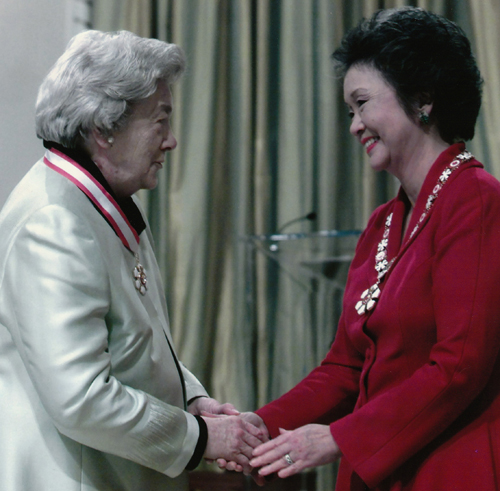
After she retired from the Phoenix Trust, Sister Elaine returned to Canada, where she was made an Officer of the Order of Canada in 2001 in recognition of her humanitarian work. Ironically, when she tried to duplicate the work she had done for the British prison system in Canada, she ran into resistance.
“I suspect because the people I was talking to didn’t appreciate meditation and didn’t know what it could do for human beings,” she suggests.
One of her students, Patrick Gallagher, was with us during this meeting, and he added, “One of the problems in the early days was that Zen didn’t fit into any of the slots that they were used to. It wasn’t a chaplaincy. It wasn’t a specifically religious thing. It didn’t fit. So they didn’t know what to do with it. I think that your Order of Canada helped. You’d been honoured by the country, so you weren’t” – he searches a moment for the proper word – “flaky.”
We all laugh.
In addition to founding the Three Treasures Zendo in Toronto and establishing Sanbo Zen practice in that city, Sister Elaine’s legacy includes the “Freeing the Human Spirit” program in which now currently thirty-six volunteers provide yoga and meditation instruction to incarcerated people in ten Canadian prisons.
She was a remarkable woman, and I cherish the memory of the day I spent with her.
Dec 4, 2001 – receiving the order of Canada from Governor General Adrienne Clarkson
[This post is a reworking of the profile of Sister Elaine I published in Catholicism and Zen.]
With virtually no prompting, Marinda de Beer reviews her early biography, born in South Africa, family moved to Canada when she was 11. Raised in the Methodist/United tradition but pulled away from Christianity when in college, rejecting the concept of God as a judgmental male figure. A 20-year career as a stage manager in Toronto. Happened upon Steve Hagen’s books Buddhism: Plain and Simple and Buddhism Is Not What You Think It Is. The books, she tells me, “came to her”; however, she skipped the chapter about meditation in the latter because she didn’t consider herself disciplined enough to take up the practice.
“Then about thirteen/fourteen years ago, I got to a point where I was very stressed. I wasn’t happy. And I read that book again; I read the meditation chapter this time, and it suggested sitting with people.”
“Why were you feeling stressed?” I ask.
“Why was I stressed? Well, now I think if I look back, it was because I wasn’t paying any attention to my own needs. I wasn’t paying very much attention to my own authenticity. I had basically given myself over to my career and my family. And the idea of sitting and meditating and being with myself, I was doing the opposite of that in the way I was living my life pretty much. You know, with all the right intentions. And I was thinking, ‘I gotta do yoga; I gotta exercise.’ Well, that wasn’t me. I just didn’t believe I was that kind of a person. And also, the theatre world, you’re working approximately sixty hours a week, six days a week And I’m raising two children. I get one day off a week. Like, when do you want me to exercise? It wasn’t happening. So I decided to try meditating. I immediately googled my area, found a place, went and sat twice with four random people on a Wednesday afternoon, enough to get some instructions on ‘just sitting’ – zazen basically – and was doing a show that was touring to Vancouver, and the director of my show had been sitting in the Zen group for many years. And I remember going into his hotel room and saying, ‘Yeah, I’ve started to meditate.’ And I looked over and his cushion was setting against the wall, and he said, ‘Yeah, that’s where I sit.’ And I was like, ‘Oh?’ And he said, ‘Yeah, I sit facing the wall.’ And I was like, ‘What!?’ ’Cause I was sitting on my bed with my cushions. And he sent me a couple of videos from – I don’t know – a sangha somewhere in the States. What I remember from them is that our thoughts are clouds, and can we sit and imagine these clouds passing. And I’ll never forget that image ’cause I just understood it, and it became the basis of my sitting. And I sat every day – not very long, but I sat – and very quickly my life started to change. Within two weeks, I’d say my stress level was reduced by 25%. I could feel a difference in myself.”
“You’re still practising by yourself at this point?” I ask. “Even though the Hagen book said to sit with other?”
“Still by myself. And I started to dialogue with this friend who had been sitting for a long time, and very quickly I was asking him questions which were beyond his capability to be able to help me. I was saying, ‘Okay, these emotions are coming up, but if emotions are just . . .’ I mean, my world was exploding all of a sudden in trying to understand this new perspective on what was going on inside me. And he said, I think you need to talk to Patrick, my teacher.”
“So Patrick and I made a date to meet in the park near Loblaw’s grocery store, and it was August, and we sat on a bench, and I kind of told him what was going on with me and what I was doing. And he kind of talked me through a little bit of technique. You know, just physical technique and also what I was doing when I was sitting. And then he said, ‘I think you would be a pretty good candidate for our group that starts in September.’ And I had just that year left stage management and had tried to go into administration which actually meant I had my evenings free, which hadn’t happened in eighteen years. So, again, it was like, ‘Oh! Perfect. For the first time in my life, I’m actually free on a Wednesday night, and I’m being invited to sit with this group on a Wednesday night.’ And – you know – thus began my journey with Zen.”
Through koan work, Marinda had an opening experience. Tradition holds that people not speak about these or koan work, so I put the question generally, asking if it had made a difference. She doesn’t answer immediately but eventually says, “It made a big difference, and it made no difference.” She pauses again. “I wasn’t able to hang onto it very long. I tried my best, but I came back to the city, and I came back to my life, and – you know – all that happened. And so, in a way, it didn’t. But there is something about, for example, this idea that the opposite of everything is always true. These kinds of concepts for me . . . I think what it did was, it deepened my faith. And my faith is what makes me trust sitting and the truth and wisdom that everything is unfolding as it should. Faith in my journey, even if it has all kinds of suffering. It’s not about everything turning out great, and it’s not about me being ‘happy.’ It’s about it being as it should. And I do think my opening was one in which I understood that on a very deep level in that moment, or in the period of those days, there was a wisdom I already had but didn’t have access to. So this is, for me, a really big thing. The act of sitting every day helps me access something that’s already inside of me, a wisdom that I have. But there’s all this noise that comes. The things that in Buddhism we call attachments are the things that cause our suffering, but also our belief systems, our emotions, all this stuff is noise that can cloud our wisdom of trusting that everything is unfolding as it should, which allows me to accept what is happening. And if I can accept what is happening, then I’m not suffering.”
Sister Janet Richardson is a member of the Sisters of St. Joseph of Peace. I corresponded with her in 2015 as I was preparing my book, Catholicism and Zen, at which time I asked if she were retired. She wrote back to tell me: “I don’t think women religious ever retire. I am not gainfully employed now.”
When she had been gainfully employed, she’d worked for a while at the Holy See Mission to the United Nations. “I was the press officer, a member of the United Nations General Assembly Third Committee which deals with social and cultural affairs, and on the delegation to various international conferences.”
She was nearly 50 years old when she first became involved with Zen. “A colleague at Caldwell College asked me to go on a Zen retreat with her. She was a rock of good sense, so I wasn’t going to get into anything weird.”
“The evening meeting before the retreat began sold me. The topic was Karl Rahner’s work on small communities of prayer in the future of the church. I was a Rahner fan. I never completely understood him, but what I could understand I liked. Our CSJP chapter had committed ourselves to it. We had organized a social development project with the audacious title, Center for Human Development, to respond to the ‘signs of the times’ as we saw them in our neighborhood in Jersey City: families needed food, money for diapers, homeless men came for something to eat. We gathered with groups of the mothers – mostly Latinas and a couple of African-Americans – to pray, to study Paul VI’s Encyclical on ‘The Progress of Peoples,’ and to plan activities to meet their needs as they articulated them. The Center is a fabulous story, I mention it now only to show why Bob’s opening lecture on small prayer groups attracted me.
“As for the retreat itself: Well, you know how painful that first retreat is, how slow it goes. I remember that through the open windows came the sounds of people having fun at the local swimming pool. There were shouts, laughter, the sound of water splashing. The retreatants were facing the wall, and Bob was seated in the middle. It occurred to me, as I sat enduring this, that he had left and was down at the pool enjoying himself. Then the bell rang!”
She recognized that in some way Zen was “something I had been searching for. I shared the experience with the Sisters at home, and we all accepted Bob’s invitation to join his sitting group at St. Peter’s College.”
I asked what she meant by saying that Zen was something she had been searching for.
“Well, spiritual growth is a basic dimension of religious life, and women religious are always getting instruction, going to classes and lectures to that end. Bob’s opening teisho on Rahner was on target, and his approach was the compass here. He also pointed out that zazen was a form of prayer.
“My initial assignment in zazen was to count the breaths to ten and then repeat, being careful not to go beyond 10. Then letting go of the counting ‘since it was a scaffolding’ and just following the breath. When I was introduced to Mu, it repelled me, and I found this practice very unsatisfactory.”
I asked in what way unsatisfactory, and she explained that she felt it was leading nowhere. “Perhaps that was the point, but at the time the discomfort, frustration, and unsatisfactoriness were very negative for me and indicated to me a need for some alternative.” She told Kennedy how she felt, and he suggested she try shikan taza.
Shikan taza is silent, receptive sitting without focusing the attention on any particular support. One is aware of the breath, for example, without having to concentrate on it as in the earlier exercises. It is the standard meditative practice in the Soto School of Zen and is considered an advanced practice in the Sanbo Zen tradition. It is a practice which, following Kennedy, Janet identifies as a form of prayer.
“Prayer is an awareness of God. Bob taught that Zen is a form of prayer insofar as it increases awareness of God. Zen is a discovery path and each of us using the path discovers God as God reveals Herself. The stillness, the awakening to depths and dimensions of an interior life, the presence of others in the same involvement. Sesshin provides samu[1] as an opportunity to collaborate with others who are similarly involved. I remember one of my students telling me that as a Christian, Zen gave her the ‘how to.’ That speaks to me. Was it Yamada Roshi who promised that Zen would make you a better Christian as you emptied yourself as Jesus did? That sounds good to me.”
Ed (Sanshin) Oberholtzer is a Soto priest teaching in the Joseph Priestley Zen Community in Northumberland, PA., the Greater Boston Zen Center, and the Empty Moon Zen Sangha. He is a Dharma heir of James Ford, and – as James was when I first met him some nine years ago – Ed is wearing a Hawaiian shirt when we speak. I ask if it’s a lineage thing. He doesn’t deny it.
“You know, old farts wear these,” he tells me. “We’re actually trying to reclaim them from the Boogaloo Boys.”
When I contacted him, I was aware that he held an affiliate position with the Unitarian Congregation of the Susquehanna Valley and was under the mistaken impression that – like James – he was combining a Unitarian ministry with Zen practice. It took me a while during the course of the interview to recognize my error. He has had a number of careers. He practiced law for ten years, worked in bookstores and libraries, but he has never been ordained in the Unitarian Universalist tradition, although he’d probably be pretty good at.
He left law after recognizing that it was a career path he wasn’t suited for. “I realized that I wanted a profession that was not harmful, and it hit me that I could become a librarian. What could be less harmful than that? And, of course, it turns out that you can be incredibly harmful if you want to be.”
His quest for a spiritual practice came about after his father’s death. “It was one of those lingering affairs. He had COPD. I was by his bedside when he died, and I can remember thinking, ‘This is going to be me.’ You know? ‘What am I going to do about that?’” He was 40 at the time.
He tried a couple of meditation centers which didn’t seem a good fit. Then “I stumbled into the Cambridge Buddhist Association. There was a guy there at that time named Dharman Stortz.”
I don’t immediately recognize the name of the Cambridge group and ask about them.
“They’re Harvard,” Ed tells me. “That’s the best way to put it. The story that I was told was that in the ’50s a group of Harvard professors who had huge book collections wanted a place to keep them, and they created the Cambridge Buddhist Association, and they got D. T. Suzuki to be president.”
In the 1950s there had been a number of wealthy New Englanders – including John and Elsie Mitchell – who developed a semi-academic interest in Zen. The Cambridge group, I remembered, was established by the Mitchells.
“Anyway, I started sitting with Dharman. Dharman made it clear that he wasn’t a teacher and that you really needed a teacher, and I was desperately looking around for a Zen teacher. I started driving out to Zen Mountain Monastery, which was a four-hour drive to get there for a 9:00 service on Sundays.”
It wasn’t a very practical arrangement. Then he learned “they had a sitting group in Framingham that was easier to get to with a bunch of lay people. I went and sat with them, and, at one point, one of them said, ‘You know, there’s this guy who’s just shown up in the Boston area who does koan practice.” The guy was James Ford.
“He had a group that he was meeting at the church he had in West Newton, and there was kind of a satellite group with another teacher in a really, really appalling dark basement room in Sommerville. It was so small you couldn’t do kinhin.[1] When the bell rang, you stood and that was it because there was no place to actually walk. And once a month, James would come, and he would do dokusan.”
After a period of working with James, going through the koan curriculum, Ed decided upon another career path and sought ordination. I ask him what he imagined his role as a Soto priest would be.
“It was primarily pastoral. That’s what was really clear about what James had to offer and what he expected from the people he ordained. He sees us as ministers, as someone taking care of a congregation, of a sangha.”
Although his ordination is through the Soto lineage, Ed is also in the Harada/Yasutani lineage through James’ work with John Tarrant. Koan work is central to the latter but not necessarily. the former, and Ed has completed the Harada/Yasutani koan curriculum.
“Koan practice is fun,” he tells me. “It is an enormously amusing form of something that is deadly serious. And that if you can’t laugh . . . well . . .”
I ask what he sees the purpose of Zen practice to be, and he answers personally.
“It’s about me wanting to know who I am.”
“And how does it help you do that?”
“I sit quietly, and I look. And I ask myself, ‘Who am I? What am I?’ My grandmother’s best friend was the registrar at the Harvard Business School for a long time, and I remember her sitting there and shaking her head and saying, ‘You know these people, they don’t have time to greet their own souls.’”
It’s a lovely phrase which stays with me for a long while after our conversation.
It was at the suggestion of Bobby Rhodes that I made contact with Richard Shrobe. I found him listed in Wikipedia as Wu Kwang Soen Sa Nim. Members of the Kwan Um school had also referred to Seung Sahn as “Soen Sa Nim”. So when our conversation began, I asked Richard if he were now the head of the order. He admitted that he probably was for North America, but that, in fact, Bobby Rhodes was the Head of the Order. Well, I had missed that entirely during my conversation with her.
Soen Sa Nim, it turns out, is a title meaning Zen Master. Soen is the same as Zen; Sa means master; and nim is an honorific. So when members of the school used it to refer to Seung Sahn—or to Richard or to Bobby—it was much like members of Japanese Schools referring to their teacher as “Roshi.” Both Richard and Bobby wear the title lightly. At the time I spoke to them, they also both had “day jobs” by which they support themselves. Kwan Um teachers don’t make a career of it. Bobby Rhodes was a hospice nurse. Richard was a psychotherapist. One gets the sense that the Korean school, on the whole, is a little less stiff, a little less formal, than Japanese schools can be at times.
Richard is a former jazz musician and hard-drug user. “The two kind of went together.” When he realized he needed to do something about his life, he, his wife, and young daughter moved into a Hindu Community run by Satchidananda. It was the ’60s. Satchidananda was the opening speaker at the 1969 “Woodstock Music and Arts Festival”—the one with Jimi Hendrix, Janis Joplan, and the Jefferson Airplane.
Five years later, Richard decided that the Satchidananda’s Integral Yoga program wasn’t doing all that he’d hoped it would, so the family moved out. Later, he learned about Master Seung Sahn and found his teacher.
He had been raised in a Jewish household. I ask how his family responded to his interest in Eastern religions.
“Well, I think,” he says with a laugh, “the fact I wasn’t using drugs anymore meant something. But also I remember periodically my father would ask me—both when I was practicing with Swami Satchidananda and later when I was practicing with Seung Sahn—he would ask me things like, ‘Is Zen a religion or a way of life?’”
“It’s a good question,” I admit.
“Right. And I remember one day asking him, well, exactly how did he see the difference in those two? You know? And first I would initially answer him it was more a way of life than an organized religion as such. But that’s not totally true either. But—you know—it’s true to a large degree, I think. But he never had an answer when I put it back on him.”
Richard wasn’t, he admits, one of the students who went out of his way to attend every retreat or rush off to Korea. He made it clear early on that he was intent on balancing family, career, and his Zen practice. But he was committed to the practice, and eventually Seung Sahn gave him inka—the first of two stages of authorization. The second—transmission—came some time later.
When I ask Richard what the function of Zen is, he tells me: “Zen is a practice of becoming clear, returning to your original mind before concept, opinion, and idea.” It is the same answer I’ve received from teachers in Japanese-based lineages. I ask Richard if he believes there’s any difference in the way the Japanese Schools and the Korean School approach this function. “Not fundamentally. The flavor might be a little different in terms of the cultural underpinnings.”
An interesting aspect of Kwan Um training is that, before a student is given inka, he or she is sent to visit a number of Japanese Zen sites in North America to undertake Dharma Combat with the teachers in those centers. Richard sat sesshin with Taizan Maezumi, Eido Shimano, and others.
The Kwan Um School makes use of the same koan (kong-an in Korean) collections as the Japanese Rinzai—the Mumonkan and the Blue Cliff Record. But their approach is a little different. Early in their training, students are assigned an initial kong-an such as “What is it?” which if dwelled upon with sufficient sincerity and perseverance will help the student arrive at what they call “Don’t Know Mind.”
“It’s like the story of Bodhidharma,” Richard tells me, referring to the opening case in the Blue Cliff Record. “When he’s before the Emperor Wu, and the Emperor asks him, ‘Who are you?’ Bodhidharma says, ‘Don’t know.’”
Ruben Habito, a former Jesuit priest, is the founder and teacher in residence at the Maria-Kannon Zen Center in Dallas. He was born in the Philippines in 1947. His father was a university professor, and, as a young man, Ruben was aware of his family’s privilege. “I did not suffer the hunger or the deprivation or the discrimination or illness or the things that many of the people in my country had to – and still have to – undergo.”
He questioned how God could allow the suffering of so many innocent hardworking people and spare others. “There is so much injustice in the world, so much unfairness and so much suffering. And how can this be allowed if God is all-powerful and all-loving and so on. And so the basic question of whether God did exist or not became very acute for me.”
“Did you ever resolve those questions?” I ask.
“Uh . . . I’d say the jury’s still out on that one,” he tells me with a smile.
The questioning eventually led him to enter the Jesuit novitiate. And while studying there, he had a chance encounter with an American missionary returning from Japan to the United States in order to complete his final year of formation. The young priest was Robert Kennedy, who – by his own admission – had had no interest in Zen during his posting to Japan, although years later he would later become a student of Koun Yamada Roshi and eventually a Dharma Heir of Bernie Glassman.
“He gave a talk to the novices about how Japan was a very challenging place for Christians because they were less than 1% of the population – half of them Catholic, half spread among different Protestant denominations – and that it was a country that was gradually becoming secularized and losing it spiritual heritage.”
The talk inspired Ruben to apply to be assigned to Japan.
His first task was to learn the language. “I was in the language school in Kamakura and our spiritual director happened to be Father Thomas Hand[1] who had already started practicing Zen for some years before I arrived. And he advised me, ‘To deepen your spiritual life and also to really deepen your knowledge of Japanese culture, why don’t you come with me and join me in sitting in Zen with this group.’” The group was Yamada’s Zendo. “There were several Jesuits who were practicing Zen and integrating it with Jesuit spirituality.
“So when I came to Zen practice in my early 20s, we were just given simple instructions on the basic principles of taking a proper seated posture conducive to stillness and then of being aware of the breath, then allowing the mind to be calm and focused in the here and now. And so I found that very nourishing and direct. And I discovered it was a way of really arriving at the very place that St. Ignatius leads an exercitant who goes through his Spiritual Exercises. Spelled out briefly, in the Jesuit exercises we go through the first week meditating, using the discursive intellect to consider human sinfulness with a view to experientially realize the problematic nature of the human condition and be able to see clearly all of those things that need to be straightened out in our human way of living. This is the stage of purification.
“Then, in the next phase, the second week, we begin to set aside the discursive mind and are led to a more simple contemplative practice. We are now instructed to just ‘behold’ the words and actions of Jesus, to contemplate this looming figure of Jesus with a view to ‘putting on the mind of Christ’ in one’s own life and way of being. The point of this second week – a state of Illumination – is to become one with Jesus through listening to his words, watching his actions, and absorbing all of that into one’s own being. In going through the contemplative exercises of this second week, one comes to understand that to follow Jesus does not simply mean ‘imitating Jesus’ in a way that one looks at a model of behavior from a distance. Rather, all this leads one to embody the mind and heart of Jesus in one’s own life, to become an ‘alter Christus’ in all the dimensions of one’s own human life, infused with divine grace of course.
“The third week is a stage that involves a death to one’s own egoistic self, to die with Jesus on the cross as it were. This – and the fourth week – is the stage wherein one experiences the newness of life in the Risen Christ. To be one with Jesus in the risen life is to behold the divine glory permeating the entire universe. The third and fourth weeks are referred to as the stage of union, wherein one’s life is seen in the full light of divine grace and is lived in union with the divine will. So that final stage – the summit of the exercises, called the Contemplation on Divine Love – consists in simply resting in divine love, beholding everything in the light of this love.
“Now that is exactly what I found most directly and intimately in this practice of Zen. It is simply a practice of just sitting there, breathing in and breathing out, without any need for any kind of discursive or mental efforts, but a practice of just allowing that unconditional love to permeate through one’s entire being. It is allowing oneself to be immersed in that unconditional love, sitting there opening one’s entire being to allow that to happen. That’s where I found the point of convergence between Zen and the Spiritual Exercises.”
Joen Dempsey is a practitioner with Thousand Harbours Zen in Halifax. She grew up in the community of Herring Cove, just south of the city, which is the current location of the Theravadan Atlantic Buddhist Meditation Center, whose facilities Thousand Harbours used for day retreats prior to the pandemic. I interviewed her, however, during the period when restrictions were in place and groups like Thousand Harbours were only able to meet through Zoom.
She tells me that when she reflects on her childhood, “I actually remember looking forward to being an adult. I remember explicitly thinking, ‘I can’t wait until I’m an adult.’ And I remember in my late 20s feeling like I’d come out the other side of a dark tunnel. It sounds so bleak. Who knows why?”
She uses terms like anxiety, depression, and even trauma. Which may be a factor in why at the time I interviewed her she was training to be a clinical psychologist.
One of the ways in which Zen has been viewed by people in the west is as a form of Eastern Psychology. The Zen popularizer, Alan Watts, wrote a book on the subject, entitled Psychotherapy East & West. I find myself wondering how closely related psychology and Zen actually are. Joen believes the goals are different.
“When I think about Zen, if you have a goal when you sit down to do zazen, then there’s something wrong with that picture already. That’s how I’ve been trained and how I practice. That ‘simply sitting’ is the point of Zen. Being present. Maybe it is like making friends with oneself. People talk about that in Zen, and it kind of resonates with me, the idea of getting to know oneself not in a discursive way where you’re asking probing questions and responding internally or anything like that. But where you sit and notice and see and being okay with that. That’s what I understand Zen to be about.”
“If one sits without a goal,” I suggest, “doesn’t that imply it’s purposeless? Why would you do it if it were without purpose?”
“Because it’s honest. It feels honest.”
“Honest in the sense that one doesn’t have an intention?”
“For me the reason to do it, despite no goal, is that it feels like an honest thing to do. I’m being truthful with myself; I’m being authentic in the moment. I’m not avoiding; I’m not trying to escape. So, I guess, to be more in touch with the moment, to be more in touch with reality. I think these are important reasons to sit. Just with the caveat that if one sits down with the idea, ‘Okay, now I’m really going to get in touch with reality,’ then you’re projecting yourself onto reality and you’re not doing it anymore.”
“And what are the goals of psychology?”
“Well, the goals of psychology are the goals of the person you’re with. So, in my training the goal is understand a person’s suffering and then help them to make changes.”
“Are the issues which lead people to Zen similar to those that lead them to therapy?”
“Well, I’m told that there are people who are drawn to Zen because they have spiritual curiosity, or they’re interested in enlightenment. So, that, obviously, is quite different from the folks that I work with. But do you mean, ‘I have mental problems, so I want to try Zen’?”
“Is that what people say when they go to a psychologist? ‘I have mental problems, I need help’?”
“Sometimes. But usually there’s a problem. They come to you because they have a problem. And I started sitting in Zen because I had a problem. But in psychology, the problem has to be inside you. I can’t help you with your husband; I can help you with how you respond to your husband – that might help your relationship – but I can’t change anybody else. So, yeah, you come to psychology with an internal problem. Now, a lot of people actually don’t. A lot of people come to psychology with an external problem. Then the job of the psychologist is to help them see whether there is or there isn’t an internal problem that can help them with their external problem.” She pauses a moment. “I’ve been thinking about this a lot because of this kind of dual interest in my life or occupation or what have you. So I wonder if in a way Zen sort of opens a door to introspect, to seeing oneself in context, seeing the patterns in one’s mind, and seeing how one responds habitually. So, it can be informative in a psychological way, particularly on retreat or something, if you’re interacting with a lot of people, and you’re starting to anticipate responses from them that they have given you reason to anticipate, then you begin to see the way that your past experiences inform your anticipations of others. Basically, your psychology – how you understand others now – is based on how you understood others in the past. And Zen can help you see those things and identify them and understand them through meditation and through community. I think when people have a clinically significant problem that they’re seeing a psychologist for, I’m not sure Zen would help them see these patterns. And I know that for some populations, some forms of meditation can be counter-indicated depending on the type of mental issue the person is working with. But the ability to introspect and to understand oneself in context, I think, can be compromised by one’s life history to the degree that psychological intervention – that’s just not about ‘look inside and see what’s there,’ but that’s more structured – can be helpful in ways that I don’t think Zen could be helpful.”









 Richard Bryan McDaniel