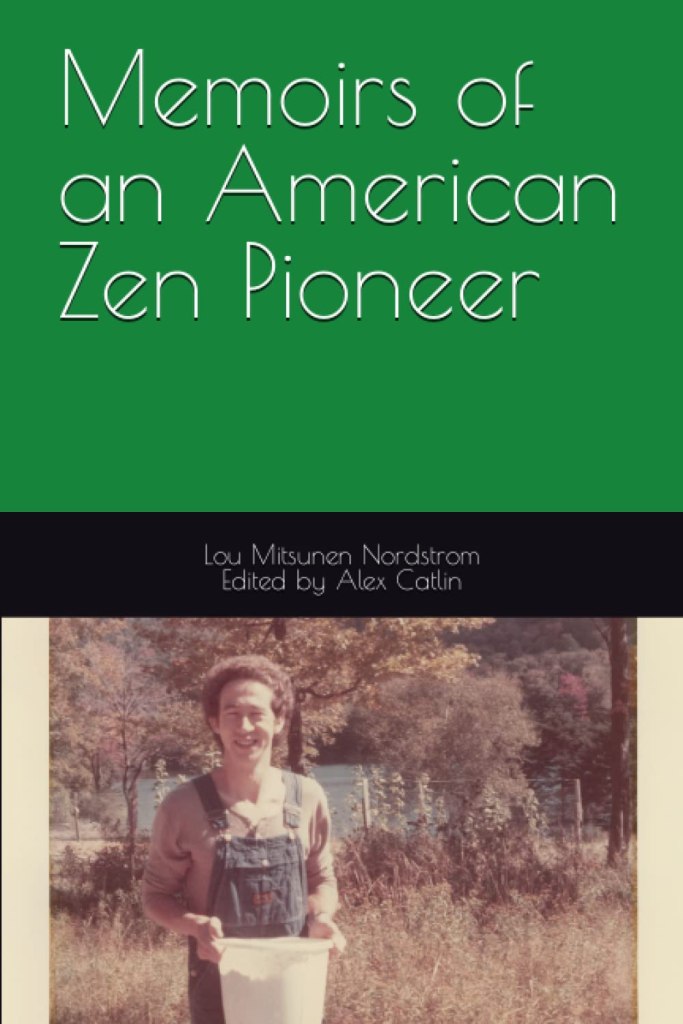
I have not interviewed Lou Nordstrom. This profile is gleaned, in part, from his book, Memoirs of an American Zen Pioneer.[1] My only communication with him was through a student who replied to my request to quote material from that book. The student wrote back: “Lou says of course it’s okay for you to use his quotes. He said you have good taste.”
Shinge Chayar
I first heard of Lou when I interviewed his former wife, Shinge Sherry Chayat, who – at the time I met her – was abbot of the remarkable Dai Bosatsu Zendo Kongo-ji monastery outside Livingston Manor, New York.
I visited Dai Bosatsu in June 2013. I had only been conducting interviews for three months at the time, and it was the 14th stop I made. I have admitted elsewhere that Dae Bosatsu was the only place I visited in those first few months where I did not immediately feel at ease. I suspect I would be less uncomfortable were I to return there now that I have completed 300 interviews and gained a clearer understanding of the breadth of practice on this continent.
I was received graciously and warmly. Shinge herself was easy to talk with; she was relaxed and forthcoming. But my feeling while I was at Dai Bosatsu was of people play-acting; another teacher would call it “cosplay” in a later interview with me.
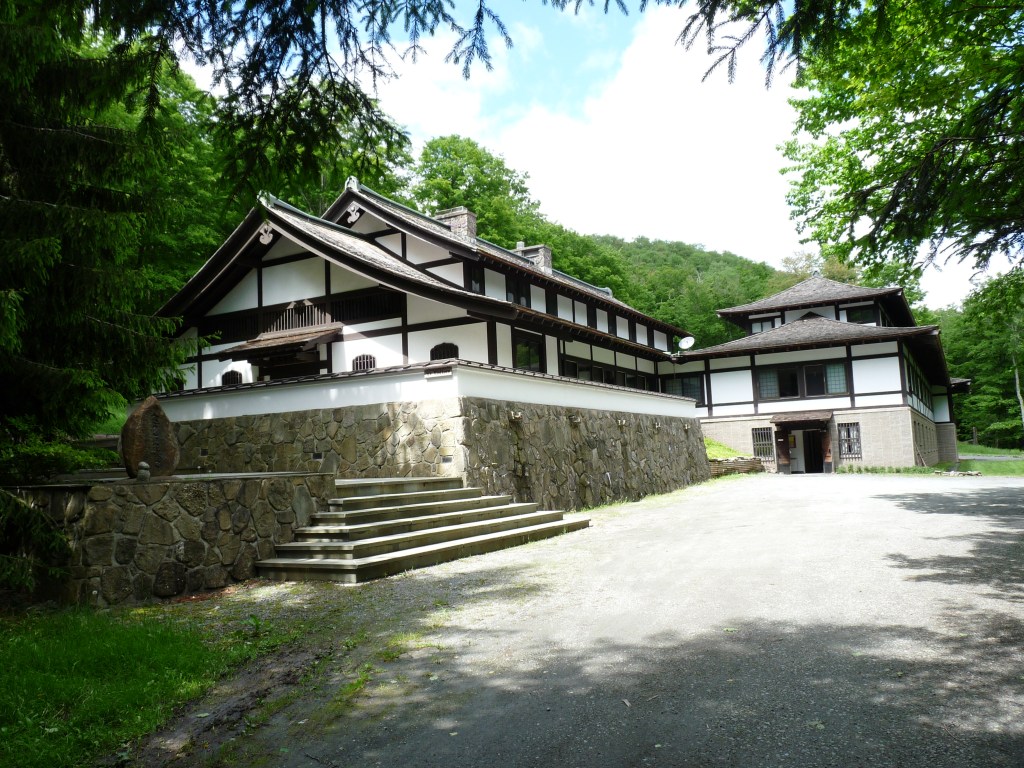
About fifty miles away from [Zen Mountain Monastery], on the other side of the Catskills, is Dai Bosatsu Zendo Kongo-ji, the first Rinzai monastery to be built outside of Asia and arguably the most significant architectural accomplishment of North American Zen. It’s not an easy place to get to. One travels along a narrow county road and then up a gravel lane which was partially eroded by the rain at the time of my visit. I had thought that Zen Mountain Monastery, with its 235 acres, was large, but the front gate of Dai Bosatsu is still two miles from the main buildings. This 1400 acre property includes Beecher Lake—the highest lake in the Catskills—and what is now the guest house had been the hunting lodge of Harriet Beecher Stowe’s brother. It is a two-storey L-shaped structure with a steeply sloped roof and is pretty much what one would expect a wealthy 19th century family to have built as a private mountain getaway, although one marvels at the effort it must have taken to construct it here. Across the lake, there is a large bronze Buddha seated on a boulder gazing serenely across the water.
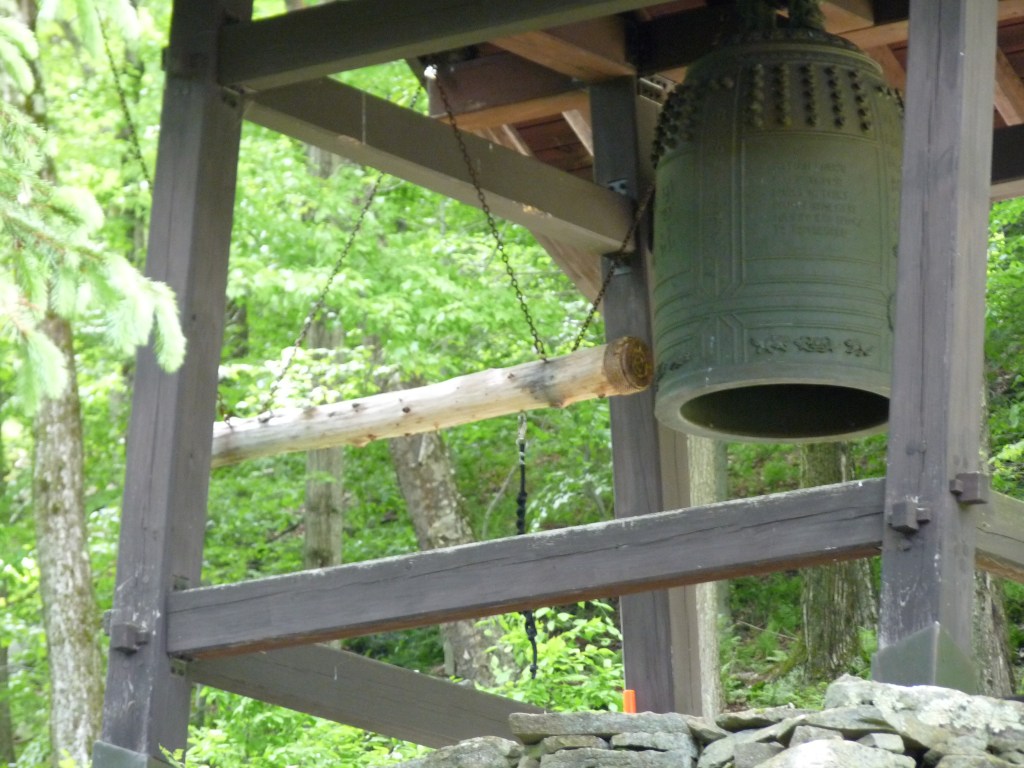
But any sense of wonder at finding the Beecher family’s lodge hidden back here is quelled when one notices the monastery building itself. A local architect, Davis Hamerstrom, had traveled to Japan to study Zen architecture in Kyoto and, using imported craftsmen when necessary, had recreated a traditional Japanese temple complete with classic tiled roof, tatami mats on oak floors, and sliding shoji screens (inside storm windows). There are stone lanterns on the grounds, a huge bronze bell—sounded by a log suspended from chains beside it—and, within, there are antique Asian treasures. The whole is a work of art.
From the moment I was met at the door by a young, robed monk, I felt challenged by Dai Bosatsu. It did not help that the monk’s first words to me were a warning to be careful while walking back to my car because the ticks carried Lyme Disease.
Dai Bosatsu is unquestionably beautiful; architecturally, it is magnificent. But it is also—as the man at the diner [who had directed me here] had said—Japanese. The monk who greeted me is not, but, when I call to him after he shows me my room, he turns and responds with a sharp, “Hai!” At lunch, a Japanese woman seated opposite me wordlessly demonstrates how to use the three nested jihatsu bowls, precisely where to place the chop sticks, how to unfold the napkin. Nor am I used to having someone kowtow before me after serving tea.
I recognize that to some degree it is a matter of taste. The very elements which make me slightly ill at ease might give others a sense of the authenticity of the practice here, a feeling of being immersed in a tradition with a vibrant cultural and aesthetic—as well as spiritual—heritage. And then, of course, is not part of Zen surrendering what Shinge refers to as “agency,” those personal preferences we cling to so tenaciously?
It is a style of Zen practice that Lou would come to eschew, although he and Shinge were both instrumental in establishing this marvel.
They came upon Zen almost by accident. They met in New York. “He was doing a Ph. D. in Western religions, writing a book on Plato. Columbia,” Shinge tells me. “And when we decided to get married I asked him, ‘Can we have a Zen wedding?’ he was in love and said, ‘Okay.’”
In Lou’s rendition of the story, the suggestion occurred while on LSD. It isn’t a trivial detail. Psychedelics played a significant role in the Zen boom of the 1960s and ’70s.
They looked in the phone book under Z and found that the Zen Studies Society was only four blocks away. They walked over. “I was wearing my little mini-dress,” Shinge continues, “and Lou’s hair was probably a huge Afro. He was white, a white Afro. Part Cherokee, part Norwegian. So we probably cut a very un-Zenlike couple.”
Eido Shimano answered the door. “He looked us over. And we told him what we wanted, and he said” – she imitates his accent – “Mmm. Well, come in for tea.” So we did. Had a cup of tea. And I gather he felt our sincerity was enough that he would do it. And when we went back to discuss details, he said, ‘You’re very fortunate, this karma. Yasutani Roshi is coming. He will be here September 2nd, wedding date, he will conduct your wedding.’ Okay. Fine. We had our circle of friends. I remember telling them, beforehand, ‘You cannot get high before this! You have to come straight! This is a Zen temple!’ So . . . who knows? But they were there, and we had a wonderful wedding ceremony that no one could understand. And we lived on Riverside Drive and—you know—started sitting. It was kind of funny. This is what I’d been searching for. I had to get married to find it!”
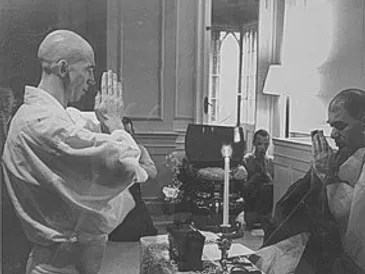
Eido Shimano and Lou
Lou describes them as a “Zen couple,” which he acknowledges was both a strength and a weakness. Although they eventually separated, they were together for a long while and even after their paths diverged, they both remained engaged in Zen practice.
In his memoirs, Lou describes the psychological baggage he carried which Zen practice would help him deal with. The opening essay in the memoir, taken from a teisho he gave in 2021, is entitled “Zazen Saved My Life.” His mother abandoned him when he was only 3 years old, and he was raised by his father’s parents, who he describes as senile and hating one another.
He was academically gifted and earned a Ph. D. from Columbia. He was teaching at Marymount College in Tarrytown, New York, when he attended his third sesshin with the Zen Studies Society, during which he had an experience of – using Zen language – “body and mind dropping off.”
“There was an incredible explosion of light, coming from inside and outside simultaneously, and everything disappeared into that light. I felt completely suffused by this light, which seemed ‘joyous,’ and swooned into a condition of absolute non-entity for an indeterminate lengths of time.”[2] The tense atmosphere of sustained practice in Rinzai sesshin can be conducive of such events, and the initial goal of that practice is specifically the attainment of what is called “kensho.” Ken [見] “seeing”, sho [性] “true nature.” But without someone to identify the experience as kensho, one wouldn’t necessarily realize that was what it was. In fact, Lou at first suspected it was a psychotic break. He continued the practice seeking an enlightenment he had already experienced.
He would later point out that the Soto school of Zen faults Rinzai for equating kensho with enlightenment. For Soto practitioners, enlightenment is “a transformed perception of . . . reality, along with transformed action and thinking.” In Soto Zen, “traces of enlightenment experience must be eliminated by ‘actualizing’ it, by fully integrating experience into the fabric of one’s life.”[3] That understanding was still in the future, however.
Shinge and Lou became active members of the ZSS community and were on the board when the decision was made to purchase the Beecher Lake property. In 1974, just before construction started, they came up for the summer as co-directors. In her conversation with me, Shinge describes the time as a great adventure.
“Lou was teaching at Marymount College in Tarrytown, and I was working there as publications designer in the PR department, and, when the end of the summer came, we didn’t want to leave. So Lou gave up a tenured position, and we stayed on. And that year, construction of this building began. We lived with five other people in the original building down the road. It was extremely cold. We had no heat, and it was a really hard winter. We would have to go out in a little pickup truck and throw down shovelfuls of salt and sand so the construction vehicles could keep coming up. And—as you know—the road is not an easy one to come up even when it’s in fairly good shape. It was not a good road then. It was an exciting time. We were real pioneers. No one knew what this would be like. Eido Roshi had a vision. We started with great idealism, and, in a way, everything was kind of up for grabs. How we were going to form this community, and how much it would find its shape in the Rinzai container of Japan and China. How much it would find its own shape. It grew organically.”
Lou’s description of living on the site as the temple was under construction is less sanguine. The rigidity of Rinzai practice, the hard labor involved, and the natural proclivity of the young Zen students to treat the experience as a form of summer vacation did not mix well together. He was in the position of “foreman,” and so the object of complaints when the demands made of the students were too strenuous. “The heavy formality of Japanese Zen tradition and the light informality of American life attempted unsuccessfully to co-exist peacefully.”[4]
He was also engaged in editing the papers of Nyogen Senzaki, who had died in 1958. Lou describes falling in love with Senzaki’s writing, in particular the emphasis he put on deinstitutionalizing Zen. The irony that Lou himself was actually engaged in the founding of an institution in the Catskills was not lost on him.
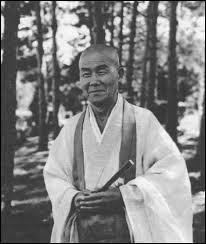
Soen Nakagawa
Then during Rohatsu sesshin in New York with Soen Nakagawa, he discovered during dokusan that his experience from the earlier sesshin was the sought-for kensho. Soen confronted Eido to ask why this had not been acknowledged. The fact that could have had kensho without realizing it led Lou to realize that Rinzai practice was – as he put it – “no longer suitable.” But by this time he was already ordained a Rinzai monk.
Eido Shimano claimed to have built Dae Bosatsu in honor of his teacher, Soen Nakagawa, but when Nakagawa visited, he felt it was unnecessarily luxurious. In his journals of this period, Peter Matthiessen expressed doubt about the necessity of using exotic materials – like Tasmanian Oak – in the construction of the monastery. Lou served as Nakagawa’s “assistant,” and heard him say that no true student of the Dharma would come there.
Eventually it was the revelation of Eido’s inappropriate sexual relationships with students that caused the community to come apart. Both Shinge and Lou left, although he admits it wasn’t just the sex scandal that led him to leave. “I left also because I wanted to leave.” Shinge later was convinced – inaccurately as it turned out – that Shimano’s changed had changed, and she returned. Lou did not. He went back to college teaching.
After leaving Dai Bosatsu, he received a letter from Taizan Maezumi inviting him to come to California and serve as Executive Director of the Zen Center of Los Angeles. He declined the offer. Later he was teaching a course at the Naropa Institute in which he identified the elements of Zen practice with which he quarreled. Maezumi was one of the attendees and met with him afterwards to commend him on it. He said he’d like to make Lou one of his heirs. The first step, however – he explained – would be to help Bernie Glassman establish the Zen Community of New York in Riverdale and begin koan practice with him. After that, he could come to LA to complete the transmission process.
“How strange! Just when I was thinking that I’d left Zen practice – temporarily at least – here I was being offered Dharma transmission. It was an offer I couldn’t very well refuse.”[5]
Lou with Bernie Glassman
His marriage to Shinge ended. He moved to New York and worked with Glassman. He ceased to be a Rinzai monk and eventually ordained as a Soto monk.
The people who were attracted to Glassman were very different from the people Lou had previously been with. He describes them as “an impressive group of sophisticated intellectual professional people from New York. Not the young dropouts I’d been used to.”[6]
When the situation in Los Angeles was rocked by the revelation of Maezumi’s alcoholism and serial affairs, Lou was disappointed and had no intention of going through that again, so took Glassman as his primary teacher instead. That, too, would prove to be a doomed relationship.
Bernie eventually decided to turn the community into a social enterprise and started Greystone Bakery. It would be written up later as a prime example of how social enterprise can work, but it ruptured the community. “Bernie had the idea of running a bakery,” Barry Magid told me, “which ended up destroying the community because the work-practice just took over the place. There had been this big community center in Riverdale which they then got rid of, and they just moved up into Yonkers for the bakery, and that whole thing imploded.” Lou describes the condition of the students as “cheap slave-labor working in an oppressive sweat-shop atmosphere . . . [Bernie] singlehandedly destroyed what we’d worked so loving to create.”[7]
Lou had now been disappointed by all of his teachers, Eido Shimano, Taizan Maezumi, and Bernie Glassman. Zazen may have saved his life – he writes – but it also broke his heart.
The memoir, he admits, was an attempt to define the relationship between Zen and his personal life.
I’ve abandoned my life in favor of a Zen-practice life, and I’ve abandoned my Zen-practice life in an attempt to find “my life.” And then this morning I realized something wonderful: I’m no longer in a relationship to or with Zen – I AM IT! IT IS I! This isn’t meant to be boastful; it is the point of the practice. TO BE ZEN. To embody it so that there’s no longer an “it.” Embodying it doesn’t mean being the exemplar of some ideal state of affairs. It means IN YOUR BODY, BEING IT! “This very body is the body of the Buddha.” And I realized that, miraculously enough, I no longer experience my life and my Zen-practice as separate. They are not-one and not-two. There is the lonely old man hoping to fall in love again; there is the old man “SITTING ALONE,” all-one. Not lonely, just BEING ONE. Loneliness and aloneness are not separate. Zen as the loved-one was after all a phantasm, to whose courtship I devoted much of my life. The phantasm has been revealed as a phantasm, and therefore the story of my relationship to Zen has also been revealed as being the tale of my pursuit of a phantasm.[8]
He had informal authorization from Maezumi to teach, and on the basis of that began to lead retreats. “I decided that I would just be a maverick, anti-institutional Zen teacher who would honestly declare that he didn’t have the Sensei title.”[9]
As it happens, after accidentally running in Bernie on the street in New York, the two were reconciled and in 1998 Bernie gave him transmission, making Lou a formally authorized Zen teacher, who taught in North Carolina and Florida until his health prevented him from continuing to doing so.
 Richard Bryan McDaniel