American Zen Facebook Page
Zenki Salad has cycled through a number of careers. He was a New York cab driver, he was a teacher of the deaf, he taught English in Japan, he held a number of adminstrative posts both in hospitals – including the Cedars-Sinai hospital in Los Angeles – and with the enterntainment group, Viacom, he became a lawyer, and eventually a therapist. He is now in his seventies and is beginning formal training to become a Zen Buddhist priest. He is also the chief administrator of the American Zen Facebook page.
He grew up in Brooklyn but tells me he moved to Los Angeles the day he graduated from college. “And out there in Los Angeles there was this bookstore called the Bodhi Tree that had many different rooms, and each room is dedicated to another thing. And when I went into the Buddhism room, I was kind of drawn into that room. And I started just picking out a few books on Buddhism. Just basics of Buddhism. I was starting to read these books and really feeling that, ‘Oh, wow! This is actually showing a very valid way to live if you can live by these principles.’ But I was a very young man; I had a whole head of hair; I was attractive. It was hippie time with lots of sex, drugs, and rock ’n’ roll, and when I was reading in Buddhism about ‘letting go of your ego,’ and ‘letting go of the self,’ I was like, ‘No. I don’t want to do that. I’m too young. I just want to go out and party and have fun. I don’t want to let go of my “self.”’ You know? My ego was a cool thing. So I told myself, ‘I’m going to put this Buddhism in my back pocket.’ Which is exactly what I did. I just always kept it in my mind, and I never really did anything about it. I never said I was a Buddhist or anything, but I guess I was meditating at that point. I was doing, like, transcendental meditation. I took a course in that.”
In California he worked in a school for the deaf and later took up secretarial work in health care. He even spent a year teaching English in Japan. “I have this total Japan-fixation. The only way I can explain this – and I don’t really believe in this – but I must have been Japanese in a former life. This Japanese woman opened up a store on Flatbush Avenue when I was a kid, and it was the weirdest thing. She was in full kimono. She had come from Japan, and she had opened up, like, a curio shop. And I would go there everyday to hang out with her as a kid.”
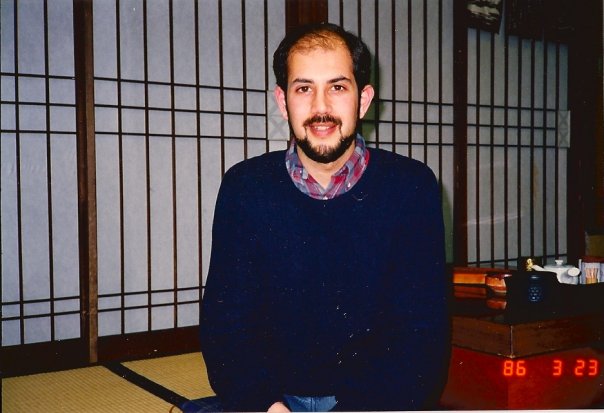
He lived in Japan for a year. “But I was not a Zen Buddhist then. So that realm didn’t touch me at that point. Then I came back to California, ’cause the year was up, and I was working in a hospital as a nursing administration manager, and both my parents got really ill. My dad got cancer, and my mom’s kidneys failed, and she needed a transplant. So they needed me to be there. My father was just lookin’ at me, like, ‘Please. I don’t have anybody else.’ And so I moved back to New York to take care of them.”
He was forty at the time and a long while had passed since he’d browsed the volumes at the Bodhi Tree bookstore.
He took a job in the financial department of Viacom but had difficultly with one of the men he was supposed to assist. The situation became so difficult that one day the idea came to him that he needed to “detach” himself from this individual. “I started hearing this word, ‘Detach.’ You need to detach from him. You have to detach from this situation.’ And I kept hearing that, and I wondered, ‘What is that?’ Then I realized, ‘That’s Buddhism talking.’ And so I said, I have to get back to that; I have to explore that and figure this out. So I was living on the upper east side of Manhattan at the time, and I used to walk by this place all the time. It was this beautiful carriage house front; it had a plaque on it, and it had Japanese writing on it. And I would think, ‘Isn’t that pretty?’ And I’d walk by. But one day it caught my eye, and it said something like Zen Something Institute.[1] Something like that. And I said, ‘That’s Buddhist.’ And so when I got home, I looked it up in the phone book and called them up, and they said, ‘You can come here and we’ll do beginning instruction.’ I had yet to be trained how to sit. So I went. And there was a handful of us, and this guy with a brown robe came in, and it turned out to be Eido Shimano’s place, which is still going. And this guy – not Eido Roshi – was so nice and peaceful, and he showed us how to sit. To do zazen. You know, how to count your breath.”
Zenki tells me he took to the sitting “like a duck to water. I was just, ‘Wow! This is amazing! It’s calming me down. It’s getting my mind still so I start to make some decisions about this guy at work. I just really liked it; I liked meditating every day in that kind of situation. But I also felt that that particular place at that particular time was a little bit colder. It was very chilly in there. I don’t mean the temperature; I mean the atmosphere of the individuals. It just seemed I wasn’t really welcomed there as much as tolerated. Like, ‘You beginner meditators, you go sit in the back.’ So I practiced with them for about three months, and then I went back to the phone book. Looked up Zen Buddhism, and, sure enough, there was another place on the west side called Fire Lotus Temple which was a satellite temple in New York City of Daido Roshi’s Zen Mountain Monastery in Mount Tremper in the Catskills in New York.”
It can take a few tries before finding the sangha in which one feels at home. This group was run by Myotai Treace, with whom Zenki immediately felt at ease. “I am still in contact with Myotai; I love her dearly, and I am eternally – eternally – grateful to her and Daido for giving me the best foundation in Zen practice. So lucky!”
However when Myotai and Daido ceased being romantic partners, the community was fractured. “I wound up practicing informally with Pat Enkyo O’Hara at the Village Zendo. And she was lovely. She was kind of like a sister Dharma person. And so I went to the Village Zendo and practiced there for about three years, until I left New York. But informal. I did not take her as a teacher, and – you know – I went there when I felt like it.”
He didn’t, however, leave New York before getting a law degree by attending night school classes.
“While I was in law school, they had this program where you could go to a foreign country for a semester and practice or study the law in that country. So I went back to Japan. And the program was in Kyoto, and as fate would have it, the American guy that was running the program found out that I was a Zen Buddhist, and he said, ‘That’s incredible. I am too.’ And he said, ‘Do you want to practice at a temple here?’ He didn’t say it at the time, but it was the temple Ruth Sasaki started, and it was in Daitoku-ji, which is the gigantic mass temple complex; it was this little temple on those grounds.”
The abbot was of leery about taking Zenki on until he demonstrated he was able to sit properly and then he was welcomed. “Before I went to school, I would ride my bike there every day and sit with him. He was the nicest, most wonderful person. He died of cancer just a couple of years ago. But he let me sit with him. What an experience to sit in that temple! I’ve been very fortunate how Zen has touched my life in terms of people that I was able to practice with.
“Then I came back from there, graduated, and then I practiced law for a while in New York, but – corporate law – but I didn’t really like it all that well, and the last job I had there was pretty awful. And I got sick of being in New York. It was not holding its allure for me anymore. My parents were dead, and there was nothing there for me that I needed to be there about. And I wanted to get back to the California kind of lifestyle, but I couldn’t afford it. California had become so expensive. So I started to explore Florida.”
He landed on the gulf coast of Florida and eventually found the Tampa Zen Center.
“It was run by an old, old hippie student of Suzuki Roshi from the San Francisco Zen Center. She had been a student of his in the ’70s. So she opened up this little place, Tampa Zen Center, and I kinda liked it because it was very grassroots. And I liked her at first, and I was interested in this Suzuki Roshi, and I was interested in this San Francisco Zen Center. So I started reading about him; I read his book, Zen Mind, Beginner’s Mind and really liked it, really was enjoying getting to know this Soto group because my background was White Plum. And I said, ‘Soto is nice. It’s more relaxed, and it seems a little lighter. It’s like White Plum Lite.’ And at one point they had a Branching Streams meeting in San Francisco, and we represented Tampa in the Branching Streams meeting, and I fell in love with that place like there was no tomorrow.”
The first San Francisco Zen Teacher he worked with was Reb Anderson, then, when that didn’t quite work out, he met Blanche Hartman. “I asked her to be my teacher, and she accepted readily. Told me to just come on out – I was living in St. Petersburg – and take jukai with her. I became her student in 2008 and then went back there to take jukai in 2009. Blanche was the greatest human being I ever met. She accepted me unconditionally. I was to sew a rakusu for jukai, so went there and had a personal session with her. When the others went to the zendo for meditation, I sat with her in her sewing room and sewed my rakusu during that week, after which we had the jukai ceremony. It was definitely a highlight of my life and one of the most meaningful ceremonies I’d ever been through. I remained her student until her death in 2016.
“After her death, I realized there are no Zen teachers down here in Southern Florida at all. Nothing that’s viable, or nothing that’s even worthy of attention. There are other Buddhist organizations but not Zen.”
So he practiced online for a while. “I proved you can practice online. I did zazenkai, sesshin, dokusan, koan work. I did everything online. So you can do it, you can practice it, it’s just a real discipline you have to develop. But I wanted something closer to home, I said, ‘I really need to study with somebody.’ So I saw this Atlanta Zen Center and Michael Elliston, and he was like, ‘Yeah, sure. I’ll be your teacher.’ So I started practicing with him. He’s a remarkable individual. He reminds of Blanche, who I adore still to this day. Anyway, I studied with him for about a year, and I was on the priest track with him. And so something happened where I felt a call to practice solo for a while.”
And then it turns out that I influenced Zenki’s decision to contact Michael again. “I got in touch with him because you sent me your profile of him, and I published it. And so I went back to him, and I said, ‘Hey. I hope you’re well. I haven’t spoken to you in a while, but your interview is up if you want to read it. And, thank you, and goodbye.’ And so he wrote me back.”
He had decided to pursue ordination with Michael – “If Blanche were still alive, I’d already be ordained” – and made arrangements to spend a month in Atlanta to complete the training. “And then I’ll be ordained. And then I can come back here and open up a Zen sitting group here in Fort Lauderdale which is what I’ve been wanting to do for a long time. The situation here seems ideal. There’s nothing. I think, particularly for the gay community here, that would be a needed – sorely needed – and a successful operation. I’m hoping. But I wanted to do that after I was ordained; I didn’t want to do that just opening something up, because I – for one – want to have the credentials behind me to offer it as a more formal way of getting into Zen practice. So we’ll see how that goes. But, yeah, I’m on that track now, and it seems finally that this will be it.”
I ask him how the “American Zen” Facebook page came about.
“I think it was 2009 when I joined Facebook, and, of course, I looked up Zen groups and Zen this and Zen that, and I found this one that I was fascinated by called ‘American Zen.’ Because I’m extremely fascinated by American Zen and how it’s manifesting in this country and the culture around it. I love it. That’s why I love all these interviews and stuff about these notable American Zen people, because I feel like – hopefully – I’m contributing to that in a good way, in a positive way. Someway. I hope I am. So I saw this American Zen page and I recognized Suzuki Roshi was on top of the banner, but I didn’t know who the other guy – Soyu Matsuoka – was. So I got in touch with the guy that started American Zen, Jyozen Anjyu out in California. He’s a Zen priest out there who is a student of Watanabe Osho. He’s Matsuoka’s Dharma grandson. And so it was his page. I started to communicate with him. He told me who Matsuoka Roshi was, and I looked him up. And I started communicating with him, and I started helping him ’cause he was having a hard time. At that time, the page was little. And he had many other Facebook pages. He’s also into aikido and some other things, and I think he was kind of having a problem keeping up with the American Zen page. So I said, ‘Let me help you.’ I did that more and more, and, after a while, I just took over the page. He moved into the background and let me just do it.”
I ask what he sees the intention of the page to be.
“Well, for one thing, I’m hoping that the page is a respected repository for Zen material, info on Zen, how to live a Zen life. Or what tenets – you know – are being put forward or what sages should be looked at. All that information is contained in the American Zen page, I’m hoping. And the other thing that I’m hoping is it’s a repository of notable people in American Zen that you can look them up and see if you want to go and study with them or not, or what they have to offer to the culture of American Zen. That’s what I want the page to be. A place you can really rely on for information on Zen in America. I’m hoping that that’s what it is.”
[1] First Zen Institute
 Richard Bryan McDaniel