Conversations with Rebecca Li
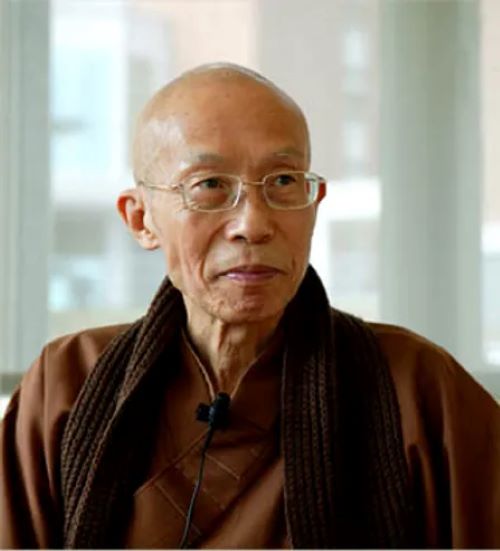
Rebecca Li is a second-generation Dharma heir of Chan Master Sheng Yen, whose Dharma Drum Foundation now has affiliate centers in fourteen countries.
“The first time I met Master Shen Yen in person,” she tells me, “was when I was in grad school, and he visited Los Angeles. It was very rare for him to make it over there at that time. I was already part of a weekly meditation group led by a student of his, and that’s how I heard of the visit and that he was going to be in LA to give a public lecture and give the Three Refuges. I wanted to be there because I wanted to take the refuges with him.”
“How did you first learn about him?” I ask.
“When I met my now husband, he was already practicing with this group, and he kept talking about this Master Sheng Yen. So I started borrowing books from a library run by a temple in the Monterey Park area, east of LA, a big Chinese community. I picked up a couple of Master Sheng Yen’s books on Buddhism. I think they are books he wrote during his six-year solitary retreat, and that was my first exposure to someone talking systematically about the teachings, and that really resonated with me. And I felt, ‘Yeah. I think this is the right person for me to study with.’”
Sheng Yim had been traveling to New York since the 1970s, Rebecca met him in 1995. I ask if she knows what first brought him to America.
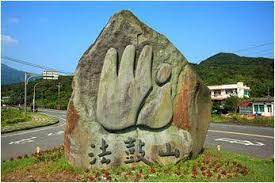
“He came to North America after he finished his graduate studies in Japan, after he did his six-year solitary retreat in Taiwan. So after the solitary retreat practice, he realized that he had to go and get more education because he believed what was needed to reinvigorate Buddhism in Taiwan was to have a more educated sangha, monastic sangha. And he felt he should do that so he would be qualified to train others and whatever was needed. But when he was done with the education in Japan, there wasn’t a place for him in Taiwan at that time. But he was invited to teach as a Buddhist monk at the Temple of the Great Enlightenment in the Bronx by one of his main benefactors, Shen Chia-Theng, a very devoted lay Buddhist who built this temple in the Bronx. I don’t know much about this temple, but Master Sheng Yin was invited to go there, and I think he actually became the abbot there. And that’s where he started teaching meditation because he found there were a lot of Westerners in the ’70s who were interested in learning kung fu or something like that, and he thought this was a way to get people interested in Chan practice. So that’s where he started to teach. And actually when he was in the Temple of the Great Enlightenment, he started leading seven-day intensive Chan retreats. If you look at historical photographs, it was a quite small group. They borrowed a villa owned by this benefactor, Shen Chia-Theng, on Long Island to run these retreats. That’s when Master Sheng Yen started running seven-day residential meditation retreats. He wasn’t doing that prior to that.”
“The early Japanese teachers on the west coast usually had two communities they worked with,” I point out. “There was the cultural community, which basically wanted a temple and had little interest in meditation, and then there was the non-Asian community who had no interest in the temple activities but wanted to learn how to meditate. Did Master Sheng Yen find himself in similar circumstances?”
“The way it developed was a little bit different because Sheng Yen was familiar with Suzuki Roshi’s story. And because Master Sheng Yen was not brought here in that same way, he wanted to develop mainly a Western sangha. He believed his mission was to bring Chan practice to the West. To bring the Dharma, to the West. But what happened was, he was doing that, leading these retreats while he was based in the Temple of the Great Enlightenment, then his master in Taiwan passed away in 1988, so he had to go back to Taiwan where he inherited a Buddhist Cultural Institute that his master had established, and he needed to take care of what his master left behind in terms of a congregation, and I think some publishing affairs. And he was there for a long time, and by the time he returned to the US the Temple of Great Enlightenment had a new abbot because they needed to continue to operate in his absence. So when he returned he was no longer the abbot, and he decided he had to find some other way to develop a sangha in the US.
“So he started to divide his time between Taiwan and the US. Some lay practitioners helped him find a location in Queens – not the current location, but close to it – to establish the Chan meditation center in Queens. At the same time he was also developing what his master left behind in Taipei, the Nung Chan monastery in Taipei. My understanding is because he had students in the US, in Taiwan they started seeing him as like an important Chan master and so people were attracted to follow him. That was also the beginning of people immigrating to the US from Taiwan, and so his center in Queens also started to have a larger number of people who were originally from Taiwan whether they were recent immigrants or not and who had established a life in the US. I have been told in the beginning most of his students were Westerners and then the proportion began to change because of his popularity in Taiwan.
“By the time I first went to it, the center was mostly bi-lingual programs. And Master Sheng Yen has always been giving these open house talks, and he spoke in Mandrin Chinese and somebody would translate it in English. So always bi-lingual, and the retreats were always bi-lingual. So of course there are people who only understand Mandarin, and then there are some people who don’t understand Mandarin, so they needed their translations. So really three groups of people – Mandarin-speaking only, bi-lingual, English-speaking only – are all practicing under the same roof. Then when I turned up in the late ’90s and moved to the East Coast, I was asked to join the teacher-training program because it involved people giving presentations. So there’s the Mandarin-speaking side and the English-speaking side; I was very much part of the English-speaking side.”
I reminded her of an earlier conversation we had had in which she’d said that one of the things that had led Sheng Yen to teach in the west was a belief that by doing so he would be strengthening the Dharma as a whole.
She nodded her head and said, “Yes. In the 1970s, there was a feeling that there was this vibrancy in the West. And so that would be a good place to bring the Dharma and breathe some fresh life into it. Not just Master Sheng Yen, many teachers felt this way. And so I think that’s exactly what happened. Buddhism before the first part of the 20th century largely had been taught in these very homogeneous cultures. And so they developed in this mode and largely they did do well in accommodating a particular set of characteristics in certain cultures. But that means that if you live in those cultures and you don’t have those characteristics, you won’t find the Dharma very accessible because of the way it was institutionalized in those times. But when the Dharma came to the United States, the marvelous thing about here – especially the development in the last couple of decades – is the cultural diversity here meant that teachers had to teach in a way that’s not speaking to one culture. I also think the recent years’ discussion on identity explicitly – it’s always been around – and the effort to push Dharma centers to pay more attention to that is really healthy for the development of Buddhadharma.”
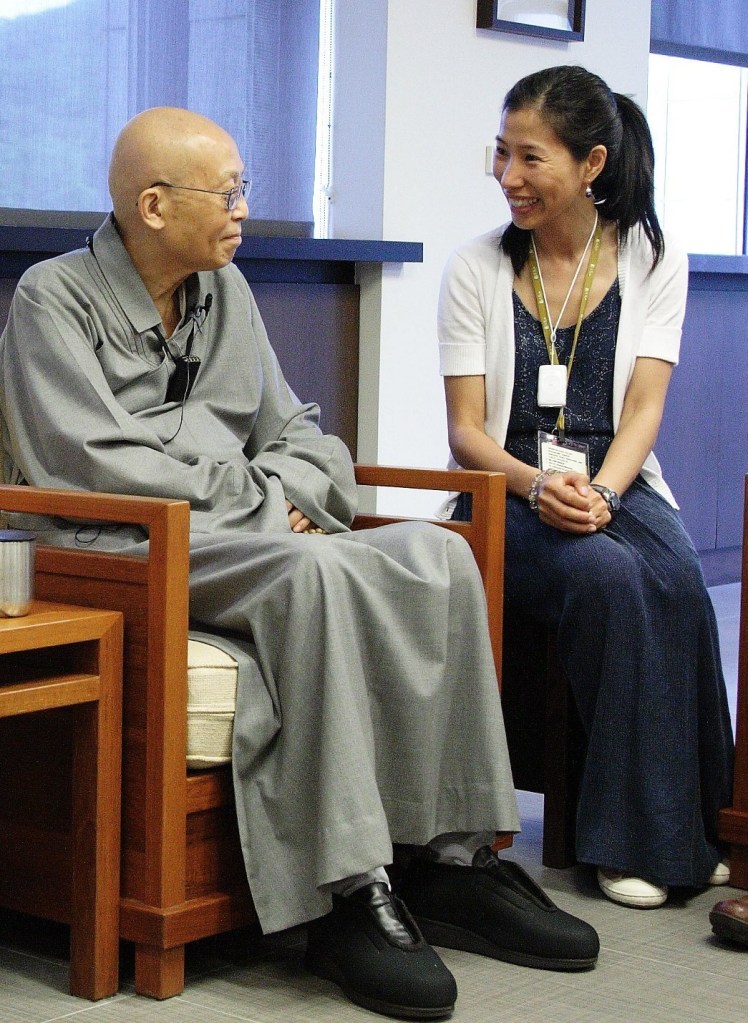
“Do Westerners respond to the Dharma differently than Asians?” I ask.
“Master Sheng Yen has been asked this question before, so I will convey his answer to you. He said that, in his experience, Westerners – actually, I like to call it Western-educated people – respond to teaching very differently. He said traditionally educated Chinese people, you could tell them go do something, they just go do it. They don’t ask any question. Now that does not mean that they actually understand what they’re supposed to do. They just go do it. Whereas the Western educated people, ask a lot of questions, like, ‘How does it work?’ ‘How long will it take?’ All that stuff. We need to understand the ins-and-outs of how the whole thing works. And when you’re convinced of that, then, ‘Ah, okay, I understand it,’ then you will start doing it. And he always said his Western students tend to be much more serious when they actually practice.”
“Okay, I’m a Western-educated person. How would Master Sheng Yen – or you or another teacher in his lineage – explain what Chan was about?”
“It is to help us understand how our mind works so that we can understand clearly why we do what we do.”
“And how does it do that?”
“So, with Chan practice one important aspect, engaging some sort of meditative practice – whatever type of meditative practice you use – is to have you settle your mind so that it is possible for us to begin to see the subtle actions of the mind. A lot of the time we don’t actually know the thoughts and the feelings behind our actions. If we’re alert, we might be aware that we said something, otherwise we may only be aware of what we said by the effect of it. Like, we just got someone really upset, and ‘Oh! Did I say something?’ So you’re aware that someone’s upset. Some people are completely oblivious. So when the mind is settled and clear enough then we can actually see what’s coming through the mind in response to what’s happening. And there are different ways that we can respond to it. Like, most of the time we are compelled to blurt out something or just react in a certain way. So seeing how mind works, we see how we are being controlled by certain habitual way of perceiving the world because of certain habitual ways of believing how things work. And even though, in the moment, there may be some part of you seeing that, like, maybe that’s not a good idea, you act anyway. I call all that ‘layers,’ layers of very subtle thought, mental habits. But being able to see that, then you have a chance of breaking out of unhelpful habits.
“So in Chan practice, what we’re doing is recognizing that these layers are there. If we’re not aware of them, that’s how they take over. By cultivating more clear awareness you become very familiar with how they show up, how they work. Because any kind of habit is our reaction to what’s going on, but it’s thought after thought after thought. So to engage in meditative practice, the mind is still and clear so that we can see these very subtle thoughts coming up in very rapid succession. Then we can say, ‘Oh. Okay. It’s this chain.’ But they’re not on autopilot. It feels like they’re on autopilot because of the habitual tendency. But actually every thought that arises we can stop. We don’t have to add to it. We don’t have to pick this next moment and take that step. So instead of taking the next step, you can say, ‘Okay. I’m standing here.’”
“What is the most significant thing people who practice Chan or Zen should know about Master Sheng Yen?” I ask as our conversation draws to a close.
“I think two things. One is the dedication and commitment that he exemplified through his own lifelong work engaging in the practice, really actualizing the vows, the Great Vows. So that’s one very important thing. The other is the importance of bringing together the Dharma study with meditation practice. That Chan practice is not only about the meditation. It’s also very important to engage in theory and study, sutras, various Buddhist philosophies, to understand what it is that we are doing, to come to the Right View. Because it’s easy often to have your own idea about what this is about. And so to study, to recognize the persistence of various erroneous understandings. So those two would be, I would say, the most important. And something I think that has not been mentioned was his Dharma successors.
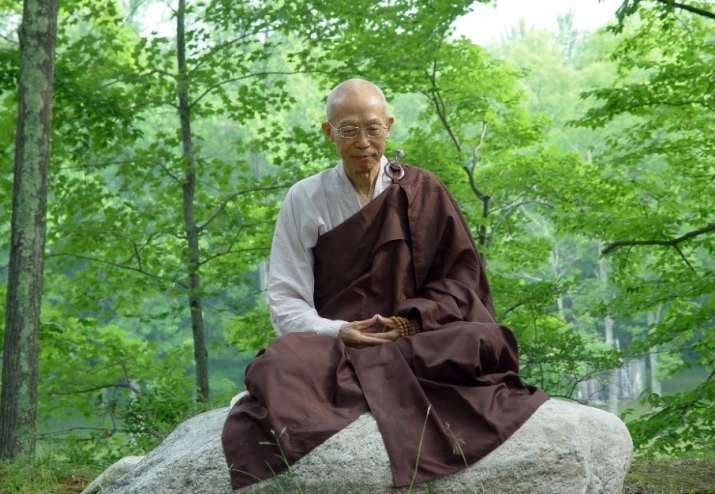
“One other important element – I could add it as a third part of his legacy – is how Master Sheng Yin gave full Dharma transmission to several lay practitioners in the west, giving them the responsibility and, of course, the authority to pass on the lineage in the west. So my understanding was when he did that it was relatively ground-breaking because at that time people understood those were things that only happened to monastics. So in ’89 he gave transmission to John Crook,[1] an Englishman who had started practice Chan in Hong Kong in the ’50s. But basically they were of a similar age. John Crook also studied Tibetan Buddhism. He actually established a retreat place using his farmhouse in Wales and was teaching. Then he discovered Master Sheng Yen and started attending retreats with him in New York and really followed Master Sheng Yen. So Master Sheng Yen basically saw that he would be someone who would really be instrumental in helping him bring Chan practice to the west and so he gave him transmission in ’89 designating him as his senior Dharma heir to provide guidance to the later Dharma heirs. Simon Child was his second lay Dharma heir who received transmission from Master Sheng Yen in 2000. Simon Child is actually my current teacher, I received Dharma transmission from him.”
“And all of these heirs – including you – are lay?”
“Yes. And they are creating their own sangha in their home territory. This is a very important way in which he brought Chan practice to the west.”
[1] According to the lineage chart of the Western Chan Fellowship, John Crook received transmission in 1993, followed by Simon Child and Max Kälin in 2000. Rebecca received transmission from Child in 2016. – https://westernchanfellowship.org/about-the-western-chan-fellowship/lineage-of-the-teachers/lineage-chart/
 Richard Bryan McDaniel