
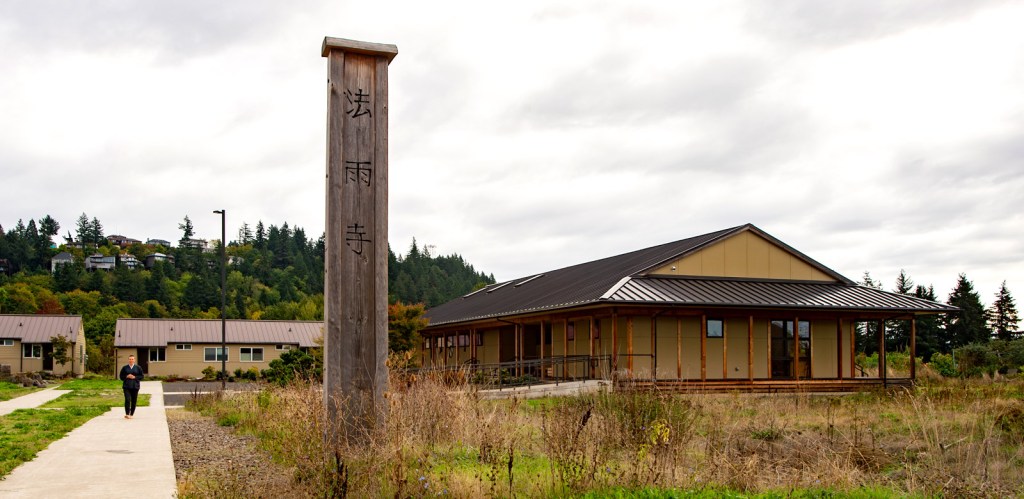
Dharma Rain, Portland, Oregon –
When I was in high school, I became involved with the Mormons for a bit. It had nothing to do with religion and everything to do with a girl, but I acquired a basic knowledge of their belief system. It’s hard to believe someone attracted to it would also be attracted to Buddhism, but, I guess, it happens.
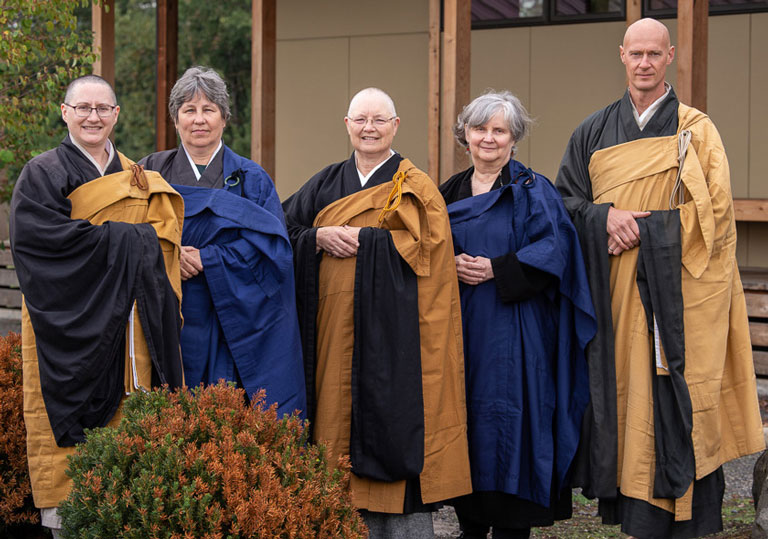
Jiko Tisdale is the godo at Dharma Rain in Portland, Oregon. The godo, Jiko, explains, “is essentially the head of teaching. Traditionally you divide it into the teaching side and the operations or administrative side. The abbot – Kakumyo Lowe-Charde – oversees all of it,, and I oversee the teaching. We also have a kanin who oversees the operations side. So I facilitate our Dharma council which is a group of about eight seniors whose job is to make sure that we don’t deviate too much from the teaching that we offer, and that we keep our mission clear and don’t get too diluted. So we look at work practice, Dharma talks, classes, as well as what’s the temperature and tone of the sangha’s character right now. Are workshops going okay? It’s all kinds of little stuff like that. I give Dharma talks; I lead classes; I teach seminary classes, and I have formal students of my own. We have six or seven active teachers right now, and I keep an eye on what everybody’s doing to make sure that we’re not duplicating, we’re not missing things.”
Godo and kanin are traditional terms for positions within the Soto monastic system. They are usually reserved for people who are ordained. Jiko, however, is not. “I have lay Dharma transmission which enables me to give the Precepts, take formal students, and transmit other lay teachers. And it allows me to continue a lineage within my own traditional Soto Zen lineage.”

I ask how she first became involved with Zen.
“I was very young,” she tells me with a laugh. “I was in my very early 20s. I was in nursing school and really stressed and depressed, and I knew something was missing. And I didn’t know how to figure out what was missing, but some deep, wise voice told me that I needed religion. I had been raised kind of a milquetoast Lutheran by parents who had left their churches to compromise on the Lutheran Church, but it was very much an Easter and Christmas kind of thing. No passion. And when I was twelve, I converted to the Mormon Church, which was quite a shock to my parents. And then by the time I was in college, I became active politically in radical and progressive causes. So I kind of went from the Mormon Church to the Church of Politics, but it was always about a passionate belief in something greater than myself. And I was seeking a community, a community of fellow travelers. And by the time I was in my last year of nursing school, there was still something missing, and I decided that I wanted a religion. I didn’t know what it would be; I was open to any possibilities. So I opened the yellow pages, and I started with the A’s, which was the Adventists. And then when we got to the B’s, there was Buddhism. So I knocked on the door of this unprepossessing little rental house here in Portland, in a neighborhood I’d never been in before. And there was a Swiss guy with curly hair who said he was the priest, and he gave me a cup of tea. I had no idea what he was talking about, but now I say that it was like I’d heard the language when I was a baby. It felt like I knew this language even though I didn’t speak it. It felt like going home just immediately, and I had no idea why. But I kept coming back. And I started sitting zazen because they told me to do that.”
The unprepossessing rental house was the Oregon Zen Priory, a satellite of Jiyu Kennett’s Shasta Abbey. After the Swiss monk returned to Europe, Kyogen and Gyokuko Carlson were appointed the guiding teachers, and Kyogen became Jiko’s formal teacher.
“I plunged in with both feet and became just a passionate practitioner from the beginning with no idea what I was doing. Going down to the abbey for a ten-day winter Jukai with no idea of what a retreat meant, what a sesshin included. And I just kept plugging away. And then after a couple of years, the Carlsons separated from the Abbey and became independent, and we started our own temple, and eventually I knew what we were talking about. And I’ve been here ever since. I’ve been to other places, dropping in as a friend or just seeing what was up, but I never felt any need to explore any further. Soto Zen was the right fit for me from the beginning.”

“You said you were ‘stressed and depressed.’ What were you depressed about?”
“You know, I would say now that I was at a transformational point in my life where I had to make some decisions about who I was going to be. But at the time I didn’t understand that. I was agoraphobic, but I was in my senior year of nursing school and had to get up early in the morning to do hospital clinicals, and I had a kid. And so there was this collision. My need to slow down and be quiet and listen to my interior life bashed against a time in my life when I had to be very outward and very ‘on.’ By the time I graduated nursing school I had pneumonia, and I was just kind of a wreck. But I grabbed hold of Soto Zen, and – you know – Soto Zen is so interesting because it doesn’t give you anything to grab onto. There are no mantras. There are no mandalas to look at. There are no exercises to do. All I was given was, ‘Go stare at the wall for half an hour.’ If I had encountered Rinzai Zen first, I might have become a very competitive koan student. If I’d encountered Vajrayana, I’m sure I would have been seduced by the music and the color and all that other stuff. But I got lucky in finding Soto Zen because there’s nothing, no crutches, nothing to grab onto at all. I don’t know why I stayed. I mean, I was bored; I was confused. But I kept going back. For some reason it was what I needed.
“And I loved the monastery. I was immediately entranced by the very plain, pure form of Soto Zen. I was drawn to the plainness of it, I think, because I have a very complex brain going on up there all the time so there was something about the ascetic nature of it. It was a good balance. A lot of people I know in Soto Zen are Type A personalities, lawyers, psychotherapists, physicians, people who are pretty powerful and intense in lay life but are somehow drawn to this place where there’s nothing to be competitive about, where there’s nothing to grab onto and make concrete. You’re just stuck with yourself, and we somehow seem to recognize that we need that balance.”
“What is the function of Zen? What’s it for?”
“What is it for? It doesn’t have a function. It isn’t for anything. I’m in it; it’s not in me. We have this saying: ‘Zazen doesn’t care.’ And I’ve always really liked that because the idea is that it’s just there. It’s available for me if I partake in it. But zazen doesn’t care if I sit or not; zazen doesn’t care if I like it or not, or if I’m bored or tired or whatever. Zazen doesn’t care. Zazen is a space that exists, and it’s a place where there’s enough room for me to have whatever I have.” She pauses a moment, then says, “I’m very suspicious of too many words here.”

“You said that the godo is the head of teaching. What does a Zen teacher teach?”
“Nothing much,” she says chuckling. I’m used to getting that kind of answer to the question, but then Jiko actually goes on to list specific things involved in teaching. “That’s the pat answer. But I do teach Dharma. I’ve studied for decades to understand the basics of Dogen’s Zen, and Dogen is something I’m very passionate about. I’m facilitating a sutra study group in the spring where every week we’ll study a different sutra in overview. There’s plenty of history. The next Dharma talk that I’m going to give is about Keido Chisan Koho Zenji, who was Jiyu Kennett’s teacher and is considered one of the founders of our temple. I studied the Japanese language for a few years. I can’t speak Japanese, but I’m not entirely at sea. I’ve travelled to Japan. So there is a whole academic or intellectual side to what we teach. That’s about half of what our seminary program is, which is advanced studies for senior students.
“But the other half is practice and personal integration, and that you can’t teach. All you can do is make a space for it. Invite and welcome people and offer them a little bit of guidance. I think it was Jack Kornfield had this image I really like of it’s like you’re standing on the ground and you’re watching somebody climb a cliff. And you can see where the handholds are, and you’re saying, ‘Go right! Go right!’” She laughs gently throughout this description. “And they’re going left, and you just keep yelling, ‘Go right!’ There’s a certain bit of that involved. But I think one of the most important functions you have – especially with the students you work with intimately – is you get to know them over time and you function as a mirror. Because it’s often easier for another person to see your patterns than for you to see them from inside. So the teacher-student intimacy allows a teacher to see patterns and call them out. To say, ‘We’ve been here before’ or ‘I’ve seen you have this reaction before, this response pattern.’ And working really hard to make it safe to be yourself, to be authentic and whole. It’s not about suppressing parts of ourselves that we don’t like or ignoring things or trying to be a different person. It’s really about integrating oneself into a whole. You need a big space for that to happen, and you need time for that to happen.”
“So studying Dogen,” I say, “studying sutras, looking at patterns in one’s life. It brings me back to the question I asked earlier. To what end? What’s the purpose – the function of all this activity? What’s it gonna do for me?”
“Well, I’ll tell you one thing it’s done for me. I started out depressed and thinking about driving off a bridge, and I felt anxious all the time, there was just this sort of free-floating dread. I haven’t been afraid in a long time, and I haven’t been depressed in a long time.
I ask how, then, it differs from psychotherapy.
“Oh, it’s quite different. I said this in a talk recently: Zen has plenty of room for psychology. Psychotherapy is great. Counselling is great. I think almost everybody can benefit from therapy. But therapy isn’t big enough to contain Zen. We have to not get confused. Psychology is part of the self, and Zen has room for every part of the self. But Zen is bigger than that. Zen is an inter-being with all things. And it is a kind of freedom and liberation from the patterns of the self which we may heal and strengthen through therapy. But there’s a space that’s much bigger than that. And I’m not going to say a whole lot about this, Rick. But we touch that space sometimes. You can’t chase it, and you can’t make it happen, but once you touch that space, people are conditioned forever by that moment of freedom. And I knew the moment I touched it my life was never going to be the same. And that sense of freedom, that sense of fearlessness has never left.”
I ask if she’s willing to talk about that moment, and she shakes her head. “No. I don’t know if it was Shunryu Suzuki, maybe it was Maezumi, but one of them said, ‘Once or twice in a lifetime there is the big liberation, but there are a million moments that make you dance.’ And I think those million moments are as important as one or two iris-openings. You know? A million moments that make you dance! What else could we want? Marvelous! And I do feel that even in a down time or a hard time or irritation or frustration or sadness . . . I mean, the world is burning; of course I’m sad. But I can close my eyes and feel a root that goes all the way down into the ground of being, and it stabilizes me. And I think one of the most important things we get from this practice is stability of self. An equanimity, an undisturbedness beneath superficial disturbances. The ocean has lots of waves. Our everyday awareness and consciousness can be very roiled. But the deep ocean is very still. And if you can put an anchor down into that ocean, you’re going be very stable.”
In addition to being a Zen teacher, Jiko is also a nurse and a writer, but everything in which she’s engaged is connected, inevitably, to her Zen practice.
“Nothing is not connected. It’s like a gestalt. Zen is a way of being in the world; it is a way of seeing the world and being in the world. It’s a way of interpreting things. I notice right now with what’s happening globally and politically that I’m conscious of having an equilibrium that many people do not have. That doesn’t mean I don’t feel enraged at times. It doesn’t mean I don’t feel a little anxiety about what my grandchildren will have to cope with. It doesn’t mean I don’t have emotional reactions. But I don’t feel knocked off my feet. I don’t feel unstable. And I do feel grateful. I’m very aware of the kind of privileges I have and the safety I have as a white, educated American citizen in a fairly peaceful part of the world. I’m aware of the tremendous good luck and privilege of that. So Zen is never not talking to me, reminding me – as my teacher would say – to look up.”
“What is zazen?”
“It is a matter of simply being as present and aware of what’s happening in this moment as possible. So it’s what’s happening in your body and what’s happening in your mind and what’s happening in the room, and not chasing any of it or judging any of it or grasping on to any of it or pushing any of it away. It’s a matter of cultivating this deep presence and attention without valuing parts of it. We do a lot of pushing away and grabbing onto, and they’re both clinging. They’re both attachment. This is fundamental Buddhism, the Four Noble Truths. So zazen is a way of cultivating a space in which everything can arise and fall, including myself, without entanglement.”
As the time we have available begins to draw to an end, we talk about changes which have taken place at Dharma Rain since she first found the Oregon Priory in the yellow pages of the phonebook.
“When I first came there was one teacher, and three people would come to sit, and we would listen to a recording of a Dharma talk by somebody else. Last Sunday there were sixty-five people in the zendo. We have a flourishing children’s program. We have a pre-school – a Montessori pre-school – on campus and a pretty strong family practice. So it’s a thriving community, and post-pandemic – to our surprise – we’re seeing a lot of younger people. People just like me in their early 20’s, lots of questions, really wondering what to do and seeking a way forward. So I feel a lot of gratitude for the yellow pages.”
After having a chance to see this profile online, Jiko sent me an email in which she wrote:
“So what is really missing for me is enlightenment. For you, too, I think! I really avoided that! When you ask, what is the function of Zen? My answer is about zazen, which is avoiding the question. Like any good Zen teacher would! Let me just say this: There are not enough words, no adequate words, to explain awakening. We don’t wake up to language, we wake up to reality. It happens in an indefinable moment, the iris opens, we can see the whole of it. Then the iris closes, and we are forever changed. Zazen is an opportunity to visit a space without judgment or separation. A space where dualism can disappear. Most of the time, we are just cultivating the ability to be present and aware. Plowing the ground and planting the seeds. Good Zen requires this effort, as well as character development – moral development – and then we open our hands and let go. Awakening is our birthright and sooner or later, each of us will find the way. I deeply believe in this promise.”
 Richard Bryan McDaniel