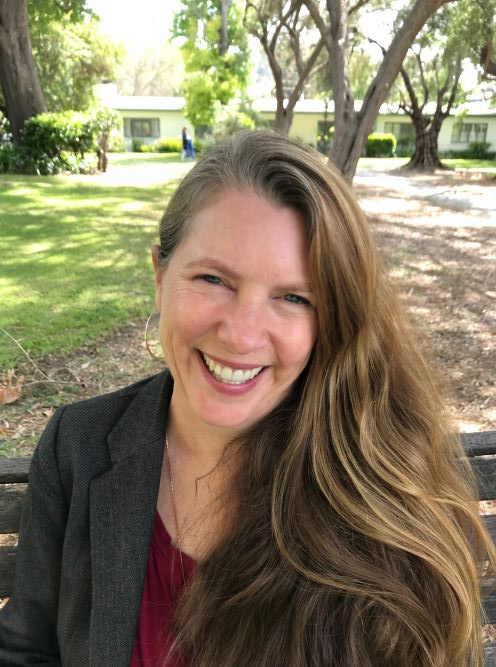
Crimson Gate Meditation Community, Oakland, CA –
Megan Rundel is a Dharma heir of Joan Sutherland and the guiding teacher of the Crimson Gate Meditation Community in Oakland, California. She grew up in Houston, where her father was a member of the Physics Department at Rice University. The family religion, she tells me, was science.
“Both of my parents were kind of actively anti-religious and anti-spiritual. They believed that everything in life could be explained by science, and that logic and reason and scientific reasoning were the highest ways to use one’s mind and the best way to know truth.”
“And did you share that point of view?” I ask.
She pauses for a moment. “I always had . . . I knew that that wasn’t the whole truth, but, of course, as a child I couldn’t articulate why. Actually, I was a wall-gazing kid. I would sit in my bedroom as a ten-year-old – I think I was feeling over-stimulated probably – but I would stare at the wall and kind of just let things settle, and I knew there was something bigger that I wanted to make space for. But it took me until I was in college to start to be able to articulate to myself what this other way of knowing could be.”
It began with a course in world religions she took at Wesleyan University. I ask why – given her family background – she had enrolled in the class.
“I was fascinated. I had an identity already as not a scientist and a bit of a rebel in the family. You know, I was an English major.”
“God forbid!” I had also been an English major.
“So I was trying to find my footing in a – I guess – low grade rebellion. And in this world religions class, we used Houston Smith’s textbook, The World’s Religions, and the section on Buddhism really lit me up and excited me. I thought, ‘This is what I’ve been looking for.’”
“Okay. Life sucks; it sucks because you want things; the only way to stop it sucking is not to want things; and then you won’t be reborn again. What was the allure in that?”
“Yeah. I don’t think it was that exactly. It was more the kind of expansiveness. The feeling that the world . . . that the universe is so much larger and stranger than what’s in front of us, and that there are ways to explore that facet of reality.”
“How is that different from the way in which a physicist approaches understanding the world? Might they not describe what they’re doing in much the same way?”
“I think that’s very astute, and I think I did absorb something from my father, a fascination with theories of everything. Wanting to understand the big picture. So I do think I had that quality of mind certainly from my family, but I inclined it in a different way. I think I leaned into the mystery rather than trying to figure out the mystery.”
For students who were interested, the professor for the World Religions course hosted a zazen group before class.
“That required getting up at the ungodly hour of 8:00 a.m.” Megan tells me.
I ask what drew her to it – especially given the ungodly hour – and she considers a moment before answering.
“Here’s the true story about why. I sometimes hesitate to tell it, but it’s the truth. Just a few weeks before I began this religion class, I had taken psychedelic mushrooms.”
“I’m shocked.”
Megan laughs. “I know. But I had what I now recognize was a very deep mystical experience which I didn’t have much way to make sense of. And I knew that I needed to keep working with it. I needed to find a way to lead it into my life in some way, and I had no idea of how to do that. And so when I got to this religion class and had the opportunity to sit zazen, they synced up beautifully. The zazen really gave me that chance, and the teachings worked so well with the experience that I had had that it all felt of a piece to me.”
“It isn’t a unique story,” I mention.
“Yeah. I know.”
“So what you were looking for was a way to understand the experience that you’d had with the mushrooms. And perhaps integrate it?
“Integrate it? Yeah. That’s the language we would use now, for sure. I just knew that I wanted to live a life that was informed by that experience. And I knew I couldn’t take mushrooms all the time. I also had a work-study job in the university library. So I could go into the stacks, and I read every book – I think – by D. T. Suzuki. There wasn’t a lot out there at that point, but I read everything I could get my hands on and just felt really inspired. It opened up a world to me that felt important. So when I graduated from college and moved to San Francisco in 1988, I started to attend sittings at the San Francisco Zen Center. But it was kind of sporadic. I was also young and enjoying life in the city. Then a few years later I moved to Madison, Wisconsin, because my husband was in graduate school there. And I found myself kind of lonely and depressed, and I found – not too far from where we were living – the Madison Zen Center, which was an affiliate of the Rochester Zen Center.”

There was no resident teacher in Madison, but Bodhin Kjolhede from Rochester visited regularly. “People who had a teacher were working with Bodhin. So it was just a small, local basically sitting group affiliated with Rochester, and I really dove headlong into training, doing every sit that they offered and before too long starting to do sesshin in Madison and in Chicago and in Rochester. And that’s where I started koan practice, and my first teacher was Bodhin. And as you know, it’s a style of Zen – at least back then, maybe it’s changed – which was pretty vigorous and Japanese in style. And that kind of worked with my temperament at the time. It was the early ’90s, and I was in my 20s. I had so much energy and angst and stuff at that point in my life that it was good for me to have that discipline. The intensity kind of met my intensity.”
After her husband finished his degree, they moved back to California.
“For a while, I went back to Rochester for retreats, but I realized that that was a long way. And I asked Bodhin who I should study with in the Bay area. I wanted to continue my koan work. I had been working on Mu for a few years at that point and was very deeply involved and wanted to continue that, and Bodhin suggested John Tarrant. So I looked him up. John’s group was in Santa Rosa, but there’s an affiliate group here in Oakland, and I just took to it. And it was so different from Rochester, the culture of Rochester. It totally blew my mind. It was so much more California,” she says with a laugh. “Creative and free and expansive and sometimes psychological and really with an emphasis on the creativity that’s inherent in the koans. And, again, I think the timing was perfect. I had benefited from the intense discipline in Rochester, and then it was so wonderful to feel this freedom that John’s teachings offered. And I just kind of exploded out from that.
“John is charismatic and a koan genius in a certain way, and his vision of Zen and the koans and the practice is incredibly beautiful and inspiring. And that was very important and meaningful to me, personally, and to a lot of other people as well. I don’t think it’s a secret that he can be problematic personally, but those initial years of just feeling the possibilities, just the joy of the koans with him was an incredibly valuable teaching.”
John had not yet established the Pacific Zen Institute, and his group at the time was known as the California Diamond Sangha. Joan Sutherland was a senior student when Megan began practice there.
“I adored her. I thought she was wonderful. I loved having a woman teacher, and I loved that she combined some of the beauty and the creative energy that John brought without the drama. And I really just kind of fell in love with her. She started to teach maybe a year later, and I was one of the first people in line to be her student. And after I started working with Joan, she very quickly became my primary teacher.”
“You said you ‘loved’ having a woman teacher. Does it make a difference?”
“It sure did to me. Probably a man could be similar in some ways, but Joan brought a way of teaching to groups and in one-on-one dokusan that was just so warm and engaged. It was something I hadn’t experienced before, and it felt – I don’t like the word ‘feminine’ exactly – but it felt . . . It had the qualities that I would feel in other female relationships. A certain warmth; embodiment; kindness. Combined with her incredibly keen intellect and prajna. You know? That combination was so profound. It really met me exactly where I wanted to be.”
Megan was in graduate school at the time studying clinical psychology.
“So I had a period of time in the ’90s when I was in grad school – I was getting a doctorate, so it was a long time – and I had the flexibility to do a lot with Zen, go to all the retreats and so forth. And I was studying psychology, and those two endeavours really informed each other.”
“Did you formally give Joan the box of incense and all that?” Presenting a box of incense is a traditional way of asking a teacher to accept one as a student.
“Uh-huh. I think that was probably ’96.”
“Her approach to koans – as you pointed out – very different from the Rochester style.”
“Oh, yes! Oh, my gosh! I felt like it was the first time that my subjectivity was part of it in an authentic way where I felt there was interest in me as an individual human. And that really felt important to me. I felt like I needed to be met on a human-to-human level.”
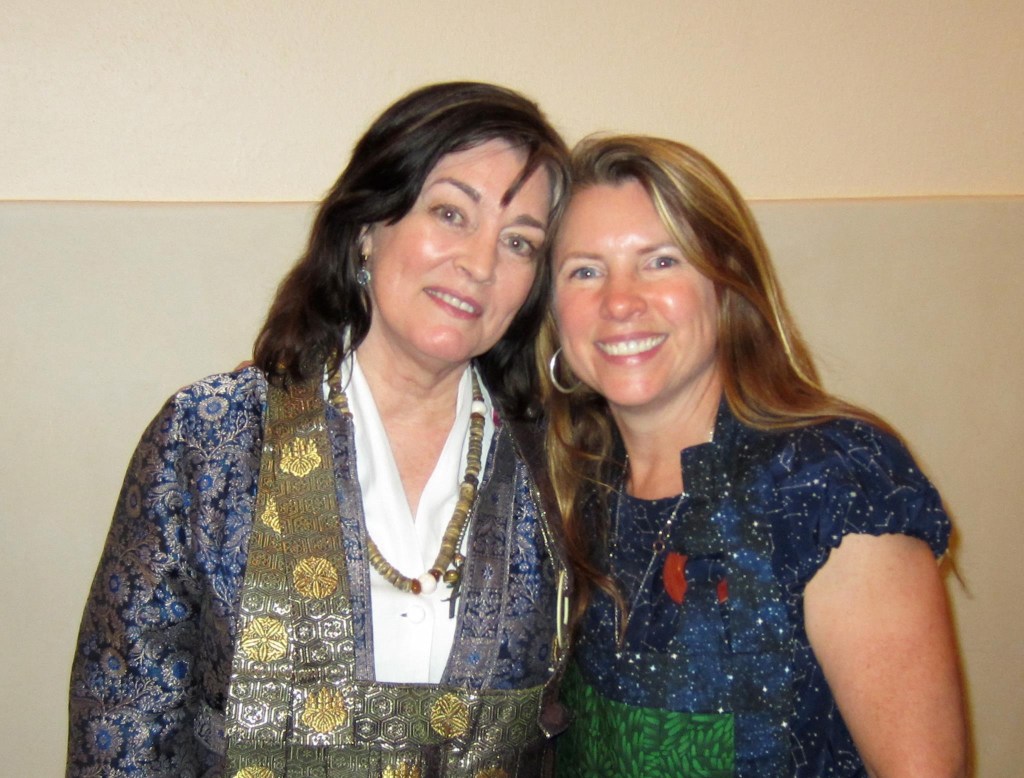
“Okay. So you formally become her student in 1996, and then somewhere along the line she identifies you as a person whom she could entrust with carrying on this tradition.”
“I have no idea how that happened. I mean, I worked with Joan for a long time, and I just felt so fortunate. I did not at all think of myself as anybody who could carry on the tradition or teach. I really didn’t. I didn’t have interest in that or confidence that I could. I sort of actively didn’t want to. For lots of reasons it didn’t feel at all like a natural fit.”
“What changed your mind?”
“I guess a couple of things. Joan seemed to think that I had the qualities needed for the role, and I trust her. So part of it was just trusting Joan. And the other thing is that I’m the last person that she named as a teacher before she retired. And I knew that she was about to retire, so I really knew that I had two choices. I already had my little group here in Oakland and was kind of operating, I guess, as a meditation instructor. So I could try to struggle on in that role, which didn’t seem likely. I could just find another group, which around here is just dominated by the San Francisco Zen Center, and I knew that’s just . . . Or I could take her up on the offer.”
“What was your reservation about Zen Center?”
“It’s very formal. And I really loved koans which they don’t do. I felt engaged with that and I really liked the more expansive and free feeling that it brought out in me. As somebody who can be kind of shy and interior, I liked the expansive quality of Joan’s lineage.”
She tells me that her group in Oakland – Crimson Gate – is largely made up of fellow psychologists. “Not all. But everybody kind of knows – you know – it’s a psychologically-minded group.”
“So tell me what the difference is between what a psychologist/psychotherapist does and what a Zen teacher does.”
“Traditionally a psychologist helps a person look at their story, question aspects of it, and heal past wounds. And a Zen teacher helps a person get beyond their personal story and expand into what I guess we might call ‘big mind.’ So I guess psychologists specialize in helping us with our ‘small minds,’ which does relieve a lot of suffering, and Zen teachers help show us the realms of ‘big mind.’”
“What draws people to Zen practice? What makes somebody wake up one morning and search out Crimson Gate on Google?
“Well, as I said, most of the people who come to our group are psychologists or therapists.”
“Okay then, so what is it that psychology doesn’t offer them that they hope to find in Zen?”
“It depends on the person, but I guess I could say a few things. One is just a break from the hecticness of modern life. And especially maybe in the Bay Area where things move really fast. Everybody’s really busy. It’s an intense place. So I think a lot of people just want a break. Want the quiet, a way to be quiet and to just drop all of the speed and the burdens and the complications. And then I think a lot of therapists have the intuition that there’s something beyond the personal story. And I think we regularly get glimpses of that and intimations of that as therapists, but our training doesn’t really offer us any way to work with that or explore it in ourselves or our patients. So I think the Zen practice offers a way to . . . You know, Freud has this great note – Freud was always best in his footnotes – and he had this one in The Interpretation of Dreams about the dream navel which he said was the place where any dream opens out into the unknown, the unknowable. So I like to imagine it as a sort of corridor where on one side you can see into the dream world, and the other side is just this mystery. So sometimes I think of Crimson Gate as sort of a way of being in that dream navel with one eye on the world of dream and play and the other eye on the vastness. And I really think people have a craving for finding a way to get to know that place and to do it together. Joan’s tagline for her group used to be, ‘We all wake up together, a conspiracy of friends.’”
“On the webpage for Crimson Gate you say that the practice helps us ‘heal dualities.’ What do you mean by that?”
“Modern life and language encourages divisions in the mind. Like good and bad, right and wrong, success and failure. And it’s so easy to get trapped in those dualities and have your entire life run by trying to get from one to the other or feeling polarized. And Zen practice is a way to see into the ‘no-self-ness’ of those qualities – the non-existence of those qualities – and that is a healing experience.”
“And yet you chose to work with a female teacher in order to avoid the drama associated with a male teacher. Is this not duality?”
“‘Emptiness is form,’” she says, quoting the Heart Sutra, and we both chuckle.
“Well, let’s consider that,” I suggest. “We chant these things: ‘Form here is only emptiness, emptiness only form / Form is no other than emptiness / Emptiness no other than form / Feeling, thought and choice, consciousness itself are the same as this.’ We chant it, but that doesn’t necessarily mean it makes any sense to us. How is ‘form emptiness and emptiness form’?”
“I love that there’s really no paradox there. That’s truly my experience. I always think of it as having binocular vision. With one eye we can see emptiness or the vastness – as Joan would call it – and with the other eye we have a firm grip on reality and how the world works. So it’s a ‘both and.’ It’s both true that there is no gender, there is no practice, there is no duality, and, at the same time, having a woman teacher was profoundly important to me as a woman. I grew up at a really interesting point in history. My mother was having her consciousness raised when I was a little girl. And I think she was in the League of Women Voters and kind of in that wave of feminism, and I think I really learned from her early on that it’s important for women to speak up, to not just absorb the patriarchy but to own our differences but also our strengths. Joan, I think, was an amazing role model for that.”
“Let me make sure I’m following you here: You seem to be suggesting that one first has to recognize the dualities? So in my case, as a white, cis-gendered male there may be a whole bunch of things I might take for granted, and the first step is to be aware of those assumptions, and the real differences that exist?”
“Absolutely.”
“Okay. And, at the same time, what? If it’s important for me to be aware of the dualities, especially being this highly-privileged individual . . . And I’m out-numbered in my family. Most of the people in my family are female; one is trans-sexual; I have three Filipino grandchildren; I have a First Nations great-grandchild. So . . . ‘Form here is only emptiness, emptiness only form?’”
“So in your family there’s differences, there’s markers, there’s gender, there’s ethnicity, there’s sexuality, and you’re in the same family, and they’re both true.”
“Okay, then the website goes on to say: ‘More than ever our Way helps us heal dualities, cultivate a kind and open heart, and make way for inquiry into our true natures.’ What is our false nature?”
“Well, our false nature is ‘I’m right and you’re wrong.’” We both laugh.“That’s the world of ignorance. And our true nature is, ‘It’s really nice to meet you, Rick.’”
“That doesn’t really clarify anything, does it? Say I come across this on your website, and I’m curious enough to come by the center. If you start talking about ‘true nature,’ in order to make any sense out of what you’re saying, don’t I have to have some idea of what my false nature is?”
“I would probably say, ‘The stories that you have about yourself are false, and there’s more to you in your life than that. And you have to find out about that for yourself. I can’t tell you that. But if you come and sit in meditation with us, you’ll discover something for yourself.’”
“So, again, how is that different from if I came to you as a psychotherapist?”
“In psychotherapy we move into your story and try to help understand the story and to make sense of it, and to help you have – maybe – better stories. More effective stories that work better in the world. And in Zen, it’s about dropping the story and seeing what’s bigger than that.”
“And what is the value of doing that?”
“It helps us be wiser and kinder and more aware of our place in the world.”
One really can’t ask for more than that.

 Richard Bryan McDaniel