Heart of Wisdom Zen Temple, Portland, Oregon
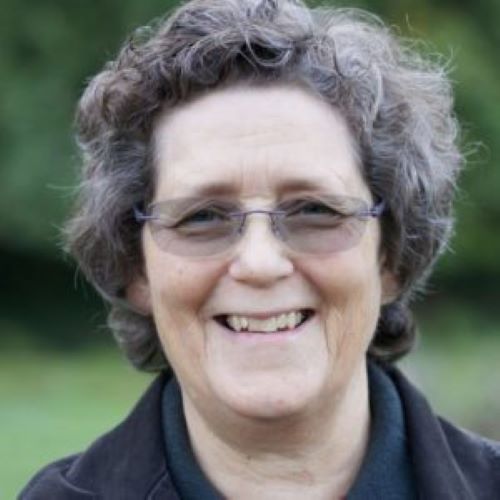
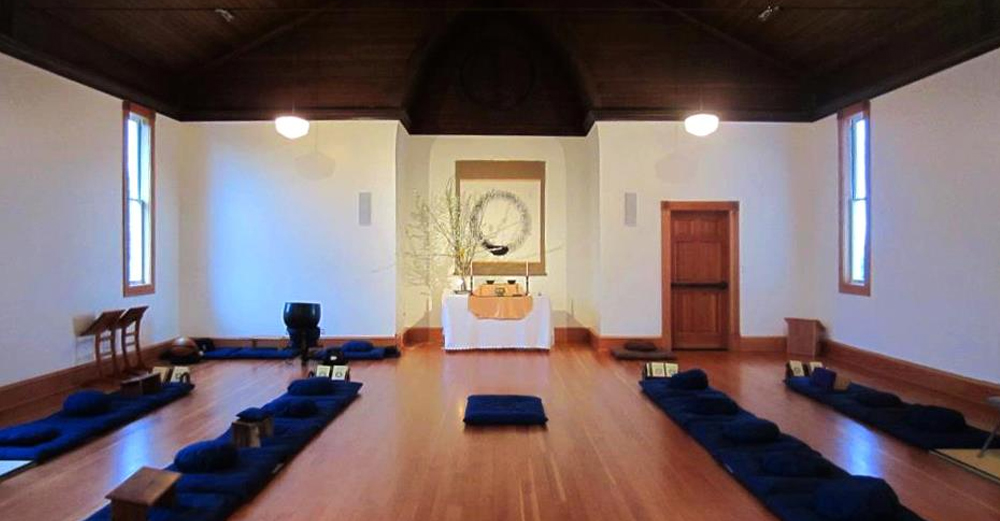
Kodo Conover is the “temple manager” of the Heart of Wisdom temple in Portland, Oregon. Originally a Methodist Epsicopal Church, the structure was built in 1891. The Methodists sold the building to a Ukrainian Orthodox congregation in 1959, who installed a three-bar cross on the steeple which still stands. In 1968, it was taken over by the largely African American Church of the Living God, which thrived for a time, but as the congregation dwindled, debts piled up, and the church was slated for public auction. Hogen Bays of the Zen Community of Oregon, learned of the sale and visited it with some board members. He later told a newspaper that when they “first came into the place, all those years of singing and praying had saturated the building. Everybody who walked into the chapel said, ‘Ooh, this feels really good.’ There were 120 years of spiritual practice soaking the walls.” The article went onto note: “The Buddhist community was willing to pay a fair price for the property, $205,000, so the pastor could pay off the church debts and have a little left over for his next ministry. It was an offer in keeping with the concept of karma – that actions have consequences and good actions have good consequences. The Zen community could have waited for the auction and probably spent less to acquire the property, but Bays didn’t want to benefit from another group’s difficult circumstances.”[1]

Kodo, herself, also underwent a slow conversion from Methodism to Buddhism.
“My grandfather was a Methodist minister, and he was quite involved in church architecture. In fact, he was the first Director of Architecture for the World Council of Churches. So we were a family of faith even when we moved to Reno when my dad got a job teaching journalism at the University of Nevada.”
“Was church something you found meaningful?” I ask.
“It was part of the family; it was what we did. When I was a little older and became a member of the church, something fell away, and I didn’t feel connected to it. There wasn’t that connection that I was looking for.”
She was about 12 at the time. I ask what she meant by not having the connection she was looking for.
“I’m not sure at that age, but I thought something would happen when I became a member of the church.” She had been baptized as a baby, but there was a confirmation program for young people, and she thought taking part in it would bring her a sense of being closer to God. “But it didn’t happen. Then I started questioning more and more about God and what this religion was all about. And it was kind of a rift in the family because everybody else was okay with going to church, and I wasn’t.” She chuckles and shrugs. “But I had to go. I refused to go to the Sunday School part. So they said, okay, I could be in the adult church. So I went to adult church from 12 on; I would just sit with my folks.”
A group of friends at the time began an exploration of alternative religious traditions. “We were interested in different things – I think – as kids. As young adults. You know? I was involved with the Girl Scouts, and there was a lot of outdoor activity. And so I think nature was the entrance for us, of a connection to the Oneness of all things.”
“Is that how you would have expressed it at the time?”
“As a young person, I think we would have expressed it as, ‘This is amazing!’ When I was about 14, I did a star-study. I was able to go the university and look at stars at night with the big telescope. They had the Atmospherium Planetarium, and they had a big telescope. And, you know, you look at a star, but it’s really a galaxy. And that was a mind-blowing experience in a way. So it just opened up this whole world that is much bigger than what we see right here. So I became fascinated with the stars and the universe, and we’re just this little planet of people. This is kind of remarkable.
“I think the girls I hung around with were kind of open to these ideas and larger questions. It was a turbulent time to grow up. There was all this racial inequality going on. There was busing. There was JFK being assassinated, and that was really big. And the day we graduated from high school Robert Kennedy was assassinated. Martin Luther King was assassinated right before that. It was grim for kids too. So you’re seeing this grimness, and then you’re seeing these wonderful and mysterious stars and the world out there. So it’s like, ‘Whoa! How do I fit into this world?’
“When I went to college, this Zen thing, I didn’t know what it was, but it was very interesting. We read Siddhartha; we read On the Road. We were interested in the Beats and Thomas Merton. So like mysterious, mystical – you know – ‘What is this?’”
I am two years older than Kodo, and we share a lot of cultural memory. “Writers like Kerouac were part of the zeitgeist of the times,” I agree. “Was that your entry into Zen?”
“I think it was the connection to nature, to the wilderness. Because we also did a lot of backpacking. We were right there in the Sierras. Lake Tahoe was in our backyard. We were introduced to backpacking at a young age. 11/12 years old.”
She studied Physical Education at Oregon State University. “I was interested in working with kids, especially kids with disabilities. Getting into what was called Adaptive PE at the time. But I couldn’t find any place, any spiritual community that I really fit in.”
“Did you feel a need for one?”
“I was interested in finding a teacher. When I look back at some journals and things, I see I wrote, ‘I’d like a teacher. I’d like to find a teacher. I’d like to learn to meditate.’ And that was kind of a theme for quite a while.”
“What did you think a teacher would do for you?”
“Help me!” she says, laughing. “Help me connect back to this thing of God. This God or whatever. I had this idea that connection was what was missing. Some kind of connection. I felt connected when I was out in the wilderness, in the woods. So why would I feel connected there, and I would not feel connected in the city? That was the question I kept asking.
“Then after college a friend of mine and I travelled all over the United States and Canada for about six months. Nine months. Something like that. Long time. And we stayed with her relatives who were Catholic nuns outside of Boston, and they had a school for multi-handicapped kids. And we would help them. And I thought these women have really got . . . They have some wisdom. I didn’t know any other people like them. We just stayed there for a few weeks. But I kept a correspondence with one of the nuns, and I asked her, ‘How do I find God?’ And she said, ‘Go to a community.’ Like, find a young peoples’ community. She said the Catholics have them, and you might find them here and there. I always thought community wasn’t where I was looking. I wasn’t interested in community particularly. At that time! So, in a way, I just kinda dropped the search for a long time. And went ahead. I got married. I had a career. Spent a lot of time out in the wilderness.”
“So somewhere along the line you met someone to marry,” I remark.
“I met somebody to marry, yes, in college, and then we reconnected. A bunch of us lived together.”

“Were you in a commune?”
“That’s what my parents called it, ‘The Commune.’” She laughs. “But it wasn’t really. Anyway, I worked with developmentally disabled people for a long time, and I had a career as a vocational rehabilitation counsellor.”
“Where was this?”
“In Portland. We moved to Portland, and I got a Master’s in that field, and I worked for the state. And when I started working – and was almost fifty by then – it was really a pretty stressful job. And I kinda went back and, ‘Wow. I never really did find that spiritual practice that I was looking for.’ And so I asked a friend to help me. She had been a Catholic nun for a little while. She was going back to the Catholic church, but then she came in and said, ‘You should go to the Zen place down by your house.’ And I had been pointed to Zen another time. I had a bad sleep-disorder problem and a therapist had me do some psychological evaluations, and he said, ‘You’re okay, but you should go to Zen, ’cause your questions are all Zen questions.’”
She tells me the Zen place was about three-quarters of a mile down the street from her. It was a rented space shared by Kyogen and Gyokuko Carlson’s Dharma Rain program and by Hogen and Chozen Bays’ Zen Community of Oregon.
“So I finally made it down there, and I walked in, and there was Chozen at the door, greeting people. And Hogan was running around. And they showed me a few things about how to meditate, and I went upstairs, and I go, ‘This is exactly what I’m looking for. I’m home. I haven’t left since.”
“It was that simple?”
“It was that simple.”
“What was it that made you feel at home?”
“It was sitting in the zendo. It was just sitting in the zendo. It was just the feeling, the place. It was a feeling, I would say, more than anything. It wasn’t like a mental thing; it was a body sensation. Which was exactly what I was looking for.”
“And now you’re a priest.”
“Yeah.”
“So somewhere along the line, you not only decided you were going to take up Zen, you also decided you were going to be ordained.”
“Yes, and, since I didn’t live at the monastery, this took a long time. Things have evolved. So my friend Bansho – Patrick Green – said, ‘I’m going out to talk to Chozen about being ordained.’ And I said, ‘Hey! I want to go with you.’ So we did, and we asked her, and she kinda said, ‘We’ll see.’ In that way, you know?”
“Why did you want to take that step?”
“A lot of people ask that. I just think it adds a level of commitment.”
“Do teachers have to be ordained?”
“No. In our community, you don’t. You can be a teacher; you don’t have to be ordained. And I was actually transmitted as a teacher first.”
“And one assumes that one could be a priest without necessarily being a teacher?” I suggest.
“Yes.”
“So, if I’m a Soto priest in Japan,” I say, “I know what my job is. I’m gonna take over a temple somewhere. It might not even be a job I want. It’s just something I inherited from my dad, and I’m stuck with it whether I’m interested in it or not. I kind of get that. I understand what that is in Japan. What I’m not real clear about is what a Soto priest does in Oregon.”
“Most of them live in a monastery. Actually, we haven’t graduated very many. So three or four who have become priests are now teaching in different places.”
“But we established that teachers don’t need to be priests. So what’s the point of priesthood? If I become a Catholic priest, I know what that means. I lead services – say mass – I administrate the sacraments, do weddings, funerals, provide pastoral care. There’s a job description. What’s the job description for a Soto priest?”
“Well, we carry on a tradition for one thing, and we do the ceremonies like you mentioned. Weddings and funerals and we do some baby blessings.”
“Hospice care?
“We can. I did a program called No One Dies Alone up until the pandemic. So, yeah, some people do that.”
“Is there a certain irony in stopping a program called No One Dies Alone during a pandemic?”
“Yeah. There was. We can’t do it now. It completely fell apart. And some priests, a lot of them do a ministry, so to speak, in prisons or take on someplace else. But we have a temple, and Hogan would always send out this information about what a Temple priest does. Since they couldn’t make me a priest – or wouldn’t – I said I’m just going to do this.”
“This” is being the Temple Manager at Heart of Wisdom.
In 2002, Hogen and Chozen established Great Vow Monastery in the township of Clatskanie. It became their primary place of instruction, but, as Kodo puts it, the people who remained in Portland felt a need for their own place as well and so the former Methodist, Ukrainian Orthodox, and African American community church was purchased.
“But it was falling down, and I was retired, and I said, ‘I’ll manage this place.’ And Chozen and Hogen said, ‘Well, what do you want to be called?’ I said, ‘I don’t know. A temple manager I guess.’ So what I do now is make sure everything works day-to-day. Take care of the property. Take care of the grounds. We have a garden.”
I ask her if one has to be a Buddhist in order to practice Zen. She tells me one doesn’t. So I ask what the benefit of formally becoming a Buddhist is then.
“Well, Buddhism gives you more context for this. Some people can just practice Zen, but it gives you more of the religious kind of side to it. The teachings.”
“And you’re a teacher now.”
“Yes.”
“So what does a Zen teacher teach?”
“Whatever is important to them,” she tells me, chuckling gently.
It is very difficult to get a straight answer to that question.
“Okay, look at it this way,” I try again. “When someone comes to the door for the first time at Heart of Wisdom, what is it that they’re usually looking for? What is it that they expect you to do for them?”
“Well, that’s a good question because everybody comes with a different expectation. But most people want a Zen Buddhist view of how to deal with the world. I mean, I think a lot of people want to make sense of the world or how they can live in the world. They’ve been injured by someone or they got fired or something. So from a Zen Buddhist point, we would say everything that happens, you can take as a learning experience, as a teaching. And you can turn this into something that’s worthwhile for you, instead of holding to the regrets that you didn’t do it a certain way. Or the resentment. Or those other negative things that just bind you up into thinking about tasks over and over again.”
“So they’re coming for psychological reasons?”
“Well, in a way, but it’s a Buddhist view; how to live in the world. So we always say, the foundation of our practice is the Precepts, is ethical living. So a lot of people come to calm the mind, because their mind is all over the place. Lots and lots of people come for that. Other people come wondering, ‘How do I connect? How do I feel connected? I’m separate. I’m lonely.’”
“And what will Zen do for them?” She doesn’t immediately respond, so I rephrase the question. “You became a priest, you said, because it is a deeper commitment. So I’m guessing one of the things you’re committed to is ensuring the continuance of the tradition. So what is it that you’re offering?”
“Right. What I’m offering you is an experience. Your experience. So, you have to practice. You have to do this.”
“So I take up the practice, and then – what? – somewhere along the line you tell me, ‘Oh, by the way, this is a Buddhist practice.’”
“Yeah. That’s a good way to put it.”
“And do all the people who work with you do it consciously as a Buddhist activity? Or are there people who say, ‘Yeah, that’s nice. You guys do your Buddhist thing; I just want to do the meditation’?”
“Yeah. Sure. And a lot of people who don’t do the Precepts part at all. But we encourage it.”
“Why? Why isn’t the practice itself – the meditation – enough?”
“You could say the practice is enough if you were practising continuously. But we tend to compartmentalize whatever it is we do. We come to the Temple once or twice a week to practice but then immediately get lost in our own thoughts and dialogue when we leave. If you can carry mindfulness with you throughout the day, include ethical living in all your relationships and interactions, expand your heart to be inclusive, kind, generous and patient If you can greet each day with humility and whole-hearted engagement – if you can cultivate wisdom and compassion; if all of these and more are part of what you call practice – then, yes, practice is enough.”
[1] https://www.oregonlive.com/O/2011/06/northeast_portland_church_find.html
 Richard Bryan McDaniel