
Kansas City Zen Center
Stan Lombardo and his wife, Judy Roitman, are the co-founders of the Kansas Zen Center. They are both Dharma heirs of Zen Master Seung Sahn in the Korean Kwan Um school, although Stan is probably better known as a classics scholar and translator.
I note that “Lombardo” sounds Italian.
“Sono siciliano,” he says with a laugh. “Yeah. Sicilian, which is Italian, of course. My great-grandfather came from Palermo or Vicino Palermo, as he would say. On my mother’s side I’m French, New Orleans French. Grew up in New Orleans.”
Italian and French background, growing up in New Orleans, I suggest he probably grew up in a Catholic household.
“From kindergarten through a BA degree, I had – in succession – nuns, Christian Brothers, and Jesuit priests educators.”
“Did the church have any significance for you when you were young?” I ask.
“It had a lot of significance until I took a theology course when I was either a junior or a senior at Loyola University in New Orleans. And somehow it all just dissolved in that course. You’d think that it would strengthen it, but I began to see it as a philosophical structure more than I ever had. In fact, I hadn’t at all before. I was still a real practicing Catholic for the first two or three years of university. Nothing like a Jesuit education to make you an atheist. Otherwise, I got a very good education.”
He’s a few years older than I, and, like for many people of our generation, his initial contact with Zen and Buddhism was literary. The first Zen book he read was Eugen Herrigel’s Zen and the Art of Archery.
“So you were disillusioned by Jesuit theology and then just happened to pick up a book on archery?”
“Yeah. Pretty much. We’re talking about the late ’60s – right? – and Zen is already very much in the air, in the cultural air. And that just happened to be the first Zen book that I came across. Then I looked around for people who might be practicing Zen. By the time I started teaching here at the University of Kansas, I had almost given up hope of finding any Zen practice teachers and was resolved that I would have to move out to the East Coast or the West Coast to really encounter this. Nevertheless, I started a little meditation group. I just put up a sign, ‘Anybody want to sit Zen?’ And maybe seven or eight people came into the school of religious studies where I had reserved a room, and one of them was Judy Roitman.”

Judy had already told me the story. She had been a student of Seung Sahn in Rhode Island and had taken the Precepts with him. Then she accepted a position in the math department at the University of Kansas. “When I got here Stan was the faculty advisor for a brand-new Zen meditation group. He had never studied with anyone, but he was interested; he was faculty, and they needed an advisor. I don’t know why they needed an advisor because there were no students in it. There was a guy who had sat a few sesshins with Eido Roshi and a guy who had studied with Kobun Chino Otogawa, there was me who’d studied with Zen Master Seung Sahn, there were a couple of other people who had studied with a couple of other teachers. We’d meet together and sort of try to figure out what form we wanted to use and what chants we wanted to use and stuff like that. Then Stan and I decided to get married, and I was out in Berkeley, because I would go out to Berkeley to do mathematics in the summer and Stan wasn’t out there yet. And Zen Master Seung Sahn was out there, and I said, ‘Oh, I’m going to get married. Can you perform the wedding?’ And he said,” – imitating his accent – “‘How close Chicago?’ And I said, ‘Oh, about an hour and a half.’ Meaning by plane. And he thought I meant by car, and he said, ‘Okay.’ So he came out, and none of the other peoples’ teachers came out, so that’s how we became a Kwan Um Zen Center. Because he was the only teacher who came out. And he came out every year for something like a dozen years – ten or twelve years – which is kind of amazing. It’s a tiny town, not many people, but he would come out because we were sincere. And our little center here . . . Of the twenty-seven teachers in North America, five of them originated at Kansas Zen Center. So we’re a little powerhouse. We’re small, but we’re powerful.”
“What’s the purpose of Zen?” I ask Stan.
“The purpose of Zen is to sit here talking to you.”
I’d actually had another Kwan Um teacher say exactly the same thing when I asked her the question, so I tell him I should have seen the answer coming. He laughs. “Yeah, you can be a little more general. To keep a clear mind and always act compassionately. For me it’s always had that strong ethical component. You know? Wake up and help this world.”
“Wake up from what?”
“The dream of life. The dream that we started to dream when we were quite small actually. Really, ‘What is this?’ It’s confusion from the beginning. You’re trying to make sense out of this world if you’re at all reflective. You might never reach that stage, but, if you do, Zen is a good practice for you.”
“Before you took up formal Zen practice you sensed that you weren’t viewing the world accurately?”
“I had a strong sense of that actually.”
“Why do you suppose that was?”
“How did I come about that? I don’t know what led to that disposition. I don’t think that it’s a reaction to the dogmatism of Catholicism, but I wouldn’t completely rule that out. You know, you’re given all the answers, and you memorize them. You might very well have a very strong reaction to that kind of indoctrination – you know? – that I’m not seeing for myself. I’m being fed all the answers. So, a Catholic would say, ‘I rebelled.’” He chuckles and adds, appropriately enough for a Classics scholar, “You know, for me, the crowning touch for leaving Catholicism was when they went to the English mass.”
“And why did you think Zen might help?”
“Zen always seemed to me – from my first encounters with it – to be an ‘open mind.’ Not closed and set. But there was always the question, ‘What is this?’”
“What brings people to Zen now?” I ask. “Is it that kind of existential questioning?”
“People have a lot of different dispositions, different sets of personal problems so there’s no single answer to this. Somehow – and this is much easier now than it used to be – they learn something about Zen; they decide ‘Oh, this sounds interesting.’ I don’t think most of them think, ‘This can really help me.’ They just find it intriguing and interesting. That’s my impression from thirty or forty years of doing this. And they show up at the Zen Center. It’s so much easier now, of course, to find Zen Centers. We’re all over Facebook and websites and whatnot. And they want to practice. They want to have the experience of practicing Zen with other people, and I don’t think that they’re immediately interested in any of the profound questions that we bring up and entertain. They’re simply curious. They think, ‘This might be something that would really fit me. Just let me try.’ And they have this experimental disposition. And, of course, only maybe ten percent of them stay. I don’t know if it’s ten percent or five or forty or whatever. Certainly less than half – way less than half – and, of course, we’re used to that. And so we teach people the fundamentals of Zen practice. How to sit, how to breathe. We do use kung-ans, the Korean term for koans as you know. But the first interviews that we give don’t get on to actual kung-ans. And it’s three or four or five interviews before you might have the first gate. And by that time they know what the practice is like; they see that, ‘Okay. This is something that I can stay with.’ And we’re just very open about that. Don’t feed them anything. Just present the opportunity.”
“Is it a technique that they’re looking for? Is that what you’re suggesting?”
He nods his head and adds, “They’re also looking for a community, I think. A community that has espoused a technique that they’re willing to try.”
“And the technique is seated meditation?”
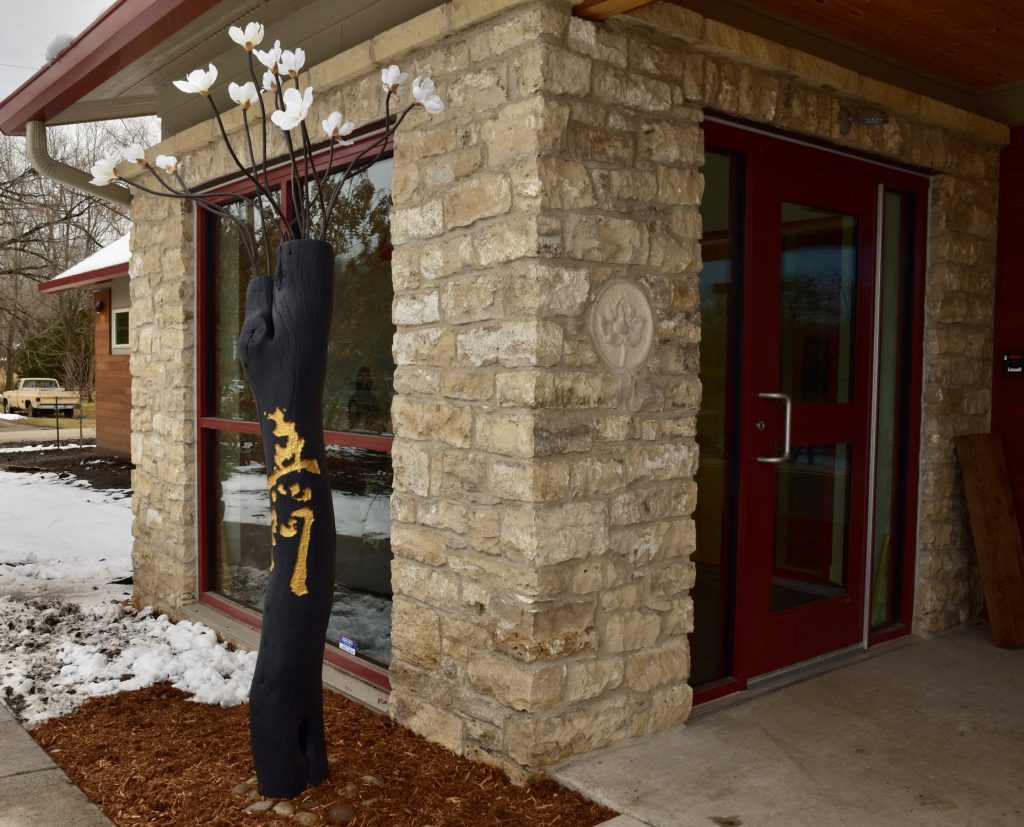
“Well, seated meditation, and then everything else we do in a Zen Center. Walking meditation. Many of them are attracted to the formality, I think. You know, we wear robes, and we’re quite disciplined at the Kansas Zen Center. Not as much as at other Zen Centers that I’ve encountered or heard of. But, yeah, we run a tight ship, and the people who show up tend to react positively to that. Interviews are every Saturday morning and, of course, on retreats. And – you know – the first interviews are not very encouraging and deliberately so.”
“Are interviews required?”
“You don’t have to come to an interview.”
“So I could show up, think, ‘This seems like a nice place,’ bring my zafu and just sit there without having to ever speak to anyone?”
“You could do that. It would be very awkward for you,” he adds with a laugh. “After Sunday practice especially and also after Saturday morning practice, we have a social hour. That’s not required. You could just leave. But most stay and talk. We get to know them; they get know us in an informal setting.”
“As I remember my conversation with Judy, she suggested there was a strong emphasis on the Precepts in the Kwan Um School. So in addition to providing a technique and a community, you’re also promoting a certain ethical vision.”
“Yes, that’s true. Yeah, ‘find your truth out and help this world’ is how we summarize our practice. And that second part is even more important than the first.”
“So a technique, a community, an ethic.”
“Yes.”
“And does that bring about change? Do the people who come to the Kansas Center have a sense that the practice in some ways changes things for them?”
He’s reluctant to generalize but eventually admits, “Sometimes we do get into discussions about their life, problems that they have, and how Zen practice might help them through life’s difficulties. It can give you the inner strength and stability – even the physical practice of Zen can develop that – to meet difficult situations. And then cognitively you learn through meditation how to deal with various mental and emotional states that you experience and therefore you may be able to help other people as well. And we emphasize the importance of keeping a strong practice. I recommend two practices mostly. One is just the standard counting your breaths along with the mantra on the inhalation ‘What am I?’ and the exhalation, ‘Don’t know.’ The other practice I use is also breath based but it simply uses a mantra, and the mantra that I strongly recommend is ‘Hwa Om Song Jong’ which in Korean translates to, ‘The assembly that heard the Avatamsaka Sutra preached.’ In other words, all the Buddhas and Bodhisattvas from infinite time and space.”
He demonstrates how the mantra is chanted to a rudimentary melody four times on the exhaled breath and four times on the inhalation.
“And what is the actual impact of taking up that kind of practice?” I ask.
“Stability is the first. That if you can maintain it even for one round, you experience what our teacher – in his pidgin English – called a ‘not moving mind,’ which I’m describing as stability. Cognitive and emotional stability. With that kind of stability there’s the possibility of clarity. Without that kind of stability, you’re looking at muddy, swirling water all the time. So that’s how I present it in my teaching. And that kind of meditation practice can really have an effect on your overall disposition towards yourself, towards others.”
A little later he adds, “Being aware of your condition is the first step in understanding what you are. And that’s what Zen practice has as its basic question” – speaking each word distinctly – “‘What. Am. I?’ And then, with some knowledge of that, ‘How can I help?’ In other words, what is my nature, and what is my function? And I can’t get it to be any more elementary than that.”
“How important is for practitioners to be aware of Buddhist theory?”
“I think it’s important to know at least the standard outlines of basic Buddhist teachings because Zen has its place in that larger cultural concept. I can’t imagine anyone who has been practising for a while not being familiar with it. Everyone reads books these days. I haven’t had a single student come to Zen without first reading five books. And we offer a lot of classes. All sorts of classes about every aspect of Buddhism you can imagine. We also put it in a larger historical and social framework. ‘This is where we fit in.’ We’re always teaching one class or another. I tend to like the classes that deal with a particular sutra or a certain kind of practice. That sort of thing. But if you look at our offerings over a period of years, it covers a broad spectrum of Buddhist teaching.”
“And what is it that you hope for the people who show up at the Kansas Zen Center?”
“That they keep coming.” We both laugh at that. “And! And as a result attain some degree of self-knowledge. In other words, awareness of what they really are and how they can help. That’s what we hope for.”
“And when you say ‘how they can help . . .’”
“I mean moment-to-moment in whatever situation you’re in, what is the best response? The best response being the one that is the most helpful. And that’s what we mean by that.”

 Richard Bryan McDaniel